
It’s mid-September. ERAS is open in one tab, Reddit in another, and your friends keep asking, “So what’s your backup specialty?”
You don’t have one. You really want one competitive specialty—derm, ortho, plastics, ENT, ophtho, neurosurg, rad onc, urology, whatever your particular hill is. And you’re stuck on the same anxiety loop:
“How do I show programs I’m truly committed… without looking like a naive applicant with no Plan B? And how do I do that without pretending to be interested in something else?”
Here’s how to signal genuine, focused interest in one competitive specialty—without tanking your match chances or playing dumb games.
Step 1: Be Honest With Yourself About Risk
Before you start “signaling” anything to programs, you need to be brutally clear with yourself.
Three questions:
- Are you truly willing to reapply if you don’t match?
- Are you only happy if you’re in this one specialty, or would you actually be okay in a less competitive alternative?
- Does your current profile even put you in the same ballpark as matched applicants?
If your internal answers are:
- “Yes, I’ll reapply if I have to.”
- “Yes, I really only want this one thing.”
- “I’m at least in striking distance on scores / grades / LORs / signals.”
…then focusing your whole application on one specialty is a reasonable choice. Risky, but coherent.
If instead your honest answers are:
- “I can’t stomach the idea of not matching.”
- “I could be happy in something else.”
- “My application is significantly below average for this field.”
…then the real problem isn’t how to signal interest. It’s whether your strategy is realistic. No magic phrasing in a personal statement overrides a weak foundation.
So first reality check: look at this table and place yourself honestly.
| Factor | Strong Position | Borderline / Risky |
|---|---|---|
| Step 2 (if used) | ≥ national mean for matched | Below mean for matched |
| Clerkship grades | Honors in core relevant rotations | Mostly Pass, few or no Honors |
| Research | Multiple projects, 1+ pubs/posters | Minimal or no specialty output |
| Mentorship | Strong letters from known faculty | Generic or non-specialty letters |
| Signals / Sub-Is | Several strong options | Few or none |
If you’re mostly in the “Strong Position” column, leaning into one specialty makes sense. If you’re mostly in the “Borderline” column and you still insist on “only this specialty,” then your strategy is the problem, not your signaling.
Step 2: Understand What “Genuine Interest” Actually Looks Like
Programs don’t believe interest because you say “I’m passionate about dermatology” three times in your personal statement.
They believe it when your record shows:
- Longitudinal commitment (over years, not weeks)
- Repeated exposure to the field
- Concrete work that helped someone in that specialty (research, QI, teaching, clinics)
- Faculty in that specialty willing to put their name on you
So your job isn’t just to declare interest in one field; it’s to make your entire application read like:
“This person has been consistently walking toward this specialty for a while. If they matched here, it wouldn’t be a whim.”
That means:
- Clinical rotation choices that fit (electives, sub-Is)
- Research that clearly ties to the field
- Extracurriculars that touch the patient population or skills
- Letters written by people who actually do the specialty
If you’re M4 and reading this late, you can’t rebuild your whole CV—but you can sharpen what you already have and keep your story consistent.
Step 3: Your Personal Statement — One Specialty, Zero Waffling
Stop trying to write a “generic” personal statement that could fit three specialties. Programs can smell that from space.
For a single competitive specialty, your personal statement should:
- Name the specialty, clearly and early
- Tie your interest to repeated experiences, not a single dramatic story
- Show you know the day-to-day reality, not just the highlight reel
- Watch out for sounding like every other applicant in that specialty
Structure that works:
- Hook: A specific moment that reveals why the field clicked, not “I’ve always wanted to help people.”
- Proof of commitment: Key experiences that show consistent interest (research, electives, mentorship).
- Understanding of the work: What you like about the actual daily grind.
- What you bring: Concrete traits and examples that fit the field (not vague “I’m hardworking” nonsense).
- Closing: Clear statement of long-term goals inside that specialty.
Do not:
- Say “I’m keeping an open mind about multiple specialties.”
- Use vague phrases like “a field like dermatology or internal medicine.”
- Hide the specialty name to seem more “flexible.”
You’re asking competitive programs to invest 3–7 years in you. Acting vague to keep options open just reads as unserious.
Step 4: Letters of Recommendation — Your Strongest Signal
Letters are where programs really look for “Are you actually one of us?”
For one- specialty applicants, I aim for:
- 2–3 letters from that specialty (at least one from a sub-I/away)
- 1 letter from a core field that complements (IM for cards, surgery for surg subspecialties, etc.)
You want your specialty letters to sound like:
- “This student consistently sought out extra cases in our field.”
- “They show up early, ask good questions, and handle the pace well.”
- “I would be comfortable having them as a resident in our program.”
What kills your single-specialty narrative?
- No letters from that field at all.
- Weak, generic letters that clearly came from minimal interaction.
- A primary letter that reads like you’re mostly focused on another specialty.
If you’re short on strong specialty letters right now:
- Ask current mentors directly: “Do you feel you can write a strong letter for my [X specialty] application?”
- If they hesitate or give a vague “sure,” that’s a no. Protect yourself.
Step 5: Sub-Is, Aways, and ERAS Signals — How to Use Them When You Only Have One Shot
For one competitive specialty, your choices of where to spend time and “signals” matter more.
Sub-Is / Aways:
- Do at least one at your home program (if you have one).
- Do one or two away rotations only if your home evals are strong. Away rotations are auditions; they can hurt you if you’re not ready.
Explicitly tell your attendings:
“I’m applying only to [X specialty]. I’d really appreciate any feedback that could help me be competitive, and I’d be grateful if you’d consider writing a letter if you feel you can strongly support my application.”
On ERAS supplemental signaling (where applicable):
- Use your signals on programs where:
- You have some geographic or personal tie, or
- You realistically fit their competitiveness range, or
- You’ve rotated there / have a letter from there.
Don’t burn signals on pure name-chasing if your application is middle-of-the-pack. That’s not “genuine interest,” that’s wishful thinking.
Here’s a simple approach:
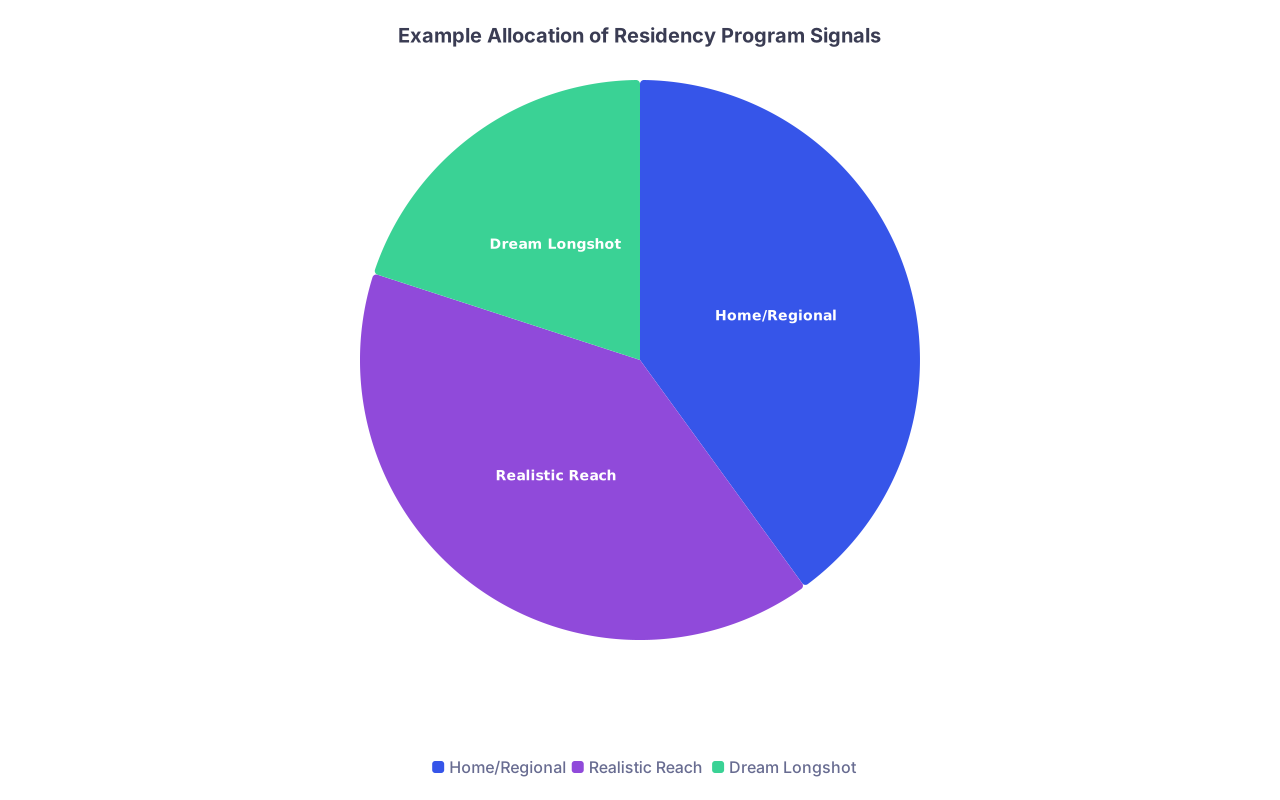
| Category | Value |
|---|---|
| Home/Regional | 40 |
| Realistic Reach | 40 |
| Dream Longshot | 20 |
40% where you have ties, 40% realistic reaches, 20% pure dream shots. Adjust, but keep that kind of ratio.
Step 6: Program List Strategy When You Only Apply to One Specialty
If you’re only applying to one competitive field, you don’t get to be picky with program lists.
You go broad.
Not 15 programs. Not 25. You’re usually looking at:
- Competitive subspecialties (derm, plastics, ortho, ENT, ophtho, urology, neurosurg, rad onc): often 50–80+ programs if you’re not a rockstar
- Highly competitive IM subspecialty pathways, integrated programs, etc.: similar logic—err on the side of more
Rough guideline:
| Applicant Profile | Suggested Program Count |
|---|---|
| Top-tier (strong in all 5 factors from earlier table) | 30–50 |
| Solid but not stellar | 50–80 |
| Borderline | 80+ plus serious backup planning |
If you’re only signaling interest in one specialty, your volume has to compensate for the risk.
Step 7: How to Talk About “Only One Specialty” In Interviews
This is where people screw up. They think being honest means saying:
“I have no backup. It’s [specialty] or bust.”
Programs don’t like that. Not because of the backup part, but because it can sound impulsive and poorly thought out.
Here’s how to handle it well.
When asked: “Are you applying to other specialties?”
If you truly only applied to one:
“I made the decision to apply only to [X specialty]. I’ve been working toward this for several years through my research, electives, and mentorship. I thought carefully about the risk, and I’m prepared to reapply if I need to. This is truly where I see myself long term.”
That hits a few key notes:
- You show this is a deliberate choice, not panic.
- You acknowledge the risk without hand-wringing.
- You reinforce your long-term commitment to the field.
When asked: “Why this specialty?”
Avoid the generic clichés for your field. Everyone in ortho talks about “immediate results,” everyone in derm talks about “visible impact,” everyone in ENT loves “variety.”
Give 1–2 specific things from your own experience:
- “On my sub-I, I loved the longitudinal follow-up in clinic after big cases. That’s what sold me.”
- “I found I enjoy the precision and planning side more than the high-adrenaline environment of trauma or ICU.”
Then tie it to what you bring to the table:
- “I like detail-heavy work and iterative improvement, which fit well with [X part of specialty].”
Step 8: How to Avoid Accidentally Signaling “I Don’t Understand the Field”
Programs get nervous when they think you’re in love with the idea of the specialty, not the reality.
Fix that by:
- Showing awareness of unsexy parts: call burden, documentation, difficult patients, long training.
- Mentioning tradeoffs explicitly: lifestyle, competition, market issues if relevant.
- Naming actual day-to-day tasks you enjoyed: not just “the surgery,” but pre-op planning, notes, follow-ups, clinic pace.
Good interview phrasing:
“I know [X specialty] has demanding call and a steep learning curve, especially in the first few years. On my sub-I, I actually enjoyed being part of that constant learning and didn’t mind the late nights when I felt useful.”
That says: I know what I’m signing up for; I’m not in love with the Instagram version.
Step 9: The Backup Question You’re Afraid Of
Someone is going to ask: “What will you do if you don’t match?”
The worst answers:
- “I haven’t thought about it.”
- “I’ll just do another specialty.”
- “I hope that doesn’t happen.”
Better:
“I’ve thought seriously about that possibility. If I don’t match, my plan would be to pursue a research year in [X field] or a preliminary year with strong exposure to [X], continue working with my mentors, and reapply with a stronger application. I’m committed to this field even if it takes longer.”
That’s how you stay “genuine” without sounding reckless.
Here’s a simple mental flow you should have thought through:

| Step | Description |
|---|---|
| Step 1 | Do not match |
| Step 2 | Research year in field |
| Step 3 | Prelim year with related exposure |
| Step 4 | Combination research + clinical |
| Step 5 | Strengthen CV and reapply |
| Step 6 | Reapply to same specialty |
| Step 7 | Options? |
Have one of those routes in mind and be ready to say it out loud.
Step 10: Common Mistakes When You Only Apply to One Specialty
I’ve seen these sink otherwise reasonable candidates:
- Writing a personal statement that could fit three specialties.
- Getting zero letters from your target field.
- Applying to far too few programs “because I really like these places.”
- Not having a backup plan (not necessarily a backup specialty).
- Sounding surprised in interviews that the field is competitive.
- Acting defensive when asked about your strategy.
Don’t do that. You chose a risky path—own it, don’t apologize for it.
FAQ: Genuine Interest in One Competitive Specialty
Do I have to apply to a backup specialty if I’m going for something like derm or ortho?
No. You have to understand the risk and have a backup plan (research year, prelim year, etc.). Applying to a backup specialty is a personal decision, not a universal requirement. Many people match competitive fields without dual applying. Many also don’t match and reapply. You decide which risk you’d rather hold.Will programs think I’m irresponsible if I say I only applied to one specialty?
If you phrase it as “I have no idea what I’d do if I don’t match,” yes. If you say, calmly, “I applied only to [X] because I’ve built my whole training and mentorship around it, and if I don’t match I plan to [research year / prelim year / reapply],” you’ll come across as focused and realistic.Can I reuse parts of my personal statement if I decide last minute to dual apply?
You can, but you shouldn’t copy-paste with the specialty names swapped. Each statement should read like it was written for that field specifically. If you dual apply, you essentially owe both specialties a full, honest narrative. Cutting corners reads as fake to both.How many programs should I apply to if I’m only applying to one competitive specialty?
For most competitive fields, fewer than ~40 is usually too few unless you’re truly top-tier (AOA, strong home program support, multiple pubs, top scores). Most serious single-specialty applicants with average-to-strong profiles are in the 50–80+ program range. Borderline applicants often need even more and a serious backup plan.What if I don’t have much research in the specialty I want? Is my interest still “genuine”?
Yes, your interest can be genuine without tons of research. But programs don’t just care that you “want it”; they care about evidence you’ve engaged with the field. If you’re late, focus on: strong sub-I evals, targeted letters, and at least some involvement (case reports, QI projects, presentations) to prove you’ve done more than just show up once.Is it bad to tell programs they’re my top choice if I’m telling that to multiple places?
Don’t lie. Saying “You’re my #1” to five programs is not signaling interest, it’s burning trust. Phrase it correctly: “I will rank this program very highly” or “This is one of my top choices because…” That’s honest and still shows strong interest without committing to something you might not follow through on.What’s the single strongest way to signal genuine interest in one specialty?
A coherent story backed by actions: consistent specialty-related work over time, strong letters from that field, targeted personal statement, appropriate away rotations, and a program list that shows you’re actually trying to match, not just chasing prestige. Interest is what you say. Commitment is what you’ve already done.
Open your ERAS application today and scan every section—experiences, personal statement, letters, program list—and ask: “If a stranger read this, would they instantly know which specialty I’m all-in on?”
If the answer is anything but “obviously yes,” fix one concrete element right now: edit your personal statement opening, email a mentor about a stronger letter, or expand your program list.