You’re an MS4 in September, sitting in front of ERAS, toggling between two specialties. Maybe it’s Derm vs IM. Or Ortho vs Anesthesia. Or Plastics vs General Surgery. Everyone keeps saying, “You’re brave applying only to that,” and you’re wondering if that’s code for “You’re being dumb.”
You’re asking the right question:
Do you actually need a backup specialty if you’re applying to a tough field? Or can you go all‑in on one?
Here’s the answer you actually need, not the fluffy version.
First: What Counts as a “Tough” Specialty?
We’re talking about the big five competitive fields plus a few others that behave like them:
- Dermatology
- Orthopaedic Surgery
- Plastic Surgery (integrated)
- Neurosurgery
- ENT (Otolaryngology)
- Sometimes: Radiation Oncology, Integrated Vascular, IR‑integrated, some highly selective programs (e.g., elite EM or anesthesia in certain cities)
These are specialties where:
- Interview numbers are limited
- Programs heavily screen on metrics and research
- The SOAP safety net is thin or nonexistent for that field
- One bad year can delay your path by at least 12 months
If you’re applying to one of these, the backup‑specialty question is not theoretical. It’s strategic and it has big consequences.
The Core Framework: Do You Back Up or Not?
Let me give you the simple decision framework first, then we’ll unpack it.
You likely do NOT need a backup specialty if:
- You’re clearly competitive on objective metrics, and
- You’ve built a coherent, focused application in that specialty, and
- You can tolerate the risk of a possible reapplication year if things go sideways.
You probably SHOULD have a backup specialty if:
- Your metrics and experiences are borderline or below average for that field, or
- You’re late to the game (switched late, minimal home support, weak letters), or
- You absolutely cannot afford to go unmatched (financially, visa status, life situation).
Let’s be more concrete.
How to Know If You’re Competitive Enough to Skip a Backup
Forget vague “strong” vs “weak” applicant language. Let’s anchor this a bit.
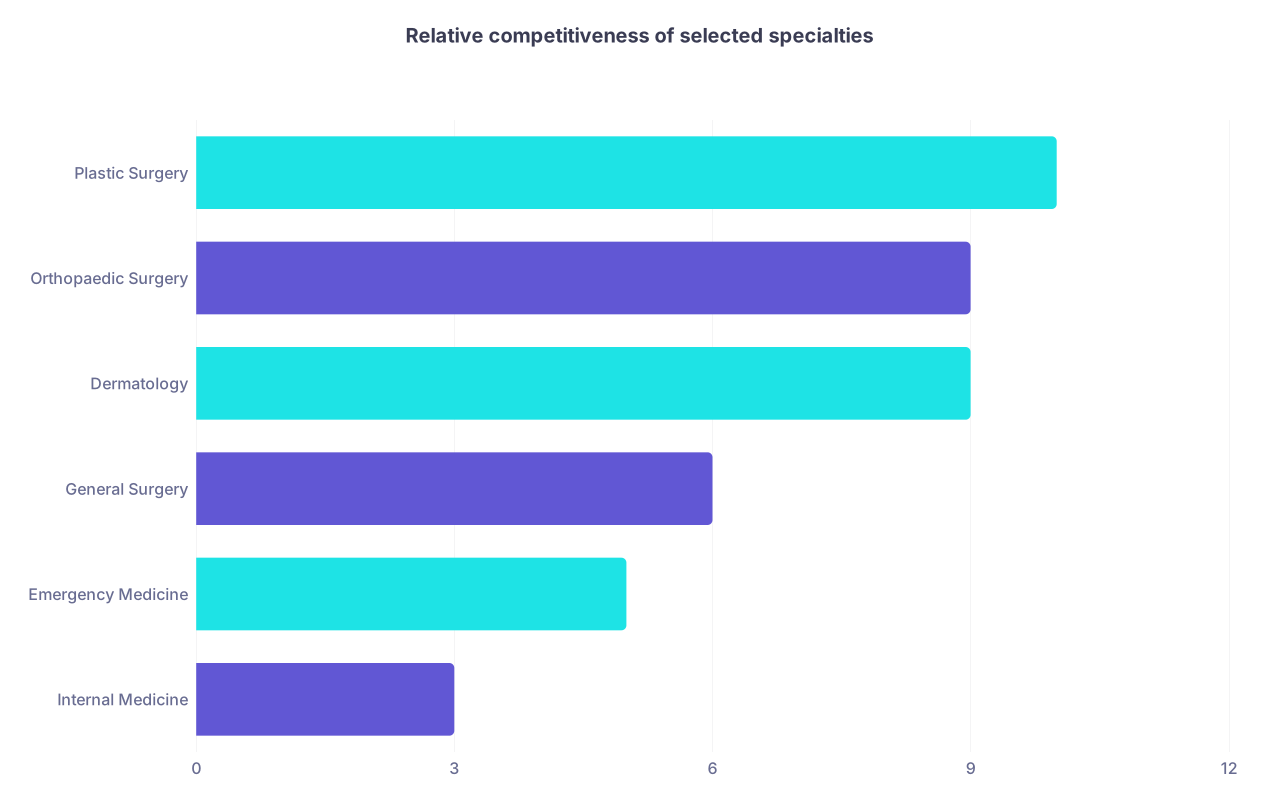
| Category | Value |
|---|---|
| Internal Medicine | 3 |
| Emergency Medicine | 5 |
| General Surgery | 6 |
| Dermatology | 9 |
| Orthopaedic Surgery | 9 |
| Plastic Surgery | 10 |
For the toughest fields, you’re in the “probably safe to go all‑in” zone if most of the following are true:
- Top quartile of your class / strong clinical comments, not just “solid”
- Strong Step 2 CK (for US MD, think ≥ 245–250+ for Derm/Ortho/Plastics/Neurosurg/ENT; DO/IMG often need higher plus other strengths)
- Multiple specialty‑relevant research projects, ideally with at least one first‑author or accepted/pending paper, or strong poster/presentation record
- Multiple letters from known faculty in that field, preferably including at least one “name” or PD/Chair
- A home or strong affiliate program in that specialty that is actually backing you
If you’re checking those boxes, it is completely reasonable to apply only to that specialty. A “backup” can dilute your story and hurt you more than it helps.
I’ve watched plenty of students with that profile match Derm, Ortho, Plastics, ENT with no backup at all.
Where it gets risky:
- Step 2 CK < 240 in those fields
- Limited or no research in the specialty
- No home program and weak away rotations
- Class rank middle or lower half without a clear narrative advantage
- Significant red flags (fails, professionalism issues, major leave without strong explanation)
In that bucket? You should at least seriously consider a backup.
The Big Trade‑Off: Focus vs Safety
A backup specialty is not free.
When you decide to “dual apply,” you pay in:
- Time (two sets of personal statements, letters, program lists)
- Money (twice the ERAS fees, more interview travel or Zoom days)
- Narrative clarity (programs sniff out a split identity fast)
You gain:
- Higher probability of matching somewhere
- A lower chance of SOAP chaos
- Psychological security (which, honestly, does help you interview better)
So the real question is: Which risk scares you more?
- Going all-in on your dream field and possibly needing a reapplication year, or
- Spreading yourself thin and possibly weakening your odds at the competitive field, but increasing your odds of matching this cycle?
If you’re extremely debt‑burdened, on a visa, supporting family, or already took a gap year, that second risk may be unacceptable. That’s when backup starts looking smart, even if it’s annoying.
How to Choose a Backup Specialty (If You Need One)
If you decide you do need a backup, do not just “pick something easier.” That’s how people end up miserable.
Good backup specialties share three properties:
You can plausibly sell an authentic story
The worst thing you can do is send a program a personal statement that screams “Plan B.” If your whole CV is Ortho and then you toss a random PM&R app with no experiences, that’s weak.There’s meaningful overlap in skills, letters, and rotations
Example:- Ortho → General Surgery, PM&R, Anesthesia
- Plastics → General Surgery
- Derm → Internal Medicine, Pathology
- Neurosurgery → Neurology, General Surgery
- ENT → General Surgery, maybe Anesthesia
You can live with actually doing that job
You might not love it like your first choice, but you should be honest: could you do this for 30 years without grinding your soul into dust?
| Primary (Competitive) | Reasonable Backup Options |
|---|---|
| Dermatology | Internal Medicine, Pathology |
| Orthopaedic Surgery | General Surgery, PM&R, Anesthesia |
| Plastic Surgery (Int.) | General Surgery |
| Neurosurgery | Neurology, General Surgery |
| ENT | General Surgery, Anesthesia |
None of these are perfect. But they let you use some of the same letters, narratives, and rotations without looking completely incoherent.
How to Actually Execute a Dual Application Without Torpedoing Yourself
If you dual apply, do it with discipline. Not with panic.
1. Decide your “primary” specialty early and commit
You cannot be 50/50 in August. That is too late. One field has to be your primary identity. The other is your safety net.
Your:
- Main personal statement
- Most letters
- Away rotations
- Research focus
…should all be oriented around the primary.

| Step | Description |
|---|---|
| Step 1 | Choose target specialty |
| Step 2 | Apply to target only |
| Step 3 | Select logical backup |
| Step 4 | Prepare 2nd PS and letter mix |
| Step 5 | Apply to both fields |
| Step 6 | Competitive profile strong? |
| Step 7 | Can accept reapplying? |
2. Structure your letters smartly
For very related fields, some letters can do double duty. For less related fields, you may need distinct sets.
Rough approaches I’ve seen work:
Ortho primary / Gen Surg backup:
- 3 Ortho letters, 1 Surgery letter for Ortho apps
- 2 Surgery letters, 1 Ortho, 1 Medicine for Gen Surg apps
Derm primary / IM backup:
- Derm apps: 3 Derm, 1 Medicine
- IM apps: 2 Medicine, 1 Derm, 1 Sub‑I/Hospitalist
Do not send a program a letter from someone clearly writing for another specialty if it undercuts your interest. Generic is better than obviously misaligned.
3. Write separate, honest personal statements
You cannot get away with a single vague PS that fits both. Programs know. They read thousands.
Your primary specialty PS:
- Full passion, full story, clear why‑this‑field.
Your backup specialty PS:
- Genuine reasons you like it
- Clear alignment with your skills
- Maybe a nod to broader interests (e.g., “I’ve always been torn between X and Y, but on this rotation I saw…”)
Do not say, “My dream has always been Derm, but I’d also be happy in IM.” That’s suicide for the IM app.
What If You Don’t Match Your Competitive Specialty?
Here’s the fear in the back of your head: You go all‑in on Derm / Ortho / Plastics, do not dual apply, and come March you’re unmatched.
Real talk: it’s not the end of the road. But it’s also not fun.
If you go unmatched after a single‑specialty competitive application, your options include:
- SOAP into a different specialty (usually not your dream field)
- Take a research year in your target field and strengthen your file
- Transition intentionally to a different specialty next cycle with a more honest, aligned app
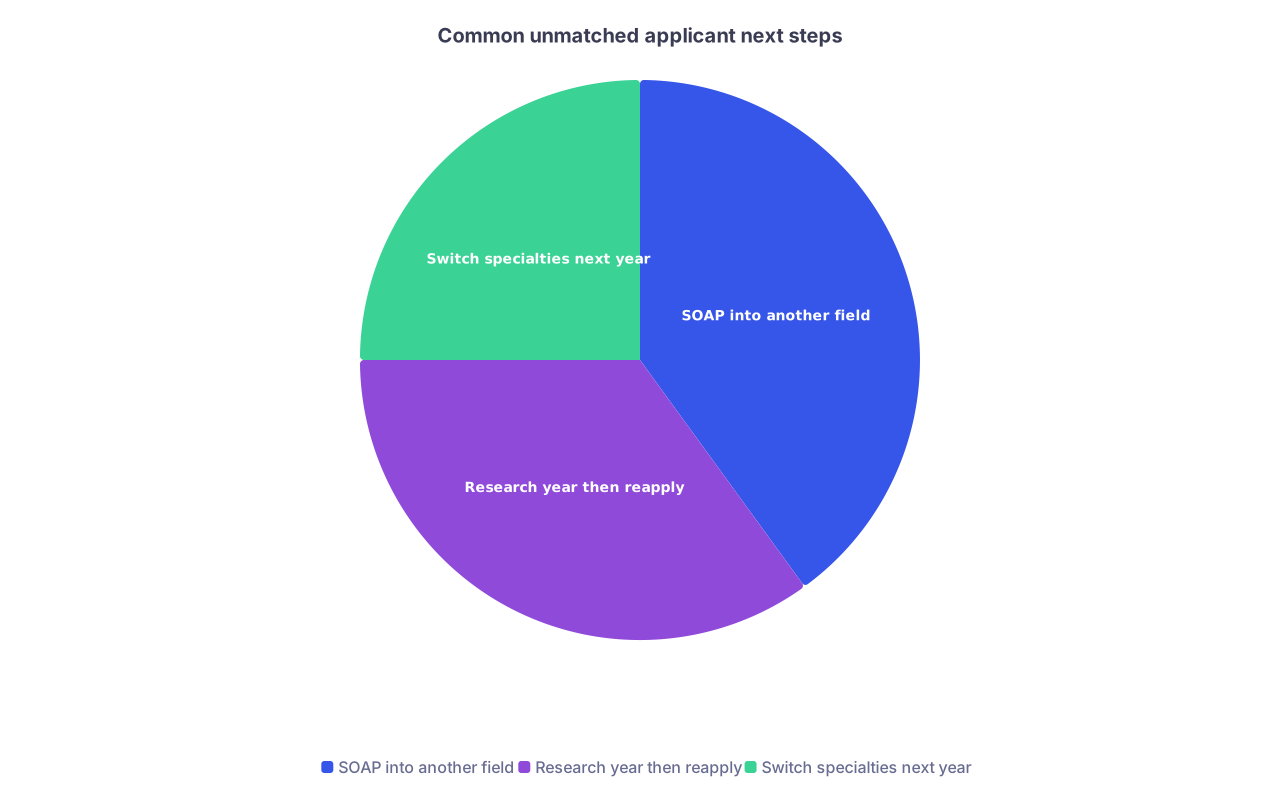
| Category | Value |
|---|---|
| SOAP into another field | 40 |
| Research year then reapply | 35 |
| Switch specialties next year | 25 |
Reapplying successfully is very possible if you:
- Identify and fix specific weaknesses (scores, research, letters, interview skills)
- Get real mentorship from faculty who know what they’re doing
- Are honest with yourself about whether you’re still a plausible candidate for that field
What you cannot do is repeat the exact same application, just “hoping” for a better result. Programs notice.
Common Scenarios (And What I’d Actually Advise)
Scenario 1: Strong but not insane Ortho applicant, no backup
US MD, Step 2 248, top 25%, 2 ortho pubs, strong home program support, two aways that went decently.
My advice:
Apply only Ortho. No backup. Maximize your Ortho signal. If you’re willing to take a research year if needed, the focused strategy wins.
Scenario 2: Late switch to Derm as MS4 Spring, thin research
US MD, switched to Derm in March of MS3, 1 poster, no full papers, Step 2 242, average IM comments, no home Derm program.
My advice:
Derm is uphill here. I’d seriously consider Primary = IM or Path, and a targeted Derm application only if you can get real mentorship and accept likely needing a gap year or switch. If you insist on going hard at Derm, then yes, you need a backup.
Scenario 3: IMG aiming for Neurosurgery, minimal US experience
IMG, 255+ Step 2, but almost no US clinical or research, no home neurosurg.
My advice:
Neurosurgery as primary is extremely high risk. I’d explicitly build a competitive application for a more accessible field (e.g., Neurology, IM with Neuro focus) and treat Neurosurg as a stretch. In practice, this means a true dual strategy leaning heavily toward the safer field.
How Many Programs and How to Split Applications
Once you’ve decided primary vs backup, you still have to pick numbers.
Rough logic:
- For hyper‑competitive fields, you usually apply very broadly (60–80+ programs)
- For your backup, you do not necessarily need to max out; you’re hedging, not fully switching (maybe 20–40 programs depending on the field and your profile)
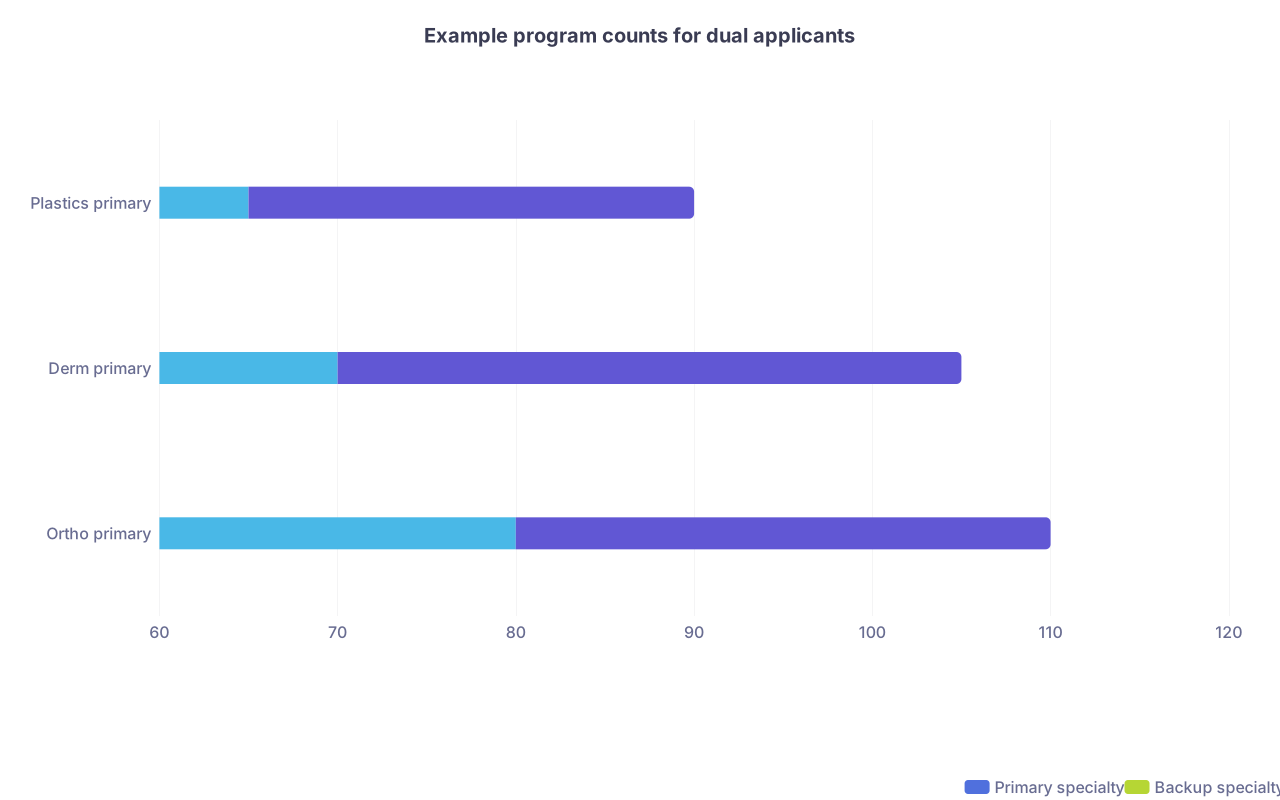
| Category | Primary specialty | Backup specialty |
|---|---|---|
| Ortho primary | 80 | 30 |
| Derm primary | 70 | 35 |
| Plastics primary | 65 | 25 |
You adjust this based on:
- How strong your primary‑field profile actually is
- Geographic flexibility
- Whether your backup is also somewhat competitive (e.g., Anesthesia in big cities is no joke)
Psychological Side: Identity, Ego, and Regret
There’s one thing almost no one says out loud: some people skip a backup not for rational reasons, but because having a backup feels like admitting they might fail.
That’s stupid.
Being strategic isn’t weakness. It’s being an adult.
At the same time, some people overload on backup apps because they’re terrified of risk, and they suffocate their chances in the field they actually care about.
Your job is to choose your regret:
- If you go all‑in and don’t match, will you say, “I had to try,” or will you say, “That was reckless”?
- If you dual apply and match your backup, will you always wonder, “Could I have made it in my dream field if I’d gone all‑in?”
There’s no algorithm for that. That’s you, a trusted advisor, and some honest thinking.

FAQ: Backup Specialty and Competitive Fields
1. If I apply to a backup, will my primary specialty programs find out?
Generally, no. Programs do not see what other specialties you applied to. They can, however, infer it if your narrative is incoherent, your letters mention other fields, or your interview answers sound split. The risk comes from mixed messaging, not from ERAS data sharing.
2. Is it better to SOAP into a different field or take a research year and reapply?
If your dream specialty is truly non‑negotiable for you and you have a realistic chance with a stronger application, a structured research year in that field can be a strong move. If your finances, immigration status, or life situation make extra years very costly, SOAPing into a decent backup field can be the smarter choice. I’ve seen both paths work; you have to weigh personal constraints.
3. Can I tell programs I’m dual applying?
In almost all cases, do not volunteer this. When you’re interviewing, you’re committed to that specialty in that room. Saying “I’m also applying to X as a backup” makes you sound half‑in. If directly asked (rare), you answer honestly but frame it around pragmatic reasons, not lack of commitment.
4. Does dual applying hurt my chance of matching my competitive specialty?
Indirectly, yes, if it dilutes your focus—fewer aways, weaker research, scattered letters, generic personal statement. Done carefully, with a clearly prioritized primary specialty and smart overlap, the impact on your competitive field can be small. Done chaotically, it absolutely hurts.
5. I’m an average applicant for a competitive specialty but I really want it. Should I still go all‑in?
Only if you can realistically absorb a reapplication year and you have a concrete plan to improve your application (research, away rotations, Step 2, letters). If reapplying is not feasible for you, I’d recommend dual applying or even redefining your primary specialty to something where your odds are better and your life still looks how you want it to.
6. Who should I actually listen to when deciding on a backup?
Three types of people:
- A program director or associate PD in your target field who has recently sat on selection committees.
- A faculty mentor who knows your file in detail and will be blunt.
- A dean’s office advisor who tracks match data and can compare you to prior classes.
Random residents on Reddit and classmates guessing based on vibes are noise.
Key points to walk away with:
- You do not automatically need a backup specialty just because you’re applying to a tough field; strong, focused applicants can and do go all‑in.
- A backup makes sense when your file is borderline for that field and you can’t afford the risk of going unmatched and reapplying.
- If you dual apply, be intentional: clear primary vs backup, separate narratives, smart letter use, and a backup you can genuinely live with.