
You’re asking the wrong question. It’s almost never “Is this specialty too competitive?” It’s “What would it actually take for me to be competitive for this specialty?”
Let’s answer that properly.
1. The Core Equation: Your Stats vs Your Story
Programs don’t care about your “dream specialty.” They care about risk. Are you a safe bet to show up, learn, not cause disasters, and maybe make them look good?
Here’s what they really evaluate:
- Objective data
- Specialty fit
- Red flags
- Context (school, life, trajectory)
“Is it too competitive?” really means:
Does my objective data put me above, at, or below the usual bar for this specialty, and do I have enough strengths elsewhere to compensate if I’m below?
Let’s anchor some numbers.
| Tier | Examples | General Competitiveness |
|---|---|---|
| Ultra-competitive | Derm, Plastics, Ortho, ENT, Neurosurgery | Very high |
| Competitive | EM, Anesthesia, General Surgery, Urology, Radiology, PM&R | High |
| Mid | IM (university), OB/GYN, Peds (top programs) | Moderate |
| Less competitive | Community IM, Community Peds, Family Med, Psych (non-top) | Lower |
These aren’t absolutes. There are chill derm programs and brutal FM programs. But it’s a useful spine.
2. Build Your “Competitiveness Snapshot” (In 10 Minutes)
Do this before you spiral on Reddit.
Step 1: Write down your objective stats
You need:
- Step 2 CK (or practice NBME if you don’t have it yet)
- Class rank/quartile or AOA status (if applicable)
- Number + depth of specialty-relevant research (first-author? poster? nothing?)
- Home program presence (Do you have that specialty at your school?)
- Honors vs Pass/High Pass in core rotations (especially the specialty you want)
Now put yourself roughly in one of these buckets.
| Bucket | Step 2 CK | Class Standing | Research |
|---|---|---|---|
| Strong | ≥ 245–250 | Top 1/3 or AOA | 2+ projects, maybe pubs |
| Solid | 235–245 | Middle 50% | Some research or solid other strengths |
| Borderline | 220–235 | Lower half | Little/no research |
| High-risk | < 220 or fails | Lower half + issues | Minimal extras, red flags |
If you’re IMGs/DO, shift your expectations slightly higher for competitive specialties and academic programs. That’s just how it is right now.
Step 2: Compare to your target specialty reality
Use program directors’ surveys, NRMP Charting Outcomes, talk to your school’s advising office, and ask residents. You’re looking for three things:
- Typical matched Step 2 range
- How much they care about research and school prestige
- How many programs exist (more programs = more flexibility)
Then ask:
- Am I above, at, or below the usual range?
- Do I have compensating strengths (stellar letters, research, home program, unique skill set)?
3. Quick Reality Check by Tier
Here’s the part everyone wants: “With my stats, can I realistically match X?”
Let me be blunt.
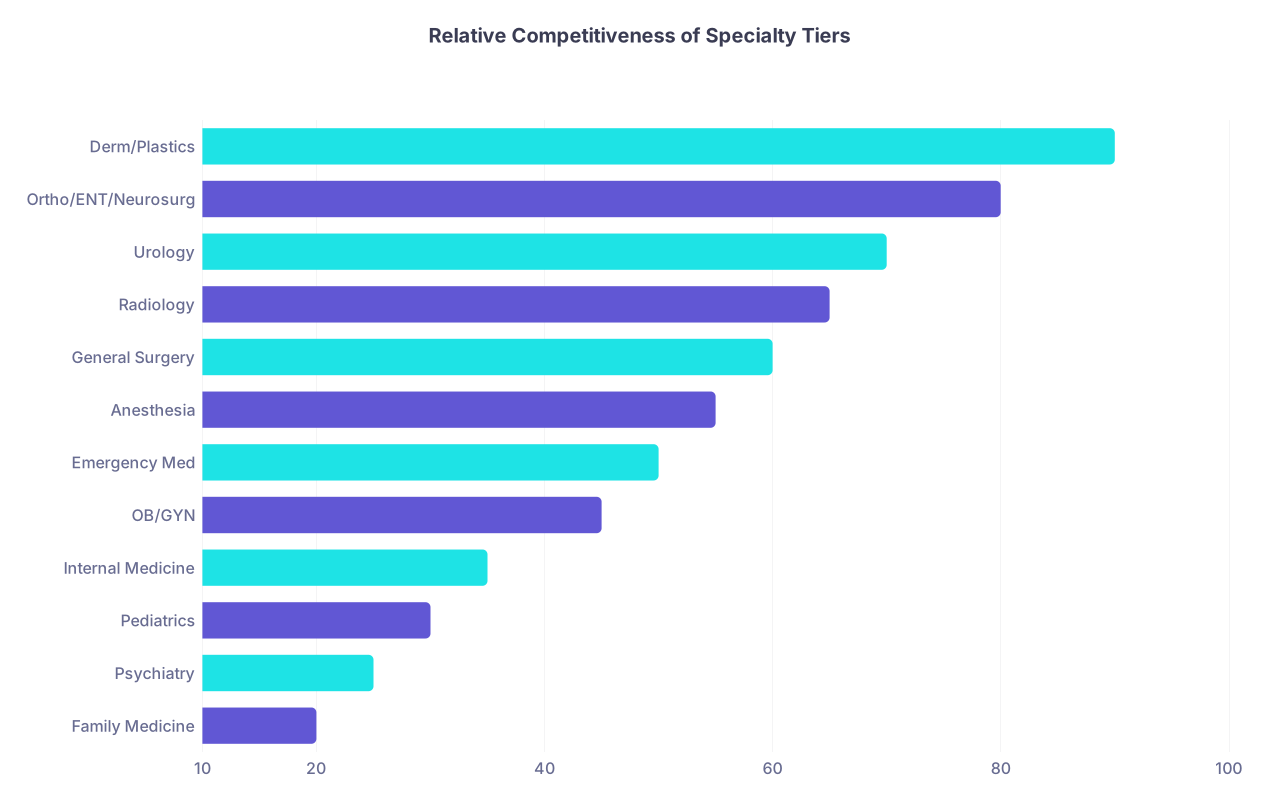
| Category | Value |
|---|---|
| Family Medicine | 20 |
| Psychiatry | 25 |
| Pediatrics | 30 |
| Internal Medicine | 35 |
| OB/GYN | 45 |
| Emergency Med | 50 |
| Anesthesia | 55 |
| General Surgery | 60 |
| Radiology | 65 |
| Urology | 70 |
| Ortho/ENT/Neurosurg | 80 |
| Derm/Plastics | 90 |
Ultra-Competitive (Derm, Plastics, Ortho, ENT, Neurosurg)
If you’re:
- Step 2 ≥ 245–250
- Strong clinical evals + at least some research in the field
- Good letters from that specialty
You’re in the game. Not guaranteed, but not delusional.
If you’re:
- Step 2 230–240
- Limited/no research in that field
- No home program
You’re in hail-mary territory. People match from here, but it’s usually with something special: crazy strong mentors, unique story, high volume research, or applying very broadly + backup.
If you’re:
- Below 230
For derm/plastics/ENT/neurosurg? I’d call it essentially unrealistic unless something truly outstanding is going on (and even then, odds are ugly). For ortho, you’re still in “long shot” land.
This is where a smart dual-application strategy becomes mandatory, not optional.
Competitive (EM, Anesthesia, Radiology, General Surgery, Urology, PM&R)
Here’s the rough “you’re probably fine” zone:
- Step 2 ≥ 235–240
- No major red flags
- Reasonable letters + at least one rotation in the specialty
Below that (220–235), you’re not automatically out, but:
- You’ll likely need to apply more broadly
- Academic powerhouse programs become harder
- You need something extra: strong letters, research, or clear commitment
EM is a unique mess right now: the market has swung wildly. Historically competitive, then overexpanded, now in flux. But strong letters + SLOEs still matter a lot.
Mid and Less Competitive (IM, Peds, OB/GYN, Psych, FM)
Internal medicine is two different worlds:
- University/academic IM (especially big names) – more competitive
- Community IM – significantly more accessible
Roughly:
- Step 2 ≥ 230: broad IM options available
- 220–230: many IM programs still realistic, especially community
- < 220: still matchable into FM, psych, some IM, especially if no fails and you apply widely
Psych used to be “chill”; now it’s heating up, especially coastal/university programs. But compared to derm? Still a different universe.
Family med is the most forgiving. If you’re passing, no huge red flags, and apply widely, you’re usually matchable.
4. The 3-Factor Reality Test: Is My Specialty Choice Reasonable?
Skip the Reddit noise. Use this:
Factor 1: Do I have any obvious deal-breakers?
Things programs care about a lot:
- Multiple Step fails
- Long unexplained gaps
- Unprofessional behavior, professionalism write-ups
- Horrible letters or no letters from the field
One Step fail does not kill you. But for ultra-competitive fields, it’s often game over unless there’s a strong redemption story + high Step 2.
If you’ve got a major red flag and want a highly competitive specialty, you need brutal honesty with an advisor who will actually tell you “No, you shouldn’t” if that’s the truth.
Factor 2: Do I have proof of specialty commitment?
For any competitive specialty, programs want to see:
- At least 1 away rotation or sub-I
- Letter from someone in the field who knows you well
- Some research or longitudinal interest in the area
- Evidence you understand the lifestyle and work (not just vibes)
If you’re trying to match ortho, with:
- No ortho rotation
- No ortho letter
- One shadowing day 3 years ago
Then no, your “interest” doesn’t matter. You look unserious, regardless of stats.
Factor 3: Is my application strategy consistent with my risk level?
Here’s where people sabotage themselves. Good-ish stats, but delusional list.
As a rule of thumb:
- Ultra-competitive: 60–80+ programs is normal
- Competitive: 40–60 often appropriate
- Mid: 25–40
- Less competitive: 15–30 may be enough, but depends on red flags and geography
If you have borderline stats and are:
- Applying to 20 derm programs
- Only university EM programs
- Only coastal academic IM
You’re not “following your dream.” You’re just ignoring math.
5. Dual Applying: Smart Safety Net or Red Flag?
This is one of the most misunderstood areas.
Programs hate desperation. But they understand risk.
- Your stats are clearly below the usual range for your dream field
- You’d genuinely be content with your backup specialty
- You have at least minimal credibility in both (some exposure, a letter)
Bad dual-apply example:
- Applying plastics + FM with zero plastics exposure
- Or derm + psych with one derm rotation and no derm letter
Good dual-apply example:
- Ortho + general surgery (if you’ve done both)
- Derm + IM (if you have derm research but also strong IM letters)
- EM + IM or EM + anesthesia
You must be able to look a PD in the eye and say, “Yes, I’d be happy in this specialty” without lying through your teeth.
6. Special Situations (US-IMG, DO, Low Step, Career Change)
US-IMG or Caribbean
You are fighting two battles: bias and volume. You can still match very well, but:
- Ultra-competitive specialties are usually extremely low probability
- Competitive specialties require stronger scores than US MDs and broad applications
- Home program absence hurts; you need away rotations and networking
If you’re a US-IMG trying for derm/plastics/ENT/neurosurg with average scores, I’d tell you directly: that’s almost certainly a losing lottery ticket.
DO Applicants
This is improving, but realistic assessment still matters:
- Many places genuinely don’t care anymore. Some still do.
- Some historically MD-heavy specialties (e.g., derm, plastics, ENT) are tougher from DO schools unless your record is outstanding and you have strong connections.
Strong DO with 245+ Step 2 and real research? You can absolutely be competitive in many “MD-heavy” specialties. But rank lists may still lean MD in some fields.
Low Step 2 (< 220) or Multiple Fails
This doesn’t end your career. It does heavily shape which specialties and which programs are realistic.
I’ve seen:
- Students with sub-215 scores match FM, psych, community IM with no problems after applying widely and fixing everything else (great letters, solid rotations, no new issues).
- People with multiple fails match, but usually in less competitive fields, and they needed a near-perfect recovery arc.
Here’s where you stop asking “Is this specialty too competitive?” and start asking “What specialty gives me the highest chance to actually practice medicine and have a good life?” That’s not settling. That’s being an adult.
7. Simple Decision Framework: Am I Being Realistic?
Use this mini-flow:

| Step | Description |
|---|---|
| Step 1 | Choose Target Specialty |
| Step 2 | Compare Step 2 to typical range |
| Step 3 | Assess letters and experience in field |
| Step 4 | Check for strong compensating strengths |
| Step 5 | Apply primarily to this specialty |
| Step 6 | Add more rotations or consider dual apply |
| Step 7 | Plan dual apply or pivot to less competitive field |
| Step 8 | Discuss with advisor and finalize list |
| Step 9 | At or above range? |
| Step 10 | Have strong letters and rotations? |
| Step 11 | Compensating strengths solid? |
If, after honestly walking through that, you still don’t know, that’s your answer: you need a brutally honest advisor, not more online charts.
8. How to Get a Straight Answer (Not Fluff)
Last piece: don’t crowdsource something this important from strangers who don’t know your file.
You want:
- One advisor at your school (ideally someone who’s actually been on a selection committee)
- One resident or faculty member in the specialty you want
- Maybe a trusted senior student who just matched
Show them:
- Your scores
- Your transcript
- Your CV
- Your draft program list
Ask them explicitly:
- “If I were your kid, would you support me applying to this as my only specialty?”
- “If not, what would you recommend as a primary plus backup strategy?”
If they hesitate more than 2 seconds? That’s a sign.
FAQs
1. My Step 2 is 235 and I want derm. Is it over?
For derm, a 235 without major derm research or elite letters puts you in extremely low probability territory. Could someone match from that position? Sure. Should you bank your entire future on it as a single-application strategy? No. If you truly love derm, talk to a derm mentor, build a dual-apply plan (often with IM or psych), and accept that derm is a long shot, not a reasonable expectation.
2. Do I need research for competitive specialties?
For ultra-competitive fields (derm, plastics, ENT, neurosurg, ortho at top programs), I’d say yes—functionally you do. No one cares about an old basic science poster from undergrad; they care about work in the field or at least in a related area, ideally with someone who can write you a strong letter. For mid-competitive specialties, research helps but strong clinical performance and letters can sometimes compensate.
3. Is it bad to apply very broadly? Like 80–100 programs?
No, not if your specialty is hard and your stats are borderline. That’s just realistic. The only time it looks bad is if your ERAS application contradicts itself (sloppy, generic, clearly copy-pasted interests). Applying broadly but thoughtfully is fine. Programs care far more about your interview performance and letters than how many places you applied.
4. I changed my mind late. Can I still match a competitive specialty?
Late switches make it harder, not impossible. The issue isn’t your sincerity; it’s your proof of commitment. If you switched from IM to anesthesia in August of M4 with no anesthesia rotations, no letters, no research…you look like a tourist. If you’re late-switching to something competitive, you’ll likely need: a dedicated sub-I, at least one strong letter, and probably a dual-apply plan. Be upfront about the story; programs can smell a fake narrative.
5. How do I know if I’m “wasting” a year applying too high?
Ask this: “If I don’t match, will I be okay emotionally and financially doing a research year or reapplying?” If the answer is absolutely not, don’t run a moonshot-only strategy. Look at your stats vs typical matched applicants. If you’re clearly below across multiple dimensions (score, letters, research, school), and two or three honest mentors say your odds are low, then a pure high-risk strategy is just denial. Build a backup plan you’d actually accept living with.
Key takeaways:
- Stop asking if a specialty is “too competitive.” Ask how your specific profile compares to who actually matches in that field.
- Use scores, letters, specialty exposure, and honest mentorship to drive your primary/backup strategy—not Reddit vibes or wishful thinking.
- If you’re below the usual bar for a field, dual applying thoughtfully is strategy, not surrender.