The belief that “you must attend a top-10 medical school to match a competitive specialty” is statistically lazy. The data say otherwise.
From mid-tier schools, applicants match into dermatology, plastics, ortho, ENT, neurosurgery, and radiation oncology every single year. Not in huge numbers, but consistently. The pattern is not random. Certain predictors show up again and again in NRMP, AAMC, and program-level data.
You are not playing the same game as a Harvard or Hopkins student. But you are playing a winnable game. If you understand which variables actually move the needle.
Below I am going to walk through those variables like I would walk through a dataset: define them, rank them by impact, and give you rough thresholds. Not vibes. Numbers.
1. Define the problem precisely: “mid‑tier” and “competitive”
If you are going to optimize, you need a clear outcome and population.
“Mid‑tier school” is fuzzy, so let’s pin it down in a way that roughly maps to how programs behave:
- Not consistently in US News research top 25
- Typically LCME-accredited MD or established DO school with moderate NIH funding
- Median MCAT and GPA in the 509–514 and 3.6–3.8 range
- Usually not the dominant feeder to elite academic residencies
Think: Ohio State, Colorado, Iowa, UC Davis, some state MDs, many DO schools that are not brand-new. Not community-only, but not “household name” either.
“Competitive specialty” in data terms usually means:
- High unmatched rates for US MDs
- High Step 2 CK scores among matched applicants
- Strong research expectations and fewer total positions
Based on recent NRMP Charting Outcomes and Program Director Surveys, this cluster includes:
- Dermatology
- Plastic surgery (integrated)
- Orthopedic surgery
- Otolaryngology
- Neurosurgery
- Radiation oncology
- Interventional radiology (integrated)
- Sometimes urology and ophthalmology (run outside NRMP but similar dynamics)
These specialties routinely report unmatched rates for U.S. seniors in the 15–30% range, much higher for IMGs and DOs in some fields.
So the core question becomes: among students at mid‑tier schools, what predicts ending up on the right side of that 70–85%?
2. The statistical heavy hitters: the variables that matter most
Across NRMP data and what I have seen from institutional match lists, the largest effects come from five areas:
- Step 2 CK score
- Specialty-specific letters and away rotations
- Research productivity (field-aligned)
- Class performance and AOA / rank
- Strategic application behavior (program count, distribution)
School prestige still matters—but as an interaction term. It multiplies your underlying stats. From a mid‑tier school, you need stronger numbers to reach the same probability of matching.
Let’s quantify each.
3. Step 2 CK: the blunt instrument that still rules
With Step 1 now pass/fail, Step 2 CK has become the primary numerical filter. Program Director Survey data are blunt: Step 2 is used in screening by the majority of competitive specialties.
You do not need a perfect score. You need a score that gets you into the “serious consideration” band for your target field.
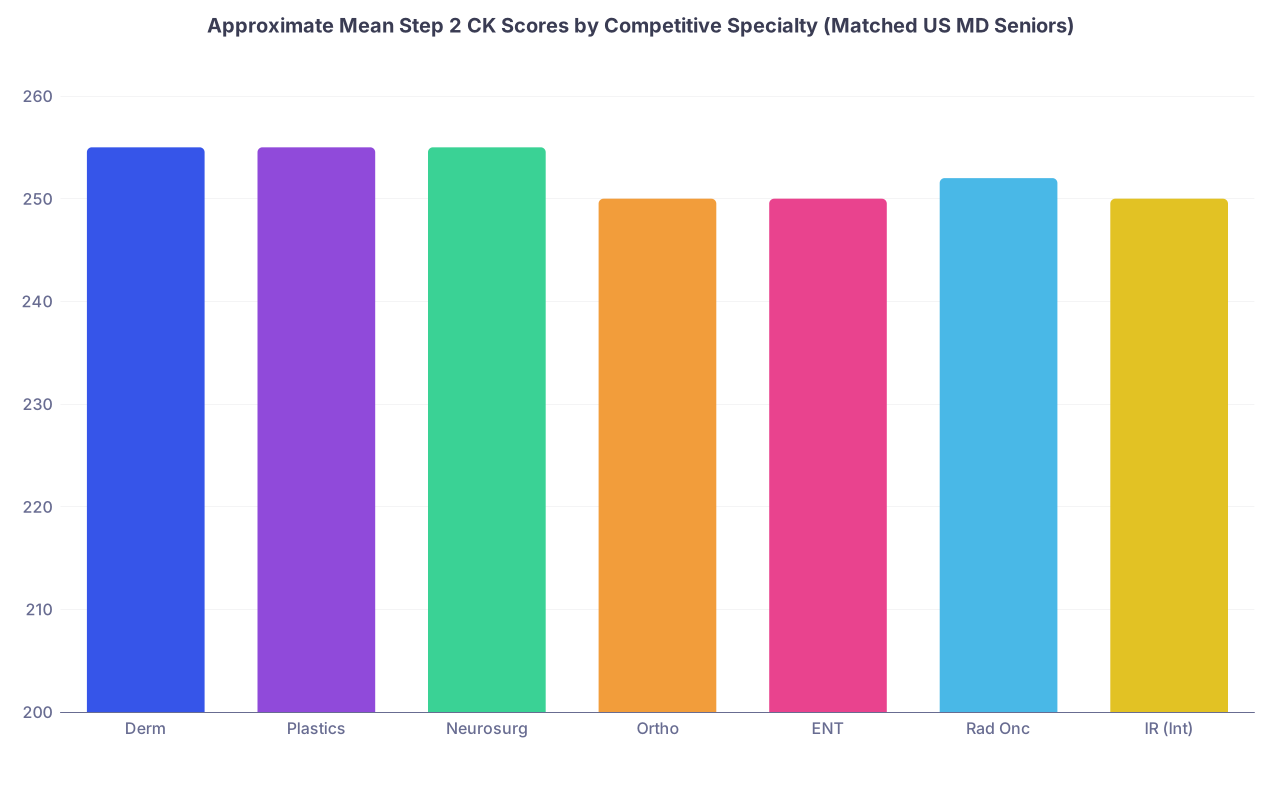
Typical Step 2 CK distributions for matched U.S. MD seniors (recent cycles, approximated from NRMP reports and specialty statements):
| Category | Value |
|---|---|
| Derm | 255 |
| Plastics | 255 |
| Neurosurg | 255 |
| Ortho | 250 |
| ENT | 250 |
| Rad Onc | 252 |
| IR (Int) | 250 |
These are means. Not hard cutoffs. But for a mid‑tier student, the distribution shifts:
- Top‑10 school, Derm, Step 2 of 248 with strong research? Still in the game.
- Mid‑tier school, Derm, Step 2 of 248 and minimal research? Very low probability.
From what I have seen in match lists and applicant datasets:
- For mid‑tier MDs:
- “Competitive but not outlier” band: ~250–255
- “Safely in most interview pools” band: 255–260+
- For mid‑tier DOs:
- You generally need to be at or above the MD average for that specialty, often 255+
Below those bands, you can still match—but only if you overperform dramatically on letters, research, or connections. Outliers exist, but the expected value drops quickly.
The data pattern is simple: Step 2 CK is the single easiest variable for programs to sort on at scale. So they do. From a mid‑tier school, being in the top decile nationally (not just locally) on this metric is your cleanest way to neutralize school prestige.
4. Specialty-specific letters and away rotations: your real “brand”
For competitive fields, “brand” is not just your school; it is the letterhead on your LORs.
Programs repeatedly rank “letters of recommendation from known faculty” and “audition electives” among the most important factors for interviews and ranking. This is where mid‑tier students can level the field.
The reliable pattern I see in match data:
Mid‑tier student with:
- 255+ Step 2
- 2–3 letters from nationally known faculty in that specialty
- 1–2 strong away rotations at reputable programs
= 4–6 field-specific publications/abstracts
regularly matches into competitive fields.
Mid‑tier student with:
- 255+ Step 2
- Generic letters from home institution, unknown to PDs
- No away rotations or weak evals on them
- Minimal research
has dramatically lower odds, especially for Derm/Plastics/Neurosurg.
The data from PD surveys are explicit: for surgical and highly competitive specialties, away rotations are often ranked among top 3 decision factors for interview offers and rank lists.
Think of it like this:
Your school name gets you some initial Bayesian prior. From a mid‑tier, that prior is neutral to slightly negative. Strong away performance plus letters from high‑signal institutions push that prior up fast.
So your tactical priorities should be:
- Do at least 1 (often 2) away rotations at programs where:
- Your board scores are near or above their mean
- Your application is realistic (no point targeting only top‑5 programs if you are average for the field)
- Aim for narrative-heavy letters that explicitly compare you to prior residents:
- “Top 5% of students I have worked with in the last 10 years”
- “On par with our own residents starting PGY-1”
Students from mid‑tier schools who match Derm or Ortho often have 1–2 letters from brand-name departments (e.g., Mayo, Hospital for Special Surgery, MD Anderson) plus a strong home letter. That trio changes how your entire application is read.
5. Research productivity: quality, alignment, and signal
For some specialties, research is optional. For the ones you care about, it is not.
Dermatology, neurosurgery, radiation oncology, plastic surgery, and ENT, in particular, show very strong associations between successful match and higher research output.
NRMP Charting Outcomes data routinely show competitive specialties at the top for:
- Mean number of abstracts, posters, and presentations
- Mean number of publications
- Percentage of applicants with research years
Typical (approximate) research activity counts for matched U.S. MD seniors:
| Specialty | Median Research Experiences | Median Presentations/Publications |
|---|---|---|
| Dermatology | 8–12 | 12–20+ |
| Neurosurgery | 10–15 | 15–25+ |
| Plastic Surgery | 8–12 | 10–20 |
| Orthopedics | 5–8 | 8–15 |
| ENT | 5–8 | 8–15 |
These are medians. Many applicants exceed them, especially coming from top research institutions.
For mid‑tier applicants, the key is not raw volume alone. It is signal:
- Field alignment: Derm papers for Derm, Ortho papers for Ortho, etc.
- Authorship: first or second author on at least a few projects.
- Output density: multiple products (abstract + poster + paper) from the same work.
A strong mid‑tier Derm applicant I saw recently:
- School: mid‑tier state MD, not top-30
- Step 2: 258
- Research: 1 dedicated research year at a top Derm department
- 2 first-author papers, 3 co-author, 6 posters
- Letters: 2 from research mentors at that top department, 1 home Derm letter
- Outcome: matched Derm at a high‑tier university program
Without that research year, the same applicant might still have matched—but probably at a less research-heavy program, and with more risk.
The pattern is clear in neurosurgery as well. Many successful mid‑tier matches did a dedicated research year, often at a high‑volume academic center.
So if you want a simple rule:
From a mid‑tier school, for Derm/Plastics/Neurosurg/Rad Onc, you should be thinking in the realm of:
- 8–15+ field-aligned presentations/abstracts/papers
- At least 2–3 first- or second-author outputs
- Ideally a research block or year if your school and finances allow
That is not overkill. For these fields, that is median-to-strong performance from a mid‑tier background.
6. Class performance, AOA, and internal ranking
Programs cannot directly see your percentile rank everywhere, but they infer it.
Signals they care about:
- AOA (if your school has it) or GHHS
- Honors in core clerkships, especially surgery, medicine, and any early specialty electives
- Narrative MSPE language ranking you among the “outstanding” group
The association is straightforward: among competitive specialty applicants from mid‑tier schools who match, a very high proportion are:
- AOA or in the top quartile by internal rankings
- Honors-heavy in clinical years
A simple heuristic from match lists:
- For matchers from mid‑tier into Ortho/ENT/Plastics:
- Often 70–100% of core clinical rotations as Honors
- Clear statements in the MSPE like “top 10% of class”
- For matchers into Derm/Rad Onc:
- High preclinical performance plus clinical honors, particularly Medicine and any early oncology/derm electives
If you are mid‑tier with average class performance (no AOA, mixed HP/Honors, middle third), you are not dead in the water, but you now need to over-deliver on Step 2, letters, and research to compensate. Statistically, the odds shift.
7. Strategic application behavior: volume, breadth, and backup
Matching a competitive specialty from a mid‑tier school is not just about strength. It is about risk management.
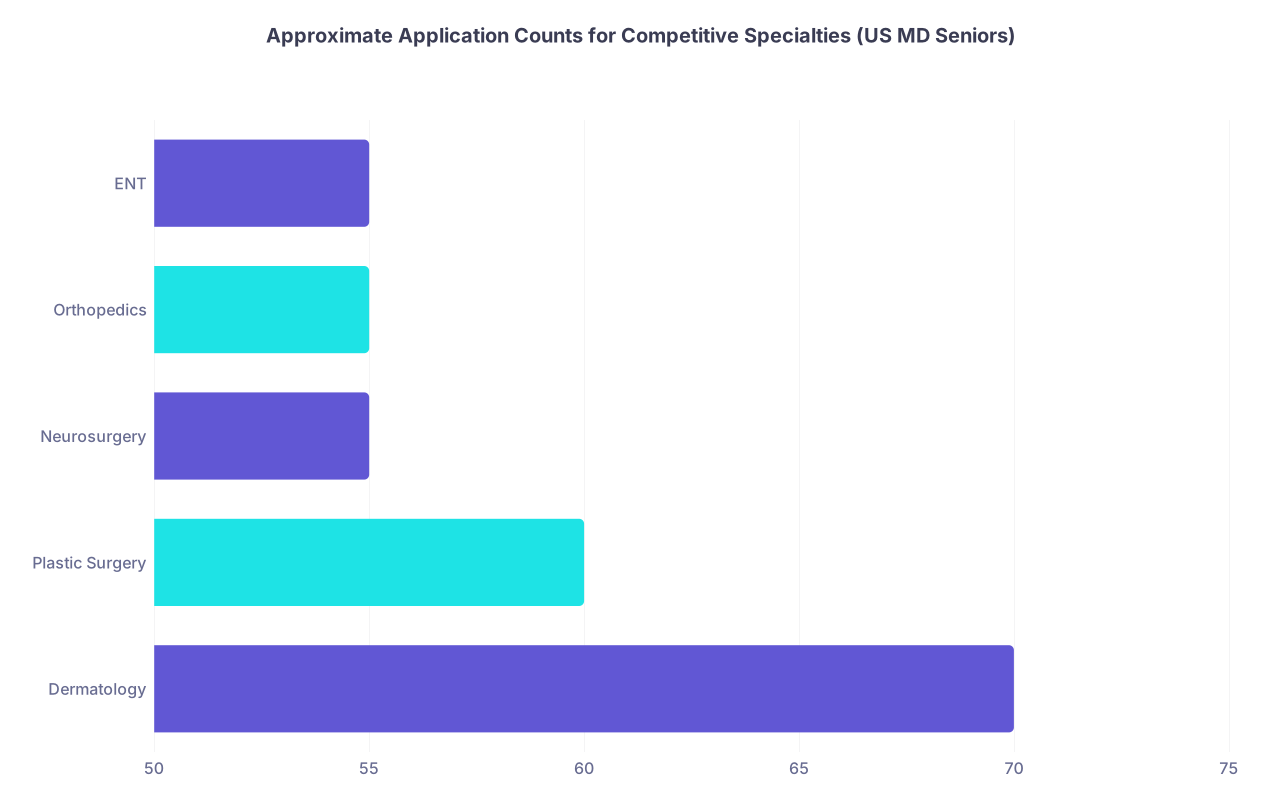
Data from NRMP show clear dose-response relationships between number of applications and probability of matching—up to a point. For competitive fields, U.S. MD seniors often apply to 60–80+ programs; DO and IMG applicants sometimes exceed 100.
| Category | Value |
|---|---|
| Dermatology | 70 |
| Plastic Surgery | 60 |
| Neurosurgery | 55 |
| Orthopedics | 55 |
| ENT | 55 |
Students from mid‑tier schools who match tend to do three things:
- Apply broadly across program tiers
- Target a mix of academic and strong community programs
- Maintain a realistic backup specialty
The backup is not just a checkbox. It is a genuine parallel plan. I have seen students crash out of Derm because they “half-applied” to IM or FM with generic letters and no signal. That is not a backup. That is self-sabotage.
Rational strategy from a mid‑tier school:
- Competitive primary specialty:
- Apply to the majority (60–80%) of programs nationwide, except those with explicit bias against DOs/IMGs if that is you.
- Ensure at least a third of your list are “mid‑tier” programs where your Step 2 and profile are at or above average.
- Backup specialty:
- Start cultivating letters and at least some continuity from early MS3.
- Do not neglect research and clinical performance in that field.
The data pattern: applicants from mid‑tier schools who over-concentrate their list on top-20 programs in a competitive field have much higher unmatched rates. The same CV, distributed more intelligently across tiers, matches.
8. Combining predictors: realistic profiles from mid‑tier schools
Data are most useful when you see combinations, not isolated variables.
Let me give you stylized but realistic profiles I have seen, with approximate match probabilities based on NRMP data and institutional experience. These are not exact percentages, but they mirror real outcomes.
| Profile | Step 2 CK | Research | Letters/Aways | Class Rank | Likely Outcome (Competitive Specialty) |
|---|---|---|---|---|---|
| A | 260 | 10+ field pubs | 2 strong away letters, 1 home | Top 10%, AOA | Very high match probability |
| B | 253 | 6–8 field projects | 1 strong away, 2 solid | Top 25% | Moderate-high, depends on specialty |
| C | 245 | 3–4 projects | Home letters only | Middle third | Low-moderate; much higher risk |
| D | 258 | 0–1 generic research | 1 lukewarm away | Middle third | Risky; may still match at lower-tier program |
| E | 248 | 1 research year, 8+ pubs | 2 big-name letters | Top 25% | Moderate-high, even in top programs |
Mid‑tier school applicants that match competitive specialties most consistently look like Profiles A, B, or E. Profile C matches sometimes in Ortho/ENT at mid-level programs, rarely in Derm/Plastics/Neurosurg. Profile D is exactly the kind of applicant who is shocked on Match Day.
Your goal is to understand which profile you are trending toward by early MS3 and then aggressively shift your parameters upward where you still control them (Step 2, research output, away choices).
9. The “school prestige” effect: real, but not determinative
I am not going to pretend school name is irrelevant. It selects for:
- Stronger average incoming students
- Greater access to high-impact research and famous faculty
- Higher baseline visibility for program directors
But look at program rosters for highly competitive specialties. You will find people from:
- State MD schools (e.g., Arkansas, Nebraska, Kentucky)
- Older DO schools (e.g., MSUCOM, PCOM, DMU)
- International schools with strong track records
Does a Harvard Derm applicant with a 252 Step 2 and 4 pubs have a higher probability of matching Derm than a mid‑tier state MD applicant with 252 and 4 pubs? Yes. Because of letters, research infrastructure, and historic relationships. The prior is better.
But that is a relative comparison. You are not forced to compete head-to-head with those applicants for the same handful of spots. Program distributions are broader, and mid‑tier students who hit the right metrics absolutely match.
In practical terms, from a mid‑tier school, you should assume you need:
- Slightly higher Step 2 CK than the national mean for matchers in your specialty
- Slightly more research output
- Meaningful away rotations and letters from higher-prestige departments
You are not out of the game. You are just playing it on “hard mode.” The data show that people win on hard mode every year.
10. Timeline: when these predictors become locked in
The other error I see mid‑tier students make is mis-timing their moves. They realize they want a competitive specialty after the highest-yield windows have closed.
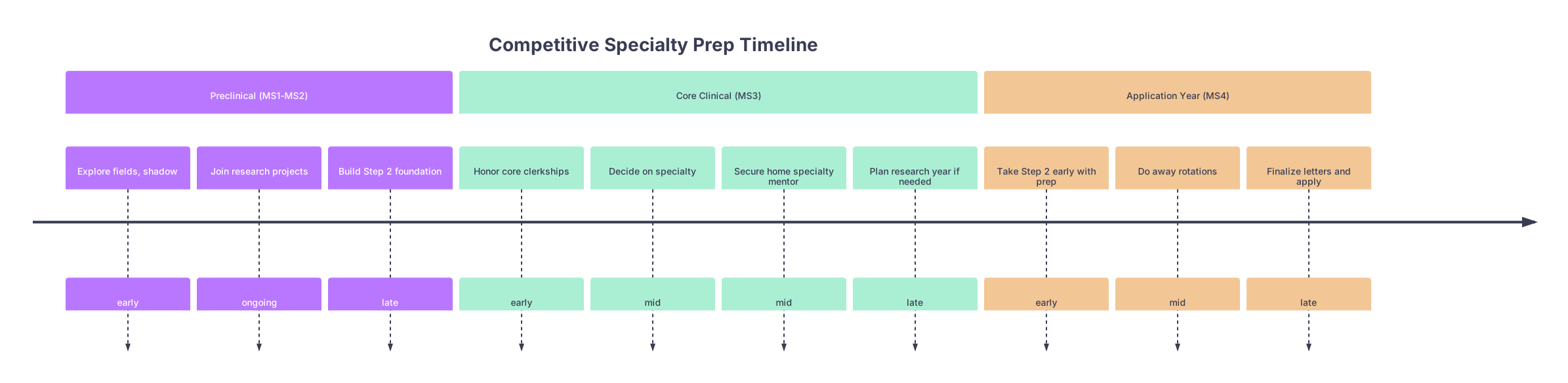
A realistic, data-driven timeline:
| Period | Event |
|---|---|
| Preclinical (MS1-MS2) - Explore fields, shadow | early |
| Preclinical (MS1-MS2) - Join research projects | ongoing |
| Preclinical (MS1-MS2) - Build Step 2 foundation | late |
| Core Clinical (MS3) - Honor core clerkships | early |
| Core Clinical (MS3) - Decide on specialty | mid |
| Core Clinical (MS3) - Secure home specialty mentor | mid |
| Core Clinical (MS3) - Plan research year if needed | late |
| Application Year (MS4) - Take Step 2 early with prep | early |
| Application Year (MS4) - Do away rotations | mid |
| Application Year (MS4) - Finalize letters and apply | late |
What this means practically:
- If you decide on neurosurgery halfway through MS4, you are almost certainly a reapplicant or a research-year candidate.
- If you decide on Derm late MS3, you will likely need an intense research year to catch up, especially from a mid‑tier school.
- If you decide on Ortho/ENT early MS3, you still have time to assemble a competitive portfolio—if you move aggressively.
Treat MS2 and early MS3 as your key inflection points. By then you should know:
- Your approximate Step 1 performance (even if pass/fail, you know how you test)
- Your research appetite and progress
- Your tolerance for risk and extra time (research year, prelim year)
11. Pulling it together: what the data actually say
Stripping away the noise, the data about matching a competitive specialty from a mid‑tier school reduce to a few blunt realities:
You cannot be “average” on more than one major axis (Step 2, research, letters, rank) and still expect to match safely in the most competitive fields. The matchers from mid‑tier schools almost always have at least two standout pillars: e.g., Step 2 + research, or Step 2 + away letters.
The combination of:
- Step 2 CK around or above 255
- 8–15+ field-aligned research products
- 1–2 strong away rotations with top-tier letters
- Top quartile of class performance
produces a high probability of matching into almost any field, regardless of school prestige.
Weak strategy kills strong CVs. Mid‑tier students who under-apply (not enough programs, too skewed to top-10), who ignore backups, or who neglect away rotations are massively overrepresented among unmatched applicants with “good enough” stats.
If you are at a mid‑tier school and want Derm, Plastics, Ortho, ENT, Neurosurg, Rad Onc, or IR, treat the match like a data problem:
- Identify your current position on the Step 2 / research / letters / rank axes by early MS3.
- Decide honestly whether your target specialty is still statistically achievable without major course correction (e.g., research year).
- Then either double down on the variables that still move or pick a less competitive specialty deliberately—rather than by default on Match Day.
The data show this very clearly: mid‑tier background is not destiny. Underpowered metrics are.