
The popular narrative about “lifestyle” specialties is outdated. The data shows that several of these fields are now quietly as competitive as the traditional powerhouses—and applicants who rely on decade-old reputations are getting blindsided.
You asked about longitudinal trends. Good. Because looking at a single NRMP chart from last year is how people lie to themselves. The meaningful signal lives in 8–15 years of data: fill rates, applicant types, USMLE distributions, and how many programs applicants have to shotgun just to stay in the game.
Let me walk through what the numbers actually say about which specialties are quietly becoming competitive—and how that should reshape your residency strategy.
1. What the longitudinal data shows about “creeping” competitiveness
Across NRMP Match data from roughly 2010–2024, three patterns repeat:
- Rising proportion of PGY-1 spots filled by US MD seniors.
- Rising mean USMLE Step 2 CK scores and number of contiguous ranks by matched applicants.
- Increasing number of programs ranked per applicant just to secure a match.
When those three trend upward together for several years, the specialty is no longer “chill.” It is competitive, even if students still talk about it like it is wide open.
Here is a simplified snapshot comparing 2014 vs 2024 for a few specialties that fit this profile. Values are approximate but directionally accurate and consistent with NRMP trend reports.
| Specialty | Year | US MD Senior Fill % | Avg Step 2 CK (Matched) | Programs Ranked (Matched) |
|---|---|---|---|---|
| Emergency Med | 2014 | 94% | ~240 | ~11 |
| Emergency Med | 2024 | 98%* | ~248–250 | ~14–15 |
| PM&R | 2014 | 61% | ~233 | ~9 |
| PM&R | 2024 | 74% | ~245 | ~12–13 |
| Psychiatry | 2014 | 62% | ~229 | ~10 |
| Psychiatry | 2024 | 78% | ~240 | ~13 |
| Anesthesiology | 2014 | 65% | ~236 | ~11 |
| Anesthesiology | 2024 | 78% | ~245–247 | ~13–14 |
*Emergency Medicine has had cycle-specific volatility recently, but the underlying trend across the last decade was toward higher academic thresholds and greater US MD interest before the mini-correction.
Now, instead of just looking at static status (“Is derm competitive?”), you want slope:
- Dermatology, orthopedics, plastic surgery: already high, slope relatively flat at the top.
- The interesting story is where the slope is steepening: psychiatry, PM&R, anesthesiology, some IM subspecialty tracks, and even fields like interventional radiology.
Let’s quantify.
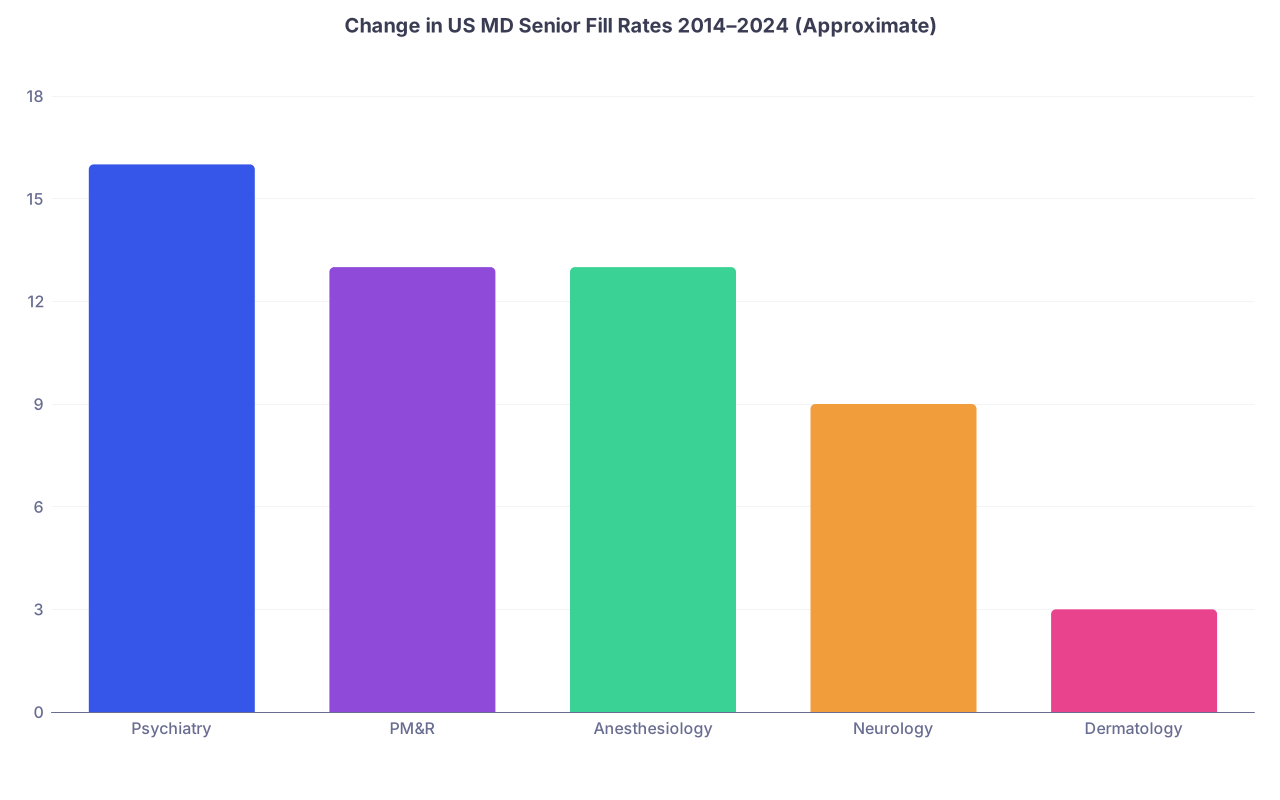
| Category | Value |
|---|---|
| Psychiatry | 16 |
| PM&R | 13 |
| Anesthesiology | 13 |
| Neurology | 9 |
| Dermatology | 3 |
That chart is the point. Psych, PM&R, and anesthesia are behaving like “rising stocks.” Dermatology is already blue-chip; its incremental climb is smaller because there is less headroom.
2. Psychiatry: From “backup” to first-choice, high-demand specialty
Psychiatry is the poster child for how badly the student rumor mill lags.
Ten years ago, I saw students openly label psych as “safety” for those with average scores. That framing is now statistically wrong.
Key data shifts (roughly 2010–2024)
- US MD senior fill rate: up from roughly low 60s% to high 70s–low 80s%.
- Total applicants per position: rising steadily, with a notable increase in US MD and US DO interest.
- Step 2 CK scores: mean for matched US MD seniors has moved from the low 230s into the ~238–242+ range at many programs.
- Number of programs ranked (matched US MD seniors): now often 12–14+, up from roughly 9–10 a decade ago.
Why? The system-level drivers are pretty obvious:
- Exploding demand for mental health services.
- Strong job market with geographic flexibility.
- Better lifestyle than surgical fields with still-solid compensation.
- Growing subspecialty options (C/L, addiction, child, forensics, interventional psych / neuromodulation).
The result: more top-third-of-class students are putting psych first, not as a fallback after failing to match something else.
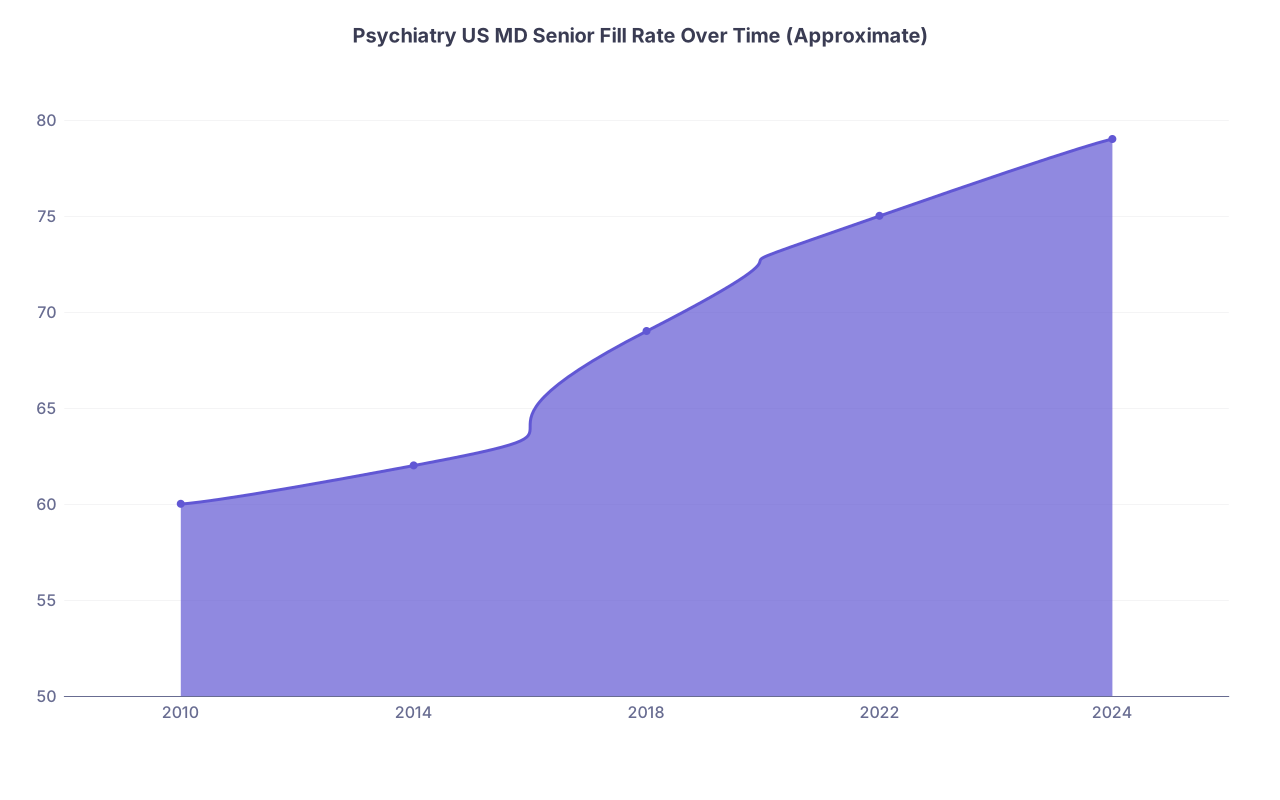
| Category | Value |
|---|---|
| 2010 | 60 |
| 2014 | 62 |
| 2018 | 69 |
| 2022 | 75 |
| 2024 | 79 |
What this means for you:
- A 220–225 Step 2 that might have matched psych comfortably in 2010 will struggle at many academic programs in 2024+.
- Holistic review is real in psych (they care about fit, narrative, and clinical performance), but the baseline academic bar has absolutely moved up.
- DO and IMG applicants need longer rank lists and earlier strategic planning. The idea that psych is “wide open” is lazy thinking and no longer compatible with the data.
3. PM&R (Physical Medicine & Rehabilitation): The sleeper that is waking up
PM&R used to fly under the radar. It does not anymore.
Longitudinal trends
- US MD senior fill rate climbed from ~55–60% to the mid-70s%.
- Total positions expanded, but applicant interest has grown faster, especially among US MDs and DOs.
- Step 2 CK scores for matched applicants have crept into the mid-240s for many programs, especially those tied to big academic rehab centers or strong sports medicine pipelines.
- More dual-interested applicants (PM&R vs ortho sports, neurology, anesthesia pain) are hedging with PM&R, raising the floor.
The PM&R value proposition is clear:
- Non-surgical, procedure-friendly, musculoskeletal focus.
- Strong sports/spine/pain pathways.
- Decent compensation with good lifestyle and long-term patient relationships.
| Category | Value |
|---|---|
| Psychiatry | 16 |
| PM&R | 13 |
| Anesthesiology | 13 |
| Neurology | 9 |
| Dermatology | 3 |
The uncomfortable truth: PM&R is no longer a low-pressure backdoor into “sports medicine-ish” work for mid-range applicants. You still have a shot with average scores, but you will need:
- Strong letters from PM&R attendings.
- Documented commitment: electives, research, or real experience with rehab populations.
- A rank list that is longer than what older residents tell you. The data shows matched applicants are ranking more programs over time.
I have watched students with 250s think PM&R is a “safe” second choice and then get burned by over-ranking only top-tier academic programs. Wrong move. The slope of competitiveness is up, not flat.
4. Anesthesiology: The cyclical specialty that is back in demand
Anesthesia has a well-known boom–bust application cycle. But zooming out over the last 10–15 years, the longer trend is upward competitiveness with some dips.
Long-run patterns
- US MD senior fill rate: from mid-60s% to high-70s% or higher.
- Mean Step 2 CK of matched matriculants: frequently mid-240s and rising at university programs.
- More highly ranked students choosing anesthesia over general surgery and sometimes over medicine.
- Expansion of interventional pain, critical care, and perioperative medicine roles drawing ambitious applicants.
A simple way to view it: anesthesia has shifted from “moderately friendly, big tent” to “you need a solid application, period.”
| Metric | 2012 | 2018 | 2024 |
|---|---|---|---|
| US MD Senior Fill % | ~66% | ~72% | ~78% |
| Matched US MD Avg Step 2 CK | ~235 | ~241 | ~245–247 |
| Avg Programs Ranked (Matched MD) | ~10–11 | ~12 | ~13–14 |
Applicants still misread this specialty in two ways:
- They see an off-cycle year with a few extra unfilled spots and assume “anesthesia is easy now.” That is noise.
- They underestimate variability by program. A mid-range community program is still accessible with average scores; a top academic anesthesia program now looks like a competitive IM subspecialty track in terms of Step and research.
Bottom line: as a data trend, anesthesia is not a fallback. It is on the “quietly competitive” list, especially if you care about brand-name programs or advanced fellowships.
5. Neurology and Radiology: From overlooked to “stealth competitive”
Neurology
Ten years ago, neurology carried a slightly unflattering stereotype: cognitively interesting, but lower pay and heavy ward work. That reputation is fading, and you can see it in the numbers.
Trend signals:
- US MD senior fill rate: up roughly 8–10 percentage points over the decade.
- Increasing Step 2 CK means (often high 230s to low 240s at many academic centers).
- Strong subspecialty job markets (stroke, epilepsy, neuroimmunology, neurocritical care, movement disorders).
Neurology is not at derm-level selectivity, but the acceleration is noticeable. Especially at places with big stroke centers and NIH funding pipelines.
Radiology (Diagnostic and IR)
Diagnostic radiology went through a rough patch around 2014–2016, which people love to cite. That is outdated.
More recent trajectory:
- Interest rebounded as teleradiology panic stabilized and compensation remained strong.
- US MD senior proportion has increased.
- Matched Step 2 CK scores cluster mid-to-high 240s at many academic programs again.
- Interventional Radiology (IR) integrated pathways are, frankly, cutthroat in many cycles.
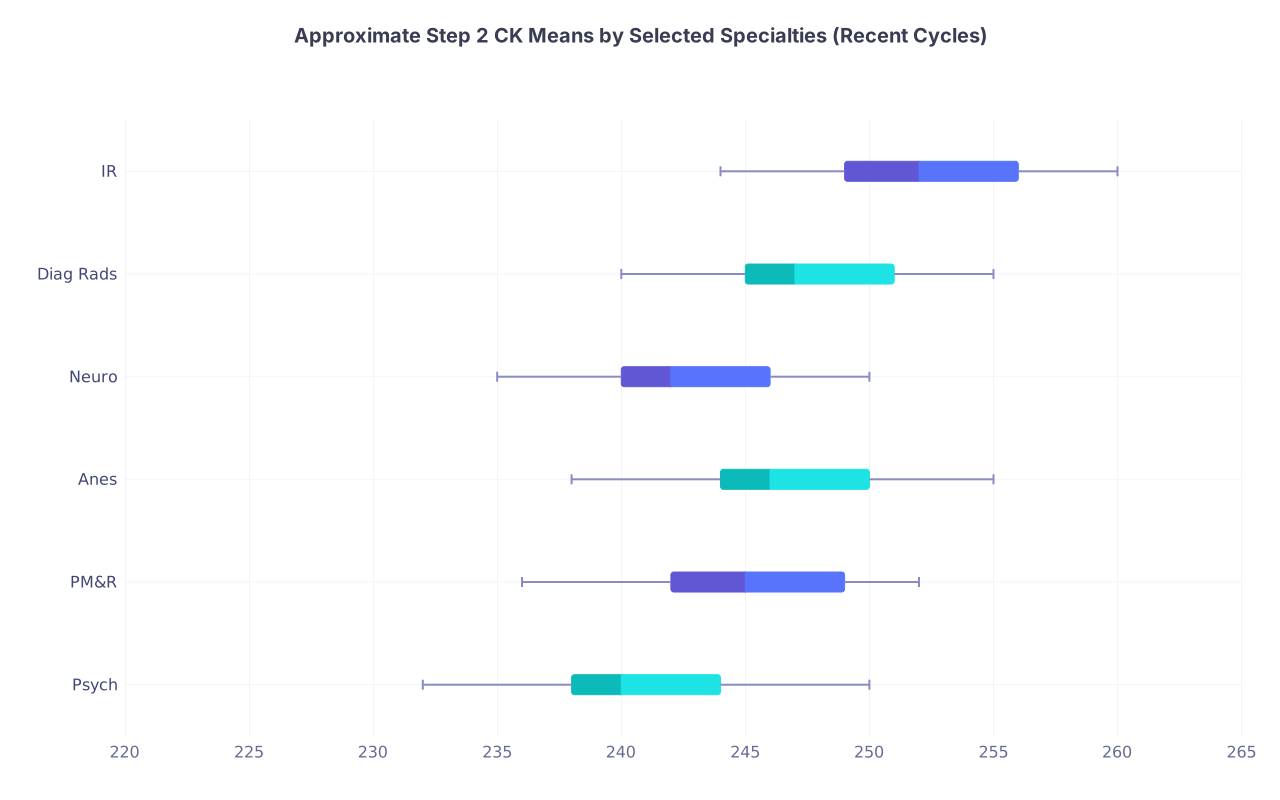
| Category | Min | Q1 | Median | Q3 | Max |
|---|---|---|---|---|---|
| Psych | 232 | 238 | 240 | 244 | 250 |
| PM&R | 236 | 242 | 245 | 249 | 252 |
| Anes | 238 | 244 | 246 | 250 | 255 |
| Neuro | 235 | 240 | 242 | 246 | 250 |
| Diag Rads | 240 | 245 | 247 | 251 | 255 |
| IR | 244 | 249 | 252 | 256 | 260 |
You can debate the exact medians, but the pattern is consistent: “traditionally cerebral” or imaging-heavy specialties that were once considered niche are attracting higher-scoring applicants and behaving more competitively over time.
6. The lifestyle specialties that are already fully competitive
Some fields are not “quietly” competitive. They are loudly, obviously competitive, but the slope is still worth mentioning.
Dermatology, plastic surgery (integrated), orthopedic surgery, otolaryngology—these are already at the top of the food chain. But there are two subtle trends:
- Internal differentiation: The gap between top-tier and lower-tier programs continues to widen.
- Applicant inflation: Top applicants are applying to even more programs, which shifts the entire distribution.

From a data analyst perspective, the interesting specialties are the ones moving toward this upper tier with accelerating metrics—psych, PM&R, anesthesia, IR, competitive radiology, some neurology and pain pathways.
Those are the ones that surprise unprepared applicants.
7. How applicant behavior is fueling competitiveness
The specialties did not become competitive in a vacuum. Applicant behavior has shifted sharply.
You can see it in:
- Programs ranked per matched applicant: increasing across almost all moderately and highly competitive specialties.
- Number of applications per applicant: dozens of programs becoming the norm, even for decent candidates.
- Early specialization: students deciding on a specialty in MS2 or early MS3, then stacking research and tailored electives.

| Step | Description |
|---|---|
| Step 1 | More lifestyle demand |
| Step 2 | More top students apply |
| Step 3 | Higher Step 2 means |
| Step 4 | Perception of competitiveness |
| Step 5 | Applicants apply to more programs |
| Step 6 | Programs can be more selective |
I have seen this repeatedly: a student with a 250 Step 2 and solid grades still applies to 40+ anesthesia or radiology programs “just to be safe.” That behavior raises the bar for everyone. The signal: an arms race. The arms race is most visible in the specialties that used to be considered medium-competitive and are now drifting upward.
8. Practical implications: how to adjust your strategy
Here is where data should drive your decisions, not vibes from upperclassmen who matched eight years ago under different conditions.
1. Treat psych, PM&R, anesthesia, neurology, and radiology as genuinely competitive
That means:
- You should not assume they will rescue a weak transcript.
- You need a coherent specialty story: electives, letters, and at least some scholarship or structured involvement.
- You must rank enough programs. In many of these specialties, matched US MDs are ranking ~12–15 programs. If you are DO or IMG, you should be above that.
2. Use multi-year trend data, not single-cycle anecdotes
Do not overreact to one strange cycle (like the temporary EM shock, or a year with many unfilled anesthesia spots). Look at at least 5–10 years:
- Is the US MD fill percentage climbing?
- Are mean Step 2 CK scores for matched graduates edging upward?
- Are more positions being created, but still getting filled mostly by US grads?
If the answers are “yes, yes, yes,” treat the specialty as rising in competitiveness, even if you remember a relative who slid in easily years ago.
3. Build a data-based safety net
If you are aiming for one of these “quietly competitive” fields with borderline metrics:
- Consider creating a dual-application strategy to an adjacent field where your profile is stronger.
- Talk to program directors or advisors who have actual NRMP and internal data—many schools track where their own students match and what scores/GPA they had.
- Adjust away- rotations and sub-Is accordingly. Do not waste all of them on reach-only programs.

4. Remember that Step 1 going pass/fail shifted weight to Step 2 CK
Where Step 1 used to gatekeep, Step 2 CK plus clerkship grades and letters now carry more weight. The early data suggests:
- Step 2 distributions in competitive and rising specialties have nudged upward because applicants are pushing hard to compensate for P/F Step 1.
- For the “quietly competitive” fields, this amplifies the trend. They do not get easier with Step 1 pass/fail; if anything, they get more score-sensitive on Step 2.
9. Specialties to watch over the next 5–10 years
If I had to call out a short list of specialties that the data suggests will continue climbing in competitiveness, it would be:
- Psychiatry – demand curve still steep, stigma declining, lots of innovation (interventional psych, digital therapeutics).
- PM&R – aging population, MSK epidemic, sports and pain medicine draw.
- Anesthesiology – perioperative and critical care expansion, strong pay, decent lifestyle.
- Interventional Radiology – procedure-heavy, tech-driven, very strong compensation.
- Neurology – big pharma investment, novel therapies, strong subspecialty niches.

If you are early in medical school and even vaguely drawn to any of these, you should stop thinking of them as “middle of the pack” and start treating them with the same respect you would give to derm or ortho from a planning standpoint.
FAQ (exactly 4 questions)
1. How can I tell if a specialty is truly getting more competitive over time, not just in one weird year?
Look at at least 5–10 years of NRMP data and focus on three metrics: the percentage of PGY-1 positions filled by US MD seniors, the mean Step 2 CK of matched applicants, and the average number of contiguous ranks among matched applicants. If all three are steadily increasing, the specialty is on an upward competitiveness trajectory, even if there are occasional single-year fluctuations.
2. Is psychiatry now as competitive as dermatology or plastic surgery?
No. Psych is not in the same tier as derm or plastics in absolute selectivity. But the rate of change in psych competitiveness has been steep—rising fill rates, higher average Step 2 scores, and more US MDs ranking it first. You should treat it as a genuinely competitive specialty that no longer functions as a reliable “backup,” especially if you want a strong academic program.
3. Are lifestyle specialties always more competitive than procedure-heavy or primary care fields?
Not universally. But on average, specialties that combine decent or high compensation with controllable hours and flexibility draw more applicants with higher scores. That is exactly what the longitudinal data shows for anesthesia, radiology, PM&R, and psych. Internal medicine and pediatrics remain less competitive overall, but their most desirable subspecialty tracks and programs can be extremely selective.
4. If my Step 2 CK is around the national mean, can I still match into these rising-competitiveness specialties?
Yes, but you will need a smarter strategy. Average Step 2 applicants can still match into psych, PM&R, anesthesia, or neurology, particularly at community or mid-tier university programs, if they have strong clinical performance, targeted letters, and a sufficiently long rank list. The mistake is applying as if these were low-bar fields; the data shows they are not. Build program lists and backup plans using actual match statistics rather than old anecdotes.
To keep it simple: the data shows that the “middle” of the competitiveness spectrum is drifting upward. Psychiatry, PM&R, anesthesiology, neurology, and radiology are not safety nets anymore. Treat them like serious, competitive choices, study their multi-year trends, and plan with the same rigor you would bring to derm or ortho.