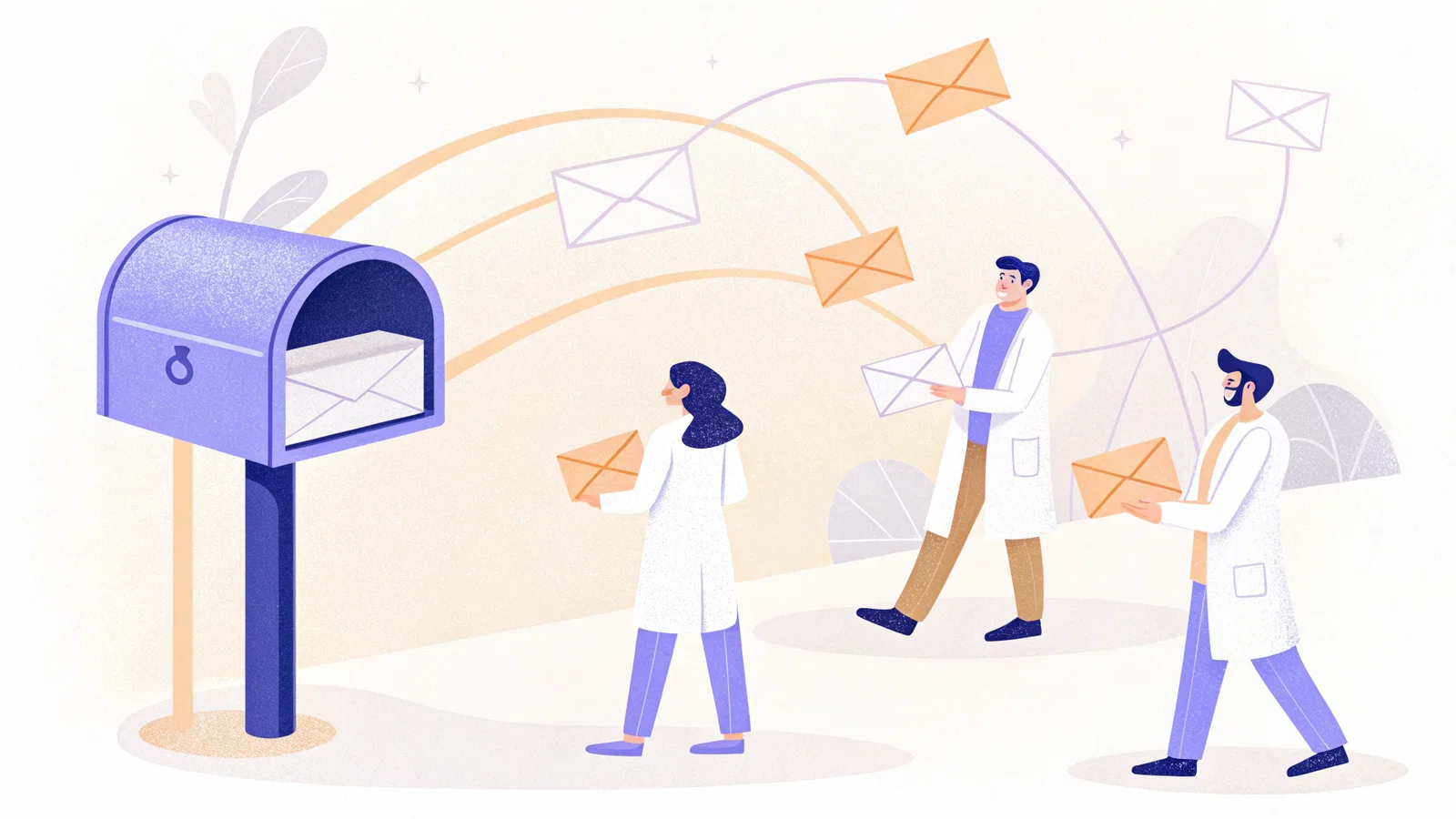
A shared departmental email sounds convenient. It usually is not.
For residency applicants, it creates one of the dumbest little bottlenecks in the whole interview season: you are trying to send a sincere, individualized thank-you note to Dr. Smith, Dr. Patel, and the program director, but the only contact you were given is something like [email protected]. So your carefully written note lands in a communal inbox already drowning in scheduling changes, visiting student requests, onboarding forms, and random messages from applicants who forgot how to use subject lines.
I have seen this go sideways more times than it should. Applicants paste three thank-you notes into one giant email. Coordinators have to manually figure out where each note belongs. One faculty member gets two copies. Another gets none. Then everyone wonders why the process feels messy.
Here is the truth: centralized email breaks post-interview follow-up unless you make routing easy. Your goal is not just to send a thank-you note. Your goal is to make sure the right human can identify it, forward it, log it if needed, and deliver it to the right faculty member with minimal friction.
That means three things:
- Triage: your note must be easy to sort at a glance.
- Redirection: there must be a backup path if the main inbox fails.
- Direct engagement: when appropriate, you should know how to reach faculty through approved secondary channels.
If you fix those three points, the shared inbox stops being a black hole and becomes a manageable relay station. That is the game. Not sentiment. Logistics.
The Shared Inbox Bottleneck: Why Centralized Email Breaks Post-Interview Follow-Up
Let us be blunt. A departmental inbox is built for program operations, not for nuanced post-interview correspondence. It is a traffic circle, not a concierge desk.
Program coordinators are often managing:
- interview invites and cancellations
- resident onboarding paperwork
- GME compliance messages
- faculty scheduling changes
- applicant questions
- internal hospital communication
Now drop your thank-you note into that pile. If your email is vague, overlong, or poorly labeled, it becomes one more administrative task to decipher. That is how messages get buried.
The biggest mistakes applicants make are predictable:
- Sending one email with multiple thank-you notes pasted together
- Using generic subject lines like "Thank you"
- Failing to identify which faculty member each note is meant for
- Attaching files with names like "Letter.docx"
- Following up repeatedly before giving the coordinator time to route the first message
Bad system, meet bad formatting. That combination is lethal.
From the coordinator side, this creates real clutter. They have to open the email, separate the content, identify faculty names, search for addresses, forward each note, and sometimes track whether it was sent. That is not a tiny favor. It is unpaid sorting labor you created.
And yes, frustration builds. I have heard coordinators say versions of the same thing: "I am happy to forward thank-you notes. I just do not have time to decode them." Fair. Completely fair.
So the fix is not to stop sending thank-you notes if the program culture supports them. The fix is to package them for routing. Cleanly. Intentionally. Like someone who understands how offices work.
The rest of this article gives you seven practical routing fixes. Start with the coordinator workflow. Then build backup channels. Then use advanced bypass options when program structure gets complicated.
Fix 1: The Program Coordinator Routing Protocol
If a program uses a central inbox, the program coordinator is your primary router. Treat that fact with respect.
Your job is to make forwarding nearly automatic.
The applicant-side formatting protocol
If you need to send multiple thank-you notes through one departmental email, use this structure:
Email body:
- one-sentence greeting to the coordinator
- one sentence thanking them for routing the notes
- a short bullet list naming each intended faculty recipient
- note that individual letters are attached as separate files
Example:
Subject: [INTERVIEW FOLLOW-UP] Jane Doe AAMC 12345678 - 3 Faculty Thank-You Notes Attached
Body:
- Dear Ms. Reynolds,
- Thank you for coordinating interview day. I am attaching brief thank-you notes for the following faculty members and would appreciate your forwarding them if permitted:
- Dr. Michael Smith
- Dr. Anjali Patel
- Dr. Laura Chen
- Thank you again for your time and assistance.
- Sincerely, Jane Doe
Attachment file names:
- Doe_Jane_ThankYou_DrSmith.pdf
- Doe_Jane_ThankYou_DrPatel.pdf
- Doe_Jane_ThankYou_DrChen.pdf
That is clean. Fast. Respectful.
The coordinator-side routing SOP
If you are advising programs, the standard operating procedure should be simple:
- Open central inbox.
- Identify interview follow-up by subject line tag.
- Confirm number of attached notes.
- Match each attachment to named faculty recipient.
- Forward each file to the relevant faculty member.
- Log completion in a tracking sheet.
The internal tagging system that prevents missed faculty
Programs should track with a simple spreadsheet containing:
- applicant name
- AAMC ID
- interview date
- faculty recipient
- date forwarded
- coordinator initials
- completion status
Nothing fancy. Just enough to prevent the classic miss: two notes forwarded, one forgotten.
If you are the applicant, your role is simple. Feed the system usable inputs. Do not send administrative confetti and hope someone cleans it up.
Fix 2: Direct Faculty Outreach via Alternative Verified Channels
Sometimes the departmental inbox is slow. Sometimes nobody confirms anything. Sometimes you strongly suspect your note vanished into the institutional swamp. Fine. You need a backup plan.
The rule is simple: use only verified, professional, program-appropriate channels.
Good sources include:
- the hospital or university faculty directory
- the department website
- an official email signature from prior correspondence
- ERAS or interview platform messaging, if available
- a coordinator-approved direct address
Bad sources:
- personal Gmail accounts
- social media DMs
- private phone numbers
- anything that feels sneaky, because it is
The backup outreach protocol
If 5 to 7 business days pass and you have reason to think a note was not routed:
- Check whether the program gave any communication rules.
- Verify the faculty member's professional email from an institutional source.
- Send one short, standalone thank-you note.
- Mention that you previously sent it through the departmental inbox.
- Keep the tone light. No guilt. No pressure.
Example opening: "Dear Dr. Patel, I wanted to share a brief thank-you note following my interview. I had also sent this through the departmental inbox, but I am forwarding directly in case that is easier."
That works. It is persistent without being irritating.
The professionalism boundary
One direct follow-up is fine. Repeated nudges are not. You are not tracking a package. You are sending courtesy correspondence. Act accordingly.
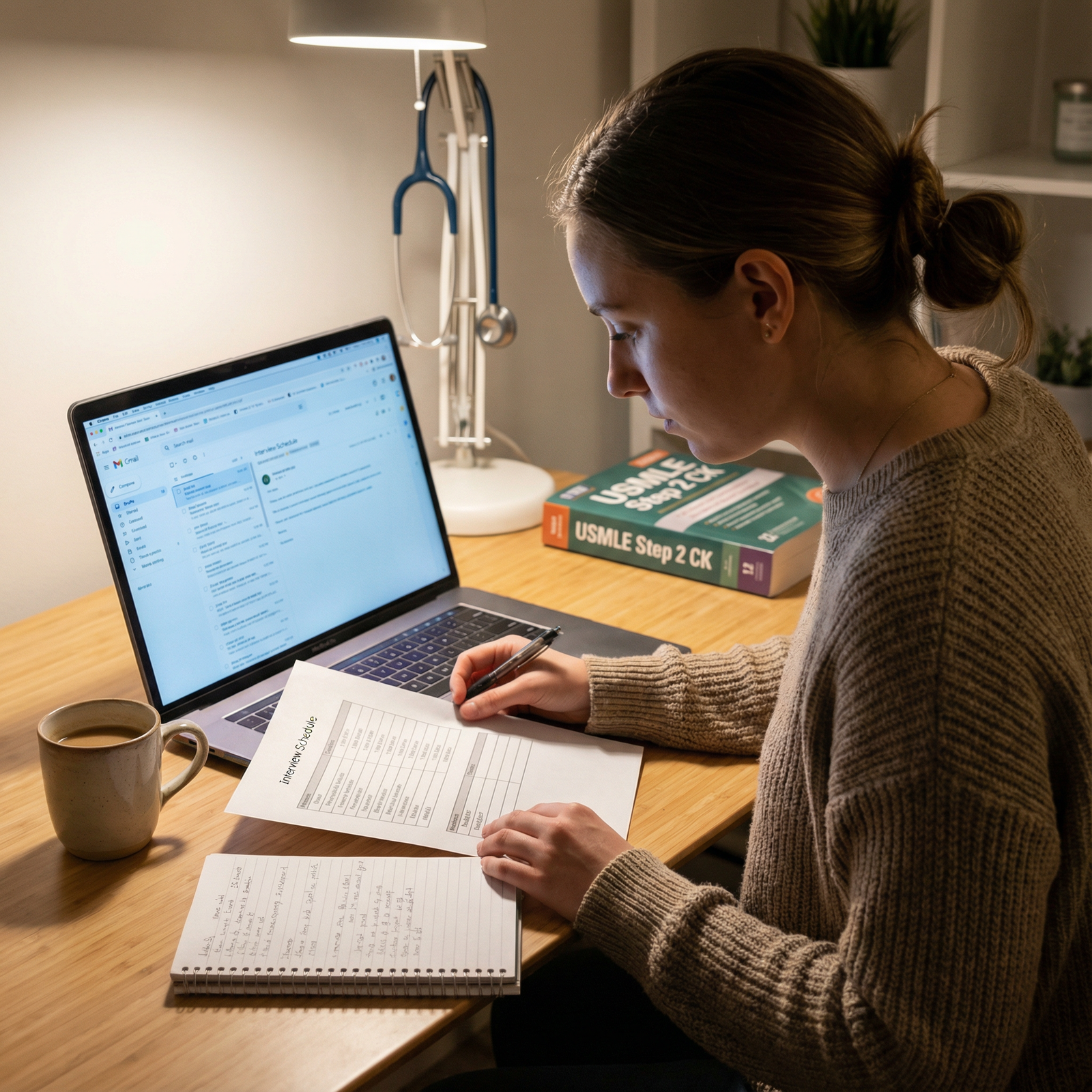
Fix 3: Batch-Formatting Your Subject Lines for Instant Sorting
Subject lines are not decoration. They are routing data.
If you send a thank-you note with the subject line "Thank you!", you are forcing an overworked coordinator to guess what your email is, who it concerns, and whether it is urgent. That is amateur hour.
Use this formula instead:
[INTERVIEW FOLLOW-UP] [Applicant Name] [AAMC ID] - FOR DR. [FACULTY LAST NAME]
Examples:
- [INTERVIEW FOLLOW-UP] Jane Doe 12345678 - FOR DR. SMITH
- [INTERVIEW FOLLOW-UP] Jane Doe 12345678 - FOR DR. PATEL
- [INTERVIEW FOLLOW-UP] Jane Doe 12345678 - 3 FACULTY NOTES ATTACHED
Why this works:
- the coordinator instantly recognizes the category
- your identity is obvious
- the intended faculty member is visible before the email is opened
- the message can be searched later
- it avoids the purgatory folder problem
Because yes, purgatory folders exist. Shared inboxes accumulate vaguely labeled emails that nobody wants to delete and nobody can process quickly. Your job is to avoid that pile altogether.
The numbers above are illustrative, but the point is dead accurate: structured subject lines get handled faster. Every time.
Fix 4 to 7: Advanced Triage Protocols for Complex Program Structures
Once you move beyond the basic shared inbox, programs get weird. Multi-site departments. Faculty who interview through one office but belong to another division. Communication embargoes. Interview software that nobody fully understands. This is where applicants either stay organized or create a mess.
Here is how to handle the complicated versions.
Fix 4: Use interview management software as a secondary routing bypass
If the program uses Thalamus, ERAS messaging, or another interview platform, check whether post-interview messaging is allowed. This is often the cleanest workaround because:
- the platform already links you to the program
- your identity is verified
- timestamps are preserved
- the message stays inside an official workflow
Best practice:
- Review the platform instructions and program policy.
- If messaging is allowed, send a brief note to the coordinator or designated contact.
- Ask whether thank-you messages can be routed through the platform.
- If yes, send one concise message per intended recipient or one clearly labeled batch note, depending on the system.
Do not abuse the platform. It is not a place for repeated "just checking in" messages. Use it as a controlled bypass, not a loophole.
Fix 5: The "One Master PDF with Bookmarks" method
This method is excellent when the program insists all communication go through one inbox and you want to minimize attachment chaos.
Instead of sending five separate files, create one PDF that contains:
- a one-page cover sheet listing intended faculty recipients
- one thank-you note per page
- bookmarks labeled by faculty name
- a file name such as: Doe_Jane_InterviewThankYous_Bookedmarked.pdf
Why it works:
- one attachment, not five
- easier for coordinators to store and forward
- less risk of missing or misnaming a file
- faculty-specific notes still stay distinct
How to build it:
- Write each thank-you note on a separate page.
- Export all pages into one PDF.
- Add bookmarks for each faculty recipient.
- Include a cover page with your name, AAMC ID, interview date, and recipient list.
- Mention in the email body that the PDF is bookmarked by faculty name.
This is the kind of formatting coordinators love because it reduces clicks. That matters.
Fix 6: Use chief residents as internal routers when faculty email is embargoed
Some programs are strict about faculty contact. No direct emails. No directory use. No exceptions. In those cases, chief residents can be the smartest internal routing option, if the program culture permits it.
Why chief residents work:
- they often help run interview day
- they know the faculty personally
- they understand program communication norms
- they can tell you whether routing through them is appropriate
The protocol:
- Confirm that chief resident follow-up is allowed.
- Send one short email thanking them for interview day support.
- Ask whether they recommend routing a note to specific faculty through the coordinator, portal, or another approved channel.
- If they offer to pass it along, send a polished, single-purpose note they can forward easily.
What not to do: turn the chief resident into your personal lobbying service. That is clumsy and transparent. Use them for logistics, not influence theater.
Fix 7: The graceful pivot if your note does not reach faculty before rank list submission
This is the scenario applicants obsess over far too much. You sent the note. The route failed. Rank lists are approaching. Now what?
Here is my position: do not spiral.
A missing thank-you note is rarely decisive. A messy, anxious chain of repeated follow-ups is far more likely to hurt you than the absence of one courtesy message.
If you strongly suspect the note never reached the faculty member:
- Send one final concise message through the best approved channel.
- Thank the program broadly.
- Stop.
- Rank based on your actual preferences, not on whether a thank-you note landed.
If no direct faculty route exists, pivot gracefully to a program-level note.
Example: "Thank you again for the opportunity to interview. I appreciated meeting the faculty and residents and remain very interested in the program. Please extend my thanks to Dr. Smith and Dr. Patel for their time."
That is enough. It shows maturity. It closes the loop. It does not beg for acknowledgment.
And let me say the quiet part clearly: thank-you notes are not magic. They do not rescue a weak interview, and they do not usually swing a rank list. Their value is professionalism, courtesy, and relationship maintenance. That is worthwhile. But only if you execute it cleanly.
The practical playbook
If you want the short version, use this:
- Send separate, clearly labeled notes whenever possible.
- Use standardized subject lines with your name, AAMC ID, and faculty recipient.
- Attach individual PDFs or one bookmarked master PDF.
- Make the coordinator's job easy.
- Use verified backup channels only.
- Respect program communication rules.
- If routing fails, close the loop once and move on.
Three takeaways matter most:
- Never dump unformatted, multi-recipient text blocks into a single departmental email and hope for the best.
- Use hyper-specific subject line metadata so program coordinators can batch-route your notes in minutes.
- Always have a backup routing plan, such as using interview management portals or verified institutional directories.
If you are in interview season right now, fix your process today. Build a reusable thank-you template, standardize your subject lines, and create a routing checklist before your next interview ends. Small systems beat last-minute scrambling. Every single time.