You walked out of the interview. You shook hands. You smiled. Now what?
Most applicants blow the follow-up. Not because they're rude or lazy, because they're operating without a map. They send generic thank-you notes that say nothing. They panic during weeks of silence and fire off "just checking in" emails that make them look desperate. Or worse, they go dark entirely and let a strong interview fade into memory.
Here's the truth: program directors (PDs) and coordinators notice how you communicate after the interview. It's a proxy for how you'll function as a resident. Will you be the person who sends concise, well-timed messages with relevant content? Or the one who floods inboxes with noise?
This is your timeline. Follow it.

The 24-Hour Rule: Strike While the Iron Is Warm (But Not Hot Enough to Burn)
At this point, within 24 hours of your interview, you should send a personalized thank-you email to your interviewer(s). Not a template. Not a copy-paste job with the program name swapped out. A real, specific, human message.
Here's what that looks like:
Paragraph 1: Thank them and reference something specific. "Dear Dr. [Name], thank you for taking the time to meet with me yesterday. I really enjoyed our conversation about [specific topic, a patient case, a research interest, a curriculum detail]." This is where most applicants fail. They write "Thank you for your time; I enjoyed learning about your program." That says nothing. It's white noise. The specific reference proves you were present, engaged, and genuinely interested.
Paragraph 2: Reaffirm fit. Connect your background to what you saw. "Our discussion about [specific thing] reinforced my interest in your program because [reason tied to your goals/experience]." Keep it tight. Two sentences, max.
Paragraph 3: Close cleanly. "I'm excited about the possibility of training at [Program Name] and would be honored to join your team. Please don't hesitate to reach out if you need any additional information. Sincerely, [Name]."
Rules that matter:
- 3 short paragraphs, max. If it's longer, you're overwriting.
- No attachments. No CV re-send. No research poster PDF.
- No follow-up questions. This isn't the time to ask about call schedules or parking.
- Send to the PD and/or your primary interviewer. If you interviewed with multiple faculty, you can send separate, distinct emails, but only if you had real conversations with each. Don't manufacture thank-yous to people you barely spoke with.
- Email the program coordinator separately. More on that later, but coordinators run the show. Treat them like it.
The 24-hour window isn't arbitrary. It's long enough that you don't look frantic, short enough that the interview is still fresh in their memory. Wait 48 hours and you're already fading. Wait a week and you're an afterthought.
Days 2-7: The Silence Is Normal, Here's What You Should (and Shouldn't) Do
You sent your thank-you. You got an auto-reply or nothing at all. Now you're staring at your inbox, refreshing, wondering if you should "check in."
Don't.
At this point, Days 2 through 7, you should do exactly nothing in terms of program communication. PDs are running clinical services, managing current residents, attending committee meetings, and interviewing 50 more applicants this week. Your thank-you email landed. It's been read or it will be. Sending a "just wanted to follow up" message now is the fastest way to signal that you don't understand how busy they are.
What you should do during this window:
- Update your rank order list notes. Open a spreadsheet. Log your impressions while they're fresh: culture, facility, resident morale, faculty engagement, location, gut feeling. You'll forget details by the time you've done five more interviews.
- Send a thank-you to the program coordinator. A brief, separate note: "Dear [Coordinator Name], thank you for organizing such a smooth interview day. I really appreciated [specific detail, the tour, the schedule, the resident dinner]." Coordinators talk to PDs. They notice who was polite and who treated them like a secretary. I've seen coordinators quietly advocate for applicants who stood out as kind and professional.
- Reflect honestly. Did this program actually feel like a fit, or were you seduced by reputation? Write it down now, before prestige bias creeps in.
Patience is professionalism. Use the silence wisely.
Week 2-3: The Golden Window for Strategic, Value-Add Communication
Two to three weeks post-interview. At this point, you should evaluate whether you have a legitimate reason to contact the program again. Most applicants don't. And that's fine, silence is the correct default.
But if you have a substantive update, this is your window.
What counts as a substantive update:
- You honored a rotation since your interview
- A paper was accepted for publication
- You improved a board score or completed a significant milestone
- You received a new award or leadership position
What does NOT count:
- "Just checking in to express continued interest"
- "Wanted to see if you had any updates on the ranking process"
- "Thought you might enjoy this article I read" (yes, people do this)
If you have a real update, send a short, professional email:
"Dear Dr. [Name], I wanted to share a brief update since we spoke on [date]. I recently received [honor/publication/score]. I remain very interested in [Program Name] and believe this further demonstrates my commitment to [relevant goal discussed in interview]. Thank you again for your time. Sincerely, [Name]."
The handwritten note question. Some programs, particularly older, more traditional ones in the Midwest or South, appreciate a handwritten thank-you note sent by postal mail. If you got a sense during interview day that the program values tradition and personal touch, a brief handwritten note can stand out. But if the program is ultra-modern, fast-paced, and digital-first, a mailed letter looks quaint and out of touch. Read the room. When in doubt, skip it.
The "I'm ranking you #1" question. This is the most misunderstood move in the follow-up game. If you are genuinely ranking a program as your #1 choice and you want to communicate that, you can, but do it sparingly, sincerely, and only if the program hasn't explicitly discouraged it. Some programs state in their interview materials that they don't want letters of intent. Respect that. If they're silent on the topic, a single, well-crafted "I wanted to let you know that I plan to rank your program as my top choice" email is acceptable. Make it specific. Explain why. And send it only to one program, because if two programs both believe they're your #1, you've lied to someone, and that gets around.
The Pre-Rank Deadline Crunch (Usually Weeks 4-6): What PDs Secretly Appreciate
Rank order list submission is approaching. The CERT deadline looms. At this point, you should consider one final, carefully timed communication, if and only if it makes sense for your situation.
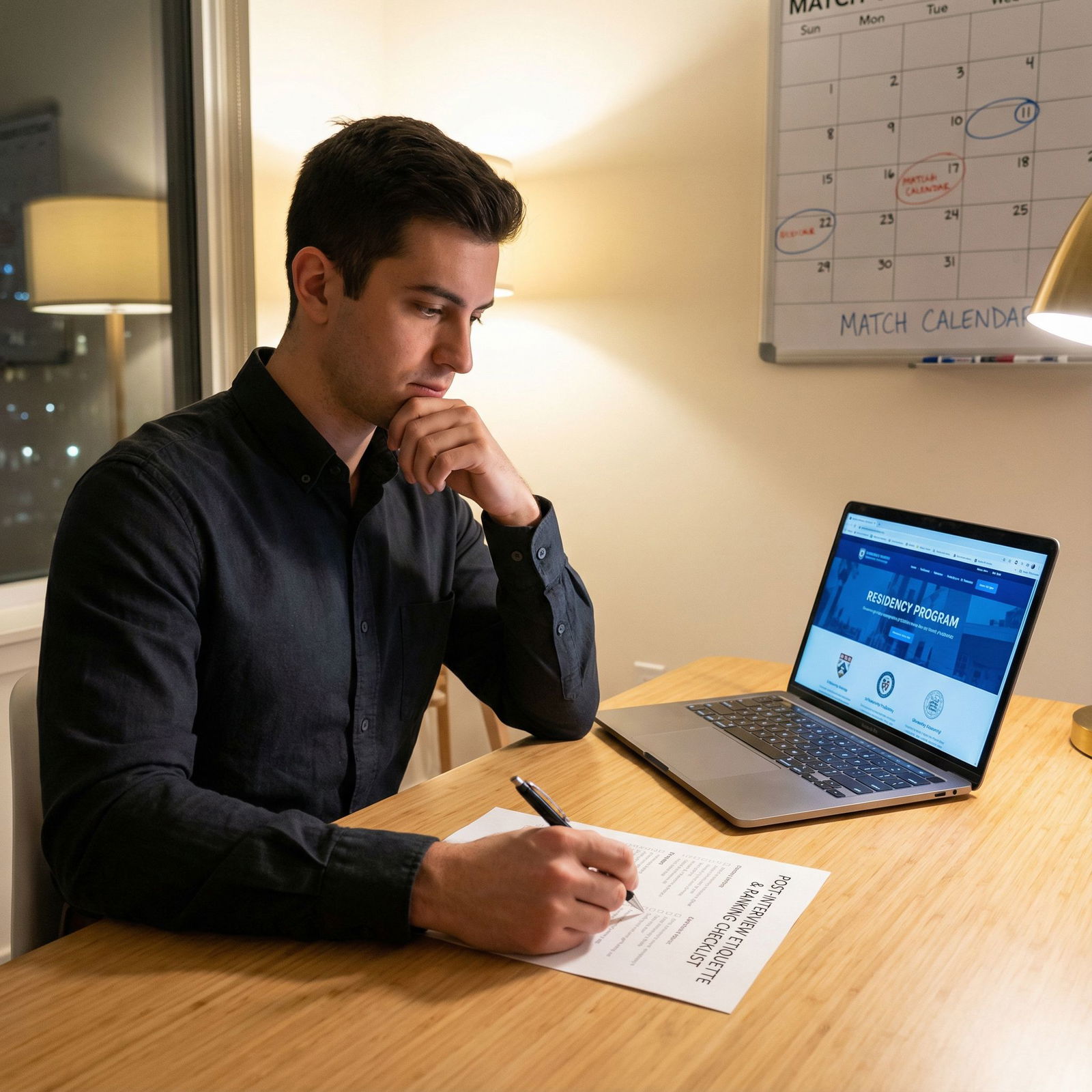
When a final email works: You've had minimal contact since your thank-you. You're genuinely ranking this program highly. You want to reinforce continued interest without sounding desperate. One brief email, sent roughly 1-2 weeks before the rank deadline, can serve this purpose:
"Dear Dr. [Name], as the rank order list deadline approaches, I wanted to reaffirm my strong interest in [Program Name]. My interview experience solidified my belief that your program is an excellent fit for my training goals, particularly because [specific reason]. I'm ranking your program highly and hope to have the opportunity to join your team. Sincerely, [Name]."
When it backfires:
- You've already sent two or three emails. A fourth makes you look obsessive.
- You phrase it as a negotiation: "If you rank me highly, I'll rank you #1." This is unethical, it violates Match rules, and PDs talk to each other. Don't.
- You mention other programs by name. "I'm deciding between your program and [Competitor]." This signals indecision, not interest.
- You send it to multiple PDs at the same program. One email to one PD. That's it.
What PDs secretly appreciate: A single, sincere, well-timed message that demonstrates you've been thoughtful about your ranking decision. It helps them gauge genuine interest, which matters more than applicants realize, especially for programs trying to avoid going deep into their waitlist. But annoyance outweighs persistence. If you've already communicated, don't pile on.
Match Week and Beyond: The Final Follow-Up Protocol
Match Week arrives. At this point, you should shift your follow-up strategy based on outcome.
If you matched at the program: Send a warm, prompt thank-you to the PD and coordinator. Something genuine: "I'm thrilled to be joining your team and can't wait to start." This is your future home. First impressions didn't end at the interview, they continue now. Then pivot immediately to onboarding. Respond to every email, complete every form, submit every document faster than asked. The residency coordinator who manages your onboarding is the same person who'll manage your schedule, your vacation requests, and your life for the next 3-7 years. Be the resident who's easy to work with from Day 1.
If you're in the SOAP: Do not contact programs where you interviewed. Focus entirely on available positions through official ERROL channels. Reaching out to programs that didn't rank you highly enough to match won't change anything and wastes critical time.
If you're unmatched: Wait at least a week after Match Day. If you had a genuine connection with a PD, you can reach out and ask for brief, informal feedback: "I'd value any insight you could share about my application or interview that might help me strengthen my candidacy for next cycle." Some PDs will respond with helpful feedback. Many won't. Accept either outcome graciously.
The bottom line: Your follow-up timeline is a test of judgment. Every email you send, or don't send, tells a PD something about how you'll function as a resident. Be specific. Be timely. Be quiet when silence is the right answer. And when you do communicate, make it count.
Now open your calendar, map your timeline, and execute. The Match doesn't reward the loudest applicants, it rewards the most strategic ones.