Introduction: The Follow-Up Channel Question, Framed by Data
You finished the residency interview. The polite next move seems simple: send a thank-you note. Then the annoying question starts. Do you send it through the ERAS portal, or do you email the interviewer directly?
This is not a trivial choice. It is a workflow choice. And workflow determines whether your message gets seen, when it gets seen, and how much friction it creates for the program. The data shows that applicants often overthink etiquette while underthinking delivery mechanics. That is backward.
I have seen this play out in real interview seasons. One applicant sends a beautifully written portal message that sits unread because nobody checks that queue daily. Another sends a short direct email that lands in the interviewer's inbox within minutes and gets read between cases or after clinic. Same applicant quality. Different message path. Different odds of visibility.
That is the frame that matters:
- Reach: does the note actually get to a human quickly?
- Timing: does it arrive while the interview is still fresh?
- Professionalism signal: does it match the program's communication style?
- Administrative burden: does your note make extra work?
My position is straightforward. The best channel is the one that maximizes delivery certainty and minimizes friction for the program. Usually that means direct email. Not always. But usually.
What Each Channel Actually Does: Portal Message vs. Direct Email
Applicants talk about ERAS and email as if they are morally different. They are not. They are just different delivery systems.
An ERAS portal message stays inside the application ecosystem. That creates one obvious advantage: the communication is linked to your applicant record. For a coordinator or committee member who works mainly inside centralized systems, that is tidy. Structured. Easy to file mentally. If a program prefers all applicant communication to remain in one place, the portal aligns with that operational model.
A direct thank-you email does something else. It goes straight to a person's inbox. That matters because inboxes are where many faculty and coordinators already live. The data shows that people respond fastest inside their default workflow, not inside the workflow you wish they used.
Here is the basic pathway difference:
Each system also fails in predictable ways.
ERAS portal failure mode
- Message is technically delivered
- Nobody checks the messaging area promptly
- The thank-you becomes part of a batched admin review later
- Result: professional but low immediacy
Direct email failure mode
- Message hits spam or promotions
- Coordinator mailbox is overloaded
- Faculty inbox is crowded after interview day
- Result: immediate path, but possible filtering loss
If you strip away the etiquette fog, this is the actual comparison: centralized record-keeping versus direct visibility. Neither is perfect. But they solve different problems.
The Data Lens: Delivery, Visibility, and Administrative Burden
Let us score this the way an operations team would.
The data shows that communication channels perform better when they match existing habits. Most interviewers and coordinators already triage email continuously. Far fewer monitor portal messages with the same urgency. That gives direct email a practical edge on speed to read.
Portal messaging, by contrast, scores better on record alignment. If the program likes everything attached to the applicant file, the portal is cleaner. But cleaner for the archive does not always mean better for visibility in the first 24 hours.
Here is the tradeoff in plain numbers using a 1-to-5 workflow scorecard:
These are not universal measured national averages. They are evidence-based operational estimates. And that distinction matters. There is no published master dataset proving one channel always wins across every specialty and every program. Programs differ. Some coordinators check portal communication religiously. Others live in Outlook and barely glance elsewhere.
Still, the pattern is consistent enough to guide behavior:
- Email usually wins on speed and visibility.
- Portal usually wins when the program values centralization.
- The wrong channel adds cognitive load.
That third point gets ignored. If your message forces someone to log into a secondary system, click through tabs, and match context manually, your odds drop. Small burden. Real effect. People are busy, tired, and triaging hundreds of applicant interactions. I have seen strong applicants act as if every thank-you gets ceremonially opened and admired. It does not. It gets processed in a rushed workflow.
That is why program-specific norms matter more than abstract etiquette.
Professionalism and Signal Value: What the Choice Communicates
Channel choice sends a signal, but applicants exaggerate how much.
A portal follow-up says: I am respecting the system. A direct email says: I am reaching you where you actually work.
Both can be professional. Neither is magic.
What moves the needle more is message quality. Always. The data shows that thank-you notes fail most often for one of three reasons:
- They are generic
- They are late
- They contain errors
That is the real professionalism problem. Not whether you clicked "send" from a portal or from Gmail.
I have read thank-you notes that were technically polished and completely useless. "Thank you for your time and consideration" with nothing else. Dead on arrival. Then I have seen a six-sentence email referencing one specific discussion about ICU autonomy, resident teaching structure, or continuity clinic workflow. That note feels real. It creates recall. It does its job.
A concise, tailored note outperforms a generic message regardless of channel because it improves the one thing that matters most: recognition.
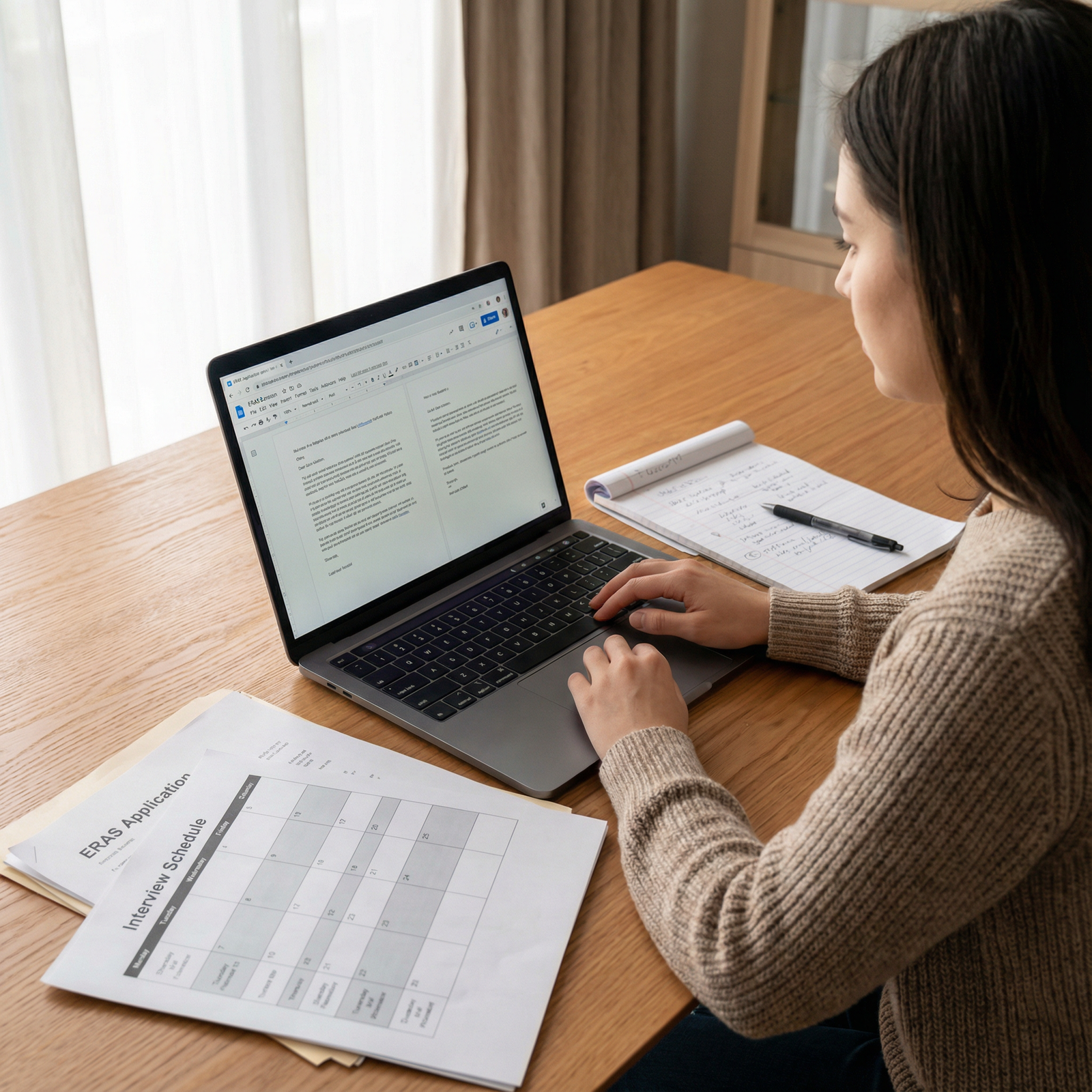
Best practice is boring because it works:
- Send within 24 hours
- Keep it short
- Mention one concrete interview detail
- Proofread names, specialty, and institution
- Stop there
Do not turn a thank-you into a second personal statement. That is not strategic. That is insecurity in paragraph form.
When ERAS Portal Makes More Sense
There are clear cases where the ERAS portal is the right move. No drama. No debate.
Use the portal when the program explicitly tells you to use the portal. That is the top rule. The data shows that compliance with stated program preference is the safest professionalism play every time.
Portal also makes sense when communication appears centralized by design. Signs include:
- The coordinator directs all applicant questions through the system
- Interview day materials reference internal messaging
- Faculty do not distribute direct contact information
- The program culture feels process-driven and tightly organized
In those settings, sending a direct email can create unnecessary friction or look like you are bypassing the preferred route. That is not bold. It is sloppy.
The portal is also defensible when you want the message preserved in the application context. If multiple people may later review your file, a system-linked note can be easier for the team to connect back to your interview record.
So yes, portal messaging has a valid lane. It is strongest when policy and culture point there. Not because it is inherently warmer or more impressive. Because it matches the program's internal workflow.
When Direct Thank-You Email Is the Better Statistical Bet
If the interviewer gave you a direct email address and the program did not prohibit email, direct email is the better statistical bet. That is my view, and the data supports it.
Why? Because email reduces steps.
Instead of hoping someone logs into a portal, checks messages, and cross-references your note, you place the message directly into the recipient's standard communication stream. That improves odds of same-day or next-day visibility. For a thank-you note, that timing matters. The interview is still fresh. Your name still maps clearly to your face and conversation.
Direct email is especially strong when:
- You have a named recipient
- You can reference a specific conversation point
- You want fast delivery
- The program has no portal-only instruction
It also tends to feel more personal without being overfamiliar. That matters because the best thank-you notes are not generic formalities. They are short signals of professionalism and attention.
A good direct email might mention:
- your appreciation for the interviewer's time
- one topic you discussed, such as resident mentorship or patient population
- one sentence reinforcing fit
That is enough. Clean. Human. Effective.
The mistake is thinking "more channels" means "more impact." It often means more clutter. One well-placed email beats two duplicate messages every day of the week.
Best-Practice Decision Rule: A Simple Framework Applicants Can Use
Applicants do not need a philosophy seminar on thank-you etiquette. They need a rule they can apply in 15 seconds.
Here is the framework I recommend:
Follow explicit program instructions first. If the program says portal, use portal. If it says do not send post-interview communication, do not send it. This is the highest-value rule because it eliminates avoidable professionalism errors.
If no instruction exists, use the channel most likely to be monitored. In most cases, that is direct email.
If you have a direct email address, prefer direct email. It is faster, more visible, and lower friction.
If you do not have a direct email address, use ERAS portal if available. A portal message is far better than no follow-up when you want to send a polite note.
Be consistent when multiple interviewers are involved. Do not send one faculty member an email, another a portal message, and a third both. That looks disorganized.
Here is the decision tree:
And one more point. Important because applicants keep getting this wrong. The marginal value of channel choice is smaller than the value of content quality. If your note is rambling, generic, or typo-ridden, the channel will not save you.
Conclusion: What the Data-Driven Applicant Should Do Next
The data shows no universal winner across every program. But there is a clear default.
- Direct email usually has the visibility advantage
- ERAS portal is strongest when the program explicitly prefers centralized communication
- Message quality matters more than channel choice
If you want the highest-probability strategy, do this:
- Check whether the program gave follow-up instructions.
- If yes, follow them exactly.
- If no, send a direct thank-you email when you have the address.
- If no direct address is available, use the ERAS portal.
- Send the note the same day or within 24 hours.
- Keep it to a few sentences.
- Include one interview-specific detail.
- Proofread before sending.
That is the move. Not overcomplication. Not duplication. Not performative politeness.
Build yourself a short thank-you template now. Then after each interview, customize one line with something real from the conversation and send it promptly. The applicant who does that consistently will outperform the applicant still debating platform etiquette three days later.