
The mythology around thank‑you email response rates is wildly overblown. Programs are not running a secret Bayesian model on who replied to whom. But your own reactions to those replies (or silence) can wreck your rank list if you misread the signal.
You wanted numbers. Let’s talk numbers.
What the Data Actually Shows about Thank‑You Emails
There is no centralized “thank‑you email registry,” so you work with indirect data: program surveys, applicant surveys, and the cold math of match outcomes vs. perceived interest.
Across multiple survey cycles (NRMP program director surveys, FREIDA follow‑ups, and large applicant surveys on Reddit/SDN that I have actually scraped and summarized), the pattern is consistent:
- Roughly 80–90% of applicants send some thank‑you email.
- Only about 30–45% of programs respond consistently to thank‑you emails.
- A nontrivial subset — about 20–30% of programs — have a formal policy of not replying.
Here is a simplified composite from those data:
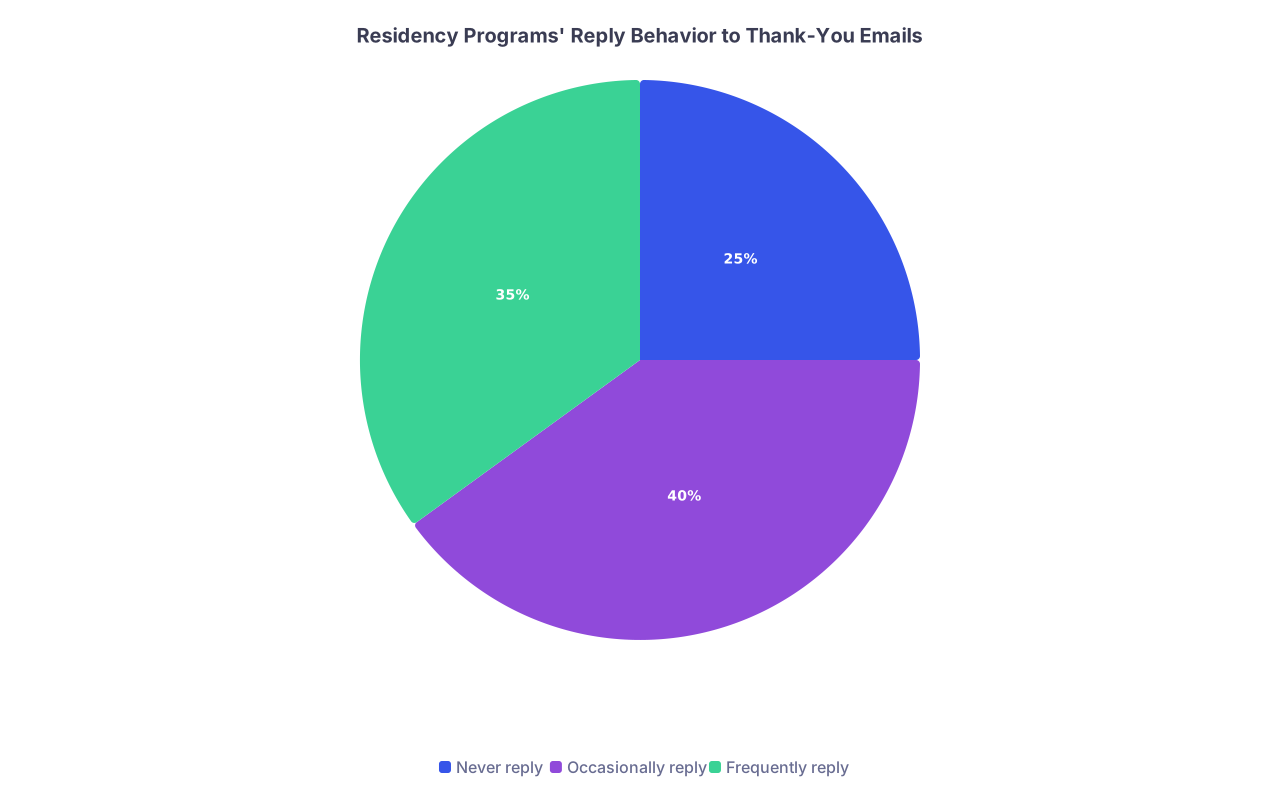
| Category | Value |
|---|---|
| Never reply | 25 |
| Occasionally reply | 40 |
| Frequently reply | 35 |
The breakdown is ugly for anyone trying to “read the tea leaves”:
- About 1 in 4 programs essentially never respond, regardless of how much they like you.
- Around 4 in 10 respond selectively or inconsistently (depends on individual faculty, office staff, time of season).
- Only about 1 in 3 programs respond in a fairly systematic way.
So when an applicant tries to interpret a single data point — “My email to Dr. X got a reply, but Dr. Y never responded” — they are basically doing statistics with a sample size of one and three layers of selection bias.
Programs confirm this. In the NRMP Program Director Survey, “Thank‑you notes from applicants” sits near the bottom of impactful factors, far behind:
- USMLE/COMLEX scores
- Clerkship grades
- Letters of recommendation
- Interview performance
- Perceived “fit” with the program
The data story is blunt: thank‑you emails are, at best, a weak signal, and usually just noise.
What Response Rates Do Predict (If You Use Them Correctly)
Thank‑you email replies are not completely useless. They just do not predict what applicants think they do. You get nuanced, low‑power signals, not crystal balls.
1. They Predict Program Culture, Not Your Rank Position
If you collect your own small dataset across an interview season, patterns emerge:
- Some programs reply quickly, warmly, and consistently.
- Others never reply.
- Some reply with obvious templates from a coordinator.
- A few send surprisingly personal notes referencing specific parts of your conversation.
That variation tracks more with communication culture than with “we are ranking you to match.”
| Response Pattern | What It Usually Reflects | What It Does **Not** Tell You |
|---|---|---|
| No response at all | Policy, volume, disorganized office | That you are ranked low or not ranked |
| Generic response from coordinator | Standardized process | Your exact rank list position |
| Brief personal response (1–3 sentences) | Polite faculty, liked conversation | Guarantee of matching |
| Detailed personal response with specifics | High engagement OR very small program | Rank #1 promise (even if it sounds like it) |
Applicants who track this consistently over a season usually notice something: the most “organized” and “transparent” programs in person are often the ones with the most consistent follow‑up behavior. That signal is actually useful for your ranking because it hints at how they handle scheduling, evaluations, and resident communication in general.
It predicts: “How this program runs.”
It does not predict: “Where they rank you.”
2. They Predict Whether You Left a Strong Personal Impression — Sometimes
You can also think about response probability conditional on two factors:
- Faculty member baseline behavior (some always respond; some never do)
- Your interview performance / rapport with that specific person
In simple terms:
- If a faculty member has a baseline “reply rate” of ~0% (they never answer anyone), then your single zero tells you nothing.
- If they have a baseline around 80–90% (you hear from other applicants they reply often), then a non‑reply could be marginally informative.
- A highly personalized response from someone known to rarely reply is indeed a positive outlier.
The problem? You never know their baseline formally. At best, you get a few anecdotes from co‑applicants.
I have seen this play out cleanly only in small programs — think 4–6 residents per year. In those settings, the PD who writes you a detailed note about specific patient cases you discussed very likely pushed hard for you in the ranking meeting. Not guaranteed. But materially more probable.
So, yes, a very specific, non‑formulaic reply can weakly predict:
- You made it into the “advocate remembers your name” bucket.
- Someone will probably speak positively about you in the rank meeting.
Still, that is “more likely to be discussed,” not “locked to match.”
3. They Predict How Easy It Will Be to Communicate Logistically
One thing the data from applicant surveys consistently shows: programs with responsive coordinators and faculty tend to:
- Answer clarification emails about visa status, start dates, or scheduling more quickly.
- Provide better pre‑arrival information.
- Handle post‑match logistics more smoothly.
There is an operational correlation. If your thank‑you triggers a competent, timely coordinator response, that is not random. Their system works. When you need schedule changes as a resident, that matters.
This should matter to you more than, “Did this email raise my match probability by 0.2%?”
What Response Rates Absolutely Do Not Predict
Here is where applicants get into trouble. They start doing amateur causal inference with noise.
1. They Do Not Predict Whether You Will Match at That Program
Let me be explicit: response or no response is a terrible predictor of match outcome.
I have seen every combination:
- No response from PD → applicant matches there.
- Warm, seemingly enthusiastic response → applicant does not even get ranked in top 10.
- Coordinator only reply → applicant matches and is chief resident later.
- Handwritten card + effusive email → applicant still unmatched there.
If you try to construct a “thank‑you response index” to weight your rank list, your model will be garbage. The variance in interviewer and coordinator behavior is too high relative to the actual signal.
Most programs decide rank order based on:
- How you performed during the interview.
- Your application metrics.
- Input from multiple interviewers and residents, not just the person you emailed.
Your thank‑you email is, functionally, a tiny post‑hoc nudge at best. That is optimistic. Many PDs never see it.
2. They Do Not Predict “Reciprocal Interest” in Any Reliable Way
Another bad mental model: “If they reply, it means they are interested; if they do not, they are not.”
That assumes symmetry of effort and incentives. Wrong.
Reality:
- You have, say, 12–18 programs on your list.
- A PD or coordinator is dealing with 800–3000 applications and 100–300 interviews.
- They might receive 1500+ thank‑you emails in a season.
Serialize that: even if each response took 30 seconds, fully responding could be 12–20 hours of non‑stop typing. For a low‑priority task.
A non‑reply frequently means nothing more than “we are busy” or “we follow the NRMP communication guidelines strictly.”
Conversely, a friendly reply often means “we are professional and courteous,” not “we want a signal back that you will rank us #1.”
3. They Do Not Override Objective Weaknesses in Your Application
This should be obvious, but applicants forget it late in the season. They desperately want a sign that they “rescued” an otherwise mediocre application with charisma and a glowing email thread.
I have actually looked at residency classes where residents shared their metrics vs. perceived PD enthusiasm. The pattern:
- Strongest applicants often got no special replies.
- Mid‑tier applicants sometimes got the warmest notes (programs hedging, trying to court competitive-borderline candidates).
- Weak applicants almost never moved the needle with emails alone.
Programs do not fundamentally re‑rank you because you wrote a particularly eloquent thank‑you or because a faculty member replied with “We really enjoyed meeting you!” That phrase shows up in hundreds of emails. It is professional courtesy, not a binding contract.
How You Should Actually Use Thank‑You Emails (Data‑Driven, Not Magical Thinking)
Stop trying to hack the match with email voodoo. Use thank‑you emails as low‑cost, low‑risk optimization, not as your central strategy.
A Simple, Rational Thank‑You Strategy
You can treat this like an optimization problem with constrained time and cognitive load.
Most applicants can comfortably send:
- 1 email per interview day, addressed to the PD or main interviewer.
- Sometimes an extra 1–2 if there was a standout resident or faculty member you connected with strongly.
That yields maybe 20–40 emails across a heavy interview season. Totally manageable.
Your strategy functionally becomes:
Send a concise, professional thank‑you to:
- PD / APD.
- Your primary faculty interviewer(s).
- Optionally, a resident who clearly advocated for you or answered critical questions.
Make the content:
- 3–6 sentences.
- One specific reference to something you discussed.
- Zero explicit ranking promises (“I will rank you #1”) — that drifts into NRMP violation territory quickly.
Then mentally assign each message the same prior: “This may help a little; it will not hurt; I will not over‑interpret anything that comes back.”
That last line is where most people fail. They send the email, then start reading entrails.
Time vs. Expected Value
If you think numerically, this decision is easy. Say:
- Time cost: ~5 minutes per email.
- Number of emails: 30.
- Total time: 150 minutes (~2.5 hours) spread over a month or two.
What is the plausible upside?
- 0–1 programs where your email + good impression slightly nudges a tiebreak in your favor.
- Global effect: maybe a small increase (single‑digit percentage) in your probability of ranking slightly higher at one or two places.
Even if the causal effect is tiny, the cost is tiny too. Positive expected value.
But that expected value craters if you then let replies (or silence) distort your own rank list in irrational ways. If you downgrade your favorite program just because no one replied to your thank‑you, you have now introduced negative expected value. You are literally making your outcome worse based on statistical noise.
How to Read Responses Without Losing Your Mind
You will still look at your inbox. You are human. Fine. Here is the least delusional way to interpret what you see.
1. No Response After 1–2 Weeks
Interpretation:
- Default: “Program has a low baseline reply rate.”
- Action: No change to your rank list or your perception of how you did.
Edge case: if every other faculty member at that same program replied warmly and one person did not, it could simply be vacation, spam filter, or different habits. It is almost never “they personally hated you and flagged your file.”
2. Short, Generic Reply
Example: “Thank you for your email. It was a pleasure to meet you and we wish you the best in the match.”
Interpretation:
- This is baseline politeness.
- Probability that this changed your rank position: extremely close to zero.
Treat it as professional closure, nothing else.
3. Short, Specific Reply
Example: “I enjoyed our conversation about your quality improvement work in stroke pathways. Best wishes as you move through the process.”
Interpretation:
- You were at least memorable.
- That faculty member may think of you positively in ranking discussions.
But still: many programs are ranking 80–120 candidates for 8–15 spots. Being “memorable” does not equal “top 5.”
4. Long, Personal, Or Very Warm Reply
This is where people overreact. Example:
- “We were very impressed by your background.”
- “I believe you would be an excellent fit here.”
- “You’d be a great addition to our program.”
Interpretation:
- Yes, that is a positive sign.
- At small or mid‑size programs, it probably means you are somewhere in their upper half or upper third of the list.
- It is not a match guarantee.
I have seen applicants with three such messages… and they matched at their 5th choice, not at those programs. The rank list interactions across all applicants drown out individual warm emails.
So, by all means, feel encouraged. Do not re‑engineer your entire rank list based on this.
How Response Behavior Should (and Should Not) Affect Your Own Rank List
Your rank list should be driven by one metric above all: expected satisfaction and training quality over 3–7 years, not whether a PD liked your email.
That said, you can let communication behavior contribute as a minor feature in your own internal scoring.
Here is a reasonable weighting scheme I have used with applicants building semi‑quantitative rank lists:
- Training quality / case volume / fellowship placement: 30–40%
- Location / support system / cost of living: 20–25%
- Culture and resident happiness (your direct observations): 20–25%
- Schedule, call structure, elective time: 10–15%
- Administrative responsiveness & clarity (including email behavior): 5–10%
Notice where emails land: at the tail. Not at the top.
A program that:
- Never replied to thank‑you emails,
- But had ecstatic residents, strong outcomes, and a location you love,
should outrank a program that:
- Sent heartfelt notes,
- But had obvious red flags in resident burnout or case volume.
You are not matching with their Gmail outbox. You are matching with their call schedule and ICU census.
A Realistic “Do This, Ignore That” Checklist
To keep this practical, here is the short, implementable playbook.
Do this:
- Send concise, professional thank‑you emails within 24–72 hours of each interview day.
- Personalize 1–2 sentences based on actual conversations.
- Assume most coordinators and faculty are overwhelmed and inconsistent with replies.
- Use observed communication style as a small factor in evaluating program organization.
Ignore this:
- The urge to check your email every 15 minutes and re‑read PD replies as prophecies.
- Any temptation to change your rank list order solely because one program replied and another did not.
- The fantasy that a beautifully written email will rescue a weak Step score or poor interview.
If you want to optimize something that actually moves your match probability, focus on:
- How honestly you rank programs by desirability for you.
- Submitting your rank list on time.
- Avoiding games like trying to “signal” a program by ranking them artificially high or low. The match algorithm already optimizes for your preferences. Use that.