Understanding IMG-Friendly Residency Programs and Why They Matter
For many International Medical Graduates (IMGs), the path to a U.S. residency can feel uncertain and complex. Beyond board scores and documents, one of the most strategic steps you can take is learning how to identify truly IMG-friendly residency programs—programs that not only accept IMGs but also support them to succeed.
Evaluating IMG-friendly residency programs is about more than counting how many IMGs they match each year. It involves understanding their culture, policies, support structures, and track record of integration and advancement for IMGs. When approached thoughtfully, this evaluation can dramatically increase your chances of matching into a program that fits your goals, values, and background.
This guide will help you:
- Define what an IMG-friendly residency program really is
- Identify specific markers of supportive programs
- Use practical tools and strategies to research and evaluate programs
- Tailor your application to maximize your chances of success
Throughout, we’ll connect these concepts to broader themes like Diversity in healthcare, mentorship programs, and long-term career development.
What Is an IMG-Friendly Residency Program?
An IMG-friendly residency program is more than a program that “takes IMGs.” It is a program that intentionally recruits, trains, and supports International Medical Graduates as valued members of its team and future workforce.
Core Characteristics of IMG-Friendly Residency Programs
While every specialty and institution is different, IMG-friendly residency programs often share several concrete features:
Consistent acceptance of IMGs over multiple years
Programs that are genuinely IMG-friendly usually match IMGs year after year, not just occasionally. For example, a program where 30–50% of residents are IMGs across several cycles is very different from one that matched a single IMG three years ago.Structured mentorship programs for IMGs
IMG-friendly programs often pair new IMGs with senior residents or faculty—ideally other IMGs—who can help them adapt to the U.S. healthcare system, documentation practices, and expectations in clinical communication and professionalism.Robust orientation and onboarding tailored to IMGs
Rather than a generic one-day orientation, IMG-supportive programs may provide:- Extended orientation to U.S. electronic health records (EHRs)
- Workshops on documentation, billing, and coding
- Guidance on resident wellness, housing, transportation, and visa logistics
Cultural competency and inclusion efforts
These programs recognize that IMGs bring valuable cultural and linguistic diversity. They often engage in:- Formal cultural competence training
- Workshops around communication, bias, and cross-cultural care
- Initiatives that explicitly include IMGs in leadership, quality improvement, and education roles
Active networking and alumni support
Many IMG-friendly residency programs develop strong IMG alumni networks who:- Mentor current residents
- Help with fellowship applications
- Provide guidance on job searches and visa transitions after residency
These elements don’t just “feel nice”—they directly influence how quickly you adapt, how confident you feel on rotations, and how competitive you become for fellowships and future jobs.
Key Factors to Evaluate When Identifying IMG-Friendly Programs
When you begin building your residency list, you’ll want to move beyond generic labels like “IMG-friendly” and look at specific, measurable criteria. The following factors will help you systematically evaluate programs.
1. Program Commitment to Diversity and Inclusion
Residency programs that are truly welcoming to IMGs often frame this within a broader commitment to Diversity in healthcare.
What to look for:
Clear DEI (Diversity, Equity, and Inclusion) messaging
On program or institution websites, check for:- Mission or vision statements referencing diversity, inclusion, or global health
- DEI committees or officers
- Public statements about inclusive recruitment and support
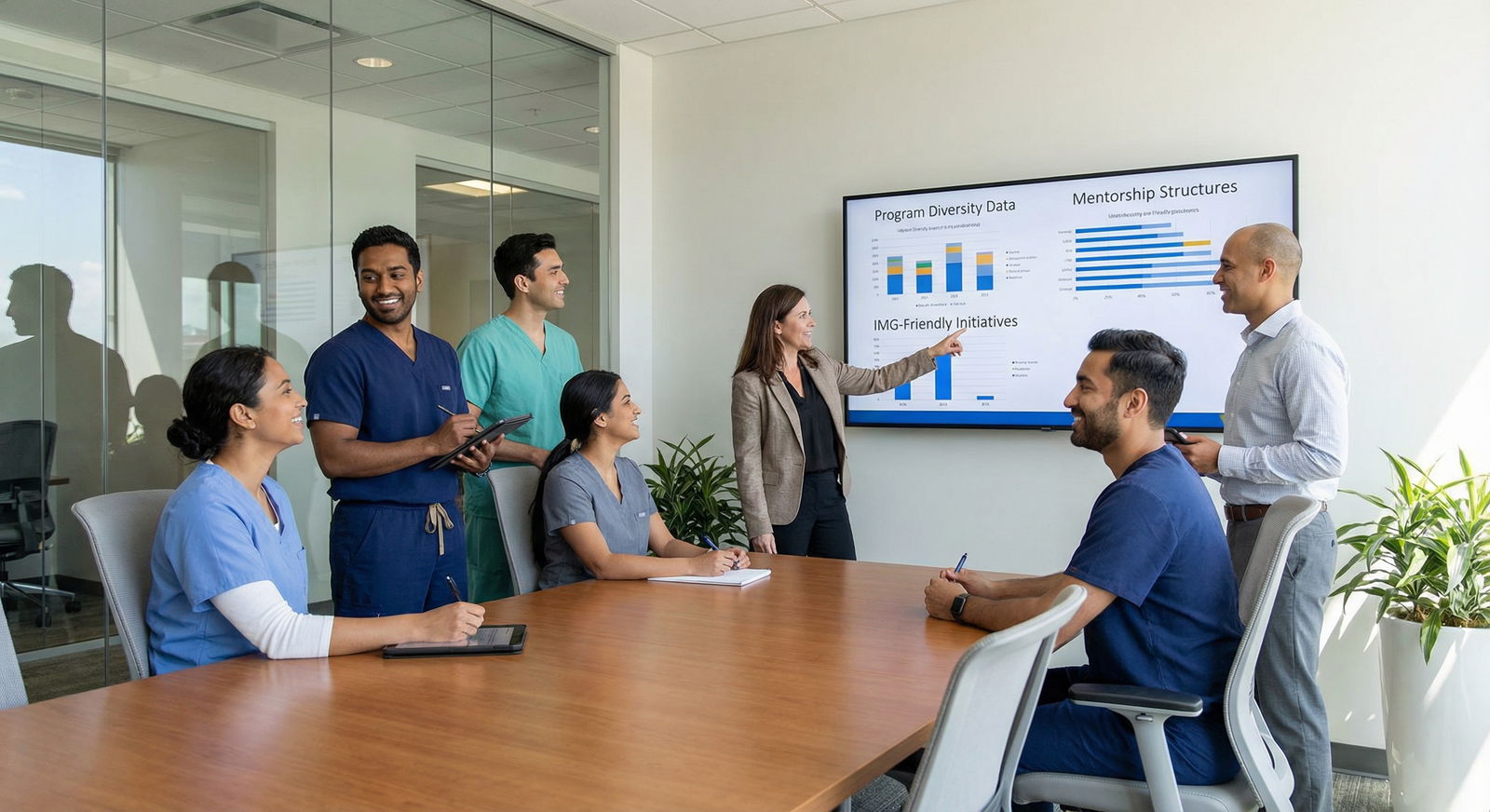
Concrete diversity data
Some programs share:- Percentage of residents who are IMGs
- Representation of different ethnic, cultural, or linguistic backgrounds
- Diversity initiatives or annual reports
Action step:
Search “[Program Name] residency diversity” or “[Institution Name] DEI” and review what the program actually does, not just what it says.
2. IMG Track Record: Numbers, Roles, and Outcomes
Past behavior predicts future behavior. IMG-friendly residency programs have a consistent history of integrating IMGs.
Key indicators:
Proportion of IMGs in current and recent classes
Look for evidence such as:- Class photos and resident lists on program websites
- FREIDA data on IMG percentages
- Match statistics where available
Roles and leadership positions held by IMGs
Are IMGs:- Chief residents?
- Members of program committees?
- Presenting at conferences?
If IMGs are visible in leadership, education, or research, it signals that the program values and advances them.
- IMG success after residency
Scan for examples of IMGs who:- Matched into competitive fellowships
- Obtained academic or leadership positions
- Successfully navigated visas and stayed in the U.S. healthcare system
These outcomes speak volumes about a program’s investment in IMGs long-term.
3. Mentorship and Support Systems
Mentorship programs are one of the strongest signals of an IMG-friendly residency. Transitioning from your home country’s system to the U.S. system is not intuitive; structured support makes a huge difference.
Questions to ask or research:
- Is there a formal mentorship program pairing interns with senior residents or faculty?
- Are IMG interns ideally paired with former or current IMGs?
- Do they have wellness initiatives acknowledging unique IMG stressors (distance from family, visa concerns, cultural adaptation)?
- Are there support networks or affinity groups (e.g., “International Residents Group,” “Global Health Interest Group”)?
Tip:
During interviews or open houses, ask:
“Can you describe mentorship programs in place for new residents, and how IMGs are supported specifically during their transition?”
4. Networking and Professional Development Opportunities
IMG-friendly residency programs recognize that career building starts from day one and create structured networking pathways.
Examples of strong networking and development structures:
- Regular scholarly activity opportunities
- Access to mentors for research and quality improvement (QI) projects
- Support in preparing posters, abstracts, and publications
- Connections to alumni and fellowship directors
- Alumni panels, webinars, or recorded sessions featuring IMG graduates
- Clear pathways for subspecialty exposure and letters of recommendation
Why this matters:
For many IMGs, U.S. professional networks begin in residency. Programs that actively connect you with mentors and leaders are giving you a powerful advantage for fellowship and job applications.
5. Cultural Competence and Communication Training
Adaptation to a new medical culture goes beyond learning EHR shortcuts. It includes subtle expectations in communication with patients, staff, and colleagues.
Signals of strong cultural competence training:
- Workshops or curricula on:
- Cross-cultural communication with patients
- Racism, bias, and structural determinants of health
- Language access and working with interpreters
- Inclusion of IMGs in curriculum design and feedback about these sessions
- Case-based discussions that reflect diverse populations and varied cultural norms
Programs that invest in this not only support IMGs but also deepen their commitment to Diversity in healthcare and high-quality, patient-centered care.
6. Program Location and Patient Population
Your experience as an IMG will be influenced by where you train.
Location considerations:
Diverse patient population
Urban and safety-net hospitals often care for patients:- From numerous cultural backgrounds
- With limited English proficiency
- With varied immigration statuses
This can be an asset if you speak additional languages or have experience in similar settings.
Community receptiveness to diversity
Some cities and regions are more accustomed to diverse healthcare providers and patient populations. Searching local news, hospital reviews, and resident blogs can give you context on the local culture.Lifestyle and social support
Consider:- Availability of cultural or religious communities that reflect your own
- Cost of living, transportation, and climate
- Proximity to friends or extended family in North America
Your personal adjustment strongly impacts your performance, wellness, and long-term satisfaction.
7. Residency Length, Structure, and Educational Philosophy
Beyond “IMG-friendly,” you should ensure a program’s structure actually matches the way you learn and your long-term goals.
Elements to evaluate:
Rotation schedules and variety of clinical exposure
- Balance between inpatient and outpatient time
- Exposure to subspecialties that interest you for future fellowship
- Presence of night float vs. 24-hour call
Educational support and remediation structures
Ask:- How does the program support residents who are struggling early on?
- Are there dedicated teaching conferences, board review sessions, or language/communication coaching?
Opportunities for research and fellowships
Especially if you aspire to fellowship:- Are there active research mentors in your areas of interest?
- Do they showcase residents’ publications and conference presentations?
- Are there specific opportunities or scholarships that IMGs have successfully accessed?
8. Holistic and Supportive Evaluation Process
How a program evaluates and interviews you is itself a signal of IMG-friendliness.
Positive indicators:
Holistic review of applications
Programs that highlight holistic review are more likely to:- Consider your full educational trajectory and life story
- Value international clinical experience, volunteer work, and language skills
- Interpret “nontraditional” paths (e.g., research years, observerships) in context
Flexibility around standardized metrics
While USMLE scores still matter, IMG-friendly programs often emphasize:- Communication skills
- Professionalism and adaptability
- Teamwork and patient advocacy
Fair, accessible interview processes
- Virtual interviews with time-zone considerations
- Clear instructions on format and expectations
- Interviewers familiar with IMG backgrounds
A program that asks thoughtful, behavior-based questions about your experiences and listens carefully is more likely to value what you bring as an IMG.
Practical Strategies to Find and Research IMG-Friendly Programs
Identifying supportive programs requires both data and networking. Use a layered approach: start wide, then narrow down with more detailed investigation.
1. Use Formal Databases and Search Tools
FREIDA (AMA) is one of the most robust tools available for residency exploration.
- Filter by:
- Specialty
- Location
- Program size
- Look for:
- Percentage of IMGs in current residents
- Types of visas accepted (J-1, H-1B, or none)
- Program benefits, call structure, and training sites
Other useful platforms:
- NRMP data and Charting Outcomes publications
- Offer specialty-specific data on IMG match rates and score ranges
- Program websites and institutional GME pages
- Often contain more detailed information on visa policies, diversity, and current residents
2. Leverage Online Communities and Forums
Residency application tips from peers and recent graduates can be invaluable, especially for IMGs with similar backgrounds.
- SDN (Student Doctor Network)
- Look up specialty-specific threads for IMGs
- Read program reviews and post questions about culture and IMG experiences
- Reddit (e.g., r/IMGreddit, r/medicalschool)
- Informal but often honest perspectives about program strengths and challenges
- Facebook/WhatsApp/Telegram groups for IMGs
- Country- or region-specific groups frequently share lists of IMG-friendly residency programs, templates, and strategies
Treat all anecdotal information with caution, but look for recurring themes and patterns.
3. Connect Directly with Current Residents and Alumni
First-hand conversations are among the most reliable sources of truth about a program’s culture and IMG-friendliness.
How to approach this:
- Use LinkedIn or program websites to identify:
- Current IMG residents
- Recent graduates who are IMGs
- Send a professional, concise message:
- Introduce yourself (name, school, step status if comfortable)
- Express genuine interest in the program
- Ask 3–4 specific questions (e.g., mentorship, workload, IMG support, visa issues)
Residents who are IMGs themselves often provide candid insights about:
- Integration of IMGs into the team
- Teaching quality and feedback culture
- Workload fairness and wellness
- How the program handled their visa and job search after graduation
4. Attend Residency Fairs, Virtual Open Houses, and Conferences
Residency fairs and specialty conferences have become even more accessible with virtual formats.
Benefits for IMGs:
- Direct interaction with:
- Program directors
- Coordinators
- Residents
- Opportunity to:
- Ask questions about visa sponsorship, diversity, and mentorship
- Share a brief version of your story and show professionalism and interest
Tips:
- Prepare a short “elevator pitch” about who you are and what you’re looking for
- Have 2–3 targeted questions ready for each program
- Take notes after each interaction to help you refine your rank list later
5. Evaluate Social Media Presence and Public Engagement
Many residency programs maintain active Twitter/X, Instagram, or YouTube accounts.
What these platforms can show you:
- The diversity of their residents (visible in photos, features, and resident takeovers)
- How often IMGs are highlighted in:
- Resident spotlights
- Scholarly achievements
- Leadership roles
- The tone and culture of the program—supportive, collaborative, academic, or otherwise
Programs that regularly feature resident achievements and talk openly about diversity and inclusion are more likely to be supportive of IMGs.
Application Strategies for IMGs Targeting Supportive Programs
Identifying IMG-friendly residency programs is only half the battle. You also need to position yourself effectively to those programs.

Tailoring Your Application: Showcasing Your Strengths as an IMG
When applying to programs known to support IMGs, highlight what makes you uniquely valuable in a diverse healthcare setting.
Key points to emphasize:
Global perspective and adaptability
- Experiences working with resource-limited systems
- Exposure to different disease patterns and healthcare structures
- Ability to adapt to new environments and teams
Cultural and linguistic assets
- Fluency in multiple languages
- Comfort working with multicultural patient populations
- Prior roles as translators, advocates, or community liaisons
Maturity and resilience
- How you handled major transitions (moving countries, changing systems)
- Concrete examples of overcoming challenges while maintaining professionalism
Use your personal statement and interview stories to connect these attributes directly to what the program values—especially if they highlight Diversity in healthcare, community service, or global health.
Importance of U.S. Clinical Experience (USCE)
For most IMGs, U.S. clinical experience is a major differentiator.
Types of USCE that are especially valuable:
- Hands-on electives and sub-internships (for current students)
- Observerships, externships, or research rotations (for graduates)
Programs with IMG-friendly policies often expect:
- Some degree of familiarity with U.S. clinical workflows
- Demonstrated ability to document in English and communicate with patients and teams
- Strong clinical letters of recommendation from U.S. attendings
If a program regularly matches IMGs, ask current residents how much USCE they had and whether the program helped them arrange any experiences or observerships.
Aligning with Program Priorities
Study each program’s:
- Mission statement
- Clinical and research strengths
- Patient population and community partnerships
Then tailor:
- Personal statement to connect your background to their mission (e.g., underserved care, safety-net populations, global health, research)
- Experience descriptions in ERAS to highlight skills that match what they emphasize (e.g., quality improvement, leadership, teaching)
Programs want evidence that you understand who they are and have a clear reason for choosing them beyond “IMG-friendly residency” status.
Frequently Asked Questions (FAQ) About IMG-Friendly Residency Programs
1. How can I quickly tell if a residency program is truly IMG-friendly and not just occasionally accepting IMGs?
Look for multiple lines of evidence over time:
- Repeated IMGs in resident rosters across several years
- Visible IMGs in leadership roles (chief residents, committee members)
- Clear visa sponsorship policies stated on official pages
- Testimonials from IMGs on the website or forums
If possible, confirm by speaking directly with current IMG residents. One or two IMGs several years apart may indicate exceptions rather than a genuine pattern.
2. What are the most important things to highlight as an IMG in my residency application?
Focus on elements that reinforce your fit for U.S. training and add value to Diversity in healthcare:
- U.S. clinical experience and strong clinical letters of recommendation
- Concrete examples of adaptability, resilience, and professionalism
- Cultural and linguistic skills that enhance patient care
- Any research or quality improvement aligned with the program’s strengths
Make sure your personal statement and interviews clearly connect your international background to your ability to thrive in their specific setting.
3. Do I need U.S. clinical experience to match into an IMG-friendly residency program?
While there are rare exceptions, U.S. clinical experience (USCE) is highly recommended for IMGs and often expected by IMG-friendly programs. It allows:
- U.S. faculty to comment on your clinical skills and communication
- Programs to feel confident that you understand U.S. healthcare dynamics
- You to decide whether their system and culture match your expectations
If hands-on rotations aren’t possible, high-quality observerships or research positions still show initiative and familiarity.
4. How can I find out whether a program sponsors visas and which type (J-1 vs. H-1B)?
Check the following sources:
- Program website: Look for a “Visa Sponsorship” or “International Applicants” section
- Institutional GME office page: Often lists standardized visa policies for all programs
- FREIDA and NRMP program pages: These sometimes indicate which visa types are accepted
If unclear, email the program coordinator with a concise, professional inquiry. Ensure your question is specific: “Does your program currently sponsor J-1 and/or H-1B visas for incoming residents?”
5. Are residency fairs, open houses, and mentorship programs really helpful for IMGs, or just optional extras?
For IMGs, these are often strategic advantages rather than extras:
- Residency fairs and open houses let you:
- Directly clarify visa, diversity, and support structures
- Make a positive impression before the formal interview
- Mentorship programs (especially IMG-focused) provide:
- Guidance in choosing programs and building a realistic list
- Help refining your personal statement, CV, and interview skills
- Insider knowledge on how certain specialties or programs view IMGs
Prioritizing these opportunities can significantly improve your match readiness and program fit.
By using a structured approach—examining diversity policies, mentorship programs, track records with IMGs, and the overall training environment—you can distinguish between programs that merely accept IMGs and those that truly invest in them. Combining careful program evaluation with a tailored, well-prepared application will put you in a strong position to succeed in the U.S. residency match as an International Medical Graduate.