
The Opening Scenario: The Dilemma of the Offshore Clerkship
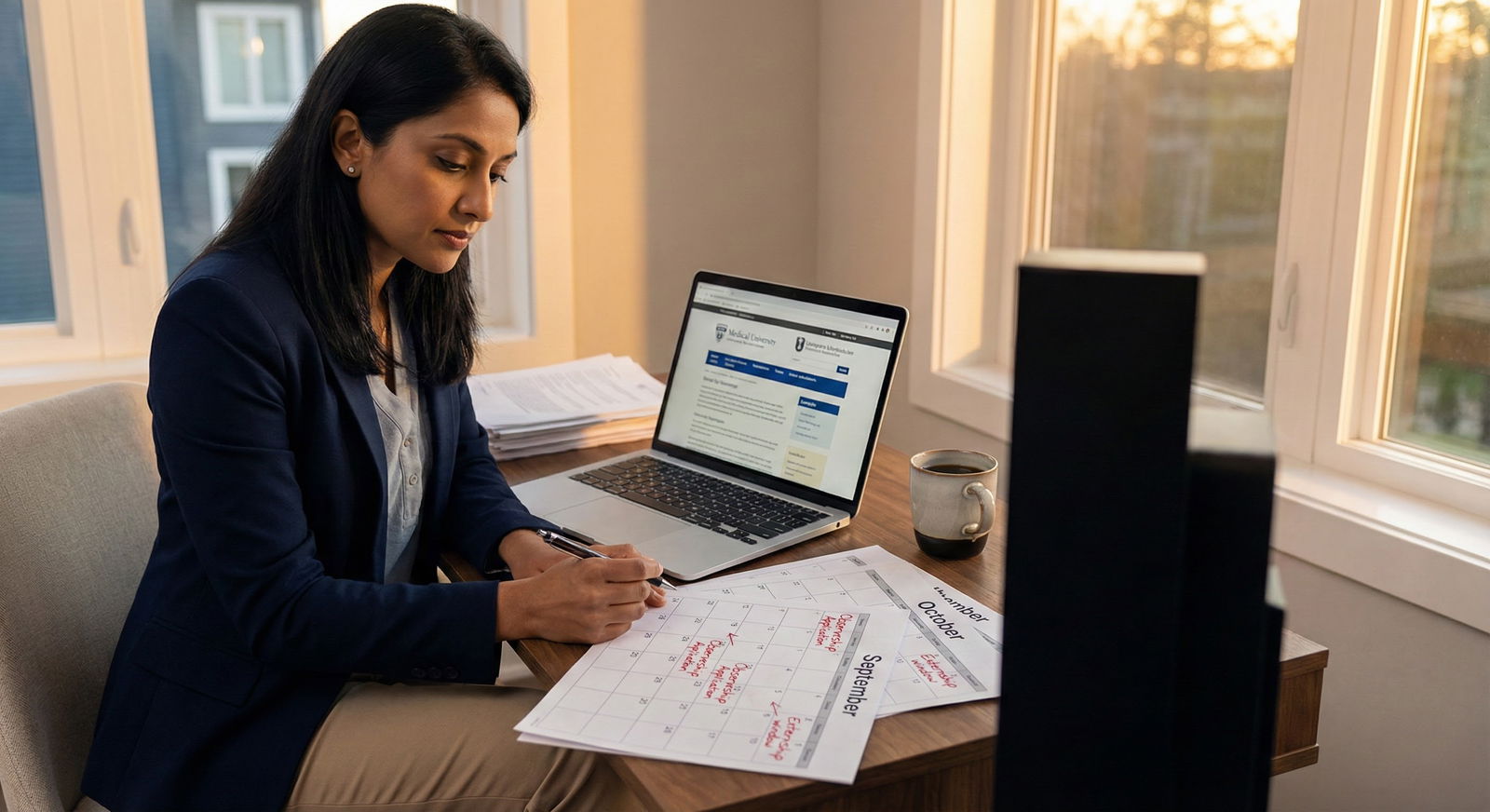
You're an IMG sitting at a small wooden desk in your apartment, credit card statement open on one tab, your medical school's international elective catalogue on the other. There's a spot in a reputable teaching hospital back home, a prestigious rotation in internal medicine, with a well-known professor who's published in The Lancet. It costs $1,200 for the elective fee, visas, and living expenses. Your parents are willing to help. But you also see that same amount could fund a US clinical elective if you hustle and land a spot through a paid agency. Only problem: you don't have a confirmed USCE slot yet, and the home-country rotation deadline is tomorrow.
Before you commit to a long-distance rotation, understand the real role of US clinical experience in IMG screening meetings.
This is the exact crossroad where hundreds of IMGs freeze every year. The lure of a "sure thing" rotation, one that adds a line to your CV without the visa hassle, feels safe. But will it actually help you match? Does a glowing letter from a professor in Mumbai, Cairo, or Lagos hold the same weight as one from a community hospital in Chicago? Spoiler: it doesn't. And I'm going to tell you precisely why.
First, let's nail down what we're even talking about. A hands-on clinical clerkship means you're touching patients, writing notes, presenting on rounds, and taking call. That's a US-style sub-internship. An observership means you're shadowing, hands in pockets, no EMR access, zero real responsibility. Non-US clerkships can be either, but regardless, the context shifts entirely. A hands-on rotation in your home country is a world apart from the same role in the US. Why? EMR differences, medico-legal exposure, team hierarchies, and the entire fabric of ACGME competencies. PDs know this. They're not guessing. They screen for it.
Before you dismiss your options, it is helpful to understand if virtual US clinical experiences actually matter for IMGs.
It is also vital to recognize that the common US clinical experience pitfalls IMGs don't realize are toxic can be avoided with better planning.
The PD Perspective: What Actually Matters?
Program Directors are risk managers. When they rank an IMG, they're betting that this person can survive, and thrive, in a US residency from day one. A bad hire means night-float disasters, patient safety flags, and faculty headaches. So they look for concrete evidence of US clinical readiness. USCE is that evidence. Non-US experience is not.
Why does this distinction exist? Because a US rotation proves you can handle a system where you're expected to write progress notes in fluent medical English within minutes, navigate an EMR (Epic or Cerner), understand HIPAA and billing nuances, and work within a team culture that's often less hierarchical and more direct than in many international settings. I've spoken with dozens of PDs who openly admit: "If I see no USCE, I can't confidently assess whether this candidate will sink in the first month."
Many applicants wonder if they are stuck abroad building US-style clinical experience from overseas effectively.
And then there's the Letter of Recommendation. A strong LOR from a US attending, someone who has trained residents themselves and knows what program directors need, carries enormous weight. That letter says, "I have personally seen this applicant perform at the level of a US sub-intern. I would trust them with my patients." A letter from a home-country professor, no matter how glowing, typically gets scanned for the institutional letterhead and then mentally filed under "couldn't verify system familiarity." It's not that your home-country mentor isn't brilliant. It's that they've never worked in a US hospital, so their definition of "excellent clinical skills" might not align with what US programs require.
Cultural competency gets screened, too. In US clinical settings, breaking bad news, shared decision-making, and patient autonomy often have their own unspoken rhythms. An observership in Lagos or an elective in Bangalore won't teach you what to say when a patient asks for a DNR or how to handle a demanding family in a US ICU. PDs look for that cultural fluency in your personal statement and interview, but they trust it only when backed by US hands-on experience.
Let's visualize this brutal filtering process:
That flowchart isn't theoretical. It's what ERAS screeners and algorithms effectively do. USCE gets you past the gatekeeper. Lack of it means you're competing in a pool where Step scores and research have to do an impossible job.
Quantifying the Weight: A Data-Driven Reality Check
Let's put numbers on this, because IMGs love data. Direct match-rate studies isolating the effect of USCE are scarce, but the NRDC and institutional surveys paint a consistent picture. In the 2022 NRMP Program Director Survey, 84% of PDs cited "US clinical experience" as a factor in interview invitations, with 58% calling it "important" or "very important." Compare that to "work experience in home country" which barely registered above 10%. Anecdotally, among the hundreds of IMGs I've mentored, those with at least three months of hands-on USCE, especially in university-affiliated programs, had interview rates two to three times higher than those with stellar credentials but zero USCE.
Here's a rough bar chart of match probabilities based on the experience profile, compiled from outcome reports and my own observations across multiple cycles:
Those numbers? They're not official NRMP stats because they don't break it down like that. But they're realistic estimates drawn from program coordinator insights and IMG community reports. See the gap? Non-US clerkships alone leave you at a sub-25% chance. You're essentially gambling.
The COVID-19 pandemic threw a wrench into things by normalizing tele-rotations. A few programs started accepting virtual USCE as a proxy. But the momentum shifted back fast. By 2023, in-person hands-on rotations were once again the gold standard. Tele-rotations that involved actual patient interaction via telemedicine platforms (not just Zoom lectures) retained some value, but PDs still see them as a poor substitute for physical U.S. hospital exposure. So don't cling to the pandemic normalization excuse.
And the limitations of non-US experience go deeper. ACGME milestones expect you to practice in a system with specific supervisory ratios, duty-hour restrictions, QI projects, and institutional safety reporting. A home-country rotation, even if intense, rarely reflects that architecture. So from a regulatory standpoint, a PD cannot comfortably map that experience onto their expectations for a PGY-1. They simply can't.
Strategic Decision Framework: Should You Invest?
Now, to the hard question: Is there ever a situation where a non-US clerkship makes sense? Yes. But only with a very clear-eyed strategic lens. I'll give you my decision framework.
When a non-US rotation could be "worth it":
- You've already secured at least three months of solid USCE and want to fill a short gap in your application year.
- The home-country rotation is with a world-renowned researcher in the exact niche you're targeting, and you have a real chance to co-author a publication during it. Not just a mention. A first- or second-author paper in a PubMed-indexed journal.
- The rotation is in a country with a healthcare system culturally similar to the US (e.g., UK, Canada, Australia) and is hands-on with EMR exposure (Cerner or Epic used), though these spots are rare.
- You absolutely cannot get a US visa or fund USCE, and you need to show recent clinical activity to avoid a CV gap.
When it's a mistake:
- You're spending money that could otherwise pay for a US elective or even a telerotation with a US attending willing to write you a LOR.
- You're doing it because a relative told you "any experience is good experience." (Please, stop listening to non-medical relatives.)
- You think a letter from a big name in your home country will impress US PDs. It won't, unless that person has a joint appointment at a US institution or is globally famous in the field, and even then it's a secondary factor.
The bottom line: the opportunity cost is real. Every month you spend in a non-US clerkship is one month you could have been searching for, applying to, or completing US rotations. Given that the match is a game of limited time and money, direct those resources to USCE. Borrow money if you must. A US elective costs $1,500-$4,000 with living expenses. That investment yields a measurable increase in match probability. A home-country rotation at $1,200 yields a pat on the back and a CV line that gets ignored.

Summary and Actionable Roadmap
So here's the direct, no-hedging answer: Non-US clerkships are a "nice to have," but they are nowhere near a "must-have." PDs want US-based letters of recommendation above almost everything else (after Step scores, of course). If you can only afford one thing, make it a US hands-on rotation. If you can't get that, push for a US telerotation with a strong LOR, or invest in high-impact research with a US-based PI. A non-US rotation should be your fifth move, not your first.
Your roadmap for the next application cycle:
- Secure at least two months of hands-on USCE, ideally in university programs, but community hospitals with residency programs work too.
- Gather three US-based LORs, from attendings who supervised you directly in clinical settings.
- If you have a home-country rotation already scheduled and can't get USCE in that slot, extract maximum value: publish a case report, get a strong letter but don't count it among your crucial three.
- Never, ever misrepresent a non-US rotation as USCE. Transparency is non-negotiable. I've seen applicants flagged for this, and it's a fast track to the DO NOT RANK list.
- Use your CV gap wisely. If you have no USCE yet, even a high-quality observership (not hands-on, but with a LOR) is better than a home-country elective.
Final verdict: The match is a high-stakes sorting mechanism. Don't waste time or money on things PDs don't fundamentally value. US clinical experience is the currency. Get it. If you can't, then pivot to research. But chasing non-US clerkships as a replacement for that currency? That's a myth. And now you know the reality.
This article is for educational purposes only. It is not financial advice, not legal advice, and not tax advice. Figures vary by individual circumstances, consult a qualified professional before acting.