
Do Virtual US Clinical Experiences Actually Matter for IMGs?
If a program director sees “4 weeks virtual US clinical experience” on your CV… do they actually care, or do they mentally file it next to “attended online webinar”?
Let me be blunt: virtual US clinical experience (vUSCE) is one of the most over-marketed, misunderstood parts of the IMG application world right now. Agencies sell it hard. IMGs pay thousands. And residency programs? They’re far less impressed than you think.
Let’s cut through the sales pitch and look at what virtual USCE really does—and does not—do for your chances in the Match.
What Programs Actually Mean by “US Clinical Experience”
First myth: “Any USCE counts, even virtual. It’s all the same.”
No. Not even close.
When program directors say “US clinical experience preferred” or “USCE required,” they are usually thinking about hands‑on, in‑person work in a U.S. clinical environment:
- Seeing real patients
- Participating on rounds
- Writing or at least drafting notes
- Interacting daily with a U.S. team (attendings, residents, nurses)
- Having your clinical reasoning evaluated in real time
Virtual USCE, in almost all the commercial forms I’ve seen, does not give you that.
It usually looks more like:
- Zoom case discussions
- Observing telemedicine visits (if you’re lucky)
- Short presentations on guidelines and management
- Group teaching sessions with little individualized assessment
That’s basically a structured online shadowing course. Helpful for learning? Sure. Equivalent to U.S. inpatient wards or clinic time? Not even remotely.
Here’s how most program directors mentally rank these:
| Experience Type | Typical PD Perceived Value* |
|---|---|
| In-person Sub-I/Acting Internship | Very High |
| In-person Hands-on Elective | High |
| In-person Observership (good quality) | Moderate |
| Research + limited clinic exposure | Low–Moderate |
| Virtual USCE / online observership | Low |
*Not every PD, but this pattern is consistent in surveys and what faculty say privately.
So if you’re thinking vUSCE is a cheap shortcut to “checking the USCE box,” you’re setting yourself up for disappointment.
What the Data Actually Shows (Not the Marketing Claims)
Let me address the elephant in the room: there’s no big randomized trial of “virtual vs in-person USCE” and Match outcomes.
But we do have clues:
NRMP Program Director Surveys
When PDs are asked what matters, recurring top items are:- USMLE Step 2 score
- Letters of recommendation in the specialty, from U.S. physicians
- Evidence of direct U.S. clinical experience
- Performance in U.S. rotations/electives
Virtual USCE barely shows up. When it’s mentioned, it’s often lumped with “online coursework,” not “clinical performance.”
ERAS and CV patterns
PDs and faculty I’ve spoken to (IM and FM especially) routinely say some version of:- “Virtual rotations are fine, but I can’t really judge them.”
- “I won’t consider a virtual rotation letter equal to a real inpatient evaluation.”
IMG Match outcomes
Look at successful IMGs in IM, FM, neuro, peds. The consistent features you see:- Strong Step 2 scores
- 2–3 solid in-person U.S. rotations
- U.S. letters that clearly describe performance on a team
You do not see many people getting in with zero in-person time and “4 virtual rotations” as their only U.S. clinical story.
To be clear: correlation isn’t causation. But if vUSCE were a serious substitute, you’d see programs endorsing it more strongly by now. They’re not.
Where Virtual USCE Does Help (When Used Correctly)
Now, this is where people swing too far in the other direction. “Virtual = useless.” That’s not accurate either.
Virtual experiences can help—but in narrow, specific ways.
1. Orientation to U.S. clinical culture
IMGs who’ve never worked in a Western system are often blindsided by:
- Hyper-focus on documentation and EMR
- Short visit times, billing documentation, codes
- The way attendings expect presentations: “one-liner, problem-based, assessment/plan by problem”
A decent vUSCE can:
- Expose you to SOAP notes, problem lists, U.S.-style H&P
- Show you how telehealth visits are structured
- Let you practice case presentations in a U.S.-friendly format
Does that equal patient care? No. But it can keep you from looking lost on day 1 of a real rotation.
2. Talking points for interviews
Programs sometimes ask:
“Have you had any exposure to the U.S. healthcare system?”
Having something is better than “none.” You can say:
- “I participated in a 4‑week virtual primary care experience with Dr. X at Y clinic, where I presented cases, discussed guidelines following ACP/IDSA standards, and observed telehealth visits.”
Not a game-changer. But it’s better than silence.
3. Networking (very selectively)
Keyword: selectively. Most virtual programs are revolving doors with 50–100 IMGs per batch. Nobody remembers you.
But if:
- The group is small
- You’re consistently engaging, prepared, and useful during case discussions
- You follow up with thoughtful emails or questions
You might get:
- Advice on target programs
- Honest feedback on your competitiveness
- Rarely, a “soft connection” to someone in a residency program
Notice what I didn’t promise: I did not say “strong letter of recommendation.” Because that’s extremely uncommon from virtual-only contact. And most PDs can smell a generic, “I barely knew this student” letter from a mile away.
The Harsh Reality: What Virtual USCE Cannot Replace
This is where IMGs get burned, because agencies selling vUSCE rarely say this part out loud.
1. It does not replace in-person US rotations
If a program’s website or FREIDA page says “We prefer hands-on U.S. clinical experience,” they are not secretly meaning:
“Online cases from another country are fine.”
They mean:
- You worked in a U.S. hospital/clinic
- You saw U.S. patients
- A U.S. supervisor took responsibility for you and your decisions
Virtual is an adjunct, not a substitute.
2. It does not generate high-impact letters (in most cases)
What makes a strong letter?
- Specific, detailed comments on:
- Your clinical reasoning
- How you interact with patients and staff
- How you perform under pressure
- Direct comparison to other students: “top 10% of students I’ve supervised over 10 years”
Most virtual USCE letters sound like:
“Dr. X attended all virtual sessions, participated actively, showed good knowledge of internal medicine topics, and was punctual and professional.”
That’s… fine. It won’t hurt you. But it will not carry the same weight as:
“On our inpatient ward, she independently evaluated 8–10 patients per day, presented concise plans on rounds, and consistently anticipated management issues. We would gladly have her as a resident.”
One is observation of behavior in real practice. The other is attendance in an online course.
3. It does not fix a weak application
I’ve seen this pattern repeatedly:
- Average Step 2 score
- No real USCE
- 2–3 expensive virtual rotations
- Generic letters
- Apply to 200+ programs
Result: No interview, or maybe 1–2 in lower‑tier FM programs.
The agencies tell you “This will strengthen your application.” They rarely add the asterisk: “but it won’t compensate for missing, real, in-person U.S. rotations and borderline scores.”
The Money Question: When Is Virtual USCE a Waste of Money?
Let me put some structure to this, because not everyone’s in the same situation.
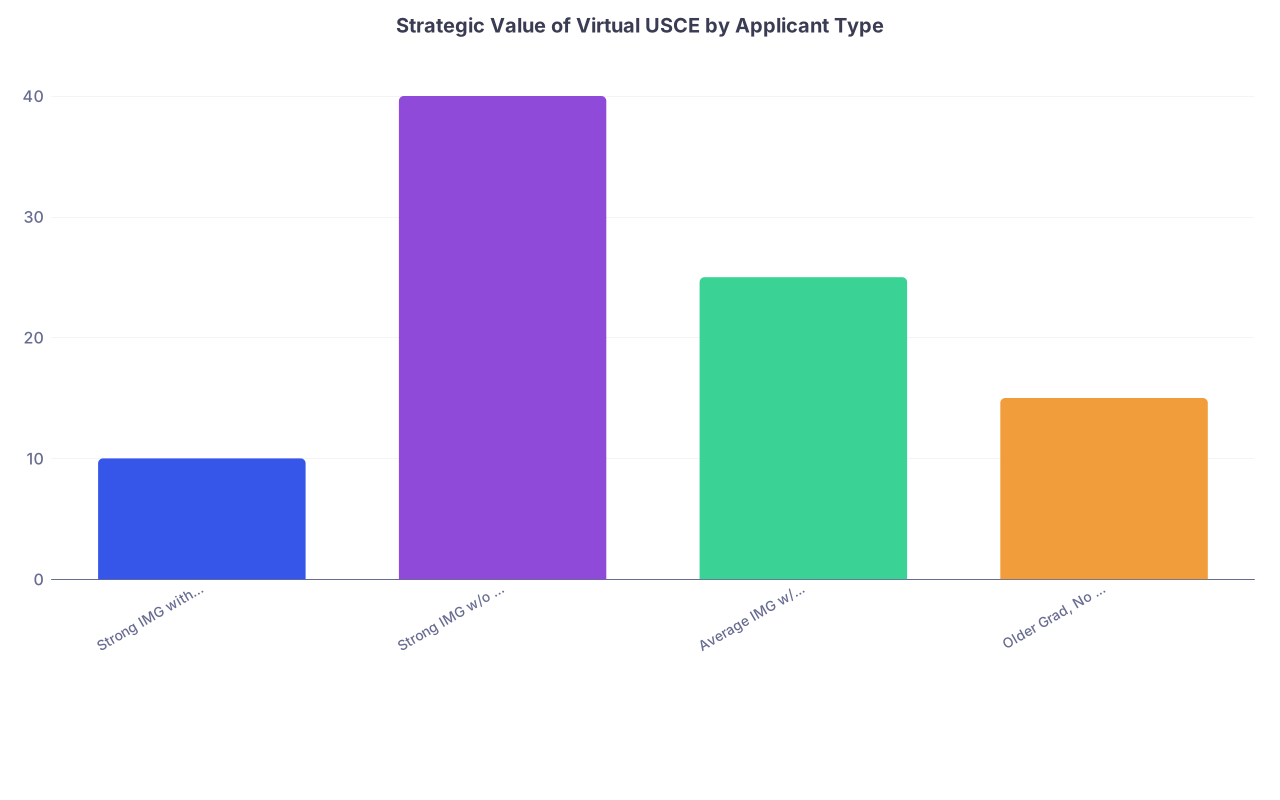
| Category | Value |
|---|---|
| Strong IMG with USCE | 10 |
| Strong IMG w/o USCE | 40 |
| Average IMG w/o USCE | 25 |
| Older Grad, No USCE | 15 |
Interpretation (not exact percentages, but relative value):
Best return tends to be for the strong IMG with no prior USCE—but only if it’s a bridge to in-person rotations, not the end goal.
Here’s how I’d call it:
Likely a Poor Use of Money
- You already have:
- 2–3 good in‑person U.S. rotations
- Strong U.S. letters from those rotations
- Or: you’re very financially constrained and every dollar counts
In those cases, put money into:
- More applications
- Better exam prep (especially Step 2 CK if not done)
- Travel for in-person rotations/interviews
Possibly Reasonable
- You cannot immediately get an in‑person U.S. rotation (visa, timing, etc.)
- You’re 1–2 years from applying
- You’ll use virtual time to:
- Learn U.S. documentation style
- Practice presenting
- Build comfort with U.S. guidelines
But you still plan to do real U.S. rotations later. Virtual is then a warm‑up, not your main event.
You’re Being Scammed If…
- Someone tells you:
- “Virtual USCE is now accepted instead of in-person rotations.”
- “Programs view this the same as hands-on electives.”
- “We guarantee letters that will significantly boost your chances.”
They’re selling hope, not reality.
How to Judge If a Virtual Program Is Even Worth Considering
If you’re still thinking about a virtual option, here’s how to separate mildly useful from completely cosmetic:
| Aspect | Green Flag | Red Flag |
|---|---|---|
| Group Size | ≤ 10–15 students per attending | 40–100 per cohort |
| Direct Interaction | You present cases, get critiqued | Mostly lectures, cameras off |
| Patient Exposure | Observe real telehealth with debrief | 100% pre-written cases |
| Assessment | Structured feedback on your performance | “Certificate of completion” only |
| Letters | Only for standout students, clearly stated | Promises LOR for everyone |
If a program can’t answer basic questions about who teaches, how many students per group, and how feedback is given, that’s your answer: it’s a certificate factory.
Where Virtual Does Make Objective Sense: The Viability Factor
There is one area where virtual experiences can be strategically smart: keeping yourself “recent”.
Some programs have rules like:
- “Graduation within last 5 years”
- “Clinical experience within last 1–2 years”
If you:
- Graduated >5 years ago
- Have been out of clinical work for a while
- Can’t immediately re-enter clinical medicine in your home country or the U.S.
Then a structured virtual program showing recent involvement with medicine is better than a complete blank.
But do not fool yourself:
A PD would still choose:
- A 2022 grad with in‑person rotations over
- A 2015 grad with only virtual experience
Almost every time.
Virtual experiences might help you dodge being instantly dismissed as “totally inactive,” but they don’t erase the time gap.
The One Smart Way to Use Virtual USCE: As Prep, Not Proof
If you want to use virtual experiences intelligently, think of them like this:
- Not: “This will prove to programs I can handle U.S. medicine.”
- Instead: “This will prepare me so when I finally get into a real U.S. hospital, I don’t waste that opportunity looking lost.”
That means you should:
- Practice U.S.-style presentations aggressively
- Learn common documentation language (assessment/plan by problem)
- Ask for brutal feedback on your clinical reasoning
- Take what you learn and apply it in your home rotations or local clinical work
So when you do get an in-person elective, sub‑I, or observership, you’re already functioning at a higher level than the average IMG, and your letters show it.
Quick Reality Check: If You Can Only Do One
You have limited money, limited time, and you’re staring at two options:
- 4‑week in-person observership (even if unpaid, even if basic)
- 4‑week virtual USCE with lots of Zoom time and a shiny certificate
Choose the in-person option. Every time.
Even if:
- It’s not at a famous institution
- It’s in community internal medicine or family medicine
- It doesn’t promise you a letter in advance
You learn the system. You see real patients. You interact with real staff. Someone can actually see you work and judge your potential as a resident.
Virtual can’t touch that.

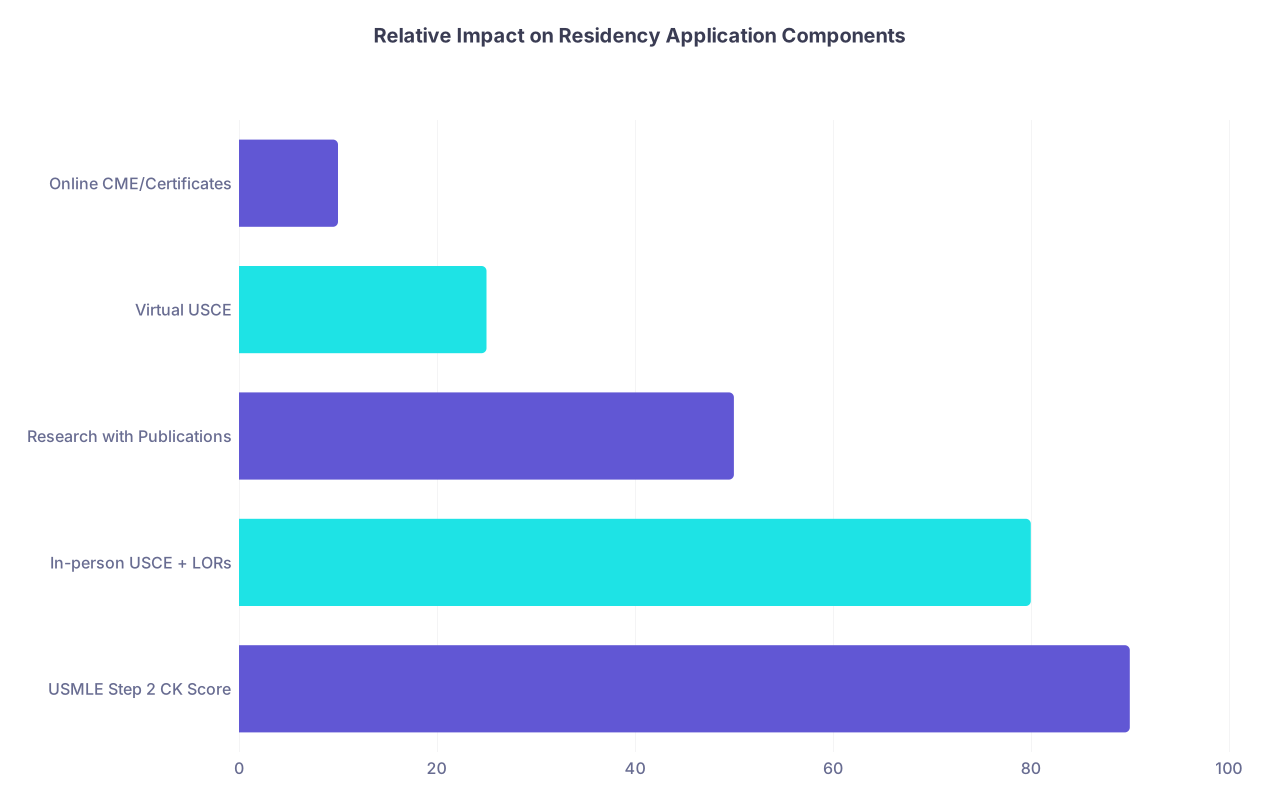
| Category | Value |
|---|---|
| USMLE Step 2 CK Score | 90 |
| In-person USCE + LORs | 80 |
| Research with Publications | 50 |
| Virtual USCE | 25 |
| Online CME/Certificates | 10 |

| Step | Description |
|---|---|
| Step 1 | Start: Considering vUSCE |
| Step 2 | Prioritize saving & planning for in-person rotations |
| Step 3 | Optional: vUSCE as prep only |
| Step 4 | Skip vUSCE, focus on exams & applications |
| Step 5 | Use vUSCE to stay clinically active & learn system |
| Step 6 | Plan long-term for eventual in-person exposure |
| Step 7 | Can you afford in-person USCE in next 12 months? |
| Step 8 | Extra budget & time? |


The Bottom Line
Three things to remember:
Virtual USCE is not equal to in-person USCE. Programs know the difference. PDs value real, in-person work with patients and teams far more than Zoom‑based experiences.
Virtual can be a useful supplement, not a foundation. It can orient you to U.S. style, give you interview talking points, and keep you somewhat “active,” but it rarely produces high-impact letters or changes your competitiveness dramatically.
If you have to choose, always prioritize in-person rotations and exam performance. Put your money and effort where program directors actually care: scores, real U.S. clinical work, and strong, specific letters from physicians who’ve seen you in action—not just on a screen.