
What if it’s November, your inbox is dead silent, and every forum post is screaming that “most IMGs already have multiple interviews by now”?
Yeah. That nightmare.
Let’s talk about that exact scenario, because a lot of people quietly end up there and then feel like they’re the only ones. You’re not.
First: Is November Too Late For IMGs?
Short answer: it’s late. It’s not automatically over.
Programs do send the majority of interview invites in October and early November. Especially the IMG‑friendly ones that get flooded with applications. I’m not going to sugarcoat that.
But “late” and “dead” are not the same thing.
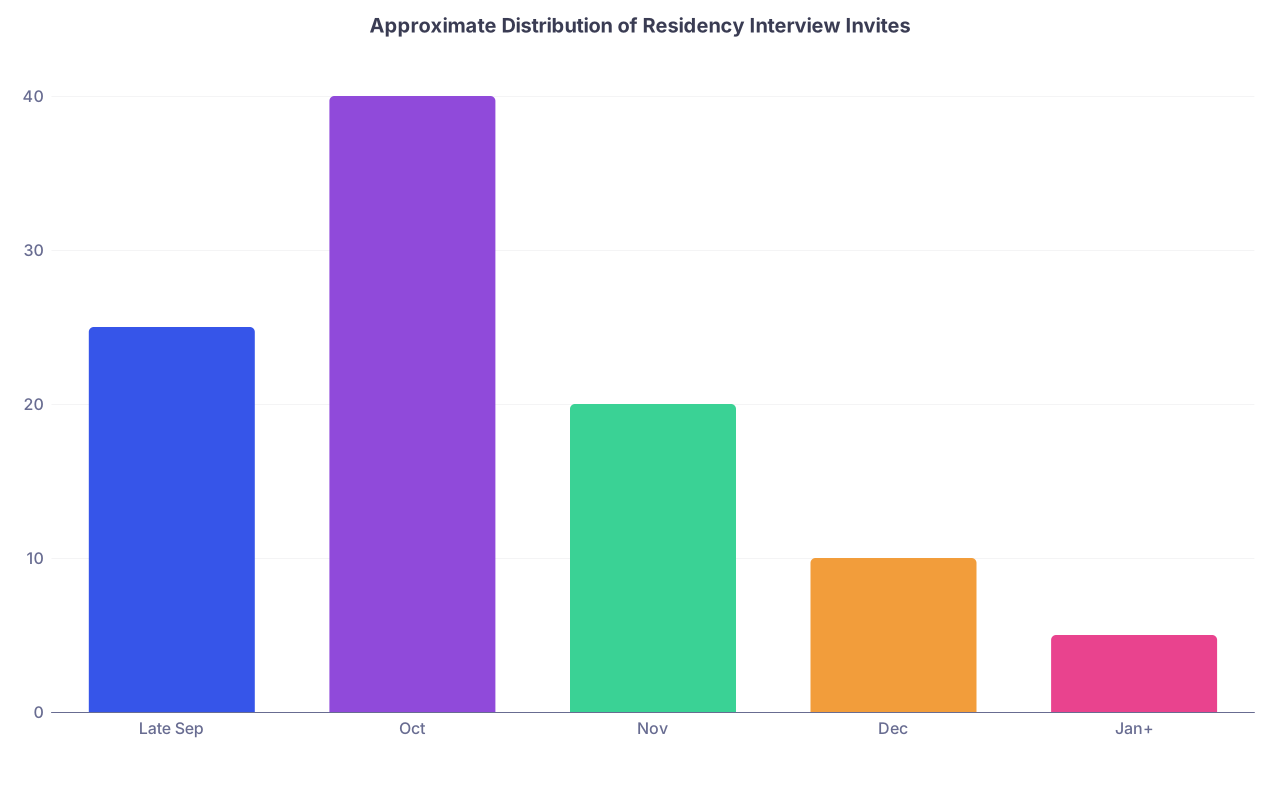
Here’s roughly how invites tend to shake out (obviously varies by specialty and year, but the pattern’s similar):
| Category | Value |
|---|---|
| Late Sep | 25 |
| Oct | 40 |
| Nov | 20 |
| Dec | 10 |
| Jan+ | 5 |
What that actually means for you as an IMG:
- By November, yes, a big chunk of spots are already offered.
- But there are still new invites trickling out.
- Cancellations and no‑shows later in the season can open spots unexpectedly.
- Some community and smaller programs move slower, especially if they aren’t drowning in applicants.
The problem is: when your inbox is empty, your brain only hears one message: “You’re done. You’re not matching. It’s over.”
It’s not over yet. But it is the point where you have to stop just refreshing your email and start actively changing the trajectory of this season.
Before You Panic: Brutally Honest Self‑Check
If you were sitting in front of me right now, I’d ask you a few questions, and I wouldn’t let you dodge them with “maybe” answers.
Because the whole “I haven’t gotten interviews yet” thing usually comes down to a few buckets.
| Factor | Roughly Competitive For Many IM Programs? |
|---|---|
| USMLE Step 1 | Pass (first attempt) |
| USMLE Step 2 CK | ≥ 220–230+ |
| YOG (Year of Grad) | ≤ 5–7 years in many places |
| US Clinical Exp. | ≥ 2–3 months hands-on |
| Visa | Clear need + applied to visa-sponsoring |
If you’re missing one or more of these, it doesn’t mean you’re doomed. It does mean:
- You need to be more strategic than the average US grad.
- You can’t just “wait and hope” like people with 10 interviews by October.
Ask yourself:
- Did I mostly apply to “nice-sounding” cities and big‑name hospitals or actually IMG‑heavy community programs?
- Did I apply broadly enough? I mean really broadly, not “I applied to 60 programs” broadly.
- Did I filter programs by visa support, IMGs in the current residents, and Step requirements—or did I just rely on word of mouth and a random “IMG‑friendly list” from 2018?
If you’re starting to realize your strategy was… optimistic, join the club. A lot of IMGs mis‑target their first cycle.
The question now is: what do you do in November?
What You Can Still Do This Season (Even in November)
You can’t rewind time. You can’t remake your YOG. You can’t transform a 211 into a 245 overnight.
But there are still levers you can pull.
1. Fix your ERAS documents as much as possible
People underestimate how much a mediocre Personal Statement and generic Experiences hurt.
No, you can’t re‑submit everything from scratch. But you can:
- Upload a stronger Personal Statement (you’re allowed to update it).
- Add or update experiences if something is missing or badly written.
- Fix obvious red flags like weird gaps, sloppy grammar, or confusing descriptions.
If your current PS sounds like any of this:
- “I have always wanted to be a doctor since childhood…”
- “Medicine is my passion…”
- “I am a hardworking and dedicated individual…”
That stuff gets skimmed and forgotten. I’ve seen IMGs go from 0 to a couple interviews after November just by tightening their story and getting rid of the generic fluff.
No guarantee. But if your application reads like 10,000 others, you’re not helping yourself.
2. Smart, targeted, non‑spammy emails to programs
Yes, I know: everyone on Reddit is divided on this. “Never email programs!” vs “Cold emails got me 5 interviews.”
Reality: Most cold emails get ignored. But a thoughtful email, targeted to the right programs, can occasionally crack a door open.
NOT this:
“Dear Program Director, I am very interested in your program. Please consider my application. I would be honored to train there.”
That’s basically spam.
Instead, something like:
- Short.
- Respectful.
- Specific about why their program.
- Shows you actually know something about them.
- Mentions any local ties, visa, or unique fit.
And you only send to:
- Programs that are historically IMG‑friendly.
- Places where your stats aren’t wildly below their norms.
- Programs where your story actually makes some sense.
Will this magically turn into 10 interviews? No. But even 1–2 interviews can literally mean the difference between matching and not matching.
The Ugly Question: What If I Get Zero Interviews All Season?
This is the part no one wants to say out loud, but I know it’s eating at you:
“What if this year is just… gone?”
I’ve seen that happen. No interviews. Or one interview that turns into a rejection. You spend thousands of dollars and still end up unmatched.
If that happens, it does not mean you’re unfixable. It means something in your overall package + strategy was not competitive enough for the places you applied.
This is where you need to stop thinking like, “I’ll just apply again and get luckier next time.”
If you reapply with the same CV and the same approach, you’re basically paying another few thousand to rerun the same failed experiment.
You need a post‑mortem. A brutal one.
Ask yourself:
- Are my scores below what most programs will tolerate for IMGs? (e.g., CK < 220 for IM is a real problem in many places).
- Is my YOG getting old? (Beyond 5–7 years is tough unless you’ve got recent, strong US clinical work).
- Do I actually have hands‑on USCE with strong letters, or only “observerships” in random clinics?
- Does my PS or experiences have unexplained gaps, weirdness, or vibes of “I don’t know what I’m doing”?
- Did I apply to enough programs? 50 for an IMG in a competitive year is not broad.
If you’re realizing multiple things are weak, the next cycle has to be strategic, not just repetitive.
If This Year Fizzles: How to Not Waste the Next 12 Months
This is where it gets heavy. Because you start wondering:
“Can I actually fix this, or am I just throwing my life away chasing something that won’t happen?”
I’ve seen IMGs match on their third try. I’ve also seen IMGs quietly pivot to other careers because they kept reapplying without real changes and burned out.
The difference is what they did in those “gap” months.
1. Get real US hands‑on clinical experience (if you don’t have it)
Not random observerships where you stand in the corner. Programs can tell.
Try to get:
- Sub‑internships / externships where you write notes, present patients.
- Community hospital rotations with real patient contact.
- Anything that will give you strong, specific LORs from US faculty in your chosen specialty.
Not just “She is a great hard worker.” Real letters talk about:
- How you think.
- How you handle pressure.
- How you communicate with patients and team.
- That you actually function in the US system, not just shadow.
2. Strengthen something concrete, not vague
You can’t magically fix everything. But you can make one or two pillars clearly stronger:
- CK score improvement (if you haven’t taken it yet, or you have a repeat coming).
- US research with actual output (poster, abstract, anything in your name).
- A consistent story: for example, if you’re an older grad, showing that you’ve been doing medicine, not just waiting and hoping.
| Category | Value |
|---|---|
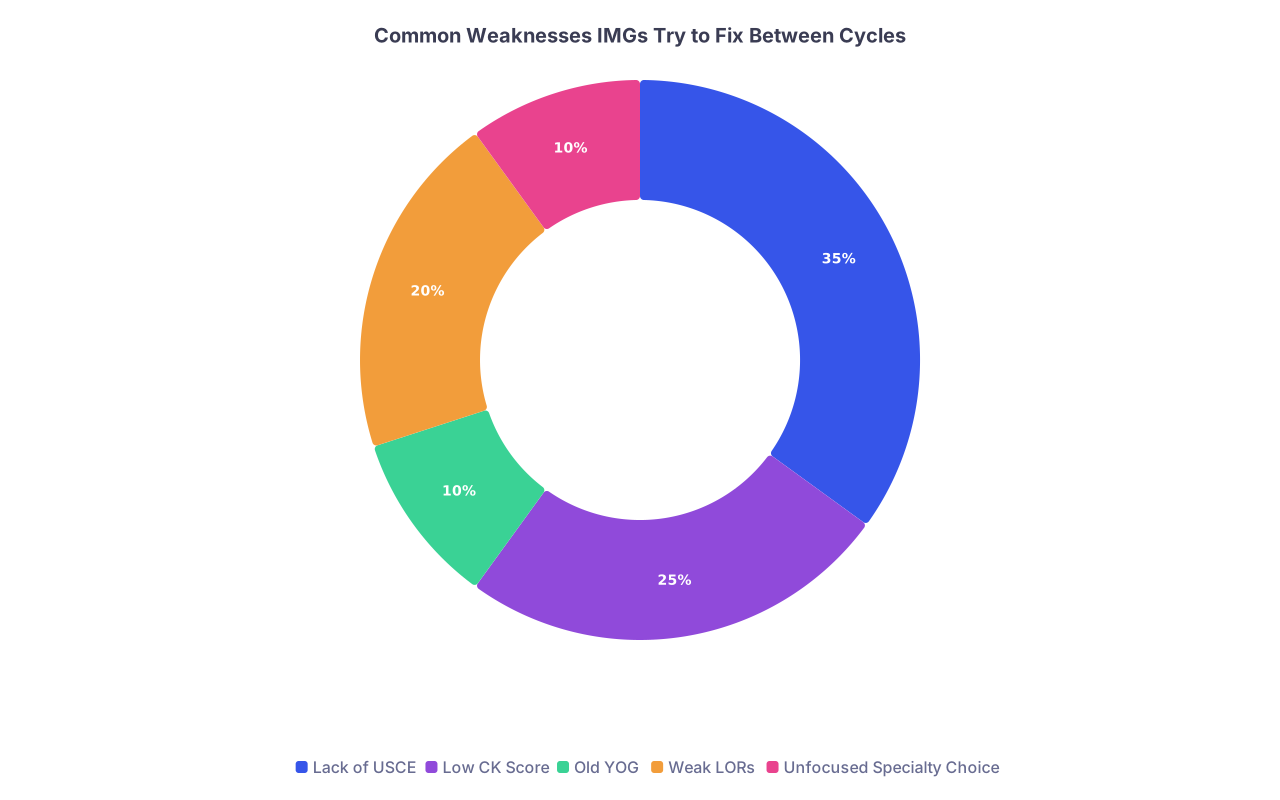
| Lack of USCE | 35 |
| Low CK Score | 25 |
| Old YOG | 10 |
| Weak LORs | 20 |
| Unfocused Specialty Choice | 10 |
You don’t have to fix everything perfectly. You just have to be clearly stronger than the last time you applied.
3. Consider specialty flexibility (even if it hurts)
This is the part where people get defensive.
If you are dead‑set on matching into an insanely competitive area as an IMG—with an average application—you’re stacking the deck against yourself.
Sometimes the path is:
- Try your dream specialty once with a realistic backup.
- If you get completely shut out, reassess:
- Could you be happy in IM, FM, Psych, Peds, or Path?
- Would you rather match in something or reapply forever for that one specialty?
Only you can answer that. But ignoring that question usually leads to years of silent, bitter frustration.
The Emotional Side No One Talks About
You’re not just dealing with numbers and strategies. You’re dealing with:
- Parents asking, “Any news?” every week.
- Friends posting “Matched!!” while you pretend you’re happy for them and your stomach sinks.
- The shame spiral: “Maybe I’m just not good enough. Maybe this was a mistake.”
I’ve watched IMGs completely lose themselves in this process. Your self‑worth gets tied to interview invites like they’re verdicts from some higher power.
They aren’t. They’re just signals from an overloaded, often arbitrary system that filters people by checkboxes because they have 5,000+ applications to 12 spots.
You’re allowed to be angry about that. You’re allowed to be exhausted. You’re allowed to question everything.
But do not let one match cycle (or even two) erase the fact that:
- You finished medical school.
- You survived exams in a language and system not built for you.
- You’re still here, trying to figure out the next move, instead of pretending it’s fine.
That already puts you ahead of a lot of people who quietly give up without even admitting it to themselves.
How to Handle November if You’re Still at Zero
Let me lay it out plainly.
If it’s November and you have no IMG‑friendly interviews:
- Stop doom scrolling and actually review your ERAS the way a PD might. Ruthlessly.
- Update what you can update: PS, experiences, minor errors.
- Make a realistic shortlist of programs where you might fit and send careful, non‑spammy emails.
- Accept that this season might not turn around—and start planning as if you will need a stronger application next cycle.
- Protect your mental health. Seriously. Sleep. Move your body. Talk to someone who actually gets it, not just people telling you “It’ll work out, don’t worry.”
Because there’s a huge difference between:
- Sitting there in limbo, letting anxiety chew through you until March.
vs - Using November–March to quietly build the version of you that does get interviews next time.
Future‑you will be brutal with current‑you. “Why didn’t you start earlier? Why did you freeze for 4 months?” Try not to give that future version so much ammo.
FAQ: Exactly 5 Questions
1. Is it normal for an IMG to have zero interviews by November?
It happens every year. Especially to:
- Older grads
- People with lower Step scores
- Those without USCE
- Applicants who applied too narrowly or to mostly non‑IMG‑friendly programs
“Normal” doesn’t mean “good.” It means you’re not uniquely terrible; you’re in a common, high‑risk group. It’s a sign you must change your strategy, not that you’re defective.
2. Should I email programs if I haven’t heard anything by November?
Yes—but carefully and selectively. Don’t mass‑email 150 programs with a copy‑paste message. Pick:
- Programs with IMGs already in their residents
- Places where your stats are at least somewhat in range
- Hospitals where your USCE, visa needs, or personal story make specific sense
A well‑crafted, targeted email might get you a look. It might also get ignored. But if you don’t overdo it or sound desperate, you’re not hurting anything.
3. If I end the season with zero interviews, should I apply again next year?
Only if you’re going to be meaningfully stronger next year. That means:
- More/better USCE
- Stronger letters
- Better scores (if that’s still an option)
- Clearer, more convincing story for your chosen specialty
If your application will look almost identical next cycle, you’re probably paying a lot of money to repeat the same outcome. That’s where you have to ask hard questions about alternatives.
4. Does an old YOG automatically kill my chances?
Not automatically, but it makes things harder, especially beyond 5–7 years from graduation. Some programs hard‑filter older grads. Others will still look at you if:
- You’ve stayed clinically active
- You have strong recent USCE
- Your story explains your timeline without sounding like you’ve just been drifting
If you’re an older grad with no recent clinical work, that’s a big problem—and that’s exactly what you should focus on fixing.
5. How do I mentally survive watching everyone else get interviews?
Limit exposure to toxic comparison. That means:
- Mute or leave some of the hyper‑competitive WhatsApp/Telegram/Discord/Reddit groups
- Set specific times to check your email instead of refreshing nonstop
- Build one small routine that’s yours—daily walk, gym, journaling, anything that isn’t “waiting”
And remind yourself: right now, your actual job isn’t “get an interview.” It’s “handle this uncertainty in a way that your future self isn’t ashamed of.”
Because years from now, you won’t remember every date you didn’t get an invite. You’ll remember how you treated yourself when the silence felt crushing.