
The idea that US programs won’t take you seriously without US clinical experience is overstated, skewed, and honestly a little lazy.
Let me be blunt: yes, having no USCE is a problem. You’re not imagining that. But it’s not the automatic death sentence your internal monologue keeps turning it into at 2 a.m.
You don’t need to hear sugar‑coated nonsense. You’re probably thinking things like:
- “They’ll just see ‘no USCE’ and throw my app in the trash.”
- “My home‑country internship doesn’t mean anything to them.”
- “I’m too late. Everyone else already has observerships and US letters.”
- “Maybe I should just give up this cycle and reapply later.”
Let’s walk through what’s actually going on in program directors’ heads, what parts of your fear are valid, and what parts are straight‑up catastrophizing.
Because “Home‑country training but no USCE” is not one single situation. It can look very different depending on the rest of your profile.
What “No USCE” Really Signals To Programs
First, reality check. Programs do care about USCE, especially for IMGs. But not all of them care in the same way, and not all “USCE gaps” are equal.
Here’s what most program directors are quietly thinking when they see no USCE:
- “Will this person be safe and functional in a US hospital system?”
- “Do they understand the culture here—documentation, EMR, liability, hierarchy?”
- “Can anyone who works with me vouch for them in my context?”
- “Are they serious about the US, or is this a backup fantasy plan?”
They are not usually thinking:
- “No USCE = instant reject regardless of anything else.”
What you have to do is answer those four questions without having USCE on your CV.
If you’re imagining some PD sitting there cackling, saying “No USCE? Rejected,” that’s your anxiety talking. What they’re actually doing is scanning for reasons to feel safe about interviewing you.
How Much Does No USCE Hurt You… Really?
I’m going to say the part you’re afraid of first.
For some programs, especially very competitive ones or those flooded with strong US‑IMGs, no USCE will be an auto‑screen reject. You will never even know which ones. They just vanish into the ether.
But that’s not the whole market.
There are plenty of community programs, smaller university‑affiliated places, and some specialties where they’re more flexible if you show:
- Strong exam scores
- Solid, recent clinical work in your home country
- Professionalism and communication (through your personal statement and interviews)
- Clear, realistic commitment to the US system
| Profile Type | Impact of No USCE | Realistic Outcome |
|---|---|---|
| High scores, recent grad | Moderate | Many interviews if applied broadly |
| High scores, older grad | Moderate–High | Fewer interviews, still possible |
| Average scores, recent grad | High | Needs very broad application |
| Low scores, any YOG | Severe | Very few US options |
| Strong home residency experience | Moderate | Better for IM/FM/psych |
So, where are you likely landing?
If you’re, say:
- An IMG with 235–245 Step 2 (or equivalent)
- Finished med school within the last 3–5 years
- Completed internship or more in your home country
- But zero USCE
Then no, your application is not dead. You’re just moving from “comfortable” into “you must be strategic and realistic.”
When Home‑Country Training Actually Helps You
Here’s the part almost no one explains properly: a lot of PDs value real, hands‑on responsibility more than a passive US observership.
I’ve heard an APD say this almost verbatim:
“I’d rather have someone who’s run a ward in Pakistan than someone who just shadowed in New Jersey for 2 months.”
Your home‑country experience helps you if you present it right.
Strong signals from home‑country training:
- You’ve actually written orders, admitted patients, managed nights.
- You’ve worked in high‑volume or resource‑limited settings.
- You’ve supervised junior trainees or nurses.
- You’ve handled emergencies, codes, or rapid decisions.
Weak signals (that you have to fix in how you describe them):
- Vague descriptions like “worked in wards and OPD.”
- No clear responsibilities.
- Nothing that screams “I can manage autonomy.”
You want to make your home‑country work sound like what it really is: actual doctoring.
Not: “I worked in the medicine department.”
Better:
“I was responsible for 15–20 inpatients per day, wrote daily notes, adjusted medications, and presented at morning rounds. I independently managed diabetic ketoacidosis, decompensated heart failure, and sepsis with attending oversight.”
One sounds like you barely existed. The other sounds like a functioning intern.
“But Without US Letters, Will Anyone Trust Me?”
Let’s be honest: this is the part that stings the most. No USCE also usually means no US letters. That’s where the spiral starts:
“No USCE → no US letters → no credibility → no interviews → career over.”
Calm down. Deep breath.
Is it harder? Yes. Impossible? No.
Here’s what programs will look at instead when you don’t have US letters:
Strength and specificity of your home‑country letters
Generic “hard‑working, punctual” letters are basically wallpaper.
But a letter that says,
“She was one of the top 5% of interns I’ve supervised in 20 years. She routinely managed 25 patients independently, stayed late without being asked, and taught junior students”
—that gets attention.Exam scores and attempts
High Step 2 (and ideally no failures) will carry serious weight if you lack USCE.Evidence you function in English professionally
This matters far more than you think. Research, presentations, conferences, teaching in English—these all help.Your personal statement
Not the cheesy “I always wanted to help people” stuff.
They want to see: do you understand what residency is actually like? Do you sound grounded? Or like somebody who has no idea and just romanticizes Grey’s Anatomy?
Is a US letter from a strong US attending ideal? Yes. But a vivid, detailed home‑country letter that shows responsibility and specific clinical stories is still far from useless.
Specialties: Where No USCE Kills You vs Where You Still Have a Shot
You’re probably already torturing yourself by reading forum posts where everyone sounds more accomplished than you. Let’s cut through the noise.
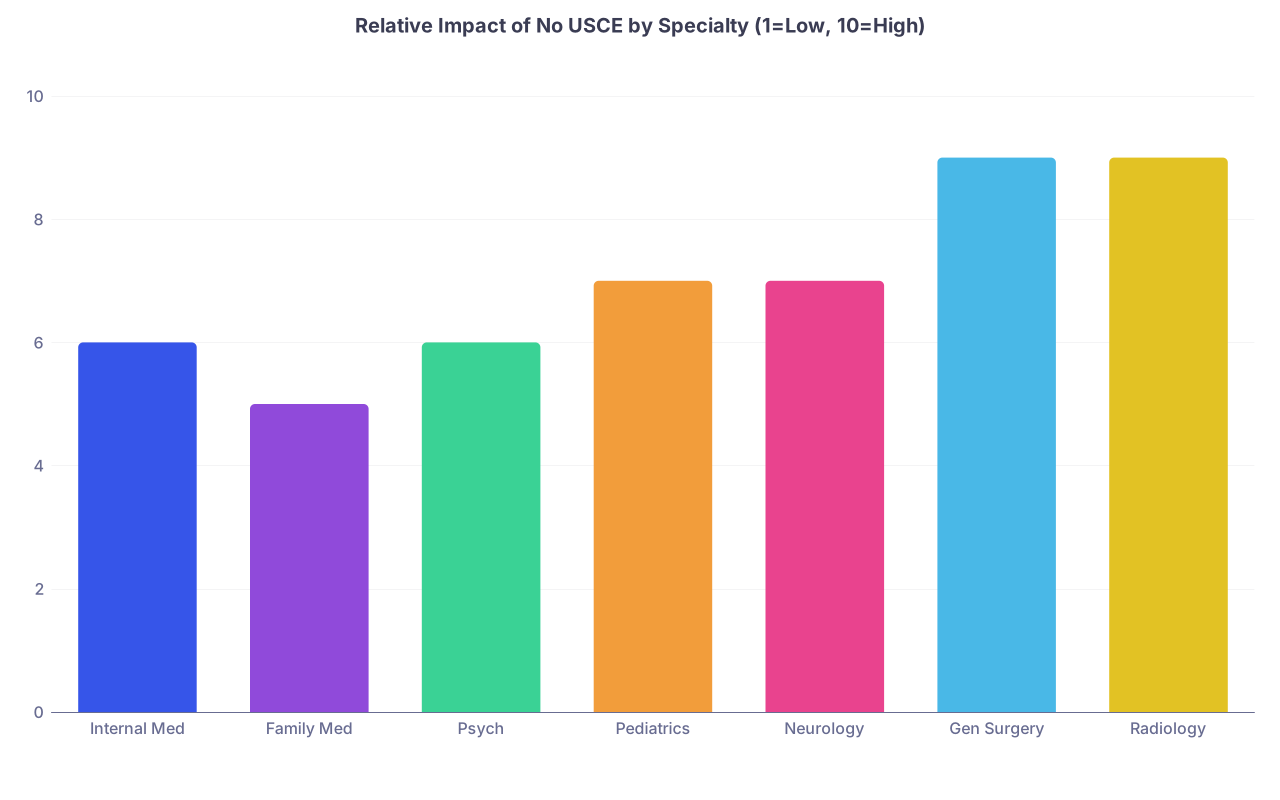
Here’s how no USCE typically plays across major specialties:
| Category | Value |
|---|---|
| Internal Med | 6 |
| Family Med | 5 |
| Psych | 6 |
| Pediatrics | 7 |
| Neurology | 7 |
| Gen Surgery | 9 |
| Radiology | 9 |
Broadly:
More forgiving (if everything else is decent):
Internal medicine (especially community programs), family medicine, some psych programs.Moderately punishing:
Pediatrics, neurology – they often want at least something US‑based but occasionally bend for strong profiles.Brutal without USCE:
General surgery, radiology, derm, ortho, ophtho. If you’re aiming here with zero USCE and no US connections, your chances are extremely slim.
If you have no USCE and you’re trying to match into general surgery at a strong university program as an IMG? Your anxiety is not overreacting. That’s nearly impossible.
But if you’re aiming for IM/FM/psych and willing to apply very broadly and smartly? Yes, plenty of people in your exact situation have matched.
How To Be Taken Seriously Without USCE
Let’s get practical. If you can’t magically create past USCE, you have to outperform on everything else and show you’re not a risky unknown.
Here’s how:
1. Make your home‑country training sound like real residency
Don’t undersell it.
Detail:
- Daily census
- Types of patients
- Your decision‑making role
- Night duties, codes, consults
- Any teaching or leadership
This goes into:
- ERAS experiences (detailed, not vague)
- Personal statement (1–2 short, sharp clinical anecdotes)
- Letters of recommendation (coach your writers if you can)
2. Crush Step 2 (and ideally have it back by application time)
If you’re sitting on an average or borderline score and no USCE, you start drifting into “why should they take this risk?” territory.
I’ve watched PDs skim an IMG app like this: No USCE → scroll to scores → if they’re not at least solid → move on.
It’s ruthless, but that’s reality.
3. Show some connection to the US system—even if not full USCE
No, it’s not as good as inpatient clerkships. But weaker signals are still better than nothing:
- Online US‑based clinical courses with certificates
- Virtual electives (yes, still a bit cringe, but better than zero signal)
- Participation in US research projects
- Presentations/posters at US conferences
- CME from US organizations (ACC, AHA, APA, etc.)
Individually, none of these “replaces” USCE. But together, they whisper:
“I’m not completely foreign to your world.”
4. Apply like you know your situation, not like you’re in denial
This is where a lot of anxious applicants shoot themselves in the foot—they under‑apply while already having red flags.
With no USCE, you can’t be cute and only apply to 60 programs in IM and assume it’ll work out.
You’re in the:
- 120–150+ programs for IM
- 100+ for FM
- Psych maybe 100+ depending on your scores and YOG
…zone, if you’re serious.
Yeah, it’s expensive. But so is going through multiple failed cycles.
Common Mental Spirals (And What’s Actually True)
You: “Programs won’t take my home‑country internship seriously.”
Reality: Some won’t. Others absolutely will—if you spell out what you did.
You: “Everyone else has USCE; I’m the only one without it.”
Reality: Tons of IMGs, especially from countries with long internships or residency, apply with little or no USCE. You’re not a unicorn here.
You: “If I don’t get USCE before this cycle, I should skip applying.”
Reality: If you’re otherwise decently competitive, skipping an entire year just to chase observerships may cost you more (age, YOG gap) than it helps.
You: “No USCE = they’ll assume I can’t handle EMR or documentation.”
Reality: Yes, some will. But that’s where you lean on your experience with different systems, rapid learning, and any exposure to structured documentation.
A Quick Visual: What Programs Need To See From You

| Step | Description |
|---|---|
| Step 1 | No USCE |
| Step 2 | High Risk: Strengthen Exams |
| Step 3 | High Risk: Get Current Clinical Work |
| Step 4 | Rewrite Experiences & Letters |
| Step 5 | Viable Applicant |
| Step 6 | Increase Program List |
| Step 7 | Strong Step Scores? |
| Step 8 | Recent Clinical Work? |
| Step 9 | Clear Home-Country Responsibilities? |
| Step 10 | Broad, Realistic Application? |
You’re trying to move yourself from “mysterious unknown entity with no USCE” to “clearly competent, safe, and motivated doctor who just happens to have trained elsewhere.”
That’s doable.
FAQs (The Stuff Keeping You Up At Night)
1. Is it even worth applying this cycle if I have zero USCE?
If you have:
- Decent Step 2 score
- No major fails
- Recent clinical work in your home country
…then yes, it’s still worth applying, if you apply very broadly and to realistic specialties (IM/FM/psych, mainly). If your scores are weak and you have no USCE and you graduated a long time ago, the ROI drops hard—but that’s about your entire profile, not just USCE.
2. Should I delay graduation or my application to get observerships first?
Delaying an entire year just for observerships is a trade‑off. You’ll be older and your YOG will be worse, but you might gain one or two letters and some US exposure. If you’re a very recent grad with good scores, I’d usually tell you to apply now rather than lose a cycle purely chasing observerships—unless you have a concrete, high‑yield USCE plan lined up.
3. Do virtual electives or online observerships actually matter?
They’re not going to blow anyone away. But in an application with nothing US‑related, they’re better than total zero. They can show effort, some understanding of US guidelines, and sometimes lead to a weak—but still US‑based—letter. Think of them as supportive evidence, not headline features.
4. Can strong home‑country residency experience replace USCE?
Sometimes, yes. Especially for IM/FM/psych. I’ve seen applicants with 3–5 years of internal medicine residency back home, managing heavy services, match without formal USCE. But they usually paired that with strong scores, well‑written experience descriptions, and detailed letters that made it very clear they acted at a resident level.
5. Are my chances destroyed if forums say “USCE required”?
A lot of program websites and spreadsheets say “USCE required” in a very rigid way, but real‑life enforcement varies. Some stick to it strictly. Others make exceptions for exceptionally strong profiles. Don’t assume “required” always means “zero flexibility.” That said, don’t rely on exceptions as your main strategy. You’re playing odds here.
6. How many programs should I apply to if I have no USCE?
More than feels psychologically comfortable. If you’re aiming for IM or FM with no USCE but reasonable scores, I’d be thinking:
- 120–150+ for IM
- 100+ for FM
More if you have other red flags (older grad, lower scores, attempts). Under‑applying in your situation is one of the most common, painful mistakes I see.
Key points to walk away with:
- No USCE hurts, but it doesn’t automatically make you a joke to programs—if your home‑country training is strong and well‑described.
- You can’t fix the past, so your job now is to out‑perform on scores, clarity of experiences, and application strategy.
- You’re not the only one applying like this—and plenty of people in your exact position have matched by being realistic, detailed, and aggressive with their applications.