
It’s 1:30 a.m. Your friends from med school are already attendings or senior registrars. You’re on your phone, staring at program websites that say things like “we prefer applicants who graduated within the last 3–5 years.” You do the math. You’re at 7 years. Or 8. Or 10.
Your brain spins:
“Did I miss my chance?”
“Are they just being polite when they say ‘we consider all applicants’?”
“Am I going to waste money on ERAS just to be auto-filtered out?”
Let me be blunt: this is a hard spot. You’re not imagining it. Old graduation date as an IMG is a real obstacle.
But “obstacle” is different from “game over.”
I’ve seen people 8, 10, even 12 years out match. Rare? Yes. Impossible? No. And the difference between those who match and those who don’t is almost never luck. It’s structure and strategy — because when you’re >7 years out, you don’t have the luxury of a sloppy application.
Let’s walk through this like adults, not like Instagram “you got this!!” nonsense.
How Bad Is It Really When You’re 7+ Years Out?
First, the ugly part. You need to actually see the battlefield you’re walking into.
Most US residency programs quietly sort applicants by a few harsh filters:
- USMLE/COMLEX scores (or pass/fail + Step 2 cutoffs)
- Visa status
- Year of graduation (YOG)
- US clinical experience
- Red flags (fails, gaps, professionalism issues)
A lot of them won’t say “we throw out everyone >5 years from graduation” on their website. Some do. Many don’t. But the filter is there in the back end.
You’ll see things like:
- “We prefer applicants within 5 years of graduation”
- “Graduated within the last 3 years is strongly preferred”
- “Recent clinical experience required”
“Preferred” is doing a lot of work there. In practice, it often means:
- If they get enough recent grads, you’re out.
- If you’re older, you must be unusually strong or unusually connected.
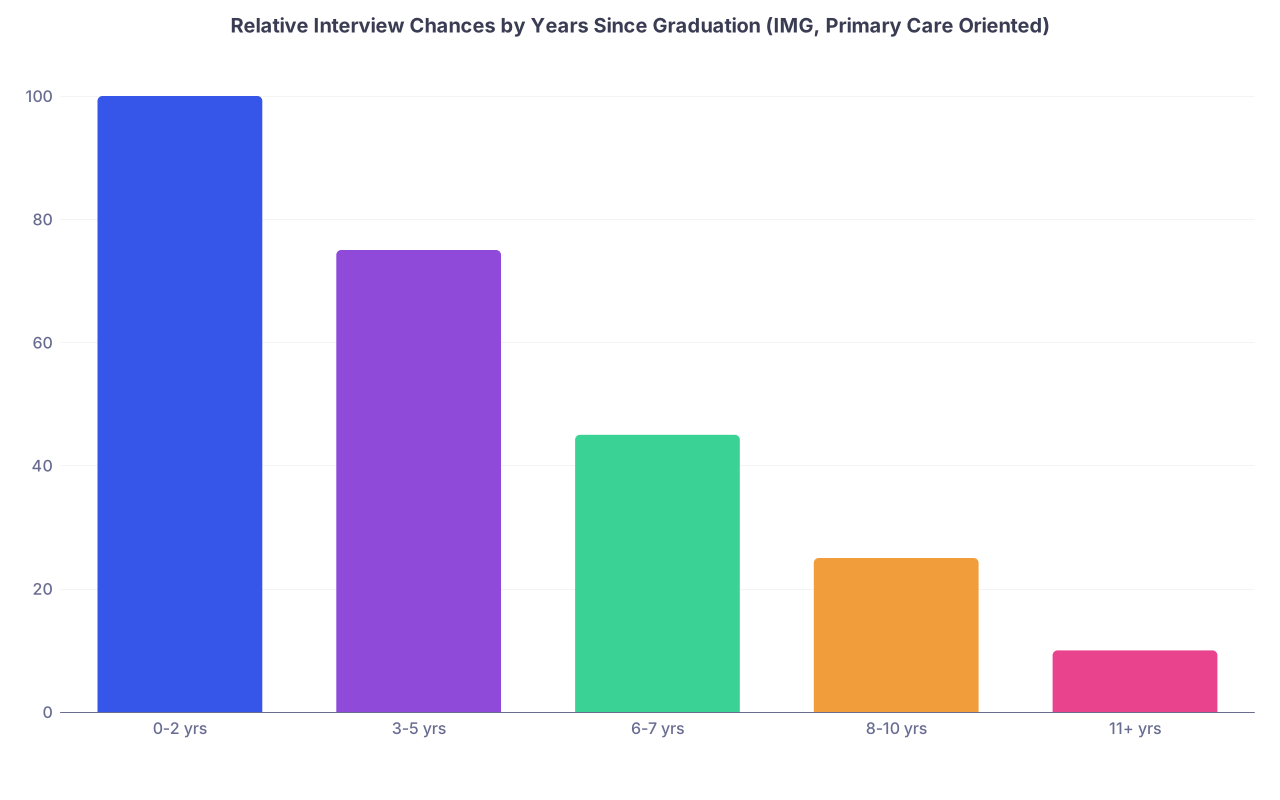
Here’s roughly how your YOG changes your odds in the typical internal medicine / FM / psych IMG scenario (assuming no major red flags):
| Category | Value |
|---|---|
| 0-2 yrs | 100 |
| 3-5 yrs | 75 |
| 6-7 yrs | 45 |
| 8-10 yrs | 25 |
| 11+ yrs | 10 |
No, these are not exact NRMP stats. This is what it feels like from watching cycles over and over.
You at 7+ years? You’re not at zero. But you’re in “I need a very deliberate strategy” territory.
The Things That Matter More When You’re an Older Grad
There’s a pattern to older grads who still match. They stop thinking like generic fresh grads and start thinking like someone who has to overcome a visible red flag that’s printed in bold on page one: YEAR OF GRADUATION: 2015 (or 2012 or whatever).
You’re basically answering one question in your entire application:
“Why should I believe this person is still clinically sharp and committed — today?”
These are your leverage points.
1. Recent, hands-on clinical experience
Not vague “observership 2019.” I mean something like:
- Recent US clinical experience (USCE) within the last 1–2 years
- Ideally hands-on: externships, sub-i’s (if allowed), pre-residency fellowships, hospitalist assistant, etc.
- If not US, then recent active clinical practice with strong letters
If your last meaningful clinical work was 4+ years ago and now you’re doing something totally unrelated, you’re in big trouble unless you fix that before you apply.
Programs will think:
- “Have they forgotten medicine?”
- “Is this person going to struggle to adjust to residency pace?”
- “Why now, after all these years?”
Your job is to give them clear, simple evidence that:
- You’re currently seeing patients (or very recently were)
- Someone in the last 1–2 years can vouch for your clinical ability and work ethic
- You didn’t just wake up after a 7-year nap and decide “Okay fine, I’ll try residency”
If you do nothing else after reading this, do this: plan how to get current clinical experience and letters for the upcoming cycle. I’m not kidding — this is that important.
2. Scores and exams: you don’t get average
If you’re an older grad and your exam story is:
- Average Step 1 (when it was scored)
- Average Step 2
- No Step 3
- No recent tests
…you’re going to look stale.
Programs love older grads who show they’re still sharp by:
- Having a solid Step 2 CK (or recent strong performance on any major exam)
- Passing Step 3 (huge bonus as an IMG, especially with visa needs)
- No recent exam failures
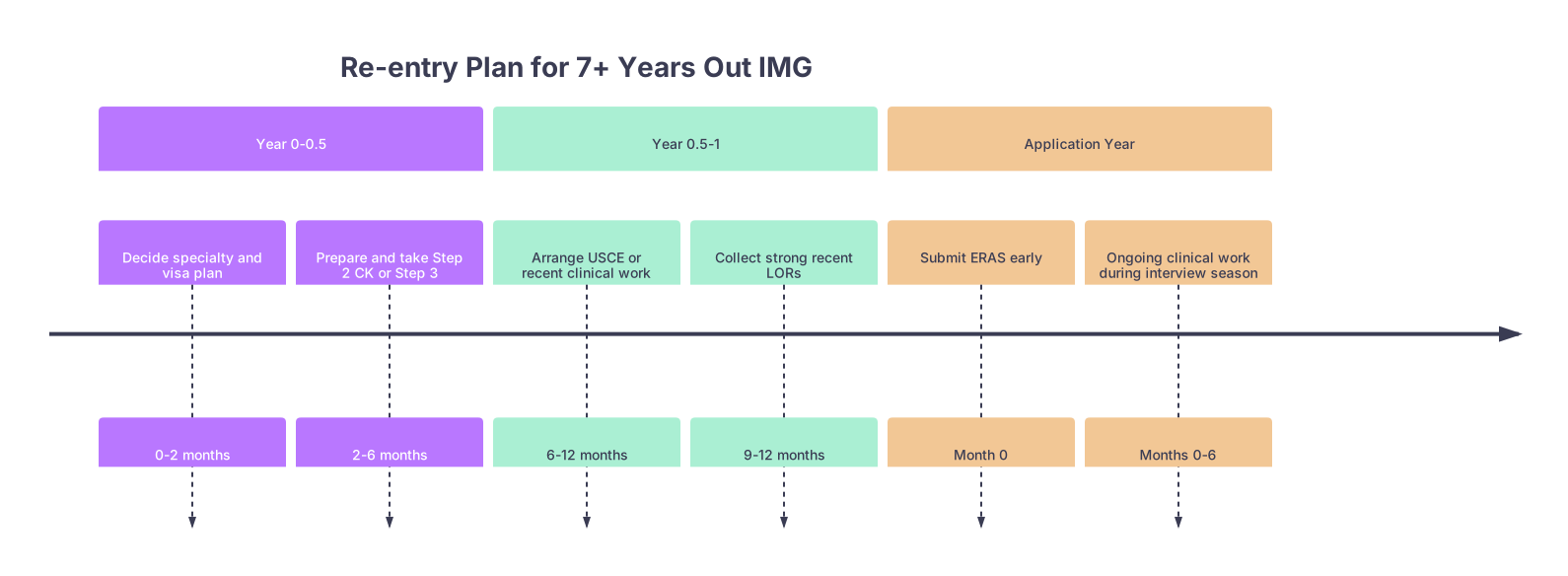
Your timeline might look like this:
| Period | Event |
|---|---|
| Year 0-0.5 - Decide specialty and visa plan | 0-2 months |
| Year 0-0.5 - Prepare and take Step 2 CK or Step 3 | 2-6 months |
| Year 0.5-1 - Arrange USCE or recent clinical work | 6-12 months |
| Year 0.5-1 - Collect strong recent LORs | 9-12 months |
| Application Year - Submit ERAS early | Month 0 |
| Application Year - Ongoing clinical work during interview season | Months 0-6 |
If you already took Step 3 and it’s fine: good. That’s a big plus, especially if you’re aiming at IM/FM/psych/neurology and need a visa.
If you haven’t: it’s not mandatory, but older IMG + no Step 3 + visa need = you’re making it extra hard for yourself.
3. The story behind your gap
The “what have you been doing for 7+ years?” part is scary, I know.
Programs see three main types of older grads:
- Actively clinical (in home country or elsewhere)
- Research-heavy / academic track
- Career detour / big non-clinical gaps
The first two can be reframed into a strength with the right narrative:
- “I’ve been practicing internal medicine in [country] for 6 years, managing high-volume inpatient and outpatient care…”
- “I’ve spent the last 5 years in clinical research at [US institution], focused on [field]…”
The third group — big non-clinical gaps — can still get in, but you need a clean, honest, coherent explanation that ends in: “And this is why now is the right time for residency, and here’s how I’ve kept my clinical skills relevant.”
You can’t just say “personal reasons” and hope they don’t notice that nothing in your CV involves medicine from 2017 to 2022. They notice.
Which Specialties Are Still Realistic for 7+ Years Out?
Hard truth time.
Competitive specialties (derm, plastics, ortho, ophtho, ENT, rad-onc, neurosurgery) are brutal even for fresh US grads. As an older IMG, they’re essentially fantasy unless you have:
- US PhD + insane research
- Massive connections
- Or you’re already deeply embedded in that department
For most older IMGs, the realistic targets are:
- Internal Medicine
- Family Medicine
- Psychiatry
- Pediatrics (harder than IM/FM but possible)
- Neurology (variable, but still do-able)
Here’s a rough “friendliness” snapshot, specifically for older IMGs, not all applicants:
| Specialty | Relative Chance* | Comments |
|---|---|---|
| Internal Med | Higher | Many community programs |
| Family Med | Higher | Often open to non-traditional |
| Psychiatry | Moderate | Growing but more selective |
| Pediatrics | Lower-Moderate | Some IMG-friendly programs |
| Neurology | Moderate | Depends heavily on program |
*“Relative Chance” = compared to other specialties, not “easy”
And within those, your best shot is usually:
- Community programs
- Smaller cities
- Hospitals with a history of taking older IMGs
- Programs less tied to big-name universities
You applying only to big-name university programs in major cities as a 9-year-out grad? That’s how you spend $3000 and get 0 interviews.
Visa + Old Grad: The Double Weight
If you need a visa and you’re 7+ years out, you’re carrying two heavy flags:
- Old YOG
- Sponsorship requirement
Some programs will filter you out based on either of those alone. Together, you’ll be filtered out by a lot of them. You need to consciously overcompensate with:
- More applications (within reason — 150–200+ for IM/FM is not crazy in your situation)
- Extremely targeted list (not just “anywhere,” but “anywhere that has ever taken someone like me”)
- Strong Step 2 CK and ideally Step 3
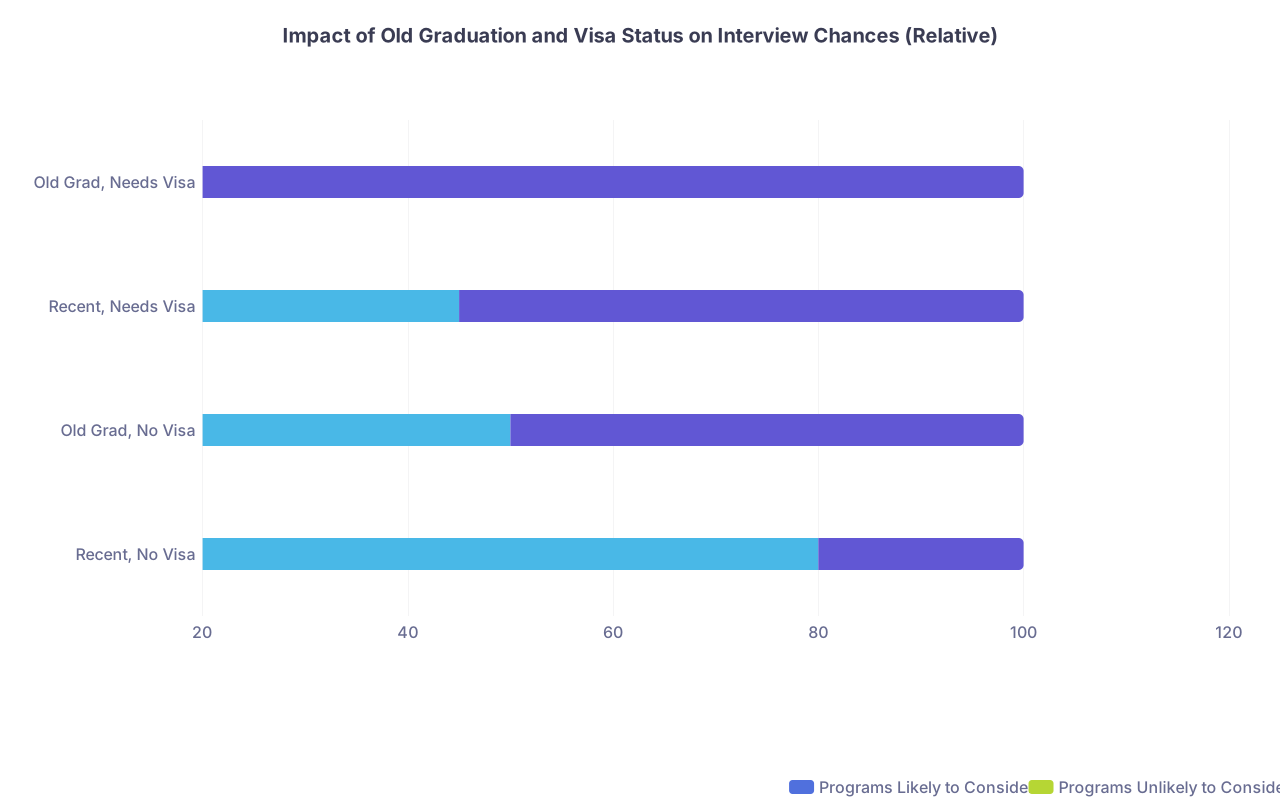
Here’s how those filters stack up in practice:
| Category | Programs Likely to Consider | Programs Unlikely to Consider |
|---|---|---|
| Recent, No Visa | 80 | 20 |
| Old Grad, No Visa | 50 | 50 |
| Recent, Needs Visa | 45 | 55 |
| Old Grad, Needs Visa | 20 | 80 |
Yeah. It’s rough. But again — 20% of programs still potentially open is not 0%.
Should You Even Apply? Or Wait Another Year?
The question that’s eating at you: “Am I about to blow money and hope on something that’s already doomed?”
Here’s how I’d think about it.
A cycle is probably not worth it if:
- You have no recent clinical experience in the last 2–3 years
- You have weak or no US letters
- You have serious exam issues (multiple fails, very low Step 2)
- You can’t afford to do it properly (apps + interviews + possible travel)
- You’re not willing to aim strategically (primary care–oriented, broad geography)
In that case, better to spend 1 year rebuilding:
- Get recent clinical experience (ideally in the US or a similar system)
- Take or retake necessary exams (Step 3, OET, etc.)
- Gather strong current LORs
- Fix your CV narrative
A cycle might be worth it if:
- You have at least some recent clinical work (last 1–2 years)
- You’re preparing or have completed Step 3
- You’re willing to apply very broadly
- You accept that your first cycle might just be information-gathering (who responds, what level of interest you get)
It’s not all or nothing. But you do need to be brutally honest with yourself.
How to Make an Older-Grad IMG Application Look Deliberate, Not Desperate
Programs are very good at smelling desperation: the “I applied to 350 programs in 7 specialties and I’ll take anything” vibe.
You want your application to feel like: “I know exactly what I’m doing and why I’m coming now.”
That means:
Pick one specialty.
Don’t be the IM/FM/Psych triple-mode applicant. It shows, and it looks unfocused.Align your CV to that specialty.
Your recent work, your personal statement, your letters — all pointing in the same direction.Directly address your YOG in your story.
Not with excuses. With facts. For example:- “Since graduating in 2014, I have practiced full-time as an internist in a resource-limited setting, which has shaped my interest in [specific area]. In the last year, I transitioned my practice focus to align with US residency requirements by completing [USCE / research / etc.].”
Keep your application clean.
No sloppy gaps. No unclear dates. No vague “clinical experience” that turns out to be 2-week observerships from 2016.
What About Prelim, Transitional, or SOAP As Back Doors?
Everyone fantasizes about the “side door”: SOAP, prelim, transitional, research position magically converting into residency.
Reality:
- Prelim-only IM or surgery can sometimes be a foot in the door — but they’re not guaranteed to convert. Many don’t.
- SOAP is usually harder as an older IMG, not easier. You’re now competing for leftovers in a compressed, brutal 48-hour window, still with all your same red flags.
- Research positions can help if they’re in a department that actually has IMGs in residency and if you hustle for relationships. It’s not automatic.
I’d treat all of those as “possible tools,” not a plan you rely on.
Quick Reality Check vs. Self-Blame Spiral
You’re probably cycling between two extremes:
- “I’ll apply everywhere and surely someone will see my potential.”
- “No one will take me, I wasted my degree, I’m finished.”
Both are bad planning positions.
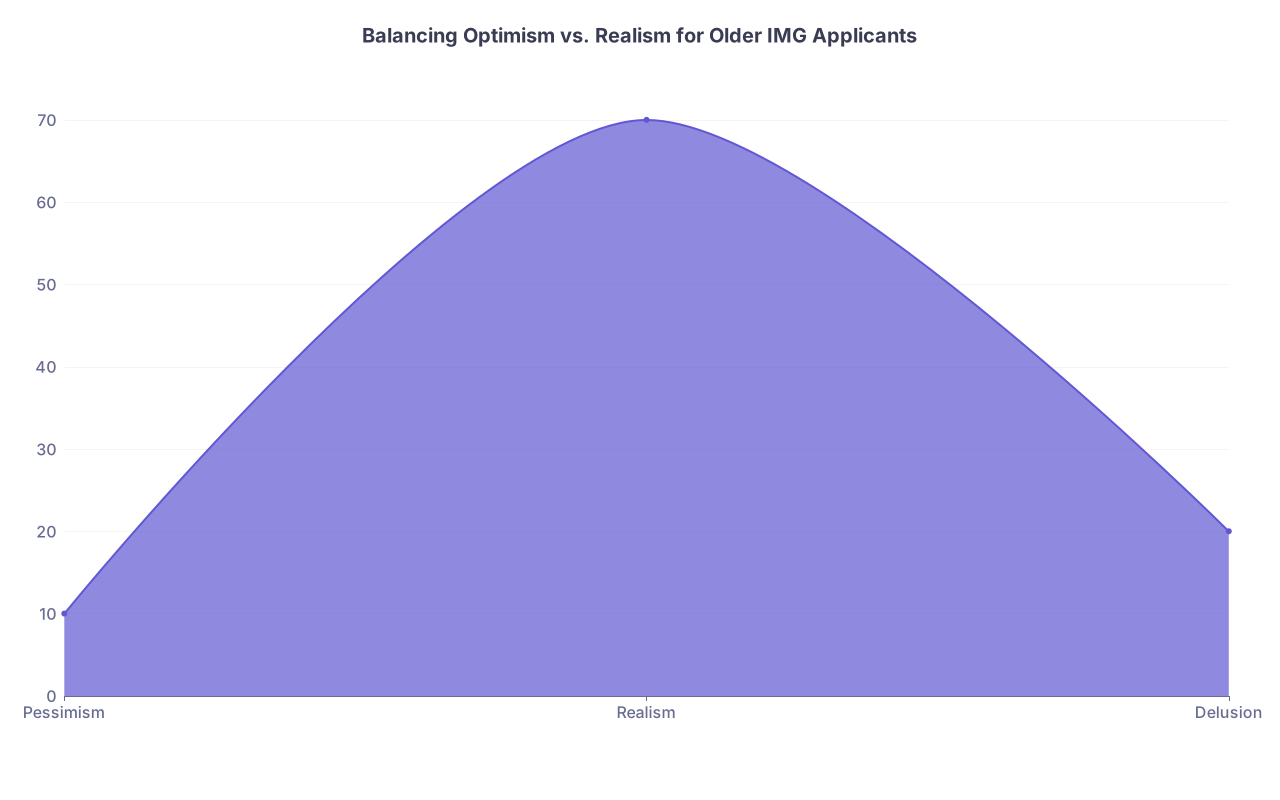
Here’s a more grounded middle:
| Category | Value |
|---|---|
| Pessimism | 10 |
| Realism | 70 |
| Delusion | 20 |
Realism looks like:
- Acknowledging you’re in a high-risk category
- Still taking action, but with a focused specialty and program list
- Giving yourself more than one cycle mentally
- Having a serious backup plan if US residency doesn’t happen (and starting to build that too)
FAQs (The Stuff You’re Probably Still Obsessing Over)
1. I’m 10+ years out from graduation. Is it completely hopeless?
Not completely, but your margin is razor thin now. If you’re 10+ years out and:
- You’ve been practicing clinically all this time, with recent strong letters
- Or you have strong US research + some USCE
- And you’re aiming at IM/FM/psych
- And you’re willing to apply broadly and maybe for multiple cycles
— then there’s still a path. Narrow, but real. If you’ve been out of medicine entirely for many years, then yes, the odds drop to almost zero unless you spend 1–2 years re-entering clinically and getting recent proof you can function as a doctor today.
2. Do I have to have US clinical experience as an older IMG?
If you need a visa and are >7 years out, I’d treat USCE as “almost mandatory.” Some people match without it, but they’re usually:
- From schools/programs US PDs recognize
- In countries whose training US PDs respect a lot
- With killer scores + Step 3
Most older IMGs I’ve seen succeed had some recent US-based exposure: observerships with strong letters, externships, “pre-residency fellowships,” or US research where they interacted with patients or residents. If you don’t have USCE, you better have continuous recent clinical work and excellent references from it.
3. Should I mention my year of graduation directly in my personal statement?
You don’t need to write, “I know I graduated in 2014.” They can see that. But you should clearly explain what you’ve been doing with your time in a way that makes sense and supports your specialty choice.
For example:
“I have spent the last seven years working as a primary care physician in a rural area, where I developed my interest in chronic disease management and behavioral health, which I now hope to pursue in a family medicine residency.”
You’re not hiding your age as a grad. You’re owning the experience and connecting it to why you’re applying now.
4. If I can only fix one thing before the next application cycle, what should it be?
If I had to pick only one for most older IMGs: recent, credible clinical experience with strong letters.
Scores are important, but re-taking or adding exams isn’t always realistic. You can, however, usually find a way — even if it’s painful and inconvenient — to spend 2–6 months doing solid, recent clinical work (US if possible) and build relationships with people who will vouch for you.
Programs forgive a lot when someone they trust says:
“I worked with this doctor recently. They’re excellent, reliable, clinically sharp, and I’d take them on my team.”
Here’s your next move — not in theory, but literally today:
Open a blank document and make three columns:
- Column 1: “What I have right now” (USCE, exams, recent clinical work, research, connections)
- Column 2: “What’s missing for an older IMG” (Step 3, recent LORs, clear story, focused specialty)
- Column 3: “What I can realistically change in the next 6–12 months”
Fill that out honestly. No sugarcoating. Then pick one missing piece from Column 2 and start fixing it this week — email for observerships, schedule Step 3, or reach out to old supervisors for potential roles.
Don’t just stare at your YOG and panic. Put something concrete on the board that a program director can respect a year from now.