

The way most IMGs approach US clinical experience is quietly sabotaging their Match chances.
Not because they are lazy. Not because they are unqualified. Because they do not understand how toxic some very common “opportunities” look to program directors—and no one bothers to tell them.
Let me walk you through the landmines. I’ve watched too many IMGs waste thousands of dollars and months of effort on experiences that hurt more than they help.
1. Confusing “Any USCE” With “Good USCE”
The first mistake is believing that any US clinical experience is automatically valuable. It is not. Some of it is actively harmful.
Programs are not impressed by:
- Random clinics that churn through IMGs every month
- Fake “hospitals” that are basically glorified urgent care with a fancy website
- Shadowing-only months stacked like trading cards
They’re evaluating:
- Setting (inpatient vs outpatient, academic vs private office)
- Level of responsibility (observership vs hands-on with documentation)
- Who is supervising you (board-certified, affiliated with real residency programs or not)
- How realistic the environment is compared with residency
Here’s the rough hierarchy of value from a typical PD’s perspective:
| USCE Type | Typical Perceived Strength |
|---|---|
| US ACGME-accredited residency rotation (sub-I/AI) | Very Strong |
| Hands-on externship in reputable teaching hospital | Strong |
| Structured observership in academic center | Moderate |
| Private clinic shadowing with no EMR/notes | Weak |
| Paid “experience” with unclear site/role | Questionable/Negative |
Do not make the mistake of thinking quantity can replace quality. Four weak months do not equal one strong, legitimate, clearly documented rotation in a real teaching hospital.
2. Falling for Scammy “USCE Packages” and Ghost Hospitals
If it sounds like a travel agency for desperate IMGs, be suspicious.
You’ve seen these sites:
- “Guaranteed US Clinical Experience in Top US Hospitals!”
- “VIP Rotation Packages – Housing and Letters Included!”
- “Guaranteed LORs from US Attendings!”
This is where many IMGs unknowingly destroy their credibility.
Red flags you must not ignore:
- No clear hospital name, just “affiliated with major hospitals”
- No specific supervising physicians listed with full names and specialties
- Gmail or generic contact emails only
- Payment required in full before you even speak with the supervising physician
- No mention of EMR use, documentation, or clinical duties
- Overemphasis on “certificate,” “letter,” “guaranteed LOR,” “placement”
Program directors know these companies. They see the same clinic names and “institutes” on hundreds of applications. When they spot them on your CV, they don’t think “motivated candidate.” They think “didn’t know how to find real clinical training.”
If your rotation site:
- Does not actually admit patients
- Has no residents, no conferences, no teaching culture
- Exists mostly to host IMGs and charge them
…then you’re not doing clinical training. You’re doing paid cosplay.
3. Collecting LORs That Say Nothing (The Silent Career-Killer)
A bad letter of recommendation is worse than no letter.
And most IMGs underestimate how obviously weak some letters look. I’ve seen letters that might as well say, “I barely know this person, but they paid to be here” without actually writing those words.
Common toxic LOR mistakes:
- All letters from non-academic, non-teaching, solo private practitioners
- Letters that never mention specific clinical incidents, just vague praise
- Letters that are clearly templated: identical structure, generic adjectives
- Letters from “Medical Director, XYZ International Institute” with no real hospital affiliation
- Letters that over-focus on personality (“very polite, punctual, respectful”) and say nothing about clinical skills or readiness for residency
A strong USCE letter usually has:
- Institutional letterhead from a real hospital or teaching site
- Attending name, degree(s), and position clearly stated
- Specific examples: “She identified X on physical exam,” “He presented on Y in our case conference,” “They actively contributed on rounds”
- Direct comparison: “Among international graduates I’ve worked with…” or “Compared with our interns…”
If your “USCE” only allows you to stand in the corner and watch, what exactly is your attending supposed to write?
That’s why choosing the wrong site kills you twice: weak training and weak letters.
4. Thinking Observerships Are Enough (When They Aren’t)
Observerships are not useless. But they are dangerously overrated.
Typical scenario I see:
- IMG does 3–4 months of pure observership
- No notes, no orders, no real responsibility
- Mostly standing behind the attending in clinic, occasionally reviewing labs
- CV ends up listing “Clinical Extern” or “Resident Observer” to make it sound better
Program directors are not fooled.
Observerships can help if:
- You’re very early and just need initial exposure
- You combine them with stronger, more hands-on experiences later
- They’re at a big-name institution and you get a serious letter from a known faculty member
They hurt you when:
- They’re all you have
- You pretend they were more than they were (“responsible for management…” when you were not)
- They come from obscure or suspicious-seeming clinics
If your country of graduation is one where you’ve already completed internship or residency, and your USCE is only observerships with no actual responsibility—programs will wonder why you could care for patients back home but only “watched” in the US.
5. Ignoring Continuity and Story – Disorganized, Random Rotations
Another quiet red flag: chaotic, scattered clinical experience that tells no story.
Example of what looks bad to a PD:
- 1 month – Internal Medicine observership, random private clinic in Florida
- 1 month – Family Medicine shadowing, New Jersey solo office
- 1 month – Research assistant role that clearly isn’t real research
- 1 month – Telemedicine observer from your home country
No theme. No progression. Obviously driven by what was available, not what builds readiness for residency.
Compare that with:
- 1 month – Medicine sub-I at community teaching hospital
- 1 month – Inpatient cardiology externship at affiliated site
- 1 month – Outpatient IM clinic with EMR, continuity care
- 1 month – Research in medicine or a related field + poster/presentation
Same total time. Very different signal: “This person knows what internal medicine residency looks like and is moving in that direction.”
Scattered, low-quality USCE suggests:
- Poor guidance
- Poor judgment
- Desperation over planning
Do not just grab whatever is available. Build a coherent story for the specialty you’re targeting.
6. Underestimating How Much Setting Matters
Program directors do judge you by where you trained.
Rotating at:
- A county or community teaching hospital with residents, call, and actual inpatients
Is very different from:
- A 2-room “institute” with 30 IMGs crowding behind one attending seeing 60 patients a day
Toxic pattern I see a lot: IMGs who spend all their USCE in outpatient-only, high-volume, low-teaching private practices, then apply for hospital-based residencies (IM, surgery, EM) and wonder why they get no interviews.
For hospital-based specialties, your CV should show:
- Inpatient exposure
- Team structure similar to residency (attendings, residents, students)
- EMR use in a real system
- At least some experience presenting patients, giving sign-out, seeing cross-cover issues
If your entire USCE could be summarized as “watched my attending prescribe antibiotics and refills,” that’s a problem.
7. Lying or Over-Inflating Roles on Your CV
This one gets applicants silently blacklisted.
Programs cross-check:
- What you write in ERAS
- What your letters say
- What you say on interview day
Common self-sabotaging moves:
- Calling an observership an “externship” when you had no hands-on role
- Claiming you “managed” patients when your actual role was “verbal discussion only”
- Listing yourself as “Clinical Research Fellow” for a 4-week chart review with no output
- Making a tiny community clinic sound like a major “teaching hospital”
Here’s the ugly truth: program coordinators and PDs talk. They know which clinics, “institutes,” and “rotation companies” inflate everything. They know the standard script some of these places give IMGs.
If there’s even a small mismatch between:
- The level of responsibility you claim
- And the type of site you rotated in
They will assume you’re exaggerating. And if they think you’re exaggerating on clinical experience, they start questioning your entire application.
Honest but modest > flashy and suspicious.
8. Wasting Time on Non-Clinical “US Experience” That Doesn’t Count
Another trap: trying to patch a weak clinical profile with unrelated US activities.
Common examples:
- Volunteer roles that are 90% paperwork, 10% patient exposure
- “Medical assistant” jobs that are essentially receptionist positions
- Random observerships in fields you will never apply to (like plastic surgery observership when you’re applying FM)
- Tele-rotations that are basically watching Zoom consults from your bedroom
Programs rarely give meaningful credit for:
- Non-clinical hospital volunteering (front desk, transport, gift shop)
- Vague “healthcare internship” programs
- Remote/virtual “US clinical experience” with no real responsibility or supervision
Will these kill your application? Not alone. But they won’t save it, either. And if you use them to claim “strong US experience,” you’ll look dishonest or naive.
Use these roles for:
- Personal growth
- Networking
- Understanding the system
But do not mistake them for actual clinical training.
9. Not Getting Anything Recent – Stale or Outdated USCE
You cannot ignore recency.
USCE from 5–7 years ago, with nothing since, looks like this: “I came, I watched, I left, and I have not practiced in the US since.”
Toxic combinations:
- Old USCE + long gap since graduation
- Old USCE + no current clinical work anywhere
- Old USCE + new attempts at exams (Step 3) just before applying
Programs care about what you can do now, not what you did in 2017.
If your most recent hands-on clinical work is:
- Several years old
- In another country
- Or from your original internship only
You need updated exposure before applying. Even 1–2 strong, recent US rotations can prevent your application from looking “expired.”
10. Ignoring How PDs Actually View IMG USCE
Here’s the part most people won’t tell you bluntly.
Many program directors automatically discount:
- Experiences obtained through notorious third-party “rotation brokers”
- Rotations at clinics known for churning IMGs for profit
- Letters from “frequent flyer” attendings who write 200 letters per year
They’re looking for:
- Real teams
- Real responsibilities
- Real supervision
- Real institutions they recognize—or at least that look legitimate on a quick search
They can spot:
- Overly commercialized IMG-rotation clinics
- Lines in LORs that scream “paid observer”
- CVs padded with fluff titles and no substance
If you choose the wrong places, you’re not just wasting time. You’re signaling that:
- You don’t understand the system
- You either didn’t know or didn’t care that your training was low-quality
- You’re used to surface over substance
And residency programs already feel burned by some prior hires from these pipelines. They remember. You don’t want to be associated with that.
11. How to Avoid These Pitfalls (Without Burning Money and Time)
Let me be practical. Here’s how to protect yourself.
A. Vet the Site Like a Program Director Would
Before you pay for anything, ask:
- Is this a real hospital, FQHC, or teaching practice?
- Are there residents or students from US schools rotating here?
- Can I see the attending’s full name, specialty, and affiliated hospitals?
- Does the site show up on the hospital’s own website or faculty directory?
- Will my role involve EMR use, presentations, or documented clinical duties?
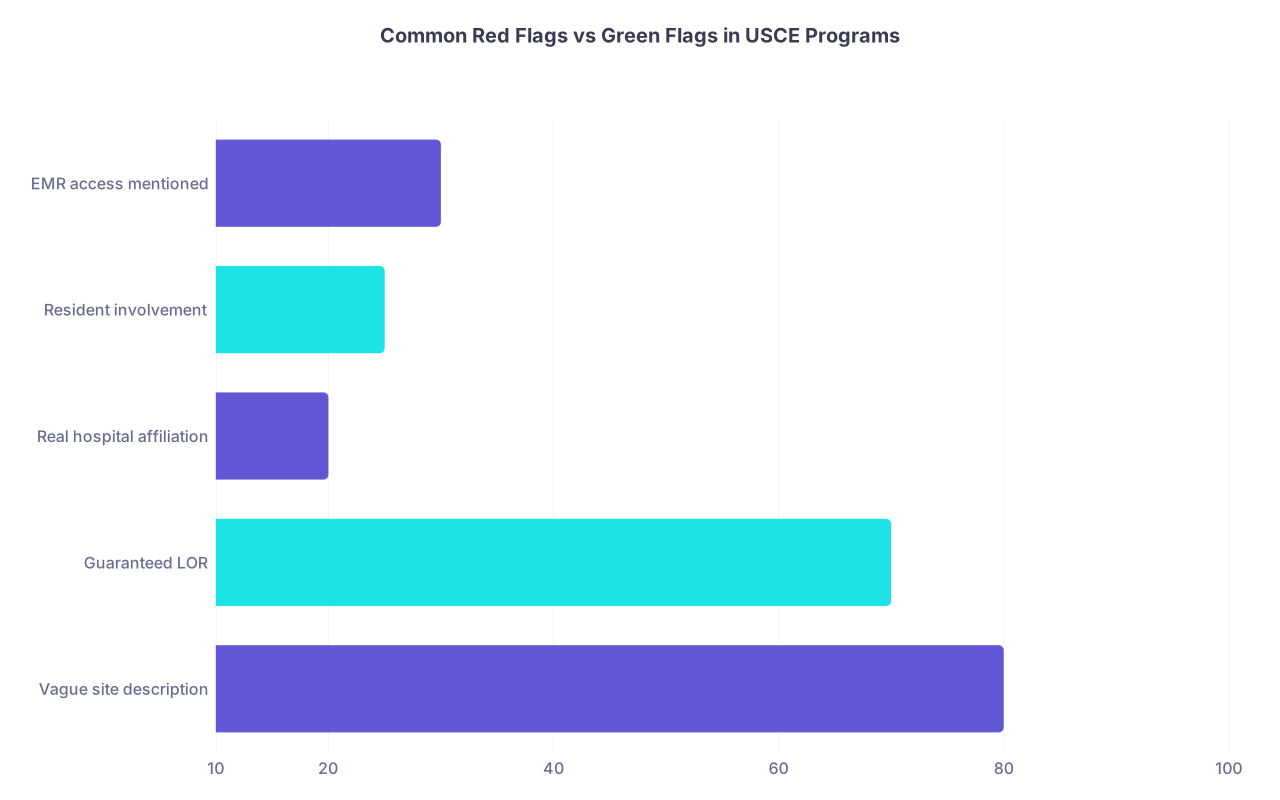
| Category | Value |
|---|---|
| Vague site description | 80 |
| Guaranteed LOR | 70 |
| Real hospital affiliation | 20 |
| Resident involvement | 25 |
| EMR access mentioned | 30 |
Red flags high, green flags low? Walk away.
B. Think in Terms of Depth, Not Just Number of Months
It’s better to have:
- 2–3 months of strong, hands-on or high-quality observerships in your chosen specialty
Than:
- 6–8 months of scattered, low-yield, private-office shadowing
Aim for:
- At least 1–2 rotations where you can get a substantial, detailed letter
- Clear alignment between rotations and the specialty you’re applying to
C. Protect Your Integrity on Paper
When you describe your USCE:
- Use accurate titles (observer, extern, visiting physician, etc.)
- Clearly state responsibilities: “observed only” vs “took histories and documented notes in EMR under supervision”
- Do not inflate your role. Ever.
You want programs to see: “This person is honest and understands their scope.” That will help you a lot more than a fake “resident-level” description.
12. What a Non-Toxic USCE Profile Actually Looks Like
To make this concrete, here’s a pattern that rarely raises red flags for IMGs targeting Internal Medicine:
- 1 month – Internal Medicine sub-I or externship at a community teaching hospital with residents; documented role in notes/presentations
- 1 month – Inpatient cardiology or ICU externship/observership at same or related institution
- 1 month – Outpatient IM clinic with EMR and continuity, maybe for underserved population
- 1–2 letters from academic or teaching attendings who supervised you closely
Plus:
- Roles described honestly in ERAS
- Dates recent (within the last 1–2 years)
- No sketchy “institutes” or obviously commercial “USCE centers”
Not perfect. But solid. Credible. Non-toxic.
Now compare that to the CV that screams trouble:
- 4 months – “Internal Medicine extern” at a generic “International Medical Institute” located in a strip mall
- 2 months – “Cardiology extern” at a purely outpatient stress-test clinic
- 1 letter each from four different private attendings, all saying the same vague things
You see the difference.

| Step | Description |
|---|---|
| Step 1 | USCE Opportunity |
| Step 2 | High risk of low value |
| Step 3 | May be OK but limited |
| Step 4 | Observership only - use sparingly |
| Step 5 | High value rotation |
| Step 6 | Real hospital or teaching clinic |
| Step 7 | Resident or student presence |
| Step 8 | Hands on or meaningful role |
FAQ (Exactly 3 Questions)
1. Are paid USCE programs always bad for IMGs?
Not always—but many are. Paying a reasonable administrative fee for a legitimate hospital-based rotation is fine. Paying thousands to rotate at a no-name “institute” with 15 other observers, no residents, no EMR, and a “guaranteed letter” is a problem. The issue isn’t payment itself; it’s whether the site is a real teaching environment or a business built on IMG desperation. If the program won’t clearly state the hospital, supervising physician, and your expected role, do not trust it.
2. Is it better to have USCE in a different specialty than none at all?
Sometimes, but don’t overestimate the benefit. If you’re applying to internal medicine and your only USCE is in dermatology or radiology, programs may question your commitment and your understanding of the specialty you’re targeting. One or two off-specialty experiences are fine, especially early on, but you still need at least some focused USCE in the field you’re actually applying to. Otherwise, your application looks unfocused and weakly prepared.
3. Can I still Match if my USCE is mostly observerships?
Yes, people do. But the bar is higher and the risk of being dismissed is real, especially if your observerships are at questionable sites. To compensate, you’ll need stronger scores, stronger home-country clinical experience, and at least a few observerships that are clearly at solid, recognizable institutions with strong, specific letters. If you can add even one hands-on or more involved rotation before you apply, do it. It can shift you from “weak experience” to “borderline but plausible” in a PD’s mind.
Two things to remember: first, not all USCE is created equal; some of it quietly poisons your application. Second, honesty plus thoughtful, credible sites beats volume and hype every single time.


