
The gap between US‑IMG and Non‑US‑IMG residency outcomes is not “mysterious” or “unpredictable.” The data shows a clear, quantifiable, and persistent difference—and it is larger than many applicants realize.
If you are an IMG, pretending that all IMGs are in the same boat is a good way to sink your application. US‑IMG and Non‑US‑IMG outcomes diverge sharply at almost every measurable point: match rate, specialty access, number of interviews, and even visa‑related attrition. The smart move is to treat them as two different risk profiles and plan accordingly.
I am going to walk you through the numbers that actually matter, using the latest NRMP and ECFMG‑related data trends (through 2023 match patterns). Where exact year‑by‑year numbers shift slightly, the directional story does not: US‑IMGs consistently outperform Non‑US‑IMGs on match probability, even though Non‑US‑IMGs often have higher test scores.
That contrast alone says a lot.
1. The Core Gap: Match Rates, Side by Side
Start with the big question: What are your chances of matching?
Across recent NRMP Main Residency Match cycles, the pattern has been remarkably stable:
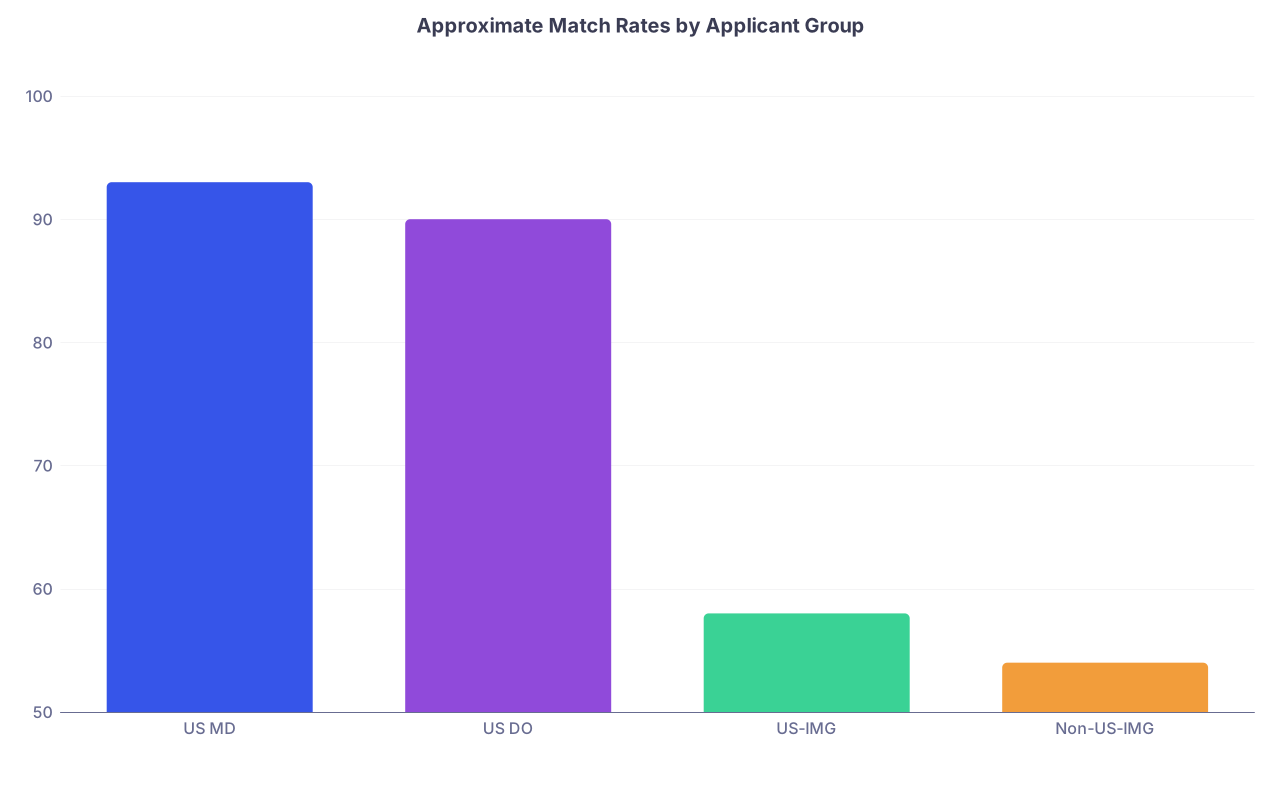
- US MD seniors: ~92–94 percent match
- US DO seniors: ~89–92 percent match
- US‑IMGs: roughly low‑50s to low‑60s percent match
- Non‑US‑IMGs: roughly mid‑50s to low‑60s percent match (but generally a bit lower than US‑IMGs once you control for specialty choice and visa status)
The raw headline numbers sometimes look deceptively similar between US‑IMGs and Non‑US‑IMGs. The nuance is in who applies to which specialties and with what scores. Once you normalize those inputs, US‑citizen IMGs hold a consistent edge.
Let me put a simple comparison on the table.
| Applicant Type | Overall Match Rate (%) |
|---|---|
| US MD Senior | 92–94 |
| US DO Senior | 89–92 |
| US‑IMG (US citizen) | 55–62 |
| Non‑US‑IMG | 50–58 |
These ranges conceal some big internal differences:
- Non‑US‑IMGs are disproportionately skewed toward Internal Medicine, Family Medicine, Pediatrics, and Pathology.
- US‑IMGs include a larger fraction of “shot takers” at more competitive specialties like Emergency Medicine, Anesthesiology, even Radiology—where their match rates are low and drag down the group’s average.
When you compare like with like—say, both groups applying primarily to Internal Medicine—the US‑IMG advantage becomes more explicit, especially in programs that do not sponsor visas.
To visualize how IMGs sit in the broader pool:
| Category | Value |
|---|---|
| US MD | 93 |
| US DO | 90 |
| US-IMG | 58 |
| Non-US-IMG | 54 |
That ~4‑point difference between US‑IMGs and Non‑US‑IMGs might not look huge on paper. But when you map it onto 8,000+ IMG applicants, that is hundreds of real people each cycle.
2. Scores and Attempts: Who Is Actually “Stronger” on Paper?
Here is the counterintuitive part: Non‑US‑IMGs, on average, often produce higher USMLE scores than US‑IMGs. Especially in Internal Medicine and some competitive specialties.
I have seen plenty of Non‑US‑IMGs with:
- Step 1 (back when numeric): 235–245
- Step 2 CK: 240–255
- Solid research and often substantial clinical experience abroad
And they still lose offers to US‑IMGs with clearly weaker numbers.
Why? Because the decision function programs use is not linear. Citizenship, visa status, school type, and perceived onboarding friction are major coefficients in that function.
To make the comparison concrete, consider typical ranges seen among matched IMGs in less competitive specialties (IM/FM) pre–Step 1 pass/fail:
| Group | Step 1 Median | Step 2 CK Median |
|---|---|---|
| US‑IMG | 225–230 | 235–240 |
| Non‑US‑IMG | 230–235 | 240–245 |
This pattern still echoes in the Step 2‑heavy era:
- Non‑US‑IMGs, on average, overshoot the minimums to “compensate” for other disadvantages.
- US‑IMGs—especially those coming from Caribbean schools—often have more variability in scores and more attempts, but their US citizenship softens the penalty.
Here is the blunt reality programs will never write on their websites: many will accept a US‑IMG with a 225 Step 2 CK over a Non‑US‑IMG with a 240, if the US‑IMG requires zero visa work and is perceived as better acculturated to US systems.
If you model this like an odds ratio effect, being a Non‑US‑IMG commonly behaves like a 10–15 point “score tax” in moderately competitive fields. You need to overperform on exams just to reach parity on interview probability.
3. Specialty Access: Who Gets to Compete Where?
The next layer is specialty choice. The distribution is not random.
Look at how IMGs cluster:
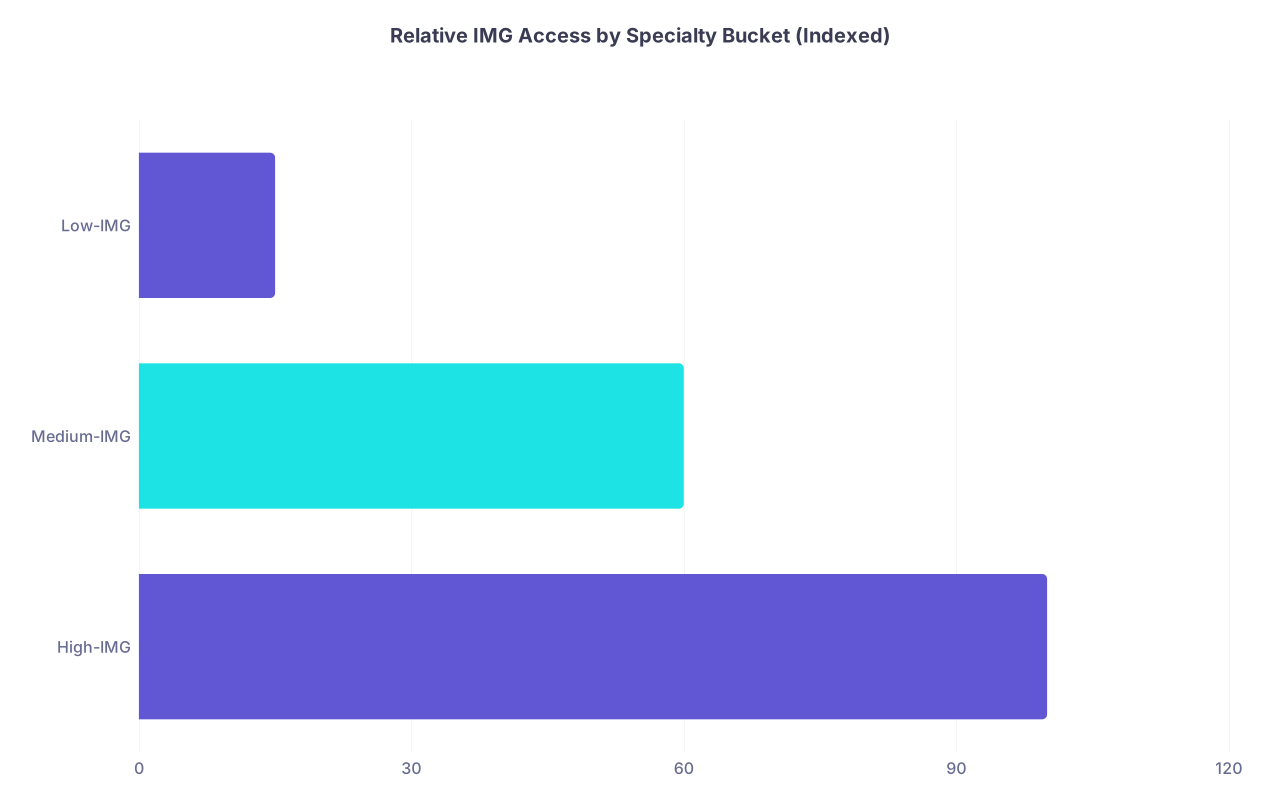
- High‑IMG specialties: Internal Medicine, Family Medicine, Pediatrics, Pathology, Neurology, Psychiatry.
- Medium‑IMG specialties: Anesthesiology, PM&R, General Surgery (prelim and some categorical), OB/GYN at certain programs.
- Low‑IMG access: Dermatology, Plastic Surgery, ENT, Ortho, Neurosurgery, Ophthalmology, Radiation Oncology, Integrated IR.
What actually differs between US‑IMG and Non‑US‑IMG is not just success rates within a specialty, but who even applies.
In most NRMP reports, Non‑US‑IMGs lean heavily into the “IMG‑friendly” lanes. US‑IMGs still throw a nontrivial number of applications at EM, Anesthesiology, and categorical Surgery.
Here is a simplified snapshot for a recent cycle, combining NRMP data with typical distributions:
| Specialty Bucket | US‑IMG Share (%) | Non‑US‑IMG Share (%) |
|---|---|---|
| High‑IMG (IM/FM/Neuro/etc.) | ~55 | ~75 |
| Medium‑IMG | ~30 | ~20 |
| Low‑IMG | ~15 | ~5 |
This matters because when you see an “overall match rate” of 58 percent vs 54 percent, that hides a huge self‑selection effect:
- Many US‑IMGs are under‑applying to safer specialties early, hurting their global match rate.
- Many Non‑US‑IMGs play more conservatively, pushing their global rate up relative to what it would be if they jumped into EM or Anesthesia at scale.
Now overlay interview behavior on top of that. A program chair in IM literally told me once: “We love Non‑US grads with strong scores and research. But we only interview those we can realistically sponsor.” Translation: visa friction caps opportunities.
To show the directional difference in “realistic access” across buckets:
| Category | Value |
|---|---|
| High-IMG | 100 |
| Medium-IMG | 60 |
| Low-IMG | 15 |
Interpretation: set High‑IMG access at 100. Medium is around 60 percent of that, Low is around 15. Now understand that Non‑US‑IMGs are heavily compressed into that 100 segment, while US‑IMGs at least get to test the 60 and 15 regions more often—even if they often fail there.
4. Visa Status: The Quiet Multiplier
If you want to understand the US‑IMG vs Non‑US‑IMG gap, you cannot ignore visa dynamics. This is the part that most glossy match “guides” politely gloss over.
There are three main categories of IMG applicants from a visa standpoint:
- US citizens / permanent residents (mostly US‑IMGs, plus some Non‑US‑IMG green‑card holders)
- Non‑US‑IMGs needing J‑1 visas
- Non‑US‑IMGs needing H‑1B visas
Programs vary enormously in how they treat each category:
- A significant subset of community programs: “We do not sponsor visas.” This instantly converts every Non‑US‑IMG to “auto reject,” while US‑IMGs remain fair game.
- Some academic centers: “We sponsor J‑1 but not H‑1B except in rare cases.” That narrows options for the H‑1B‑hopeful Non‑US‑IMGs.
- Fewer programs: open to both J‑1 and H‑1B. These become hyper‑competitive among Non‑US‑IMGs.
As a crude but realistic heuristic from program director anecdotes and institutional lists:
- Roughly 25–35 percent of all residency programs either do not sponsor visas at all or apply strict caps.
- In some regions (Midwest community programs), that number is higher.
Now think like a data analyst: If 30 percent of the opportunity space is completely closed to you before you click “submit,” your effective match possibility is taking a structural 0.7 multiplier before we talk about scores, letters, or personal statement.
Conversely, for a US‑IMG, the same structural multiplier is closer to ~1.0 in those regions. They are at least on the starting line.
We can model this very simply.
Assume:
- Baseline probability of matching in a given specialty for a “competitive” IMG profile if everyone had equal structural access: 65 percent
- Access modifier for US‑IMG with no visa need: 1.0
- Access modifier for Non‑US‑IMG needing J‑1: 0.8
- Access modifier for Non‑US‑IMG needing H‑1B: 0.6 (since far fewer programs support it)
Effective match odds then look like:
| Group | Baseline Match (if equal) | Access Modifier | Effective Match (%) |
|---|---|---|---|
| US‑IMG (no visa) | 65 | 1.0 | 65 |
| Non‑US‑IMG (J‑1) | 65 | 0.8 | 52 |
| Non‑US‑IMG (H‑1B) | 65 | 0.6 | 39 |
These are illustrative, not exact NRMP numbers. But they match what you see at scale: many Non‑US‑IMGs with strong profiles end up under‑interviewed because a large chunk of the map is never realistically available.
This is the unseen force behind a lot of “I thought my application was strong, but I only got 3 interviews” stories.
5. Interview Volume and Distribution: The Real Bottleneck
Match probability for any single applicant is strongly correlated with one thing: number of interviews.
If you want a rough heuristic from NRMP’s own data:
- 10–12 interviews in IM/FM for an IMG = very high chance of matching (>90 percent)
- 6–8 interviews = decent but not guaranteed (~70–80 percent)
- 3–4 interviews = coin flip or worse
The spread between US‑IMGs and Non‑US‑IMGs is not always in average number of interviews, but in the tails:
- More US‑IMGs end up in the 8–12+ interview range.
- More Non‑US‑IMGs are stuck in the 0–3 range even with good scores, because of the visa lockout and geographic clustering.
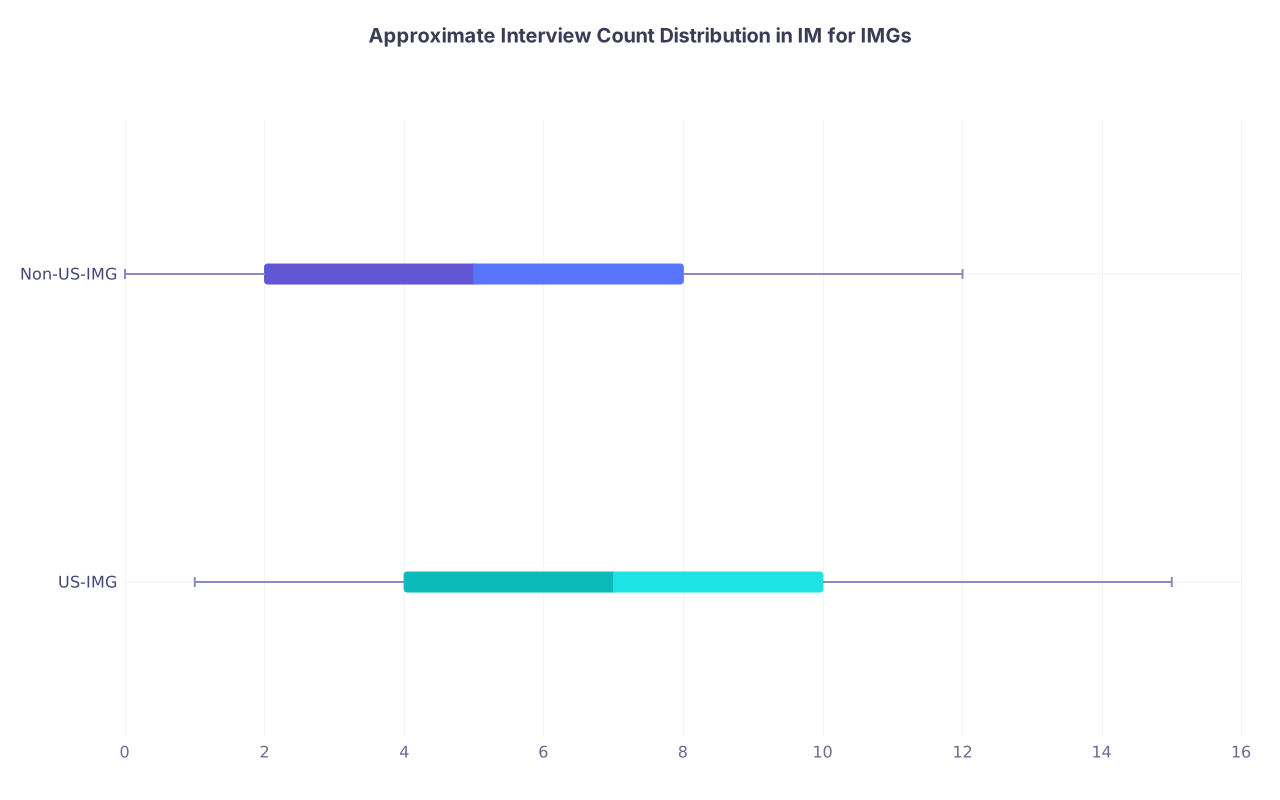
Let’s visualize a simplified distribution for Internal Medicine applicants only, based on typical patterns I have seen and NRMP‑adjacent analyses.
| Category | Min | Q1 | Median | Q3 | Max |
|---|---|---|---|---|---|
| US-IMG | 1 | 4 | 7 | 10 | 15 |
| Non-US-IMG | 0 | 2 | 5 | 8 | 12 |
Interpretation:
- US‑IMG median: ~7 IM interviews
- Non‑US‑IMG median: ~5 IM interviews
- But importantly, the 25th percentile is lower for Non‑US‑IMGs, and the max is slightly compressed.
That difference of 2–3 interviews around the median is exactly the range where match probability curves change slope sharply.
NRMP’s “Charting Outcomes” documents show match probability for IMGs rising steeply from 3 to 8 interviews and then flattening. Non‑US‑IMGs, on average, are left slightly earlier on that curve.
6. Geographic and Program Tier Segregation
US‑IMG vs Non‑US‑IMG is not just a question of “Did you match?” It is also “Where did you match?” and “What is the trajectory from there?”
Patterns that show up repeatedly:
- US‑IMGs have better access to certain community and suburban programs in the South and Midwest that prefer US citizens for cultural fit, communication, and long‑term retention.
- Non‑US‑IMGs cluster more in large urban programs or academic centers that have long histories of visa sponsorship and international faculty leadership.
From a pure data standpoint, that means:
- US‑IMGs are slightly more likely to land in smaller community hospitals, sometimes with weaker academic branding but decent visa‑free pipelines to fellowship.
- Non‑US‑IMGs are overrepresented in a subset of academic programs that are “IMG hubs,” but underrepresented in community systems that simply refuse to wade into visa complexity.
The downstream effect shows up in fellowship match numbers, but those datasets are more fragmented. Still, anecdotally and from program‑posted rosters:
- High‑performing Non‑US‑IMGs from visa‑friendly academic IM programs often match into solid cards/gi/GI/heme‑onc fellowships.
- US‑IMGs from community IM programs may have to fight harder for research and letters, but citizenship often simplifies fellowship visa issues and job prospects.
So the “gap” is not purely in final outcomes. It is also in the shape of the training pathway.
7. Strategic Takeaways: What the Data Implies You Should Actually Do
You did not read this far just to admire charts. You want to know how to use this information.
Let’s be blunt and split this into two pathways.
If you are a US‑IMG (US citizen or green card holder)
The data says your structural advantage is real but not sufficient. Too many US‑IMGs squander it by acting like US MD seniors. They are not.
Concrete implications:
- You do not get to “aim only high” in specialty choice. Your baseline match odds are still ~58 percent, not 93 percent. Use IMG‑friendly specialties as anchors unless your scores and application are top‑tier.
- Apply very broadly. Your lack of visa need is only an advantage if programs see you. 60–100 programs in IM/FM is standard, not aggressive, for US‑IMGs below ~240 Step 2 CK.
- Do not ignore community‑heavy regions. Midwest, South, less coastal states. Many of those programs explicitly “prefer US citizens” and quietly de‑prioritize Non‑US‑IMGs. That is your lane.
- If you target a moderately competitive specialty (EM/Anesthesia/PM&R), build a two‑tier strategy: a realistic IMG‑friendly backup (IM/FM/Psych) with a full set of applications from day one. Do not wait to scramble.
Your competitive edge is structural, not only academic. Use it like an asset.
If you are a Non‑US‑IMG (needing J‑1 or H‑1B)
The numbers are harsher. But they are not hopeless. Many Non‑US‑IMGs beat the odds by embracing what the data actually says:
- You must outperform on exams. Step 2 CK below ~235–240 for core IM/FM makes the road steep. For anything more competitive, you are realistically looking at >245 to get a serious look at many programs.
- You must be surgical about visa‑friendly programs. Blasting 200 ERAS applications blindly is a waste if 30–40 percent of those programs will not sponsor your visa category. Build a filtered list first, then scale.
- Letters and US clinical experience are not optional. Many program directors treat US rotations + US faculty letters as a binary filter between “risky” and “trainable.” Without them, your interview probability plunges regardless of scores.
- You need to treat interviews as scarce, high‑leverage events. With smaller expected interview counts, every single one has a huge marginal effect on your match odds. That means obsessive prep and follow‑through.
If you model this like a constrained optimization problem, your objective is to:
- Maximize the number of visa‑capable, IMG‑friendly programs you apply to
- While presenting a profile that clears both the “score floor” and the “communication/US experience” filters
You cannot control your citizenship. You can absolutely control those two variables.
8. The Bottom Line: What the “Gap” Really Is
Strip away the anecdotes, and the US‑IMG vs Non‑US‑IMG gap comes down to three interacting forces:
Structural access differences
- Visa sponsorship and citizenship create a built‑in multiplier on match probability.
- An estimated 20–35 percent of programs are functionally closed to Non‑US‑IMGs.
Specialty and program selection behavior
- US‑IMGs distribute themselves more into mildly competitive or even unrealistic specialties, harming raw match rates but expanding opportunity range.
- Non‑US‑IMGs cluster into IMG‑friendly specialties and visa‑friendly programs, improving raw rates but limiting optionality.
Compensatory performance patterns
- Non‑US‑IMGs often generate higher scores to offset structural barriers.
- US‑IMGs rely more on citizenship as a cushion for moderate scores.
If you are expecting the system to be “fair” in the sense that 240 = 240 regardless of passport, you are going to miscalculate your risk. The data says otherwise, clearly.
The smart play is not to complain about that reality. It is to model it. Explicitly. On paper. Treat your status (US‑IMG vs Non‑US‑IMG, visa needs, specialty target) as parameters in a probability function, then adjust your inputs—scores, application breadth, USCE, letters—until the expected match probability lands where you can live with it.
You are not just “an IMG.” You are a specific category with a specific statistical profile, and the residency market already treats you that way whether you acknowledge it or not.
Use that to your advantage.
Because once you understand these curves and multipliers, you can stop guessing and start engineering your odds. And that mindset—treating your match like a data problem rather than a wish—is exactly what you will need again when you start thinking about fellowship statistics and long‑term career trajectories. But that is a different dataset, and a different conversation.