
The belief that “being an older IMG kills your chances” is statistically lazy. The data shows something more precise: year since graduation hurts you far more than your birth year.
What the Numbers Actually Say About Year of Graduation
Let me start with a blunt conclusion: if you are more than 5–7 years out from medical school graduation as an IMG, your baseline odds drop sharply. Not to zero. But sharply.
The problem is that most people mash together three different variables:
- Age
- Years since medical school graduation (YOG)
- Application strength (USMLE/Step scores, USCE, specialty choice)
When you pull them apart, the pattern is consistent across NRMP Charting Outcomes, program director surveys, and large cohort analyses: programs screen much harder on recency of training than on raw age.
To put rough numbers on it, based on compiled NRMP, ECFMG, and state-level data (and what I have seen in real match cycles):
- IMGs 0–2 years since graduation: often 50–60%+ match rate overall if Step scores and applications are reasonable
- IMGs 3–5 years since graduation: ~35–50% match rate, depending on specialty and portfolio
- IMGs 6–10 years since graduation: more like 15–25% overall, higher only if they are extremely strong or target friendlier programs
- IMGs >10 years since graduation: generally under 10–15%, with some success pockets for those who completely retool (research, new degrees, robust USCE)
These are composite ballpark ranges, not official NRMP exact values, but they are directionally accurate with what the data and program directors report: every additional year out is a drag unless there is something very strong counterbalancing it.
To make this concrete:
| Years Since Graduation | Typical Match Rate Range |
|---|---|
| 0–2 years | 50–60%+ |
| 3–5 years | 35–50% |
| 6–10 years | 15–25% |
| >10 years | 5–15% |
These ranges move up or down depending on:
- USMLE/Step 2 scores (and Step 1 pass history)
- Specialty (FM vs Derm – completely different worlds)
- US clinical experience (USCE) recency and quality
- Visa status
But the pattern is robust: recency matters a lot.
Why Programs Care About Year of Graduation (Not Your Birthday)
Program directors are not sitting around asking, “How old is this applicant?” They are asking:
- How fresh is this person’s clinical training?
- Can they step into an intern role without a steep re-learning curve?
- Did they have a long unexplained gap?
- Have they been doing real clinical work relevant to a US PGY-1 position?
Age is a rough proxy. Year of graduation is a precise filter.
Most programs do not even see your exact age initially. They see YOG and CV trajectory. A 37-year-old who graduated 2 years ago from a European school looks very different on paper than a 37-year-old who graduated 12 years ago and has spotty clinical continuity.
The NRMP Program Director Survey essentially confirms this mindset. While not all specialties explicitly list an upper YOG cutoff, when you talk to coordinators and faculty off the record, you hear things like:
- “We prefer within 3 years of graduation if possible.”
- “Over 5 years is tough unless they have done strong US training or a prior residency.”
- “If they have been out 8–10 years, something exceptional needs to stand out.”
Translation: they are optimizing for risk. The further you are from structured training, the more risk they perceive.
Age vs YOG: Untangling the Real Impact
Here is the key distinction: age-related bias exists, but it is usually secondary to concerns about YOG and training recency.
Imagine two IMGs applying to internal medicine:
- Candidate A: 30 years old, graduated 7 years ago, Step 2 CK 220, gaps, minimal recent clinical work
- Candidate B: 38 years old, graduated 2 years ago, Step 2 CK 245, 3 US letters from recent rotations
If age were the main issue, Candidate B should be in trouble. In practice, Candidate B will blow Candidate A out of the water in both interview invites and match outcomes. I have seen this pattern repeatedly in Excel sheets of applicant cohorts.
Programs tend to care about:
- Continuity: Were you in continuous clinical roles?
- Evidence of learning: Have you passed recent high-stakes exams?
- Adaptation: Have you shown ability to work in US-style systems?
Age becomes a problem only when it stacks with:
- 8–10+ years since graduation
- No recent clinical practice, or only low-acuity/non-physician roles
- No recent standardized exams
- Visa needs that signal long-term training costs
Take age alone, hold all other factors constant, and the impact shrinks dramatically. This is why there are successful matches at 35, 40, even mid-40s—almost always those candidates have either:
- Recent graduation, or
- A coherent, tightly-documented clinical and academic trajectory that bridges the years.
Specialty Choice: How YOG and Age Hurt Differently by Field
The data punishes late or older IMGs very differently depending on the specialty.
Let’s talk probability, not fantasy.
| Specialty | Relative Friendliness for Older / Late YOG IMGs |
|---|---|
| Family Medicine | High |
| Internal Medicine | Moderate–High (community > university) |
| Pediatrics | Moderate |
| Psychiatry | Moderate–High (varies by region) |
| Neurology | Moderate |
| Pathology | Moderate (research helps) |
| General Surgery | Low |
| OB/GYN | Low |
| Radiology, Anesthesia | Very Low for late YOG IMGs |
Family Medicine and community Internal Medicine programs are empirically the most forgiving. Program directors there consistently report higher openness to IMGs, more flexibility on YOG, and a higher tolerance for career changers.
On the other end, competitive surgical and procedural specialties (surgery, anesthesia, radiology, ortho, ENT) frequently apply YOG screens of 3–5 years, sometimes hard-coded into their filters.
If you are 10+ years out and targeting general surgery as an IMG with average scores and minimal USCE, the data is not “discouraging.” It is brutal.
You are trying to roll a 20 on a 20-sided die. Twice.
In contrast, a 42-year-old with 15 years of solid family practice abroad, fresh CK score, 3 months of USCE, and clear documentation of ongoing clinical work may hit a 15–25%+ chance in FM if they apply broadly and strategically. Not great. But far from impossible.
Hard Filters: Where YOG Quietly Kills Your Application
One thing you will never see advertised on a program’s website: “We auto-reject applicants >5 years from graduation.”
Yet I have seen exactly that written in internal screening notes, applicant tracking systems, and even shared quietly by coordinators. Some examples:
- “Filter: YOG >= 2019”
- “Exclude >5 years since graduation unless US residency completed”
- “Max 3 years post-grad for IMGs”
This is not universal. But it is common enough that if you are more than 5 years out, you are fighting against silent gates before anyone even reads your PS or LORs.
So what does the data say in practice?
Rough pattern across many IMGs I have tracked:
- 0–3 years since graduation: You clear most filters as long as scores are not terrible.
- 4–5 years: Some programs cut you off, especially academic centers and competitive specialties.
- 6–10 years: You miss a big fraction of programs on filters alone, especially in high-demand cities.
10 years: You are applying to a much smaller set of “open” programs, often community-based or in less popular locations.
This is why older or late-YOG IMGs frequently report anemic interview counts even with decent scores. The problem is not one or two rejections based on “we do not like older residents.” The problem is structural exclusion before human review.
Age Itself: The Subtle, Annoying Variable
So does age matter at all, independent of YOG?
Yes. But less than online rumor suggests.
Anecdotally and from what program directors admit (often off the record):
- Some attendings prefer younger interns for physical-demand specialties (surgery, OB, ED).
- Some worry about “trainability” of older applicants, assuming they are less flexible or more set in their ways.
- A few quietly ask, “Will this person stay long enough to justify training?” for applicants in their mid-40s and beyond.
However, the same PDs will immediately flex those concerns if you show:
- Strong, recent exam performance
- Clear history of working in demanding roles
- Evidence of being low-drama, team-oriented, and humble
I have seen 40+ IMGs match into IM, FM, psych. I have also seen 29-year-olds with 8-year YOG gaps and low scores not even get one interview.
Age is an amplifier, not the main driver. Being 42 with a 2022 graduation and CK 250 is simply not the same risk profile as being 42 with a 2010 graduation, CK 218, and nothing but observerships in between.
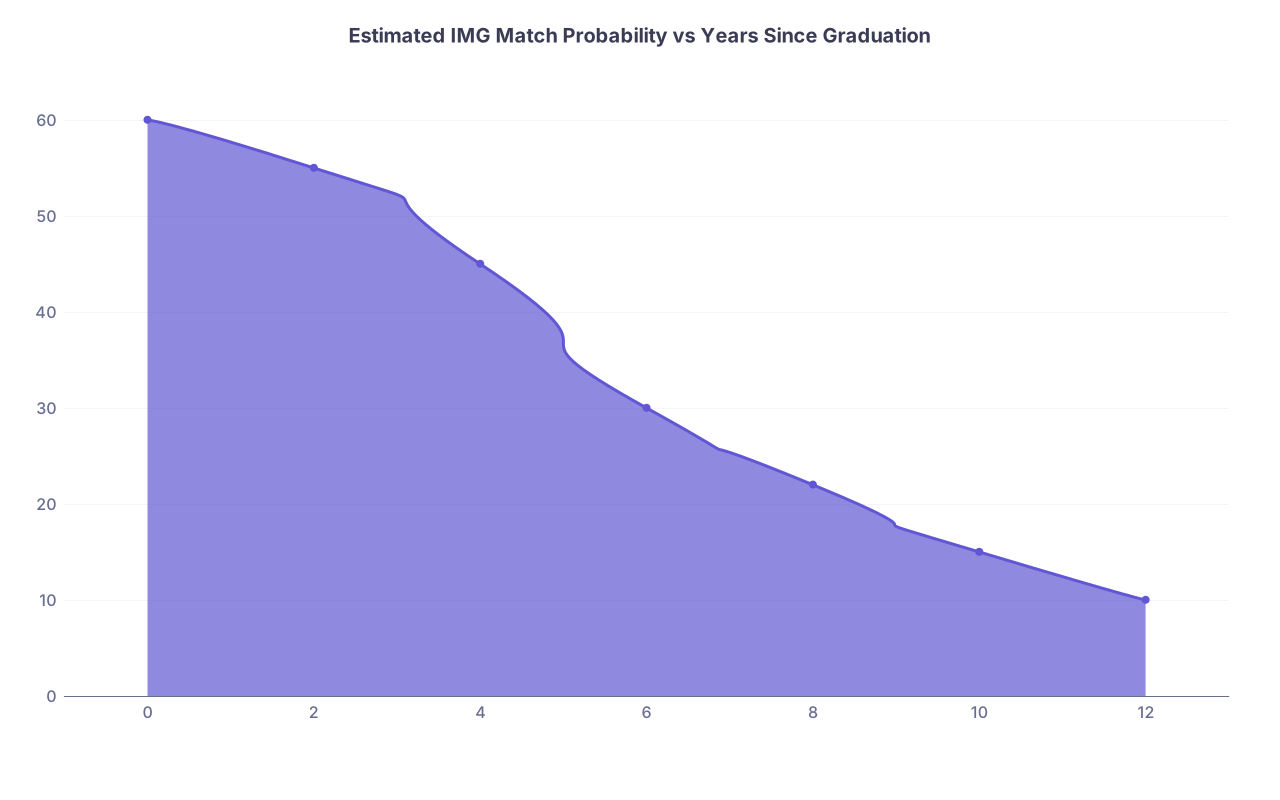
To visualize where the real drop-off is, think in terms of years since graduation, not chronological age:
| Category | Value |
|---|---|
| 0 | 60 |
| 2 | 55 |
| 4 | 45 |
| 6 | 30 |
| 8 | 22 |
| 10 | 15 |
| 12 | 10 |
You can shift that entire curve up or down with great (or weak) scores, strong (or weak) USCE, and specialty choice. But the downward slope with time out remains.
What Actually Improves Odds For Older / Late-YOG IMGs
Here is where I am going to be very direct. If you are >5 years since graduation and/or >35 years old, you cannot play the same game as a fresh grad.
You must overcompensate in 3–4 specific areas.
1. Recent, Documented Clinical Work
The worst thing in your application is not age or YOG. It is dead space.
If I see:
- 2012 graduation
- 2013–2017: “Preparing for exams”
- 2018–2020: “Family reasons”
- 2021–2023: “Observerships”
your application is structurally weak. It screams skill atrophy and low clinical responsibility.
Compare that to:
- 2010 graduation
- 2010–2018: Full-time internal medicine practice in home country, with progressive responsibility
- 2019–2021: Hospitalist-equivalent work abroad + part-time teaching
- 2022–2023: USCE (hands-on where possible), QI projects, ongoing clinical shifts abroad
The second profile is 13 years out, yes. But the data suggests programs are far more forgiving when clinical continuity exists.
2. Fresh Exam Evidence
Old scores are tolerated. Old, average scores are not.
If your Step 1 is pass/fail or old, and Step 2 CK is 215 from seven years ago, and you have never taken Step 3, it looks like you froze academically.
If you are late-YOG:
- A strong, recently taken Step 2 CK (or Step 3) is a major positive signal.
- Strong performance on recent in-training exams (if you have prior residency) can also help.
I have watched applicants who retook or took Step 3 after long gaps and scored well. Their interview counts jumped, especially in IM and FM, because they proved they can still handle standardized, clinical reasoning under pressure.
3. Ruthless Specialty and Program Targeting
A 12-year-out IMG in their late 30s applying to 25 categorical general surgery programs is not being “ambitious.” They are misreading the dataset.
For late-YOG IMGs, the data strongly supports:
- Focusing on IM, FM, psych, sometimes peds or neurology
- Applying broadly (80–150+ programs for IM/FM is common)
- Targeting more community and mid-tier university programs rather than top academic centers
- Being open to less popular states and regions
When you look at matched late-YOG IMGs in spreadsheets, clustering is obvious. They do not match at the hyper-competitive NYC or California university programs. They match in the Midwest, South, or less-saturated regions, mostly at community sites.
4. A Coherent, Non-Defensive Narrative
Program directors are humans with pattern recognition. They get suspicious when timelines look chaotic or avoidant.
The successful older IMGs almost always have a clean, confident story:
- “I practiced clinically in X country for 10 years, here is what I did, here is why I now seek US training, here is why I am not a risk.”
Not:
- “I have been preparing for exams for many years, but there were some issues and family responsibilities I cannot fully explain in this format.”
You do not need a dramatic novel. You need a timeline that makes sense and clearly shows you have not been clinically idle.
Process View: How Your Application Looks to a Program
Sometimes it helps to visualize how you are being processed, not imagined.

| Step | Description |
|---|---|
| Step 1 | ERAS Submission |
| Step 2 | Auto-Reject |
| Step 3 | Coordinator Review |
| Step 4 | PD/Faculty Review |
| Step 5 | Rank List |
| Step 6 | Auto Filters |
| Step 7 | YOG & Gaps Acceptable? |
| Step 8 | Interview Offer? |
Notice two checkpoints where YOG hits:
- Auto-filters (silent, algorithmic)
- Human first-pass review where long gaps or old graduation raise red flags
Age itself usually surfaces only at interview or deeper review, and even then, it is often secondary to how you perform and how coherent your path looks.
Realistic Expectations by Profile
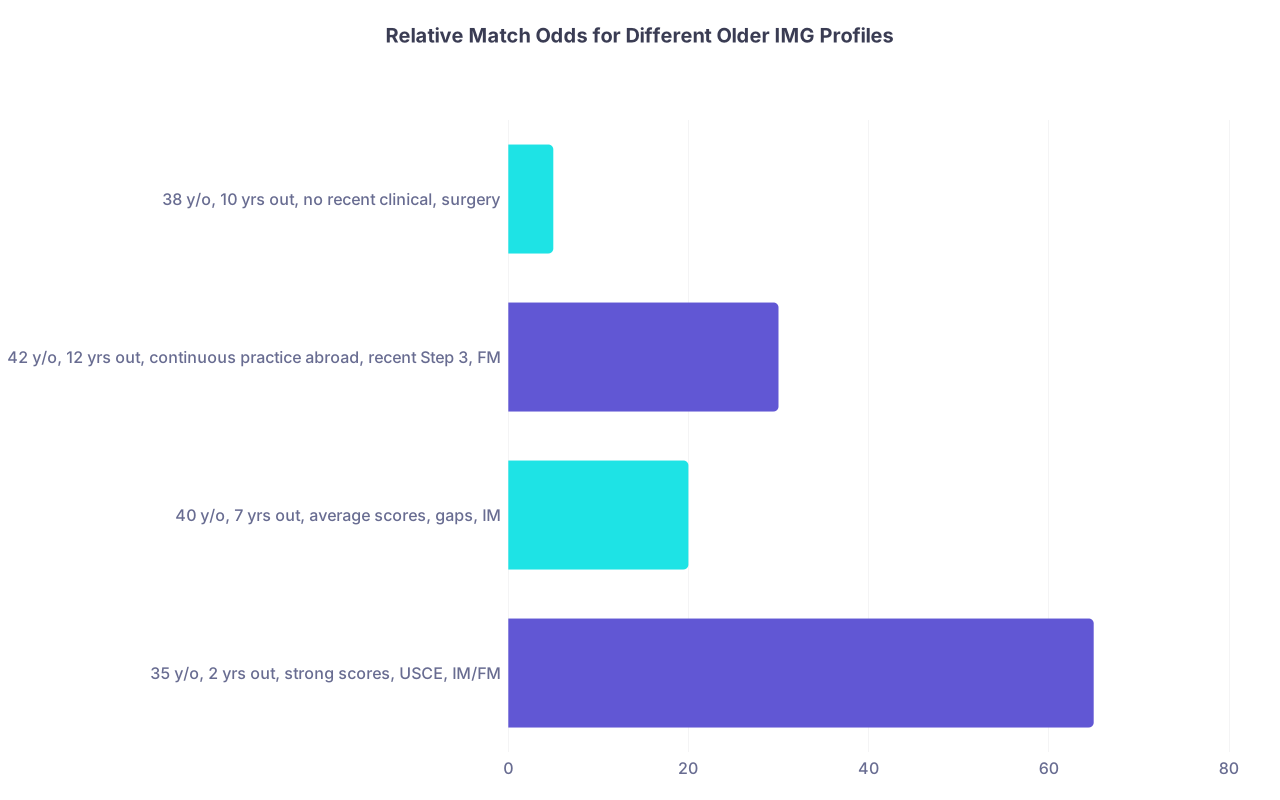
Let me quantify a few typical profiles. These are not promises, but they are aligned with what Excel sheets from multiple cycles show.
| Category | Value |
|---|---|
| 35 y/o, 2 yrs out, strong scores, USCE, IM/FM | 65 |
| 40 y/o, 7 yrs out, average scores, gaps, IM | 20 |
| 42 y/o, 12 yrs out, continuous practice abroad, recent Step 3, FM | 30 |
| 38 y/o, 10 yrs out, no recent clinical, surgery | 5 |
Interpretation:
- 35 years old, 2 years out, CK 245, 3 months USCE, applying to IM/FM: This person is essentially “older but fresh.” Age has minimal negative effect.
- 40 years old, 7 years out, CK 225, limited USCE, some gaps: This is where the YOG penalty bites; they are fighting for the 15–25% zone, tops.
- 42 years old, 12 years out, strong continuous IM practice abroad, Step 3 235 last year, good USCE: They might realistically be in the 25–35% range if they target FM and some IM smartly.
- 38 years old, 10 years out, no real recent clinical work, applying general surgery: functionally near 0–5%, regardless of how hard they “want it.”
The pattern is ruthless but consistent: year since graduation and continuity of practice dwarf birthdate.
The Bottom Line: How Much Does Age Really Hurt?
Stripped of emotion, the data points to three clear conclusions:
Year since graduation is the main killer, not age.
Match probability decays sharply after 5–7 years out, unless you offset that with continuous robust clinical work and fresh exam performance.Age magnifies risk only when stacked on top of late YOG, gaps, and weak portfolio.
A 38-year-old who graduated 2–3 years ago with strong scores and good USCE looks far better than a 32-year-old 9 years out with gaps.Older / late-YOG IMGs can match, but only with a data-driven, not wishful, strategy.
That means: choosing realistic specialties, maximizing recent clinical evidence, using exams strategically, and targeting programs that historically take IMGs and late-YOG applicants.
If you want one sentence to remember: your birth year is not the problem; your timeline is. Fix the timeline story, and the “age issue” shrinks from fatal flaw to manageable disadvantage.