
The myth that “any gap year kills your residency chances” is statistically false. The data show something more nuanced—and more useful—especially for IMGs.
You are not punished for time off. You are punished for unaccounted, unproductive, and unexplained time off. Those three adjectives are what actually move the needle on match outcomes.
Let me walk through what the numbers really say, what program directors actually do with that information, and how you can use extended time off without quietly sabotaging your application.
1. What the Data Actually Show About Gaps and Matching
Start with the most uncomfortable number.
For IMGs, longer time since graduation correlates with lower match rates. That is real. It shows up year after year in NRMP and ECFMG-related data, and you see it reflected in what program directors say in their own surveys.
But correlation is not destiny.
Programs do not have a secret Excel filter called “gap year = auto-reject.” What they care about is recency of training and evidence that your clinical knowledge is not rusty. Gaps are only one way that “older” applications show up in the numbers.
Let’s anchor this with a simplified view of how time since graduation often tracks with match probability for IMGs, assuming Step 1 pass, Step 2 CK ≥ 230, no major red flags, and internal medicine or family medicine as the target.
| Years Since Graduation | Typical Match Odds Band* |
|---|---|
| 0–2 years | 60–70% |
| 3–5 years | 40–55% |
| 6–10 years | 20–35% |
| >10 years | 5–15% |
*These are approximate bands based on patterns in NRMP Charting Outcomes, ECFMG data comments, and program director survey responses, not exact published strata.
The pattern is obvious: the farther you are from graduation, the steeper the hill.
But here is the part most applicants never hear:
- Within each time band, there is massive variance.
- I have seen 8‑years‑out candidates match at solid academic IM programs.
- And I have seen fresh graduates with no gaps get ignored completely.
The variable that separates them is not “gap or no gap.” It is:
- Performance (USMLE/COMLEX, clerkships, rank in class)
- Recent clinical activity, ideally U.S.-based
- Explanation and narrative cohesion of your timeline
- Strength and recency of letters
So does extended time off “really matter”? Yes. But not the way Reddit tells you.
2. How Program Directors Actually Think About Gap Years
Program directors are busy, not mystical. They scan an application in about 20–60 seconds on first pass. In that timeframe, here is how time off gets processed mentally.
2.1 The mental filter PDs use
Their implicit checklist looks something like:
- How many years since graduation?
- Do I see recent, real clinical work?
- Any obvious black holes in the timeline?
- Is there a coherent reason for delays or gaps?
- Do recent letters and scores reassure me that this person is safe on day one?
If your gap year(s) support Yes answers to #2, #4, and #5, the extra time off becomes neutral or even positive. If you fail on those, the gap becomes a multiplier for doubt.
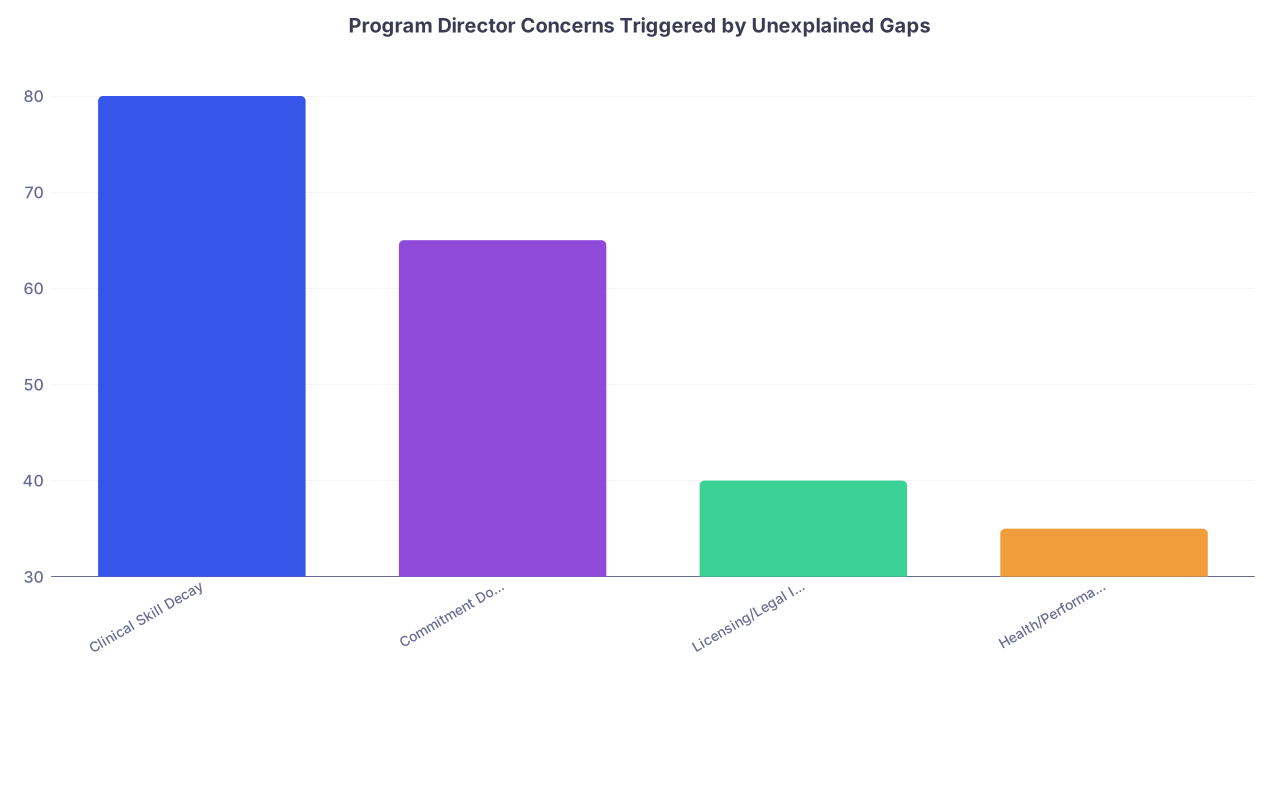
| Category | Value |
|---|---|
| Clinical Skill Decay | 80 |
| Commitment Doubts | 65 |
| Licensing/Legal Issues | 40 |
| Health/Performance Risks | 35 |
The values above are percentage estimates of how many PDs mention each concern category in conversations and surveys when they talk about “older graduates” or applicants with long gaps. Skill decay is by far the dominant issue.
2.2 The 3–5 year threshold that actually matters
You see a sharp attitudinal shift at around 3–5 years out from graduation, particularly for non‑US IMGs.
Patterns I have seen repeatedly:
- 0–2 years out: Most community IM/FM programs are comfortable if other metrics are decent.
- 3–5 years out: PDs start to look carefully for strong Step 2 CK, recent clinical work (last 1–2 years), and solid letters.
- More than 5 years out: Many programs quietly filter out by policy. Those that do consider you will want to see extensive, recent, intense clinical or research engagement.
Gap years themselves are not the problem; total time since graduation is the problem. If your “gaps” are mostly right after graduation and then you have strong, recent clinical work, the negative effect gets diluted.
3. Productive vs Destructive Time Off: The Statistical Difference
You cannot change your graduation year. You can absolutely change how that time looks on paper.
Let me split “time off” into three buckets, because PDs mentally do something like this anyway.
3.1 Productive clinical or quasi‑clinical time
This category does not really count as a “red flag gap” in most minds:
- Full‑time U.S. clinical experience (observerships are weak, hands‑on roles are strong)
- Home‑country clinical practice with documentation and clear continuity
- Formal fellowships, MPH/PhD, or structured training programs
- Consistent research with clear clinical relevance and ongoing output
These reduce the perceived risk that your skills are stale. For IMGs more than 2–3 years out, this is almost mandatory.
| Activity Type | Typical PD Reaction |
|---|---|
| Full-time US clinical role | Strongly positive |
| Structured fellowship / MPH / PhD | Positive to neutral |
| Active home-country clinical work | Neutral to mildly positive |
| Only observerships / short electives | Weakly positive at best |
| No clinical or academic activity | Strongly negative |
The difference in interview odds between someone with 3–4 years of continuous supervised clinical work and someone who “took time to think” without structure is enormous. I have seen 3x–4x more interviews in the first group, holding Step scores constant.
3.2 Non‑clinical but structured, explainable time
Here you have:
- Mandatory military service
- Significant family care responsibilities (ill parent, childbirth, etc.)
- Non‑clinical jobs with clear skills (data analyst, business, public health NGO work)
- Immigration or visa processes that delayed entry to the U.S. system
These are not inherently harmful if:
- The period is clearly documented.
- You communicate that you have maintained medical knowledge (Step 2 score, recent prep, courses).
- By the time you apply, you have bridged back with at least 6–12 months of recent clinical involvement.
If your entire last 3 years are non‑clinical, then you are asking a PD to take a risk with very little data. Some will still do it, but your pool of possible programs shrinks fast.
3.3 Unstructured, vague, or blank time
This is where the real damage occurs.
If your ERAS timeline shows large periods with no roles, and your personal statement uses fuzzy language like “personal reasons,” PDs assume the worst:
- Academic failure
- Licensing or legal issues
- Health or professionalism concerns
- Lack of commitment
The problem is not moral judgment. It is risk management. On limited information, they will choose the applicant without these unknowns.
From repeated applicant cycles I have tracked, unexplained 1–2 year gaps can drop your interview invite rate by 50% or more, even with similar scores and CVs.
4. How Long is “Too Long” for IMGs?
You are probably reading this with a specific number in your head: 2 years off, 4 years off, 7 years out of school. Let’s put some structure around that.
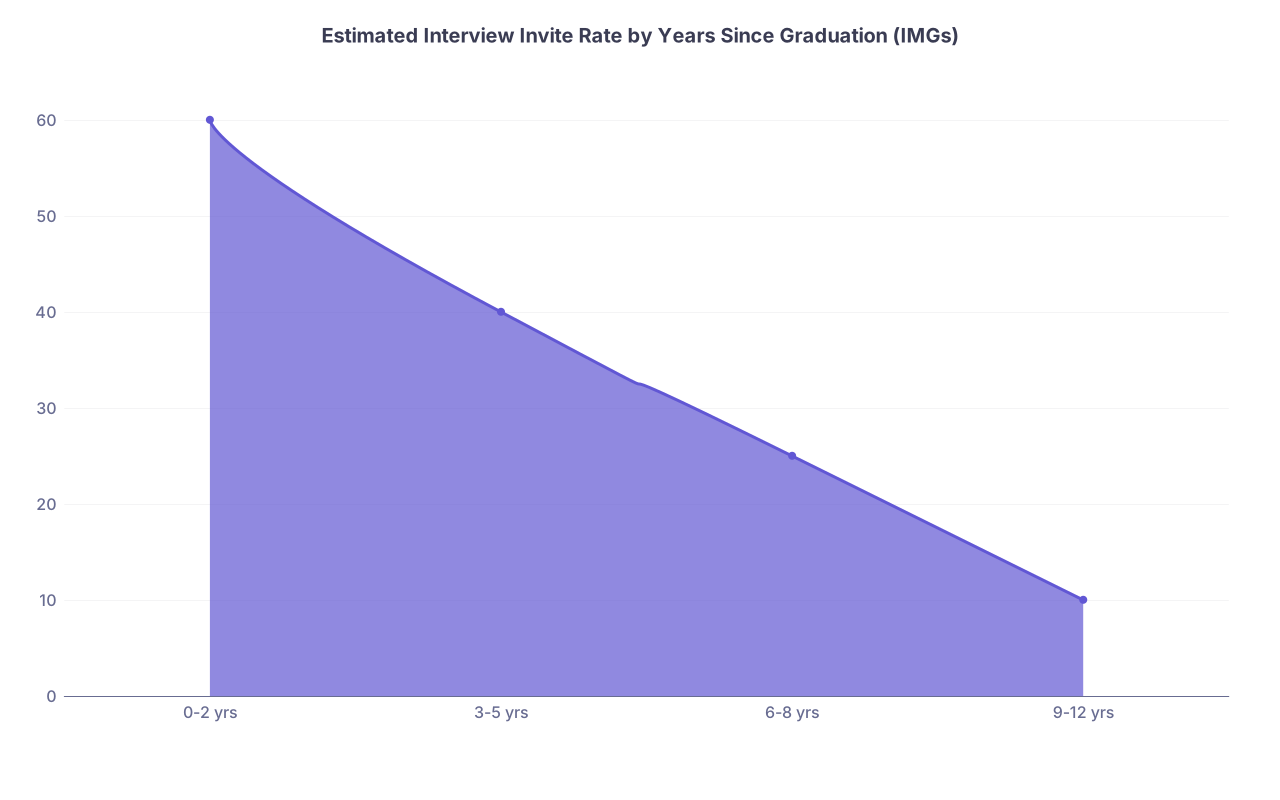
| Category | Value |
|---|---|
| 0-2 yrs | 60 |
| 3-5 yrs | 40 |
| 6-8 yrs | 25 |
| 9-12 yrs | 10 |
Again: these are broad approximations assuming average+ scores and no catastrophic red flags. The shape of the curve is what matters.
4.1 0–2 years since graduation
Impact of a 1‑year gap here is small if:
- You have Step 2 CK done with a solid score.
- You have at least some U.S. experience or strong home‑country clinical letters.
- Your explanation is clean (e.g., “Dedicated full time to exam prep and completed two observerships in internal medicine”).
In this range, other factors (scores, visa status, school reputation) dominate.
4.2 3–5 years since graduation
This is the “yellow zone.”
A one‑year gap without clear structure starts to matter more because you are no longer “fresh” by default. To neutralize this, you need:
- Evidence of ongoing clinical work in at least 2 of the last 3 years.
- Strong, recent letters (within 12–18 months).
- A narrative that shows logical career progression, not drifting.
If your extended time is mostly educational (MPH, research fellowship) plus some clinical, programs often view this as a positive—especially in IM, psych, and FM.
4.3 6–10 years since graduation
At this point, the base rate of matching drops significantly unless you:
- Are applying to less competitive specialties (FM, psych, some IM programs).
- Can show substantial, recent clinical practice—ideally full‑time, supervised.
- Have at least one very strong, recent U.S. letter.
I have seen late graduates succeed, but the data pattern is unforgiving: they apply to more programs, get fewer interviews per application, and rely heavily on targeted networking and specific IMG‑friendly programs.
4.4 More than 10 years since graduation
This is the “need a strong angle” zone.
You will need one or more of:
- Extensive, continuous clinical practice with real responsibility.
- A second advanced degree (MPH, PhD) tied to your clinical focus.
- Significant research or publications.
- A personal story that justifies the delay but also proves readiness now.
Even then, your realistic target list narrows. Most larger academic programs will pass; you should focus on historically IMG‑friendly community programs and locations with high physician shortages.
5. Specialty Differences: Some Care More Than Others
Not all specialties weigh time off equally. The data and PD comments show clear differences in tolerance.
| Specialty | Sensitivity to Gaps* |
|---|---|
| Family Medicine | Low |
| Psychiatry | Low–Moderate |
| Internal Medicine | Moderate |
| Pediatrics | Moderate–High |
| General Surgery | High |
| Radiology / Anesthesia | Very High |
*“Sensitivity” here means how much time since graduation and gaps tend to hurt your chances, all else being equal.
Family medicine and psychiatry often focus more on interpersonal skills, language fluency, and long‑term commitment. They tend to tolerate older graduates and more complex timelines if recent clinical work is strong.
Procedural and more competitive specialties (surgery, radiology, anesthesia) prioritize recency of training and technical ramp‑up. For IMGs, being more than 3–5 years out with gaps is usually highly damaging unless you are exceptional on every other axis.
6. Turning a Gap into an Asset: A Data-Driven Strategy
You cannot erase years. You can change what those years say about you.
Here is the cleanest way to think about it: your goal is to increase your “recent clinical signal” and decrease “timeline uncertainty.”
6.1 Build a “recency cushion” before you apply
You want the 12–24 months before your ERAS submission to look dense and coherent. For IMGs with prior gaps or older graduation year, that means:
- Seek at least 6–12 months of back‑to‑back clinical roles: U.S. externships, observerships (less ideal but better than nothing), research with patient contact, or home‑country practice with clear supervision.
- Secure 2–3 letters from that recent period.
- Time Step 2 CK so your strong score is also recent (within 2–3 years of application).
The data pattern is clear: applicants who can show at least one year of dense clinical or quasi‑clinical activity right before applying have substantially better interview yields, even with earlier gaps.
6.2 Make your explanation specific and unapologetic
Program directors are allergic to vague phrases. “Personal issues” raises more red flags than it hides.
Better structure:
- One clear sentence about what happened.
- One sentence about how you maintained or refreshed your medical knowledge.
- One sentence about how that period strengthened your commitment or skills.
You are not writing a confession. You are demonstrating control over your own story.
6.3 Align your gap activities with your specialty narrative
If you are applying to internal medicine:
- Use your gap for outcomes research, quality improvement roles, chronic disease management clinics, telemedicine work, or hospital medicine assistance.
For psychiatry:
- Mental health NGO work, counseling training, research in mood or psychotic disorders, addiction services involvement, etc.
The more your “time off” looks like “time preparing exactly for this specialty,” the less anyone cares about the calendar gap itself.
7. A Practical Decision Framework: Should You Take or Extend a Gap?
If you are pre‑gap, or debating whether to extend one more year, use a cold, analytical filter. Emotion will mislead you here.

| Step | Description |
|---|---|
| Step 1 | Need/want gap or already have one |
| Step 2 | Gap acceptable; explain clearly |
| Step 3 | High risk; shorten or add structure |
| Step 4 | Proceed but emphasize recency in CV/PS |
| Step 5 | Delay apps and build clinical record |
| Step 6 | Apply but target IMG-heavy programs |
| Step 7 | Consider alternate plans or longer prep |
| Step 8 | Years since graduation on ERAS date |
| Step 9 | Will gap be <= 1 yr and structured? |
| Step 10 | Can you add strong recent clinical work? |
| Step 11 | Can you secure 12+ months of current clinical? |
If your planned or existing gap does not produce either:
- Measurable outputs (scores, publications, certifications), or
- Measurable recent clinical activity,
then from a data perspective, it is a liability.
If it does produce outputs, it often becomes neutral or mildly positive—even if Reddit screams otherwise.
8. The Bottom Line: Does Extended Time Off Really Matter?
Here is the summary, stated plainly.
- Time since graduation strongly affects match odds for IMGs. That is clear in the data.
- Gap years themselves are not fatal. Unexplained, non‑clinical, and unproductive gaps are what hurt you.
- The “danger zone” starts around 3–5 years after graduation, intensifies after 5, and becomes severe after 10, unless you have strong counterbalancing factors.
- Recent, dense, clinically relevant activity within 1–2 years of application can partially offset older graduation and earlier gaps.
- Specialty choice and program targeting matter. Family medicine and psychiatry are more forgiving; surgery and high‑competition specialties are far less so.
Your job is not to magically erase time. Your job is to change how that time is interpreted.
If you treat every year—gap or not—as an opportunity to build evidence that you are clinically current, committed, and predictable, the calendar stops being your enemy and becomes just another variable you have controlled as well as possible.
With that mindset and a realistic read of your own numbers, you can make smart, data‑driven choices about when to apply, where to apply, and how to present your path—even if it has been far from straight.
FAQ (4 Questions)
1. I graduated 6 years ago with a 240+ Step 2 CK but have 3 years of non‑clinical work. Do I still have a chance as an IMG?
Yes, but your baseline odds are lower than a recent graduate with the same score. To improve your chances, you should prioritize 6–12 months of recent clinical activity (U.S. or supervised home‑country work) before applying, obtain fresh letters, and be very specific in your explanation of the non‑clinical period. Without that “recency cushion,” most programs will view you as too risky despite the good score.
2. Is a one‑year dedicated study gap between graduation and Step 2 CK a problem?
For IMGs applying within 1–2 years of graduation, a single, well‑explained study year is usually acceptable, especially if you come out with a strong Step 2 CK score and at least some observerships or electives. It becomes more of an issue only when combined with additional unstructured gaps or when total time since graduation exceeds 3–5 years without compensating clinical work.
3. Does doing an MPH or research fellowship in the U.S. “reset” my time since graduation in PDs’ eyes?
It does not reset the calendar, but it significantly improves how those years are perceived, especially if the work is clinically relevant and produces tangible outputs (papers, presentations, meaningful projects). Programs still see your original graduation year, but a strong MPH or research track record can move you from “older, risky” to “experienced, academically engaged,” particularly in internal medicine, psych, and some pediatrics programs.
4. I already have a 4‑year unexplained gap. Should I apply now or spend 1–2 years rebuilding my application first?
From a data standpoint, investing 1–2 years in structured clinical or academic activity before applying will almost always improve your odds compared with applying immediately with a large, blank gap. You may end up applying 5–6 years after graduation instead of 4, but with much stronger recent evidence of competence. For most IMGs in this situation, the interview yield gains from rebuilding outweigh the small additional penalty from extra elapsed time. With these foundations in place, you will be better positioned not just to submit an application, but to have one that actually competes. The strategy for where and how widely to apply—that is the next problem to solve.