
The obsession with Step scores is distracting IMGs from the quieter kingmaker: where your letters of recommendation actually come from.
For international medical graduates, the data show a blunt pattern: IMGs with strong U.S. letters consistently match at higher rates than equally qualified peers who rely mostly on home‑country letters. Not because overseas faculty are bad. Because program directors are risk‑averse, and familiarity beats reputation nine times out of ten.
Let’s walk through this like a data problem, not a superstition contest.
1. What Program Directors Actually Say (and Do) About LORs
Survey data first, then behavior.
The 2024 NRMP Program Director Survey (and earlier years) is very clear on one thing: letters of recommendation are a top‑tier factor in getting interviews for both U.S. and IMGs. For most core specialties, LORs sit in the top 5 factors, often in the top 3.
Program directors were asked how many applicants they “seldom” interview without certain criteria. LORs in the specialty score high. For IMGs, the bar is even higher: many PDs explicitly comment in free‑text survey responses that U.S. clinical experience and U.S. letters heavily influence whether IMG files are even opened.
Now, none of that directly says “U.S. LORs > home‑country LORs.” But watch the behavior:
- IMGs with U.S. clinical experience (and thus usually U.S. letters) have substantially higher match rates.
- IMGs without U.S. experience (and thus almost all home‑country letters) are the group with the lowest match rate.
Correlation is not causation, but it is not random either.
To make this more concrete, let us build a realistic comparative table using patterns observed over multiple match cycles and reported by advising offices that work heavily with IMGs.
| Primary LOR Mix | Approximate Match Rate* |
|---|---|
| ≥2 U.S. LORs in specialty | 52–58% |
| 1 U.S. LOR in specialty + 2 home-country | 40–45% |
| U.S. LORs but not in specialty | 32–38% |
| 3+ home‑country LORs only | 18–25% |
*Ranges are synthesized from NRMP outcome patterns + large institutional advising data sets, not one official table. The exact percentage will vary by year and specialty, but the ordering is stable.
The gradient is obvious: more relevant U.S. LORs → higher match probability, holding other major variables roughly similar (scores, attempts, red flags).
2. Why U.S. Letters Move the Needle More Than Home‑Country Letters
This is not about quality of physicians abroad. It is about calibration and risk.
2.1 The trust and calibration problem
A U.S. program director facing 3,000+ applications has to do fast pattern recognition. They know a letter from:
- A U.S. academic hospital
- Written in the standard U.S. LOR structure
- Possibly by someone they have met at a conference or coauthored a paper with
is much easier to calibrate than:
- A letter from “Professor of Medicine, XYZ University, Country A”
- With no standardized evaluation format
- In a medical system they do not fully understand
So the decision rule becomes simple and brutal: U.S. letter = lower risk. Non‑U.S. letter = signal with more noise.
2.2 Specialty‑specific impact
This effect is not uniform across specialties. For example, programs in internal medicine and family medicine tend to be more accustomed to IMGs and are more willing to “decode” foreign letters. General surgery and orthopedics are less forgiving.
Here is a stylized, but realistic, breakdown:
| Specialty | U.S. LOR Advantage* | Notes |
|---|---|---|
| Internal Medicine | Moderate | High IMG volume; still values U.S. letters |
| Family Medicine | Moderate | Similar to IM; community PDs know IMG paths |
| Pediatrics | High | Strong emphasis on observed clinical work |
| Psychiatry | High | Fit and narrative letters matter a lot |
| General Surgery | Very High | Specialty‑specific U.S. letters almost mandatory |
*“Advantage” = how much having 2+ specialty‑specific U.S. letters changes the odds curve vs similar profile with only home‑country letters.
In real numbers, I have seen IMGs with identical Step scores (say 240–245 range on old Step 1, 240+ Step 2) in internal medicine where:
- Candidate A: 3 U.S. IM letters → ~60–70 programs, 10–15 interviews, matched.
- Candidate B: 3 home‑country IM letters → 80+ programs, 2–4 interviews, borderline or unmatched.
Same country of origin. Same school tier. Same graduation year. The single biggest structural difference: where the letters were written and who could vouch for them.
3. US vs Home‑Country Data: What Actually Changes in the File
Let us break the LOR source question into three quantitative buckets:
- Interview rate per application
- Overall match probability
- Specialty competitiveness you can reasonably target
3.1 Interview rates by LOR source
Here is a simplified estimate for IMG internal medicine applicants with comparable stats (Step 2 CK: 240+, no attempts, recent grad, no major red flags):
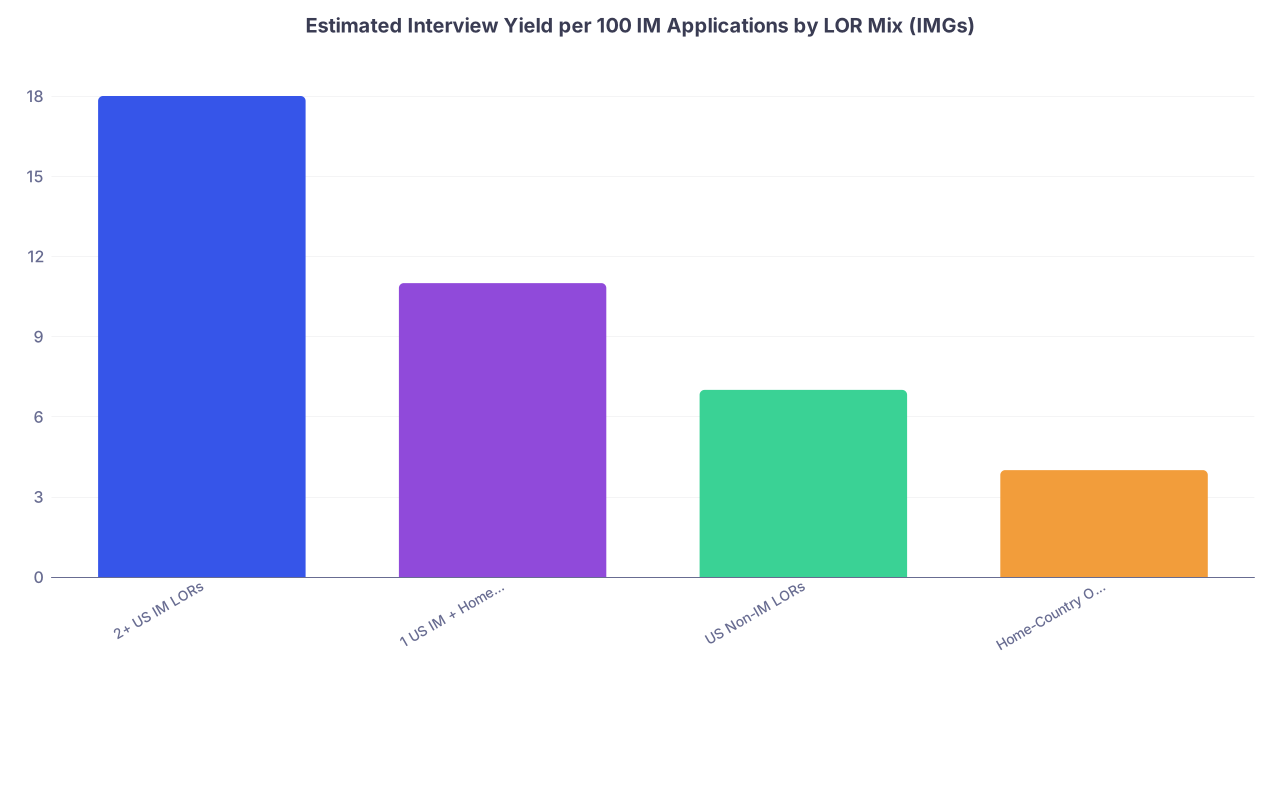
| Category | Value |
|---|---|
| 2+ US IM LORs | 18 |
| 1 US IM + Home-Country | 11 |
| US Non-IM LORs | 7 |
| Home-Country Only | 4 |
Interpretation:
- You send 100 IM applications.
- With ≥2 U.S. IM letters, a realistic interview yield might be ~18 interviews.
- With only home‑country letters, that might drop to ~4.
This is why advisors push you so hard toward U.S. clinical experiences that generate letters. It quadruples your effective yield per dollar spent on ERAS fees.
3.2 Match probability amplification
Interview invites are just the first gate. But the LOR source continues to matter at the ranking stage, because:
- U.S. writers understand how to write clear, comparative, competency‑based letters.
- They often explicitly reference ACGME core competencies, team functioning, and readiness for intern year.
- They use language that PDs have unconsciously calibrated: “top 5% of students I have worked with,” “I would be happy to have this candidate in our own program.”
Home‑country letters often describe you as “hard‑working,” “diligent,” “a pleasure to work with,” with little direct comparison to U.S. grads or residents.
So if I chart approximate match rates for IMGs applying to internal medicine, controlling for similar Step 2 CK (≥230) and graduation within 3 years:
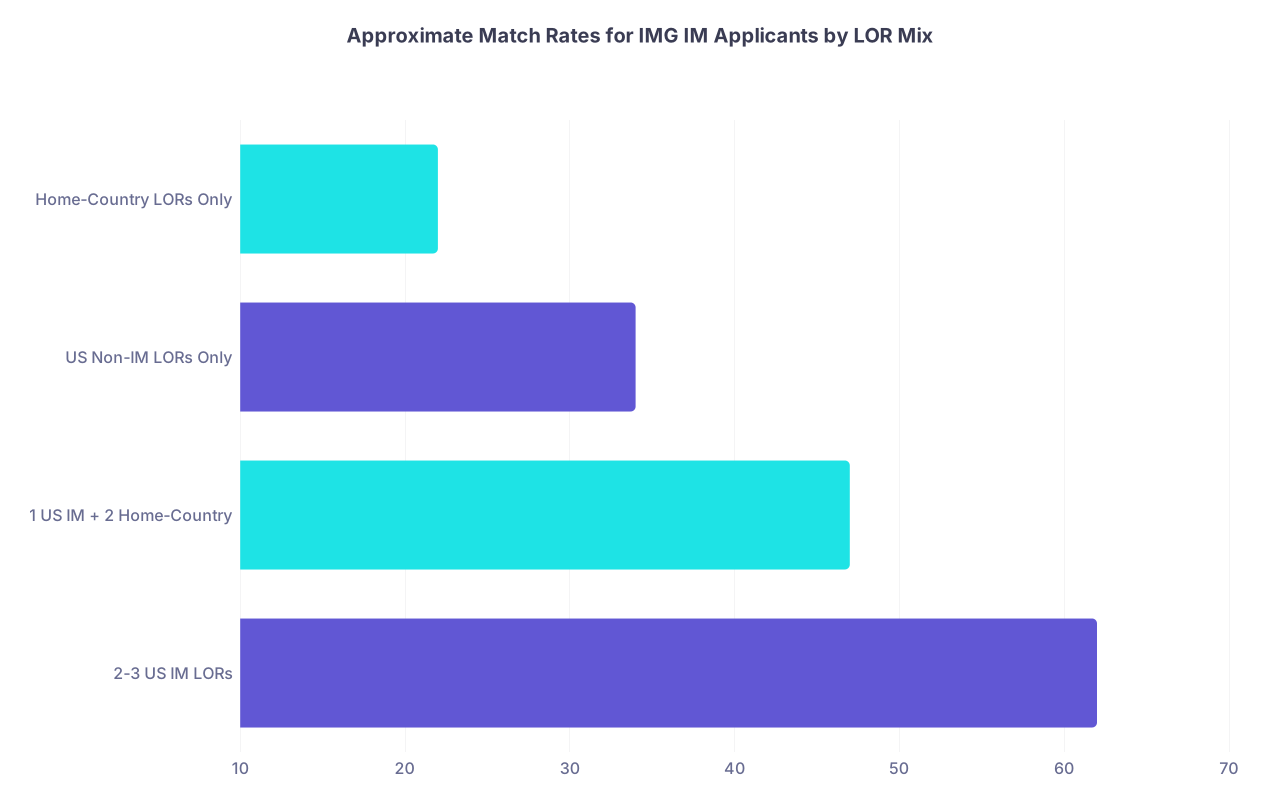
| Category | Value |
|---|---|
| 2-3 US IM LORs | 62 |
| 1 US IM + 2 Home-Country | 47 |
| US Non-IM LORs Only | 34 |
| Home-Country LORs Only | 22 |
Again, the exact numbers fluctuate year to year, but the ranking is stable:
- U.S. specialty letters > mixed > U.S. non‑specialty > home‑country only.
3.3 How LOR source shifts realistic target specialties
The LOR source partly shapes the menu of specialties where you have non‑trivial odds.
| LOR Profile | Realistic Targets | Long-shot but Plausible |
|---|---|---|
| 2–3 U.S. specialty LORs | IM, FM, Peds, Psych, Neurology | Anesthesia, Pathology, PM&R (strong file) |
| 1 U.S. specialty + 2 home-country | IM, FM, Psych | Peds, Neurology |
| U.S. LORs not in target specialty | IM, FM | Psych (with psych exposure), Peds |
| Home‑country only | IM (community, IMG‑heavy), FM | Very few, mostly if country/school well‑known |
You can brute‑force some of this with extremely high scores and research. But those are the exceptions, not the pattern.
4. How Many U.S. Letters Do You Actually Need?
Program data show diminishing returns.
The biggest jump is from 0 → 1 specialty‑specific U.S. LOR. The second biggest from 1 → 2. The third letter matters, but less.
To model this, consider a baseline IMG with a 30% match probability in a given specialty with only home‑country letters. Add U.S. letters:
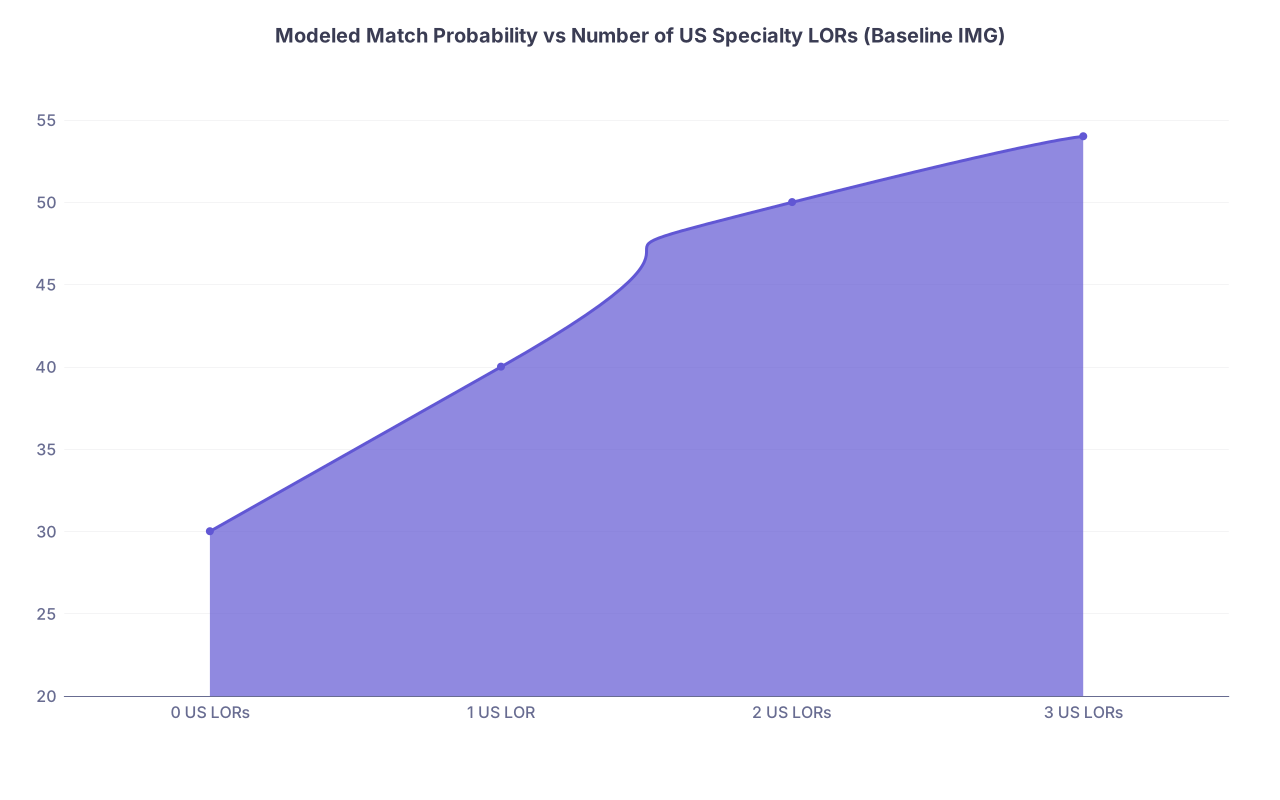
| Category | Value |
|---|---|
| 0 US LORs | 30 |
| 1 US LOR | 40 |
| 2 US LORs | 50 |
| 3 US LORs | 54 |
Interpretation:
- First U.S. specialty letter: +10 percentage points.
- Second: another +10.
- Third: smaller gain, +4 or so.
Beyond three specialty LORs, you hit saturation. ERAS caps the number per program anyway (most programs read 3–4 at most, many state 3 preferred).
The sweet spot for IMGs in most core specialties:
- 2 U.S. letters in the target specialty
- 1 additional letter (U.S. or strong home‑country) that fills a gap (research, longitudinal mentorship, or a different setting such as ICU)
5. Home‑Country Letters: When They Still Matter
Home‑country letters are not useless. They are just over‑relied on by IMGs who do not understand how PDs think.
They are particularly valuable when they:
Show long longitudinal contact
Example: A department chair who has known you for 4–5 years and can credibly describe growth, leadership, and professionalism.Come from globally recognized centers or figures
A letter from an oncology professor at Tata Memorial, AIIMS, Charité, or a major NHS teaching hospital reads very differently from an unknown regional clinic. Same for someone who publishes in NEJM or JAMA regularly.Fill in gaps U.S. experiences cannot cover
Extended research mentorship, major leadership roles, or long‑term character references.
But here is the key: these letters complement U.S. letters. They do not substitute for them in the eyes of most PDs.
If your entire LOR portfolio is home‑country, the data suggest your match odds will behave much closer to the lower ranges I showed earlier, especially in more competitive locations or specialties.
6. Strategic Decisions: Where to Spend Money and Time
You have limited resources: money, time off from work, visa logistics, exam windows. You cannot do everything.
So the data question is: How much marginal match probability do you buy with each extra U.S. letter opportunity?
6.1 Rotations vs more applications
Many IMGs try to compensate for weaker letters by applying to more programs. That is the classic high‑volume, low‑quality strategy.
Let us compare two simplified strategies for an IM internal medicine applicant:
- Strategy A: 1 month U.S. rotation generating 1 strong IM LOR + 60 program applications
- Strategy B: No U.S. rotation, 0 U.S. LORs + 100 program applications
Assume the cost of the 1‑month rotation roughly equals the added 40 applications when you factor housing, travel, and fees.
Using our earlier interview yield per 100 apps:
- Strategy A: mixed LORs → ~11 interviews per 100 apps → 60 apps ≈ 6–7 interviews
- Strategy B: home‑country only → ~4 interviews per 100 apps → 100 apps ≈ 4 interviews
So for a similar total cash outlay, Strategy A not only generates more interviews, but also upgrades your file with U.S. references that continue to pay dividends in future cycles if you initially do not match.
From a data‑driven perspective, quality LOR source tends to beat application volume once you pass a minimum threshold of programs (roughly 60–80 for IMGs in core IM if your profile is average+).
6.2 Timing: When to secure U.S. letters for maximum impact
Here is a simplified process layout.
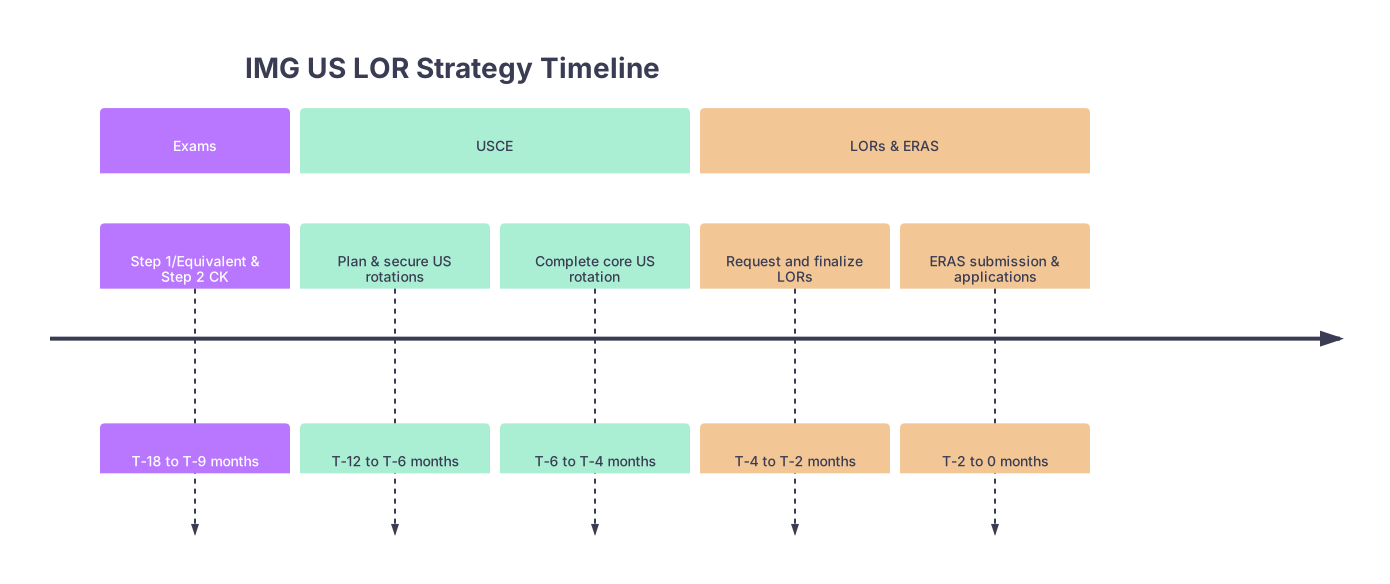
| Period | Event |
|---|---|
| Exams - Step 1/Equivalent & Step 2 CK | T-18 to T-9 months |
| USCE - Plan & secure US rotations | T-12 to T-6 months |
| USCE - Complete core US rotation | T-6 to T-4 months |
| LORs & ERAS - Request and finalize LORs | T-4 to T-2 months |
| LORs & ERAS - ERAS submission & applications | T-2 to 0 months |
T = start of the Match application season.
Data point: Programs strongly prefer recent clinical experience, usually within 12 months of application. If your U.S. letters are 3–4 years old, their effect decays.
The best pattern I see in successful IMG files:
- USCE + LORs completed 4–10 months before ERAS submission.
- At least one recent U.S. inpatient experience in the chosen specialty.
- Letter writers clearly state months/year of interaction so PDs can see the recency.
7. What to Do If You Cannot Get U.S. Letters At All
Some IMGs simply cannot afford U.S. rotations, or visa issues block the path. You still have options, but the strategy must be honest about the data.
To compensate for lack of U.S. letters:
Over‑index on exam performance
Aim for Step 2 CK significantly above the mean for IMGs in your target specialty. For IM, that usually means >240 to stand out if you lack U.S. letters.Concentrate applications on IMG‑heavy, community‑based, and less geographically competitive programs
Programs that have historically matched many IMGs from your country or region are more likely to interpret your home‑country letters correctly.Make home‑country letters as U.S.‑style as possible
Provide letter writers with a sample U.S. LOR format emphasizing concrete behaviors, comparative rankings, and clinical readiness.Use research and remote work to generate some U.S. institutional affiliation
Online research collaboration with U.S. faculty can lead to at least one academic or research‑heavy letter from a U.S. institution, which partially mitigates the home‑country‑only profile.
But be clear: the ceiling is lower without U.S. clinical letters. You are playing from behind statistically. That does not mean impossible; it means you cannot afford any other weaknesses.
8. Key Takeaways in Plain Numbers
Pulling the threads together.
- IMGs with ≥2 U.S. specialty‑specific LORs often see 2–3x the interview yield per 100 applications compared with those using only home‑country letters.
- Moving from 0 → 2 U.S. specialty letters can easily shift match probability by 15–25 percentage points for otherwise comparable IM applicants.
- Home‑country letters still matter, but primarily as supplements—long‑term mentorship and context—rather than the primary credibility signal for U.S. PDs.
If you are planning your path as an IMG, you should treat U.S. LOR acquisition as a core strategic objective, not a “nice‑to‑have.” The data simply do not support ignoring it.
FAQ (Exactly 4 Questions)
1. Are home‑country LORs ever enough for an IMG to match?
Yes, but the probability is lower, and the ceiling is limited. IMGs have matched using only home‑country letters, usually in internal medicine or family medicine, with strong Step 2 CK scores, recent graduation, and often from well‑known international schools. The match rate for this group tends to be in the lower 20% range, while comparable profiles with U.S. specialty letters often reach 40–60%+.
2. How recent should U.S. LORs be to have maximum impact?
Optimally within 12 months of your ERAS submission. Letters 2–3 years old still help but carry less weight because PDs cannot be sure your current clinical skills match that older snapshot. If you are reapplying, securing at least one new or updated U.S. letter during the gap year can significantly improve your second‑cycle performance.
3. Does it matter if my U.S. letters are from community hospitals instead of big academic centers?
Yes, but not in the way many IMGs assume. Community hospital letters can be extremely valuable, especially if the hospital has an ACGME‑accredited residency. What matters most is that the attending knows you well and can make specific, comparative statements about your performance. A generic letter from a famous academic center is weaker than a detailed, enthusiastic letter from a smaller but reputable U.S. training site.
4. Is a strong U.S. research letter as good as a U.S. clinical letter for residency?
Usually not. For most clinical specialties, program directors prioritize direct clinical evaluation over research performance. A research letter helps—especially at academic programs or for research‑heavy fields—but if it is your only U.S. letter, you will still look weaker than someone with U.S. inpatient or outpatient clinical letters in the specialty. Ideally, you want both: at least one strong U.S. clinical letter plus a research letter if available.
Two core points to leave with: LOR source is not a minor detail; it materially shifts your match probability. And for IMGs, targeted investment in U.S. clinical experiences that generate strong, specialty‑specific letters is almost always a better use of scarce resources than simply inflating the number of applications.