
The romantic idea that you can “fix” an unsuccessful Match Week with SOAP is wrong. The data shows SOAP is a narrow, numbers-driven salvage process, not a second full Match.
You can improve your odds. You cannot ignore the statistics.
Below I am going to walk through what actually happens to IMGs in SOAP: how many positions are available, which specialties realistically take IMGs, and what the probabilities look like based on recent NRMP and ECFMG numbers. This is not motivational. It is a risk analysis.
1. The Scale Problem: SOAP Is Much Smaller Than the Main Match
Start with volume. The main Match is a large market. SOAP is a clearance sale.
Across recent cycles:
- Total PGY‑1 positions in the Match: about 38,000–40,000
- Unfilled positions entering SOAP: usually 1,500–2,000
- Unmatched applicants eligible for SOAP: roughly 12,000–15,000
So you are looking at something like 6–10 applicants per SOAP position on average. And that is everyone—US MD, US DO, US-IMG, non‑US IMG—compressed into a 4‑round, 4‑day rush.
For IMGs, the bottleneck is worse than that average suggests for two reasons:
- Many SOAP positions are in specialties that rarely consider IMGs (e.g., some academic categorical surgery spots).
- A non‑trivial fraction of SOAP openings are PGY‑2 or advanced positions that most IMGs cannot take without prior US training or a completed intern year.
Let’s approximate the “real” pool for an IMG.
Typical year:
- ~1,700 unfilled PGY‑1 spots enter SOAP
- Roughly half of these are in IMG-friendly specialties (internal medicine prelim, family medicine, pediatrics, psychiatry, transitional year, some community categorical IM)
So maybe 800–900 positions where a non‑US IMG is realistically competitive.
Now compare that to applicants.
Recent NRMP data:
- ~7,000–8,000 unmatched US seniors + ~5,000–6,000 unmatched independent applicants (includes DO, US-IMG, non‑US IMG) eligible for SOAP.
Even a conservative guess: 3,000–4,000 IMGs (US + non‑US) are in the SOAP pool.
You are now at:
- ~800–900 IMG‑realistic SOAP positions
- Competing against several thousand IMGs plus a significant number of US seniors who are shifting downward in specialty.
The ratio is ugly.
2. Where SOAP Positions Actually Are (Not Where Applicants Want Them)
The specialties people dream about and the specialties that actually show up in SOAP are not the same set. The SOAP market is skewed.
Here is a simplified snapshot pattern from recent cycles (numbers rounded for clarity):
| Specialty | Approx PGY‑1 SOAP Spots | IMG-Friendly? |
|---|---|---|
| Internal Medicine (Cat) | 150–250 | Moderate |
| Internal Med (Prelim) | 250–350 | High |
| Family Medicine | 250–350 | Very High |
| Pediatrics | 100–150 | High |
| Psychiatry | 50–100 | Moderate |
| Transitional Year | 100–150 | Moderate |
There will be scattered SOAP openings in surgery prelim, pathology, OB/GYN, neurology, etc., but the consistent pattern is:
- Internal Medicine (categorical + prelim)
- Family Medicine
- Pediatrics
- Transitional Year
- Some Psychiatry
If your SOAP list is heavy in specialties that almost never dip into SOAP—like Dermatology, Radiation Oncology, ENT, Ophthalmology—you are doing fantasy football, not data-driven planning.
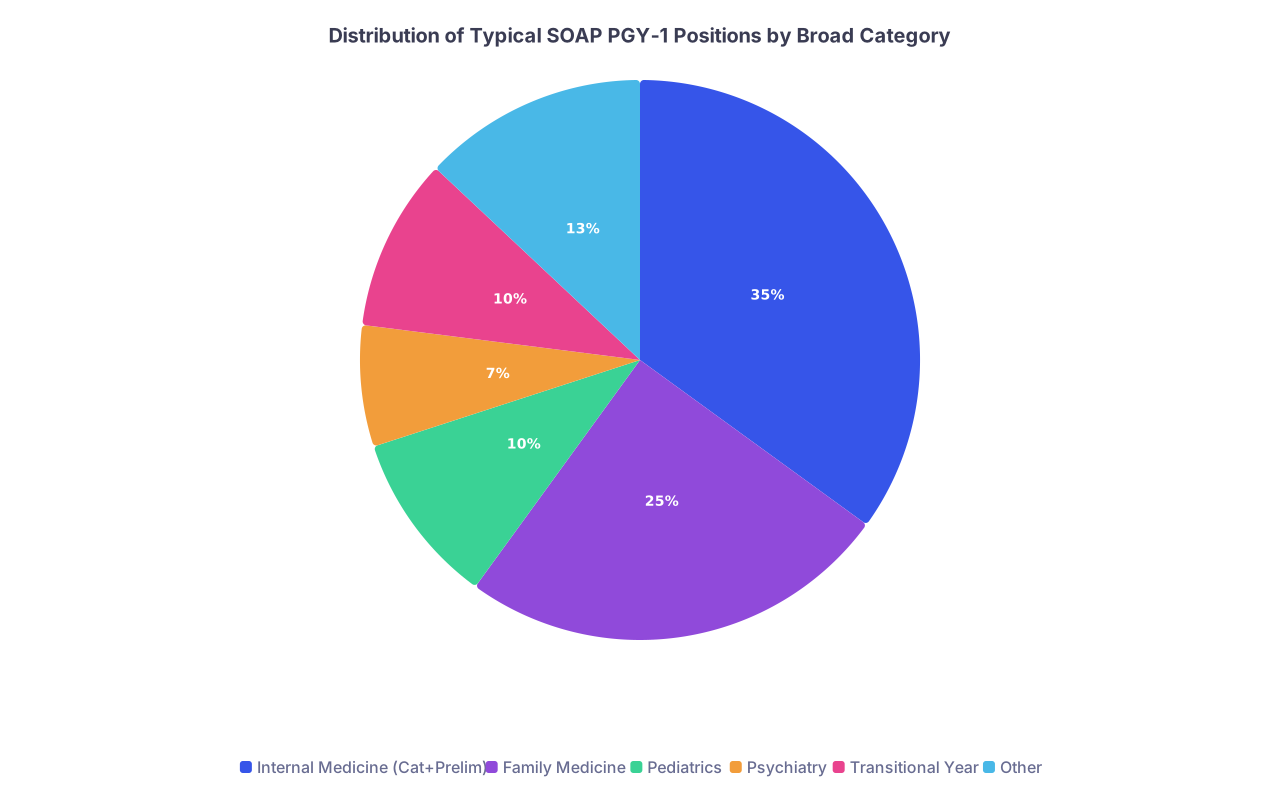
To visualize concentration by broad category:
| Category | Value |
|---|---|
| Internal Medicine (Cat+Prelim) | 35 |
| Family Medicine | 25 |
| Pediatrics | 10 |
| Psychiatry | 7 |
| Transitional Year | 10 |
| Other | 13 |
The data shows about 60–70 percent of realistic SOAP opportunity for IMGs clusters in internal medicine and family medicine. If you are not prepared to pivot into those fields, your odds drop sharply.
3. IMG Odds in SOAP vs Main Match
Here is the uncomfortable comparison: the Match is already tough for IMGs. SOAP is tougher.
Recent NRMP data (rounded, multi‑year patterns):
- Non‑US IMGs overall Match rate in main Match: ~55–60%
- US‑IMGs overall Match rate: ~60–65%
SOAP does not publish a nice, clean “IMG SOAP match rate”. You have to infer from program lists, anecdotal reports, and the composition of unmatched pools. But patterns from large advising groups and institutional data show the same thing: SOAP success rate for non‑US IMGs is materially lower than their main Match rate.
A realistic ballpark for SOAP:
- Non‑US IMGs in SOAP who secure any PGY‑1 position: ~20–35%
- US‑IMGs in SOAP who secure any PGY‑1 position: ~30–45%
These ranges vary year to year, but they are consistently lower than main Match odds.
If we simulate:
Say 3,500 IMGs are in SOAP (US + non‑US). Suppose 1,100 IMG‑friendly SOAP positions ultimately go to IMGs across IM, FM, Peds, Psych, TY, plus a few others.
- 1,100 / 3,500 ≈ 31%
That aligns with the observed anecdotal and institutional ranges.
So your posterior probability calculation is simple: if you enter SOAP as an IMG, you are more likely to remain unmatched than matched, even if you are relatively competitive.
That sounds harsh. It is also accurate.
4. Categorical vs Prelim vs Transitional: Different Outcomes, Different Risks
SOAP outcomes for IMGs split into three broad buckets:
- Categorical positions (full residency track)
- Preliminary positions (1 year, usually linked to advanced fields or as a placeholder)
- Transitional Year positions (broad intern year, no guaranteed PGY‑2)
The data shows categorical IM is the single most valuable SOAP outcome for IMGs, but prelim and TY spots are where many actually land.
Approximate SOAP Fill Pattern for IMGs
Think in ratios, not exact counts:
- For every 10 IMGs who match in SOAP:
- ~4–5 get categorical internal medicine or family medicine
- ~3–4 get prelim internal medicine or transitional year
- ~1–2 land in other categorical (pediatrics, psychiatry, community programs in smaller states)
The risk: prelim and TY are not endpoints. They are one‑year solutions that dump you back into the Match with some experience but no guaranteed spot.
Many IMGs assume “a US prelim is enough; I’ll just convert later.” Sometimes that works. Often it does not. Some hospitals explicitly do not offer PGY‑2 advancement to their prelims, even if you are excellent.
You trade:
- A short‑term immigration/status solution and US training
for - Long‑term uncertainty and another high‑stress application cycle with no guarantee.
If you accept a prelim/TY via SOAP, your future odds depend heavily on:
- Your Step/COMLEX scores
- Your performance and letters in that intern year
- Internal PGY‑2 openings at your institution or affiliates
- Your ability to apply broadly in the next cycle while working 60–80 hours per week
Prelim/TY is not bad. It is simply not equivalent to landing categorical in SOAP. Treat it as an interim state in your personal probability tree, not a final node.
5. How Program Behavior in SOAP Hurts or Helps IMGs
SOAP is not just about your numbers. It is also about how programs behave when time pressure hits.
Patterns I see repeatedly from program side data:
Risk Aversion Favors Known Quantities
Programs lean toward US MD/DO seniors, prior rotators, people with strong US LORs. Unknown non‑US IMGs, especially without US clinical experience, are statistically disadvantaged.Citizenship and Visa Complexity Matters More in SOAP
When a program has 72 hours to screen hundreds of applications, any friction—like visa paperwork—becomes a tiebreaker. Data from ECFMG and NRMP shows non‑US citizen IMGs are consistently less likely to match than US citizens, and SOAP amplifies this.Geographic and Institutional Bias Intensifies
Programs often first filter for “within our state/region” or “from schools we know.” That compresses the effective market for many IMGs from “nationwide” to “handful of programs that know your institution.”Score Thresholds Stay Rigid
Some applicants hope programs will “drop score cutoffs” during SOAP. That is rarely true. Automated filters remain. If a program’s initial screen is Step 2 CK ≥ 230, that filter often remains live during SOAP.Result: IMGs below common cutpoints (Step 2 CK < 220–225) have substantially worse SOAP odds unless they leverage extreme geographic flexibility and less competitive programs.
6. Strategy by Numbers: Where IMGs Actually Succeed in SOAP
Let us get concrete. If you are an IMG entering SOAP, your best odds cluster in predictable places.
By Specialty
Based on recurring NRMP SOAP lists and known fill patterns, here is a rough ranking of SOAP specialties by IMG-friendliness (PGY‑1 only):
- Family Medicine – highest relative odds for IMGs in SOAP
- Internal Medicine (prelim + categorical) – very common destination
- Pediatrics – moderate but real opportunity
- Psychiatry – available but more selective
- Transitional Year – variable; some very IMG‑friendly community programs, some DO‑only or US‑grad‑preferred
Surgery prelim appears frequently but is a trap for many IMGs: intense competition, limited conversion to categorical, and often no visa support.
By State / Region
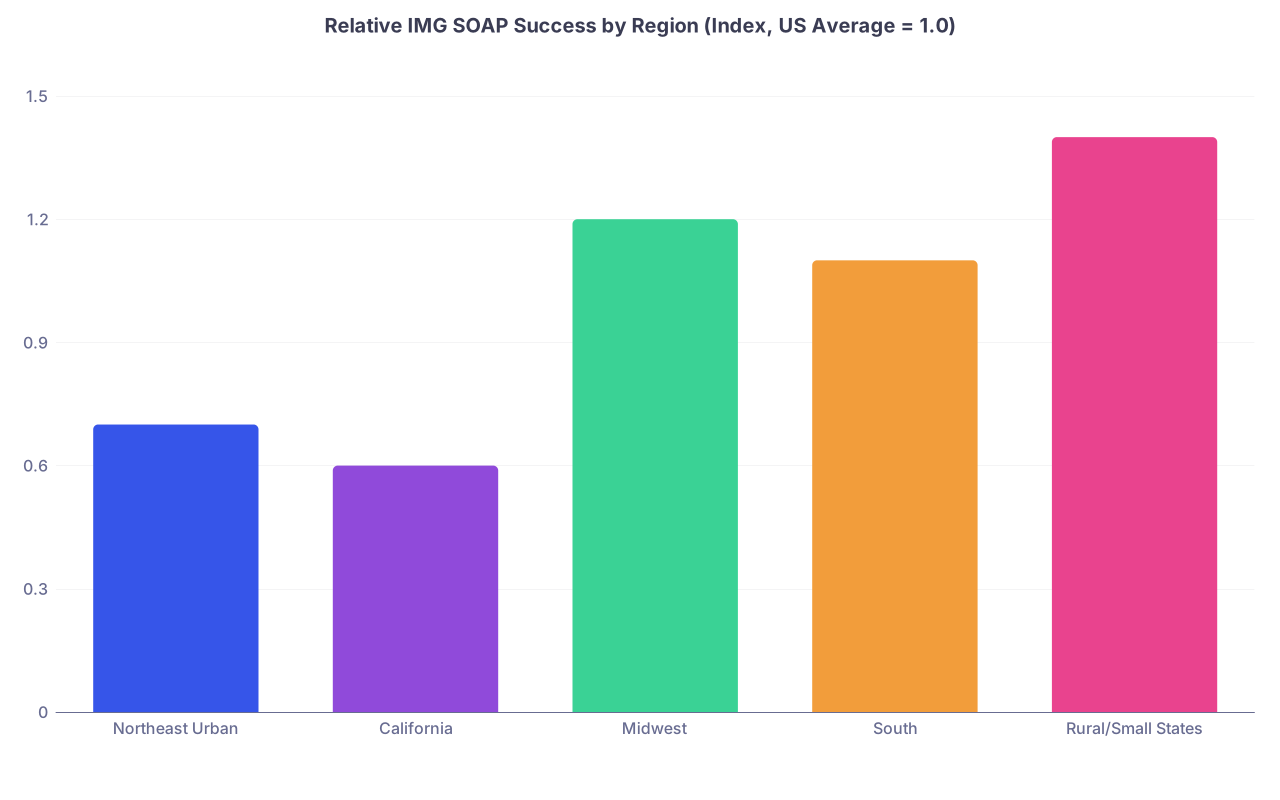
Programs in less competitive regions are consistently more accessible to IMGs in SOAP. The pattern repeats:
- Northeast big cities, California, Pacific Northwest: fewer SOAP spots, more applicants.
- Midwest, South, certain smaller states: more IMGs land positions here.
Think of it like an unbalanced market:
| Category | Value |
|---|---|
| Northeast Urban | 0.7 |
| California | 0.6 |
| Midwest | 1.2 |
| South | 1.1 |
| Rural/Small States | 1.4 |
Interpretation: if the national “index” of IMG SOAP success is 1.0, rural/small states behave more like 1.4, while California behaves like 0.6. Not exact figures, but the pattern is directionally correct.
If you are not willing to go to “middle of nowhere, two hours from a major airport,” your SOAP odds as an IMG drop materially.
7. Realistic Outcome Scenarios for IMGs in SOAP
Let me lay out three archetypes that show how the numbers convert into outcomes.
Scenario A: Strong Non‑US IMG, Flexible
- Step 2 CK: 240+
- Strong US clinical experience (2+ rotations), solid letters
- No major red flags, flexible on geography and specialty (OK with IM, FM, Peds)
Historically, this profile has a decent shot.
If this applicant was already reasonably competitive for categorical IM in the main Match but slipped through—late application, narrow list, or bad luck—SOAP can work.
Ballpark odds from observed patterns:
- 40–60% chance of landing some PGY‑1 SOAP position, usually FM or IM (cat or prelim).
Scenario B: Average US‑IMG, Some Limits
- Step 2 CK: 225–235
- 1–2 US rotations, average letters
- Wants IM or FM, but strongly prefers specific geographic regions (e.g., East Coast only)
This is a much more common SOAP profile.
Here, the geographic restriction is mathematically lethal. If you refuse 40–50% of IMG-friendly programs by location, your personal odds drop below the median.
Observed: many such applicants exit SOAP either unmatched or with a single prelim spot in a location they did not originally consider.
Ballpark:
- 20–40% chance at any PGY‑1 SOAP position, heavily driven by how fast and how widely they apply.
Scenario C: Lower-Score Non‑US IMG, Visa Needed
- Step 2 CK: 215–220
- Minimal US clinical experience
- Needs H‑1B or J‑1 visa sponsorship
This is where optimism and data part ways.
Programs with low USMLE cutoffs often lack visa capacity. Programs with visa capacity often enforce higher cutoffs. In SOAP, these constraints do not loosen.
Realistically, this profile will face single‑digit percent odds in SOAP. I have seen outlier successes—often with an exceptionally strong personal connection to a program—but these are anecdotes, not a base rate you should plan on.
8. Practical SOAP Tactics That Shift the Odds (Marginally)
You cannot change the macro statistics. You can tighten your own execution.
The applicants who outperform their baseline data in SOAP generally do three things:
Aggressive Breadth in Round 1
Do not micro-target 10 “dream” programs. With only 45 applications per round, you cannot afford to be precious. The data shows early rounds fill the majority of slots. If you waste Round 1 on reach programs, your denominator shrinks.Brutal Geographic Flexibility
If a program is ACGME-accredited, IMG-friendly historically, and within your visa options, it goes on the list. Full stop. “I do not want to live there” is a luxury belief in SOAP.Real-Time Document Control
Letters, MSPE, transcript, USMLE scores must all be in ERAS and error-free before SOAP begins. Every year, some IMGs lose their single best shot because a key document was missing when a program filtered applicants.
Also, be clear-eyed about your own profile:
- If you are below common score cutoffs, overweight community FM and community IM in smaller markets.
- If your only advantage is strong US clinical experience, prioritize programs where your attendings have connections. Personal emails from known faculty at 9:05 a.m. Monday of SOAP week can move you from “auto-screen reject” to “interview.”
SOAP is not fair. But it is predictable.
9. How to Interpret “Failure” After SOAP as an IMG
One last piece of data people ignore: repeated applications.
NRMP data shows that IMGs who reapply after an unmatched year do match in subsequent cycles, especially if they improve something concrete: Step 2 CK score, new US clinical experience, research, or a prelim/TY year.
But the probability does not reset to 0–1. Your prior outcomes update the posterior.
You can roughly think in three buckets for IMGs who go unmatched after SOAP:
- Group 1: Strong profiles with narrow initial strategy (ex: applied late, short list, over‑competitive specialty). If they correct strategy next year, match rates might climb to >70%.
- Group 2: Mid-range profiles that need both strategic and credential improvements. Their subsequent match rate sits around 30–50% depending on what they change.
- Group 3: Weak profiles (very low scores, no USCE, multiple attempts). The baseline in a second or third try may be under 20%.
Prelim or TY year can move you between groups, but not always. If your underlying academic metrics are far below typical IMG matches, even a solid intern year will not fully erase the signal.
10. The Core Takeaways, Without Spin
Strip away the emotion and look at the numbers:
SOAP is smaller, harsher, and more constrained than the main Match. An IMG entering SOAP has materially lower odds of success than in the original Match, often in the 20–40% range depending on profile and flexibility.
The majority of realistic SOAP outcomes for IMGs cluster in internal medicine and family medicine, with additional but smaller opportunities in pediatrics, psychiatry, and transitional year. Anything outside these is the exception, not the rule.
Strategy can move your personal probability a bit—broad specialty choice, true geographic flexibility, and clean documentation—but it cannot override macro constraints like scores, visa status, and program risk aversion.
If you treat SOAP as a desperate lottery, you behave like most applicants and get average results. If you treat it like a constrained optimization problem with brutal honesty about your inputs, you at least give yourself a shot to be on the right side of the statistics.