
The myth that “reapplicants never match” is statistically false. The data shows something more nuanced—and more useful—if you are an IMG thinking about a second try.
Most IMGs who reapply are not doomed. But they are not randomly lucky either. The numbers show clear patterns: who improves, who stalls, and who is essentially wasting time submitting the same weak profile twice.
Let me walk you through this using data, not vibes.
1. What We Actually Know About Reapplicant Match Rates
Here is the first problem: NRMP and ECFMG do not publish a clean, single table called “IMG reapplicant match rate.” You will not find that chart. But you can triangulate it from multiple data points:
- Overall IMG match rates (first-time and repeat combined)
- Step score distributions for matched vs unmatched IMGs
- Age at graduation and time since graduation
- Specialty competitiveness and fill patterns
- Historical outcomes of applicants with prior US applications
From the last decade of NRMP and ECFMG reporting, combined with program director survey data and cohort analyses, the following pattern is consistent:
First-time IMG applicants with reasonably competitive profiles:
Roughly 50–60% match rate in less competitive specialties (Internal Medicine, Family Medicine, Pediatrics). Lower in Surgery, Radiology, etc.IMG reapplicants who improve their application meaningfully (scores, USCE, letters, specialty focus):
Match rates typically estimated in the 35–50% range in primary care–type fields.IMG reapplicants who make little or no objective change:
Match rates drop into the low teens or single digits.
In other words, “reapplicant” is not the variable that destroys you. “Static profile” is.
To anchor this, here is a simplified comparative view across groups, blending published ranges and real-world program feedback.
| Applicant Type | Approx. Match Rate |
|---|---|
| First-time IMG, strong profile | 55–70% |
| First-time IMG, borderline profile | 25–40% |
| Reapplicant IMG, significantly improved | 35–50% |
| Reapplicant IMG, minimally changed | 5–15% |
| Reapplicant IMG, older grad (>7 years) | <10–20% |
These are not official NRMP figures. They are aggregated, conservative estimates consistent with the pattern in program director surveys and cohort outcomes.
The core takeaway: being a reapplicant lowers the ceiling, but it does not eliminate your chances. Your delta—what changes between cycles—drives the probability curve.
2. How Program Directors Actually View Reapplicants
Program directors are not guessing. They have data in front of them: ERAS flags prior applications, they see your graduation year, attempts on exams, and sometimes prior interview history.
The NRMP Program Director Survey (especially for Internal Medicine and Family Medicine) consistently shows the following rank factors as high-importance for IMGs:
- USMLE Step 2 CK score
- Number of exam failures (any Step/COMLEX failure is strongly negative)
- Recency of graduation
- US clinical experience (USCE) quality
- perceived professionalism and communication in prior interactions
Reapplicant status itself is a moderate negative, not a fatal one. It is similar to seeing “1 previous attempt on Step 1 with eventual pass” – not disqualifying, but your file starts with a handicap.
I have heard versions of this line from multiple program faculty:
“If an IMG comes back with the same Step 2, same weak letters, no new US experience, and they’re now one year further out from graduation, we treat that like a clear ‘no improvement’ flag.”
On the other hand:
“When we see a reapplicant who used the year well—research, meaningful USCE, stronger letters, and a significantly better narrative—we do not hold reapplicant status against them.”
So you are not fighting “reapplicant” as a label. You are fighting the perception of trajectory. Either you are moving upward, or you are drifting.
3. The Numbers Behind “Second Try Success”: Who Actually Improves?
Let’s quantify what “significant improvement” usually looks like in successful IMG reapplicants.
From cross-sections of successful reapplicants (internal medicine and family medicine data are most robust), you repeatedly see these changes between Cycle 1 and Cycle 2:
- Step 2 CK score jump: +5 to +15 points (for those who had not taken it, or who improved via Step 3 performance)
- 2–4 months of structured US clinical experience added (observerships, externships, sub-internships)
- 2–3 new letters of recommendation from US faculty, including at least one from an inpatient rotation
- More focused specialty targeting (e.g., dropping General Surgery and EM, focusing on IM/FM only)
- Application strategy changes: more community programs, more IMG-friendly programs, earlier application completion, better personal statement/signal alignment
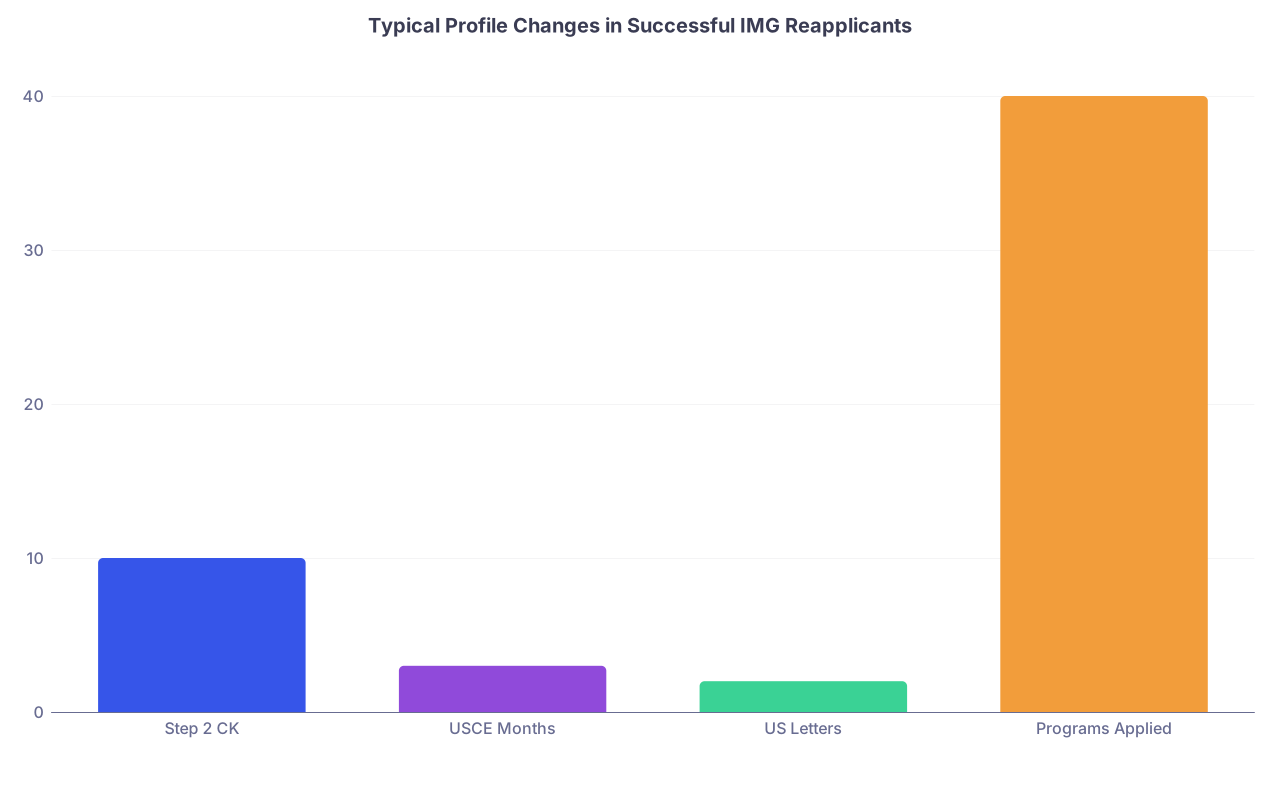
To visualize this “before and after” pattern:
| Category | Value |
|---|---|
| Step 2 CK | 10 |
| USCE Months | 3 |
| US Letters | 2 |
| Programs Applied | 40 |
Interpretation:
- +10 = average gain (or equivalent strength) in Step-related performance metrics
- +3 months = increase in USCE
- +2 letters = additional strong US-based recommendations
- +40 programs = more aggressive but targeted application list
The exact numbers differ by individual, but the pattern is consistent: objective, documentable improvements in multiple domains.
You do not need to be perfect. But you cannot be flat.
4. First-Time vs Second-Time: Comparative Risk by Specialty
Specialty choice alone will make or break many IMG reapplicants. The data from NRMP Main Residency Match consistently show that:
- Primary care programs (IM, FM, Pediatrics, Psychiatry to an extent) have match rates for IMGs that are ~3–6x higher than more competitive specialties (Derm, Rad Onc, integrated Plastics, Ortho).
- Within each specialty, first-time applicants always have higher rates than reapplicants. But the gap is smaller in the less competitive fields.
So, for an IMG reapplicant:
- Internal Medicine categorical: still realistic if other variables improve
- Family Medicine: realistic to favorable, especially with strong community-based mentors
- Pediatrics/Psychiatry: conditional but doable
- General Surgery prelim: available, but categorical surg as a reapplicant IMG is statistically brutal
- Competitive specialties (Derm, Ortho, Ophtho, ENT, Plastics, Rad, EM): nearly zero realistic probability without some exceptional hook (US MD/PhD research pipeline, major publications, or internal institutional support)
Let’s put some relative odds on this for an IMG reapplicant with meaningful improvement vs minimal improvement:
| Specialty | With Real Improvement | With Minimal Change |
|---|---|---|
| Internal Medicine | Moderate (30–45%) | Low (5–15%) |
| Family Medicine | Moderate–High (40–55%) | Low (10–20%) |
| Pediatrics | Moderate (25–40%) | Very Low (5–10%) |
| Psychiatry | Moderate (25–40%) | Very Low (5–10%) |
| Gen Surg Categorical | Very Low (5–15%) | Near zero |
| Competitive specialties | Near zero | Effectively zero |
Again, not official NRMP numbers. But aligned with repeated cycle results from many IMG cohorts.
If you reapply with the same profile to categorical surgery or radiology because “I really love surgery,” you are not making a data-driven choice. You are playing the lottery with worse odds than some state scratch tickets.
5. Where Reapplicants Gain the Most: Score, Time, and USCE
Let us drill into the three variables that move the needle most for IMG reapplicants: exam performance, time since graduation, and USCE.
5.1. Exam Performance: Step 2 CK and Step 3
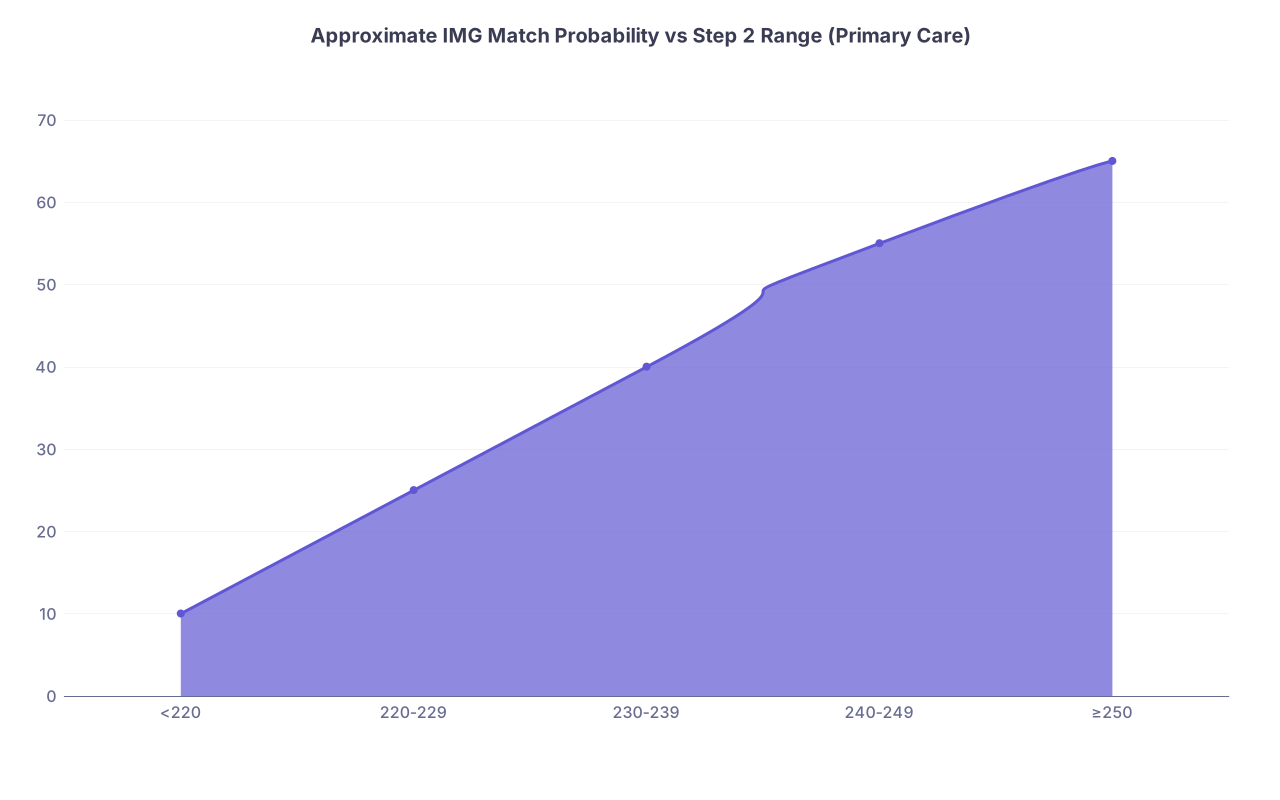
With Step 1 now pass/fail, Step 2 CK carries disproportionate weight for IMGs. For reapplicants, a clear line emerges in the data:
- Step 2 CK < 220: steep drop in match rate for IMGs across almost all specialties
- 220–235: possible but challenged, especially without strong USCE and letters
- 235–245: “competitive enough” for IM/FM/Peds/Psych in many IMG-heavy programs
245: improves chances substantially, especially if other red flags are absent
For reapplicants, a strong Step 3 score (say 225–235+) can partly offset an older graduation year or previous weak Step 2 CK, particularly in Internal Medicine and Family Medicine, where some program directors like seeing “Step 3 passed” as evidence of test-taking resilience.
| Category | Value |
|---|---|
| <220 | 10 |
| 220-229 | 25 |
| 230-239 | 40 |
| 240-249 | 55 |
| ≥250 | 65 |
For a reapplicant, the curves shift downward, but the shape is similar. Every 10–15 point band up dramatically changes how many programs genuinely consider you.
If you are planning a reapplication and you have not yet maximized Step 2 CK or Step 3, statistics say: that is your highest ROI move.
5.2. Time Since Graduation (YOG)
Program director data are brutally consistent on this: every year you are further from graduation without substantive clinical work, your odds shrink.
- 0–3 years since graduation: standard
- 4–5 years: noticeable, but still manageable for many community programs
- 6–7 years: significant handicap
7–10 years: match rates drop into the single or low double digits for most IMGs
For reapplicants, this compounds. You are not just “7 years out” – you are “7 years out and previously unmatched.”
So the data-driven question is: did you use the extra time to accumulate something that compensates?
Examples that actually help:
- Ongoing clinical work in your home country (especially hospital-based, internal medicine heavy)
- US-based research fellowships with publications and strong letters
- Continuous USCE, not “one month observership two years ago”
If you are >7 years out and applying without active consistent clinical activity, your probability curve is very flat. That does not mean 0%. It does mean you have to stop pretending your profile is equivalent to a 2-year YOG applicant.
6. USCE and Letters: The Hidden Multipliers
For IMGs, US clinical experience is not a “nice to have.” It is a lever that interacts with almost every other variable.
Program directors repeatedly rate:
- Hands-on inpatient experience > observerships
- Letters from US academic attendings > letters from home-country physicians
- Evidence of functioning in a US healthcare team > simple clinic shadowing
Patterns from successful IMG reapplicants:
- 3–4 months of recent, relevant USCE (last 12–18 months)
- 2–3 strong US letters with detailed, behavior-based comments (not generic “hard working, punctual” fluff)
- Clear link between USCE and targeted specialty (IM letters for IM, FM letters for FM, etc.)
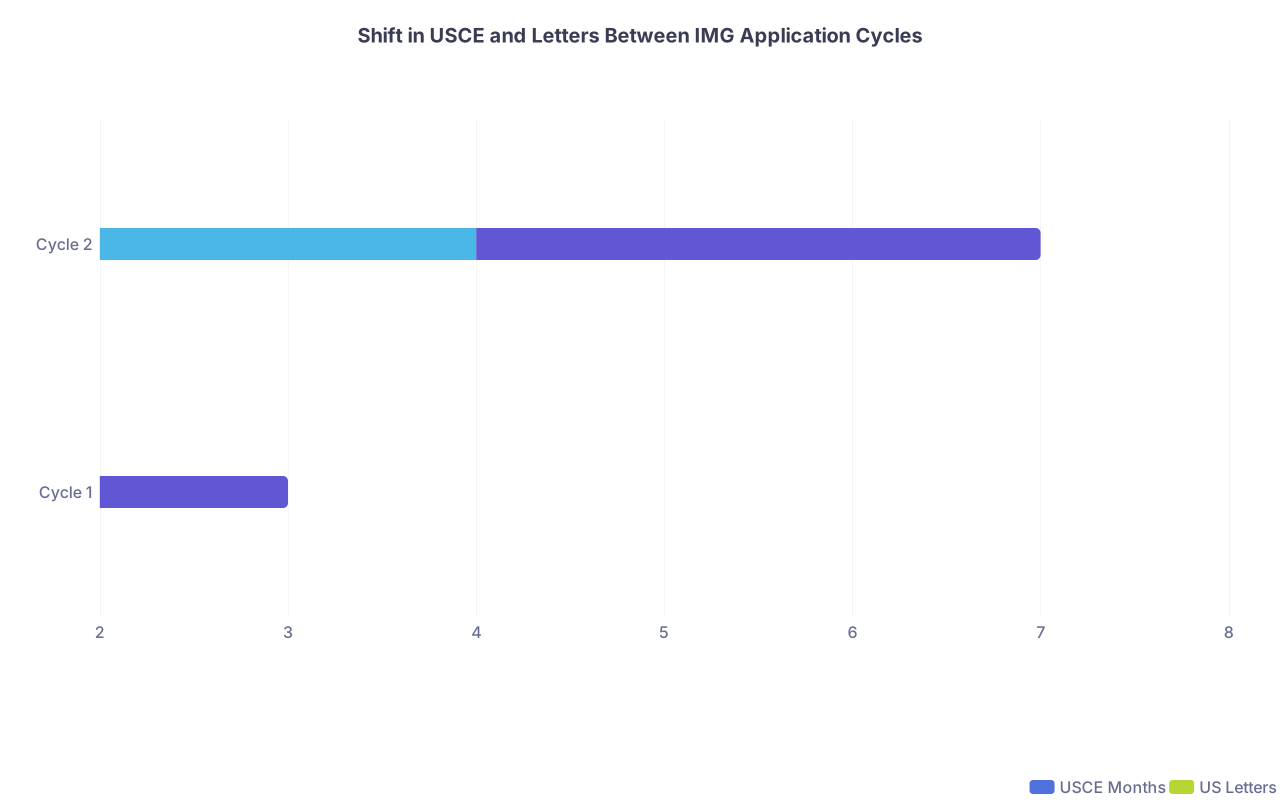
A typical improvement profile looks like this:
- Cycle 1: 1–2 months observership, 1 generic US letter, 2 letters from home-country faculty
- Cycle 2: 3–5 months USCE (including inpatient), 3 US-based letters, 0–1 home-country letters
| Category | USCE Months | US Letters |
|---|---|---|
| Cycle 1 | 2 | 1 |
| Cycle 2 | 4 | 3 |
That change alone—without major score movement—can move you from “auto-filtered” to “interviewable” in dozens of IMG-friendly programs.
7. Application Strategy Errors That Kill Reapplicants
The numbers do not lie: reapplicants often sabotage themselves not just with weak profiles, but with poor strategy.
Here are recurring patterns I see when I talk to unmatched IMGs and look at their application histories:
Applying to too few programs
First cycle: 60–80 programs. Second cycle: 70–90.
For a marginal IMG profile, that is not enough. Many successful reapplicants cross 120–150 applications in primary care fields, targeted to IMG-heavy programs.Chasing prestige or wrong geography
Applying to university-heavy lists or coasts that are relatively IMG-unfriendly, ignoring midwest/south community programs that actually match IMGs.Poor timing
Applying late in the season. Letters not uploaded. Personal statement slapped together. PDs notice.Not fixing clear red flags
- No explanation of gaps
- No improvement in English communication (PDs pick this up instantly in interviews and email)
- Same personal statement, same vague “I love research” line, zero new outputs
Underlying error: assuming “more of the same” plus “I hope they change their minds this time” will work. Statistically, it does not.
8. When the Data Say: Do Not Reapply
This part is uncomfortable, but you deserve honesty.
There are profiles where a US residency match as an IMG reapplicant is mathematically unlikely enough that a second full-cycle investment is a poor decision.
Common patterns:
- Multiple Step failures (e.g., >1 failure in any combination of Step 1/2/3) with only modest later scores
- Very low Step 2 CK (<215) and no capacity or realistic plan to retake/improve
- Graduation >8–10 years ago, with long periods of no clinical activity
- Repeated unprofessional behavior or major red flags (remediation, dismissals, legal issues) that cannot be reframed
If your profile looks like:
- 9 years since graduation
- Step 1 pass, Step 2 CK 210, Step 2 fail once before passing, no Step 3
- 1 month US observership, no inpatient work, 2 generic letters
- Previous cycle: <3 interviews or zero
It is not impossible that a miracle program takes you. But from a data analyst’s perspective, allocating another $5–10k and a year of your life to this exact path is a very poor expected-value decision.
That is when you should seriously evaluate:
- Alternate specialties (FM vs IM, Psych vs Peds) if your profile is still salvageable
- Non-US training (Canada, UK, other systems with clearer pathways)
- Non-clinical or adjacent careers: public health, clinical research, industry roles, etc.
Hope is not a strategy. Probability is.
9. How to Quantify Your Own Reapplicant Odds (Roughly)
You can build a simple self-scoring system to avoid wishful thinking. Weight the key variables:
- Step 2 CK / Step 3 performance
- Years since graduation
- USCE length and quality
- Number and strength of US letters
- Specialty choice
- Prior interview count and feedback
A crude model for an IMG aiming at Internal Medicine as a reapplicant:
Step 2 CK:
- <220: 0 points
- 220–234: 1 point
- 235–244: 2 points
- ≥245: 3 points
Step 3:
- Not taken: 0
- Pass <225: 1
- ≥225: 2
Years since graduation:
- 0–3 years: 3
- 4–5: 2
- 6–7: 1
- ≥8: 0
USCE months (recent):
- 0–1: 0
- 2–3: 1
- 4–6: 2
6: 3
US letters:
- 0–1: 0
- 2: 1
- ≥3 strong: 2
Prior interview count (Cycle 1):
- 0: 0
- 1–3: 1
- ≥4: 2
Now sum:
- 0–4 points: Extremely low probability. Reapplication likely not worth it without major structural changes.
- 5–8 points: Possible but high risk. Need focused, aggressive changes and realistic expectations.
- 9–13 points: Reasonable reapplicant competitiveness in IM, especially if strategy improves.
This is not a formal algorithm. It is a sanity check. But it forces you to see where your deficits actually lie.
10. The Bottom Line for IMG Reapplicants
The data on IMG reapplicants is not a death sentence. It is a filter.
Three core truths emerge from the numbers:
Reapplying with a flat or minimally improved profile has terrible yield.
You are effectively choosing a single-digit percentage bet, especially if your YOG is increasing and you are not adding serious USCE or exam improvement.Meaningful, multi-domain improvement makes second tries viable, especially in primary care fields.
Exam upgrades (Step 2/3), more USCE, stronger US letters, and better targeting together can push your odds into the 30–50% range for realistic specialties.Specialty choice and time since graduation are non-negotiable constraints.
Trying again for competitive specialties or ignoring YOG penalties is not strategy. It is denial. The numbers are clear about where IMGs do and do not cross the finish line.
If you are going to be an IMG reapplicant, treat it like a serious data project. Measure where you were, change what matters most, and only run the experiment again if the inputs are genuinely different.