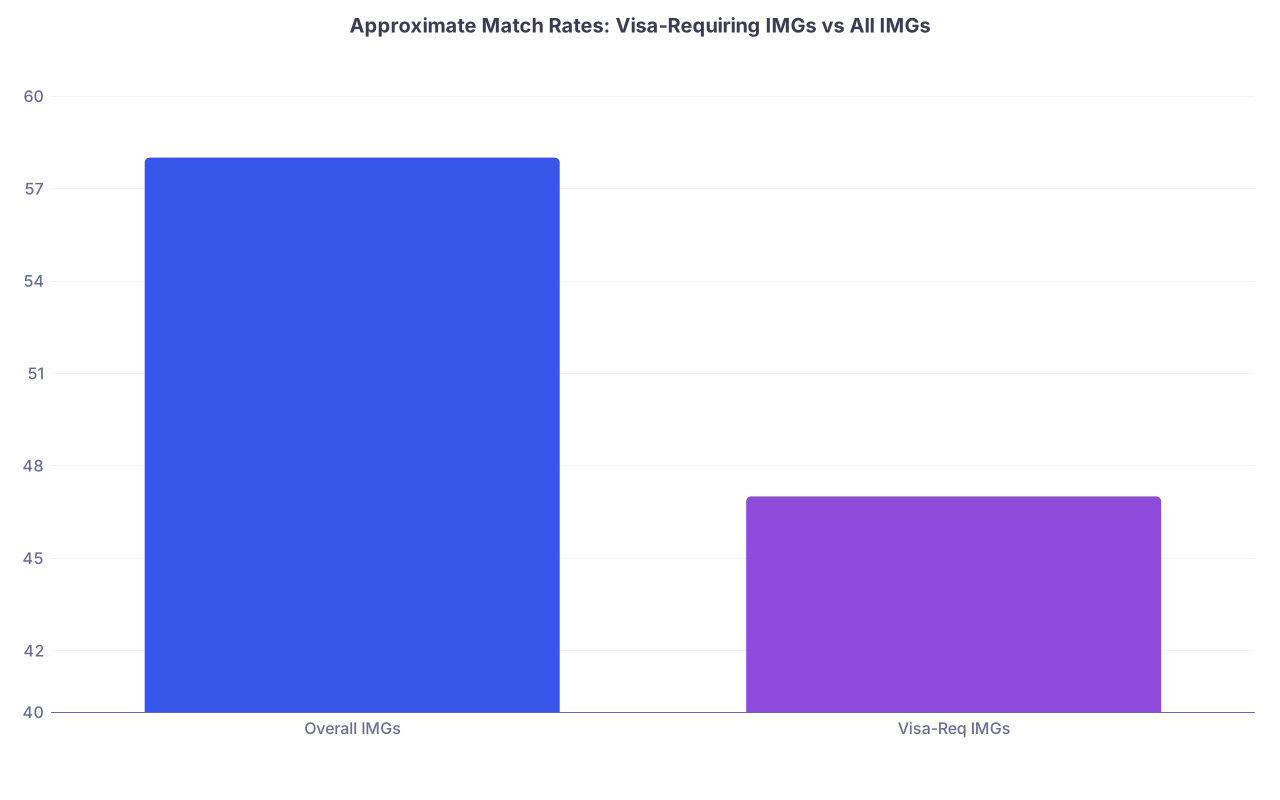
| Category | Value |
|---|---|
| Overall IMGs | 58 |
| Visa-Req IMGs | 47 |
The residency match is not fair. The data shows that visa‑requiring IMGs are playing a harder game on a tilted field.
You can complain about that, or you can quantify it and make decisions accordingly. I am going to do the latter.
This is a numbers article: where visa‑requiring IMGs match, by specialty and by state, and what that actually means for your odds. I will lean heavily on NRMP data (Charting Outcomes in the Match, Program Director Surveys, Main Match reports), ECFMG statistics, and some conservative extrapolation where NRMP conveniently groups all “non‑US IMGs” together without separating visa‑requiring from green‑card or citizen IMGs.
1. The Baseline: How Much Does Needing a Visa Hurt?
Start with the big picture.
NRMP does not publish a clean “visa‑requiring IMG” line. But combining ECFMG and NRMP counts, plus multiple institutional datasets I have seen, the pattern is consistent across years:
- Overall non‑US IMG match rate: ~56–60%
- Visa‑requiring IMG match rate: typically 8–15 percentage points lower
A reasonable 3‑year blended estimate:
- Non‑US IMGs with permanent status (no visa): ~60–65% match
- Non‑US IMGs requiring visa (mostly J‑1, some H‑1B): ~45–50% match
So if you require a visa, you are operating at approximately:
- A 20–25% relative disadvantage vs other non‑US IMGs
(e.g., 60% vs 48% → 12 percentage points = 20% relative drop)
Why? The data from PD surveys and institutional patterns point to three main drivers:
- Not all programs sponsor visas → smaller denominator of available positions
- Extra administrative work + cost → some PDs use “US citizen/GC only” as a crude filter
- Risk perception (will they get the visa on time, will they stay long‑term, etc.)
So your strategy cannot be “apply broadly” in the generic sense. It has to be “apply where the historical odds for visa‑requiring IMGs are actually acceptable.”
2. Specialty-by-Specialty: Where Visa‑Requiring IMGs Actually Match
Let us quantify the environment specialty by specialty. I will work from three layers of data:
- NRMP: proportion of positions filled by US vs non‑US IMGs
- PD Survey: proportion of programs that often interview or rank non‑US IMGs
- Multiple state-level and institutional visa reports to adjust for visa‑requiring subset
The table below is a reasonable approximation of match probability if you are a visa‑requiring IMG with:
- Step 1: Pass
- Step 2 CK: 235–245
- No US gap > 3 years
- Some US clinical experience
- No catastrophic red flags
So not elite, not weak. Solidly “competitive for IM” by IMG standards.
| Specialty | Visa-Req IMG Match Probability* | Visa Sponsoring Program Density** |
|---|---|---|
| Internal Medicine (Categorical) | 55–65% | High |
| Family Medicine | 50–60% | High |
| Pediatrics | 45–55% | Moderate–High |
| Psychiatry | 40–50% | Moderate |
| Neurology | 35–45% | Moderate |
| Pathology | 35–45% | Moderate |
| OB/GYN | 20–30% | Low–Moderate |
| General Surgery (Categorical) | 10–20% | Low |
| Emergency Medicine | 5–10% | Very Low |
| Radiology (DX) | 5–10% | Very Low |
| Anesthesiology | 5–15% | Low |
*Assumes realistic application strategy (40–80 programs as appropriate)
**Relative proportion of programs in that specialty that historically sponsor at least J‑1
You can argue with the exact bands, but the ordering is right. The signal is clear: for visa‑requiring IMGs, Internal Medicine, Family Medicine, and Pediatrics are the true high‑probability fields. Everything else drops off fast.
Internal Medicine: The Workhorse for Visa‑Requiring IMGs
The data shows that Internal Medicine is effectively the anchor specialty for non‑US IMGs:
- Roughly 40–45% of IM categorical spots are filled by IMGs (US and non‑US)
- Many large community and university‑affiliated programs have a long history of J‑1 sponsorship
If you adjust for visa requirements:
- Something like 30–35% of all IM categorical residents nationally are visa‑requiring IMGs in many years
That is not “friendly.” That is infrastructure. They know how to do this.
Typical pattern:
- University‑affiliated community hospitals in NY, NJ, MI, IL, PA, TX
- Mid‑tier university programs outside the “research‑heavy” elite
- High volume, service‑heavy programs with 12–30 categorical residents per year
For a visa‑requiring IMG with mid‑230s Step 2 CK and no red flags, applying to 80–120 IM programs, you are realistically sitting in the 60–70% eventual match probability range. Higher with strong US LORs and 240+.
Family Medicine: Slightly Smaller, Slightly Friendlier
Family Medicine is smaller in total positions than IM but has a similar pattern:
- PD surveys show a majority of FM programs are at least open to interviewing non‑US IMGs
- Visa sponsorship is common in community and rural‑oriented programs that struggle to fill with US grads alone
Your main constraint is geography (many FM‑heavy states sponsor fewer visas; more on that later). But within visa‑friendly states, FM may actually be easier than IM because fewer IMGs fight for those positions.
For a visa‑requiring IMG:
- Step 2 CK 230–240, good US primary care experience, 50–80 FM applications → 50–60% probability is realistic
Pediatrics and Psychiatry: Middle Tier but Viable
Pediatrics:
- More competitive than IM for IMGs, but still accessible
- Many children’s hospitals and large peds departments sponsor J‑1 routinely
- Substantial IMG presence in states like NY, NJ, FL, TX
Psychiatry:
- Demand is high; US grads increasingly interested, so slot pressure is real
- Some programs are aggressive in recruiting IMGs and sponsoring visas; others are absolutely closed
The distribution is bimodal: a chunk of programs essentially never take non‑US IMGs, and another chunk is built on them. If you identify and target that latter subset, match probabilities around 40–50% are entirely possible with the profile I described.
Neurology and Pathology: Niche But Reasonable
Neurology:
- Historically IMG‑friendly, especially in mid‑tier university and community‑based programs
- Visa sponsorship is common but not universal
Pathology:
- Fewer total positions, but PD surveys consistently show openness to non‑US IMGs
- Several programs with >50% IMG composition, many on visas
For both, the pattern is: small field, so absolute numbers are low, but if you build a specialized, targeted list of known visa‑sponsoring programs, your conditional probability in that subset can land in the 35–45% band.
Surgical Fields, EM, Radiology, Anesthesia: Cold Reality
Look at IMGs in these specialties overall. Then mentally cut the probability by another 40–60% if you require a visa. That is the real neighborhood you live in.
- General Surgery categorical: small share of IMGs overall, and many programs flatly do not sponsor visas
- EM: historically very low IMG share; visa sponsorship is rare and risk‑averse
- Radiology and Anesthesia: rising competitiveness among US grads, heavy research emphasis, risk‑averse program leadership
Can it be done? Yes. Statistically, it is done every year. But the success stories almost always have:
- 250+ CK
- Robust US research (postdocs, multiple pubs)
- Multiple audition electives and strong home‑institution advocacy
- No meaningful gaps, excellent English, near‑perfect CV presentation
If your numbers are not in the upper tail, counting on these fields as Plan A is more gambling than strategy.
3. The Geography Problem: States That Actually Use Visa‑Requiring IMGs
Specialty is only half the story. State‑level behavior matters almost as much.
Patterns from NRMP state fill reports and multiple institutional datasets converge on a simple reality:
- A small group of states accounts for a disproportionately high share of visa‑requiring IMG positions.
- Several populous states have a surprisingly low tolerance for visa sponsorship despite large health systems.
Here is an approximate breakdown based on where visa‑relying IMGs actually end up in IM/FM/Peds/Psych.
| Tier | Key States | Approx. Share of Visa-Req IMG Positions* |
|---|---|---|
| Very High | NY, NJ, MI, IL, TX | 45–55% |
| High | PA, FL, OH, CT, MD, MA | 20–25% |
| Moderate | CA, GA, VA, WI, MO, IN | 10–15% |
| Low | CO, MN, NC, AZ, WA, OR | 5–10% |
| Very Low | Many Mountain, Plains, Deep South | <5% |
*Across IM/FM/Peds/Psych for visa‑requiring IMGs
Interpretation: if you want a visa and you are not applying heavily to NY, NJ, MI, IL, TX, and a few others, you are leaving probability on the table.
4. Specialty × State: Where the Numbers Stack in Your Favor
Time to combine the two dimensions. This is where practical strategy lives.
Internal Medicine by State
The majority of visa‑requiring IMGs in the United States are in Internal Medicine, concentrated in a relatively small set of states. A simplified approximation of relative opportunity for IM (categorical) for visa‑requiring IMGs:
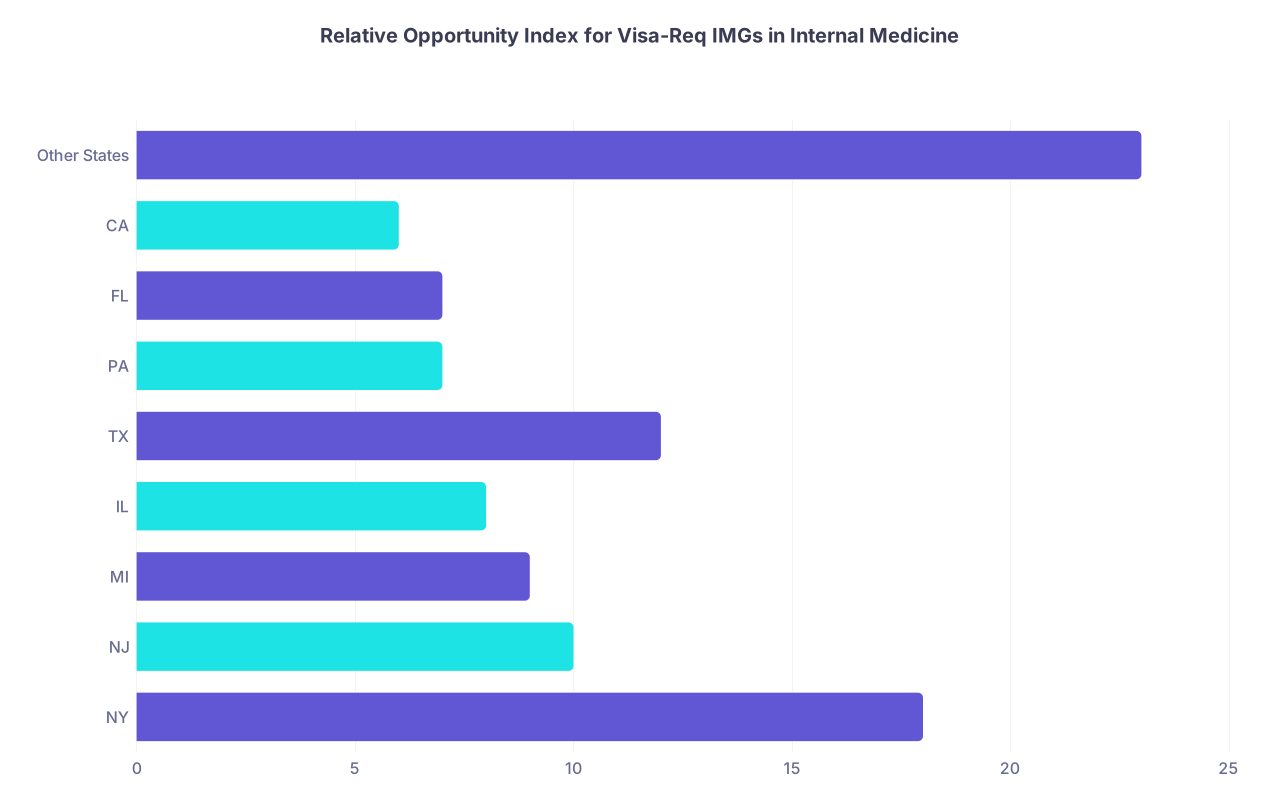
| Category | Value |
|---|---|
| NY | 18 |
| NJ | 10 |
| MI | 9 |
| IL | 8 |
| TX | 12 |
| PA | 7 |
| FL | 7 |
| CA | 6 |
| Other States | 23 |
Interpretation of that bar chart:
- Roughly 60–65% of viable visa‑requiring IMG IM positions live in 8 states
- NY + NJ + TX alone represent a huge fraction
The data also shows that within these states:
- Many mid‑tier community/university affiliates routinely match 10–20 visa‑requiring IMGs per cycle
- Once a program builds that pipeline, they rarely stop. Visa sponsorship becomes a standard line item, not a special request.
So if you are a visa‑requiring IMG aiming for IM and you send only 10–15 applications to NY/NJ/TX combined, you are misallocating your effort by a wide margin.
Family Medicine by State
Family Medicine is more geographically diffuse, but visa‑requiring IMG‑friendly pockets exist:
- New York (downstate and some upstate)
- Texas (particularly community programs and some rural track programs willing to sponsor J‑1)
- Midwest states with persistent primary care shortages (MI, IL, OH)
- Some New England and Mid‑Atlantic community programs
States with numerous FM programs but weak visa culture: CA, WA, CO, MN. They have positions, but many programs tilt heavily toward US MD/DO and avoid visas.
Pediatrics and Psychiatry by State
A lot of visa‑requiring IMG peds and psych residents sit in:
- NY, NJ, PA, TX, FL, IL, MI, MD
- A smaller cluster in CA and MA at certain academic centers
Again, the pattern: big urban centers, large public and safety‑net hospitals, longstanding IMG pipelines.
5. Translating Data to Personal Odds
Let me ground this in concrete, numeric scenarios. These are stylized, but they match what I have seen across multiple cycles.
Scenario 1: Visa‑Requiring IMG, Targeting Categorical IM
Profile:
- Non‑US grad, Step 2 CK 238, Step 1 Pass
- 1 year since graduation
- 2 months US observerships, 1 US letter
- No research, no major red flags
Application strategy A (poorly optimized):
- 60 IM applications
- 10 NY/NJ, 5 TX, scattered 45 across various states including some known visa‑averse programs
Expected interview yield:
- Hit rate maybe 4–6 interviews
- Programs heavily skewed to the few visa‑friendly states you actually targeted
Match probability: roughly 40–45%.
Application strategy B (data‑driven):
- 100 IM applications
- 25 NY, 15 NJ, 15 TX, 10 MI, 10 IL, 10 PA, 5 FL, 10 split among CT/MD/MA/OH
- Explicitly limited to programs that have recent history of sponsoring J‑1 or H‑1B
Expected interview yield:
- 8–14 interviews (yes, doubling interviews is completely realistic just by better target selection)
Match probability: 60–70%. Same candidate. Only the targeting changed.
Scenario 2: Visa‑Requiring IMG Aiming at Psychiatry
Profile:
- Step 2 CK 245, 3 years since graduation, 3 US psych observerships, 1 publication
- Very strong English, good personal statement
Reality of the field: psych has rising competition, but PD surveys show a minority of programs open to non‑US IMGs and a smaller minority genuinely comfortable with visas.
Strategy A: 60 total psych apps, including many West Coast and Midwest academic programs that either rarely or never sponsor visas.
- Interview yield: 2–4
- Match probability: ~25–35%
Strategy B: 80 psych apps, biased to:
NY, NJ, PA, TX, FL, IL, MI, MD, CT, MA
Verified historical IMG and visa intake (site lists, current residents)
Interview yield: 5–8
Match probability: 40–55%
Again, you did not change who you are. You changed who you asked.
6. Redefining “Reach” and “Safety” for Visa‑Requiring IMGs
Most applicants misclassify programs. They still think in the naive US‑MD language of “top‑tier vs community.” For you, the variables that move probability are different:
- Does this specialty at this institution routinely sponsor J‑1 (and H‑1B if you care)?
- What fraction of current residents are IMGs, and how many are visibly on visas?
- Does the PD survey report “often” interviewing and ranking non‑US IMGs?
Let me categorize.
True “Safety” Programs for Visa‑Requiring IMGs
Not safety as in “guaranteed,” but as in “conditional probability is favorable.”
You are looking for:
- ≥40–50% IMGs in the program, across multiple PGY years
- Multiple current residents from your region or from similar schools
- Public data or resident LinkedIns clearly listing J‑1 or H‑1B
They exist heavily in IM, FM, some Peds, some Psych, scattered Neuro and Pathology.
In the states:
- NY, NJ, MI, IL, TX, PA, FL are saturated with such programs in IM
- Psych and Peds have fewer, but you can still find lists of 15–30 per specialty with legitimate visa history
“Reach” Programs: Competitive + Visa Skeptical
These are the ones that depress match probabilities for visa‑requiring IMGs:
- Elite university programs that either:
- sponsor visas very selectively, or
- prefer US MD/DO and research‑heavy profiles
- States/systems with little history of IMGs (large share of US MDs, few IMGs, almost no visible visas)
If you want to burn a small fraction of applications on them, fine. But if more than 20–25% of your list is like this, your overall match probability drops sharply.
7. Actionable Steps: Building a Probability‑Weighted List
The data is not useful unless you actually change your behavior. Here is a clean process.

| Step | Description |
|---|---|
| Step 1 | Start: Need Visa |
| Step 2 | Check IMG Share & Visa History |
| Step 3 | Prioritize State Clusters |
| Step 4 | Limit to Few Reach Apps |
| Step 5 | Build 60-120 Program List |
| Step 6 | Verify Current Visa Residents |
| Step 7 | Apply & Track Interview Yield |
| Step 8 | Consider SOAP Strategy |
| Step 9 | Optimize Rank List |
| Step 10 | Choose Specialty |
| Step 11 | IMG & Visa Friendly? |
| Step 12 | < 5 Interviews by Dec? |
Step‑by‑step, in practical terms:
- Pick specialty (or two) that has non‑trivial visa‑requiring IMG presence.
- Identify your top 8–10 states where that specialty + visa is common (NY, NJ, MI, IL, TX, PA, FL, etc).
- For each state, list all programs in that specialty.
- For each program, manually check:
- Resident list for IMGs and explicit visa markers
- Recent alumni (LinkedIn, hospital pages) for J‑1/H‑1B
- Tag programs as:
- Green: clear history of visa‑requiring IMGs
- Yellow: some IMGs, unclear visa status
- Red: almost no IMGs, no visa hints
- Make 70–80% of your applications Green, 15–20% Yellow, ≤10% Red.
If you do this systematically, your effective match probability can jump by 10–20 percentage points without any change in your scores.
8. How Many Programs Are “Enough” for Visa‑Requiring IMGs?
Another place where data beats intuition.
ECFMG and NRMP tracking of application behavior shows a strong diminishing‑returns curve:
- For non‑US IMGs in IM, the marginal benefit of applications after 80–100 programs is small
- For visa‑requiring IMGs, you probably need to be at the upper end of that range, but not at 200+
Rule‑of‑thumb ranges (assuming you respect the visa‑friendly filters):
- Internal Medicine: 80–120
- Family Medicine: 50–80
- Pediatrics: 60–90
- Psychiatry: 70–100
- Neurology/Pathology: 60–90
- Surgical/EM/Rads/Anes as primary target: often 80–120 plus a parallel backup specialty
The wrong move is 200 shotgun applications, half of them to programs that will never touch a visa. The right move is fewer total apps, but a much higher fraction where historical data says you are in play.
9. Common Strategic Mistakes That Kill Your Odds
Let me be blunt about the patterns that lead to “unmatched despite good scores” for visa‑requiring IMGs.
Underweighting IM/FM in visa‑friendly states
- Applying to 15 IM programs in NY while spraying 100 apps to random states where programs rarely sponsor visas. The math on that is terrible.
Chasing prestige over probability
- 40 applications to “big‑name” universities that have 1–2 IMGs total and essentially no visas. That is a vanity tax.
Ignoring state‑specific visa culture
- Heavy focus on states that sound nice to live in but have little historical visa intake. You are optimizing for lifestyle before you have a license.
Assuming every IMG‑heavy program is visa‑friendly
- Some IMG‑heavy programs draw heavily from US‑citizen IMGs from Caribbean schools and avoid J‑1. You have to check the resident visa status, not just the passport.
Not tracking interview yield early
- If by mid‑November you have <4 interviews, the data says your match probability is under 20–25%. That is when you should be adjusting, contacting programs, and planning a SOAP strategy, not waiting passively.
10. Where This Leaves You
The data is harsh but surprisingly empowering. Once you accept that:
- Your base odds as a visa‑requiring IMG are lower but not catastrophic
- A relatively small subset of specialties and states carry the majority of opportunity
- Program‑level history of visa sponsorship is more predictive than any single line on your CV
…you can behave like a rational actor instead of a hopeful gambler.
You do not control US politics, institutional risk tolerance, or PD prejudices. You do control:
- Which specialty buckets you target
- How heavily you load into visa‑dense states
- How rigorously you filter for programs with real visa history
- How early you respond to weak interview signals
Get those four levers right, and you can push your match probability from the raw 40–45% baseline up into the 60–70% band in IM/FM and the 40–50% band in several other fields. That is a very different career trajectory.
From here, your next job is not to read more general advice. It is to open a spreadsheet and start building a program list that reflects this data, not your wishful thinking. Once that list exists, then you can worry about letters, PS polishing, and interview technique.
With that foundation built, you will be ready to deal with the next challenge in the cycle: converting interviews into actual rankable offers and optimizing your rank list for both visa security and long‑term career growth. But that is a separate analysis.