
It is 4:00 PM. You finish your last progress note, close the laptop, and exhale. Then your chief walks over. "Hey, why is not the medication reconciliation signed yet? The attending needs it before evening handoff." You stare at the screen. You thought the day was closed.
This is not a one‑time oversight. It is stealth daily chart‑closure creep. The workload expands, more required fields, more addenda, more "just one more thing", while your shift remains the same length. Nobody announces the new rules. Chiefs seldom tell you because they are navigating the same invisible escalation.
Chart‑closure creep is a patient‑safety threat. Missed tasks cascade: delayed discharges, incomplete handoffs, medication reconciliation gaps, and rework paging that fragments your night. It also breaks intern performance and morale. By the end of this article you will have a concrete, immediately deployable protocol to catch creep, set hard boundaries, and achieve reliable closure by sign‑out. No fluff. Process, templates, and escalation rules.
This article is for educational purposes only. It is not financial advice, not legal advice, and not tax advice. Figures vary by individual circumstances, consult a qualified professional before acting.
Define the enemy: what "chart‑closure creep" actually is
Three forces quietly expand your daily closure burden until you drown.
1. Scope creep. More required documentation appears without announcement. A new hospital policy demands that every PRN order has a linked justification note. An attending wants a one‑line addendum explaining why you held the morning metoprolol. The cumulative effect is that your "minimum" note grows, and nobody tells you the new baseline.
2. Timing creep. Deadlines slide earlier but you are expected to absorb the same workload. Your program says "notes signed within 24 hours," but in practice the attending wants them signed before the 7:00 PM handoff. You discover this only after being paged at 6:45 PM asking why the discharge summary is still in draft.
3. Quality creep. More scrutiny lands on your notes. A chief asks why the problem list does not include resolved diagnoses. The medical records department flags you for missing a "time of death" attestation. You then spend 10 extra minutes per chart polishing narrative that was never part of the original expectation.
Stealth triggers are everywhere:
- New orders require a note linkage that did not exist last week.
- Gaps in the problem list trigger a pop‑up that blocks sign‑off.
- Incomplete lab or imaging interpretation leaves a "pending acknowledge" alert.
- Missing attending attestation times (e.g., for admitted patients) delays your closure.
- PRN rationale gaps block pharmacy verification and generate pages during sign‑out.
- A new quality metric requires documenting a "plan for follow‑up" even for stable patients.
The goal is not "perfect notes." It is reliable daily closure that protects handoffs and prevents the end‑of‑day pileup. When you treat closure as a moving target, you will always miss. The solution is to anchor closure on a non‑negotiable minimum list, and force new requirements to join that list visibly.
The real cost: how creep quietly breaks intern performance
Creep does not merely steal an extra hour. It erodes the very fabric of safe handoffs and clinical reasoning.
Compounding workflow friction. A note missing a required attestation will not close. The pharmacist pages. The nurse stops you. The attending's in‑basket lights up. Each rework loop costs 2-3 minutes, but multiplied by 10 patients it chews through an intern's post‑call morning or delays a discharge clearance by hours.
Clinical consequences you cannot ignore. A documentation lag hides crucial decision points. If yesterday's potassium of 6.1 was not acknowledged in the note and a follow‑up plan was not written, the overnight team may miss it entirely. Incomplete notes delay follow‑up on abnormal imaging, an incidental lung nodule flagged at 5:00 PM can disappear until the next day if the reporting loop is broken.
Cognitive load disaster. Doing charting reactively at 11:00 PM is an error factory. Copy/paste artifacts multiply. Old dates and times persist. Medication lists carry yesterday's doses. I have seen interns copy forward a "plan to discharge today" for a patient who was transferred to the ICU two hours earlier. That is not lazy; it is a cognitive collapse triggered by chronic backlog.
Set a hard metric: "closure by handoff." Aim for 95% of required daily items signed and reconciled before sign‑out. This is not a suggestion. It is a safety standard. The chart below shows what happens when you move from reactive closure to structured closure by shift end.
The gap is stark, and entirely fixable.
Fix #1: Build a Daily Closure Checklist that cannot expand without you noticing
The core weapon against scope creep is a visible, immutable minimum checklist. Every new requirement must earn a place on it.
The non‑negotiable minimum checklist is your daily baseline. Do these items for every patient no matter what the chief mood is:
- Progress note essentials (date, time, service, attending name)
- Overnight events (nursing notes, vitals, any acute changes)
- Assessment/plan bullets (one for each active problem, today's decision)
- Medication changes (any holds, new starts, dose adjustments, reconciliation)
- Lab/imaging interpretation (acknowledge key results, including pending criticals)
- Problem list update (add/discontinue diagnoses, ensure accuracy)
- Discharge-critical documentation (if applicable: discharge summary draft, medication list, follow‑up instructions)
- Pending tasks (consults, studies, follow‑up labs) with a planned owner
Format this list on a single printed card or a locked phone note. Every day, run it. When you complete an item, check it off.
Creep detection rule: The moment a chief, attending, or quality meeting adds a new required element (e.g., "please add a pain reassessment note for every PRN opioid"), write it into tomorrow's checklist after you complete it once. If it is not on the checklist, it does not exist as a daily requirement. This makes expansion conscious. It also gives you data: "Last week I had 9 items; today there are 12. That is a 33% workload increase. Is that intentional?"
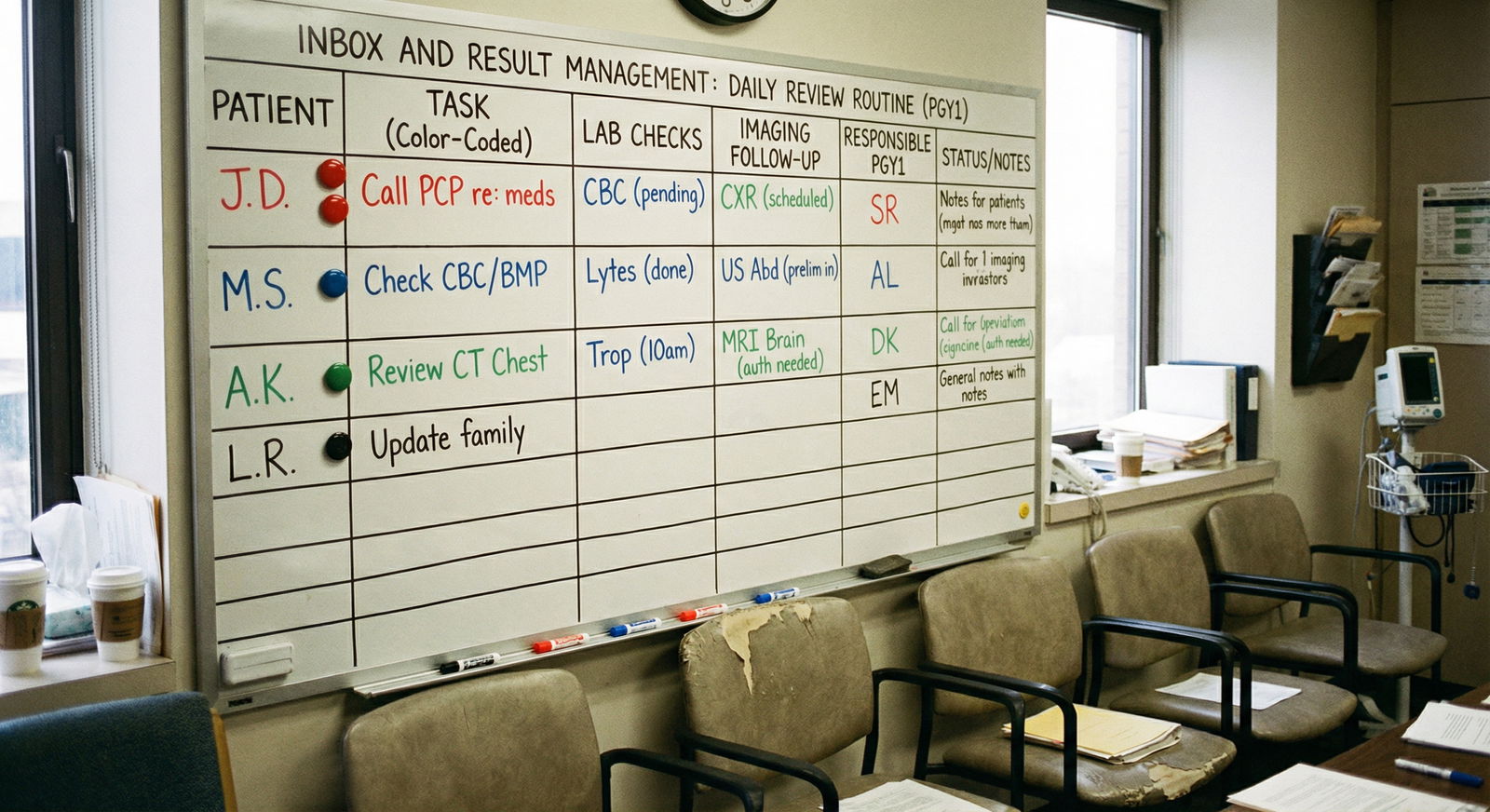
Speed is everything. The checklist must be reviewable in 10-15 seconds per patient. Keep it one page. Nothing fancy. The visual below shows a working version.
Fix #2: Use a "two‑pass charting" workflow (draft fast, verify once)
The default intern strategy, write the entire note in one sitting, polishing every sentence, is a time sink that feeds creep. Instead, separate drafting from verification.
Pass 1, draft fast (capture facts). For a stable patient, limit yourself to 15 minutes. For complex patients, 25 minutes. Include:
- Brief HPI/overnight update (2-3 lines max)
- One‑ to two‑sentence assessment and plan per active problem
- A "What changed today" section that is mandatory (more on this below)
- Hard stops: confirm the medication reconciliation, lab/imaging interpretation, and any pending follow‑up
Do not edit for grammar. Do not over‑justify your reasoning. Put down the clinical logic as you would tell it to a colleague.
Pass 2, verify completeness (the "shutdown window"). Come back in a batch at a protected time, say, 30 minutes before sign‑out, and run the verification grid:
- Dates and times are correct (no copy/paste from yesterday)
- Medication list is reconciled (admission meds, holds, discharge changes)
- Pending studies are acknowledged and linked to a plan (do not leave a CT report hanging)
- Consult recommendations are summarized (a one‑line "Dr. Smith recommends...")
- Follow‑up plan documented (even if "discharge pending family meeting")
Prevent the copy/paste trap: Never carry forward a "Today's changes" block from yesterday. Force yourself to write "What changed today:..." fresh each morning. This guarantees that stale details do not contaminate the note, and it satisfies attendings who hate seeing the same assessment for seven days straight.
Fix #3: Negotiate closure timing with chiefs using a script + measurable standard
The problem is not a late‑night pager; it is ambiguity. Chiefs rarely hand you a written minimum standard. And when they add a last‑minute "surprise" requirement, you are supposed to just stay later. I reject that.
Ask for clarity, not a deadline. The correct question is: "What are the non‑negotiable items that must be signed for a sign‑out‑ready note?" Do not say, "When is it due?" That invites a vague "before you leave."
Script you can use verbatim:
"I can close 95% of required items by handoff if I know the minimum note components. Can you point me to a checklist, or show me one example of an accepted sign‑out‑ready note? That lets me deliver what you need without wasting time on non‑essential polish."
This frames you as a solutions‑oriented intern, not a complainer.
Define "done" in measurable terms:
- All progress and event notes signed by the primary service
- Medication reconciliation completed and attested
- Abnormal labs and imaging results acknowledged with a plan
- Pending orders have a responsible team and next step noted
- Discharge documentation (if applicable) reaches a status where it will not block the next team
Escalation boundary: If a new requirement drops the same day it is due, use a short response: "I can complete X by handoff. If you add Y today, can we (1) confirm it is required for sign‑out‑ready closure, or (2) move it to tomorrow's checklist?" If it is genuinely urgent, document a safe rescue note (Fix #5) and communicate the exact gap during handoff. Do not silently add an hour to your shift without a conversation.
Fix #4: Turn chart closure into an order‑of‑operations problem
Not all notes carry equal weight at 4:30 PM. Prioritize by downstream impact, not by patient room number.
Sequence for maximum payoff:
- Discharge‑critical notes first. If a discharge summary or final med list is pending, a late signature delays pharmacy, case management, and bed control. Get it done.
- Sickest patients or those with rapidly changing plans. A note that sits incomplete on a patient with new hypotension or an evolving electrolyte derailment risks a handoff error.
- Routine daily progress notes. Close the stable ones after the critical ones, because a missing note on a stable floor patient causes fewer downstream calls.
Timebox each pass. Give yourself 25 minutes for Pass 1 on an active patient, or 15 minutes for a stable daily note. Use a timer. The discipline prevents you from over‑documenting neurological exams on a patient with cellulitis.
Protect a "shutdown window." After a set time, I recommend 8:00 PM if your shift ends later, do not add new documentation tasks. No new discharge summaries, no elective addenda. Your brain needs a cognitive boundary. If a new task appears after the shutdown, it belongs on tomorrow's list unless it is an immediate patient‑safety necessity, which you handle via Fix #5.
Fix #5: Protect yourself from backlog with an 'incomplete note rescue' protocol
Sometimes you will not close everything. That is not failure; it is reality. But if you leave a pile of half‑finished notes and no communication, you will wake up to a fire the next day. The rescue protocol prevents the spiral.
Rescue rule: When you cannot finish a full note, document the minimum safe status:
- Overnight events (brief)
- Current assessment and reasoning
- Active orders (especially any changes or holds)
- Pending results and whose responsibility they are
- Explicit follow‑up owner (name the person or team)
This takes 2 minutes. It replaces an empty note with a structured, actionable handoff.
What to defer vs what never to defer: Never defer: medication reconciliation, plan for pending critical lab/imaging results, or documentation required for a same‑day disposition (e.g., discharge order requires an interim note). You can defer: narrative polish, detailed social history, non‑urgent addenda, or problem‑list cleanup that is not affecting today's care.
Communication is the second rescue. Write a short status message in your team's preferred channel (group chat, secure message, or a verbal handoff) that states:
- What is fully done
- What is pending (with a brief why)
- When you will complete it (e.g., "by 10:00 AM tomorrow")
This message cuts the number of repeat pages by half. Chiefs trust you because you are not hiding the gap.
Key Takeaways
- Stop chart closure from being a moving target: create a one‑page minimum checklist, and force every "new requirement" to earn a place on it.
- Use two‑pass charting with timeboxes and a rescue protocol, so you can close by handoff even when the day gets chaotic.