
You spent four weeks in the ICU. You knew Mrs. Rodriguez in Bed 4 like the back of your hand. Her vent settings, her urine output down to the milliliter, the precise moment her pressors needed to be titrated. You lived in fifteen-minute intervals. You ate standing up. You ran between rooms.
Then Tuesday morning, your team list drops into your inbox. Eight patients. Eight. You scroll past the names and the panic hits somewhere behind your sternum. Not because the patients are sicker. Because the number of sick patients is now a multiple, and your brain is still wired for the singularity.
Before you dive into your new ward workflow, it helps to review how to triage your task list when overloaded.
This is the moment. The pacing shift from ICU to wards is the most disorienting transition of intern year, and almost nobody prepares you for it. Not because it's clinically hard, but because it's structurally hard. You're moving from hyper-vigilant crisis response to broad-spectrum management. The reflexes that kept your ICU patients alive will actively sabotage you on the wards. Let me walk you through it, week by week, hour by hour, the way I wish someone had walked me through it.
Phase 1: The First 48 Hours (Orientation to Volume)
Day one on the wards, you need a dry run. The night before, sit down with your team list. Open each chart. Read the most recent progress note, the most recent nursing note, and the medication administration record. Don't try to learn everything. Learn the spine of each patient: one-liner, active issues, why they're still admitted, and what needs to happen for discharge.
At this point you should have a printed or digital list with four columns per patient: problems, tasks, pending results, and anticipated disposition. This is your new bible. Carry it everywhere.
Morning pre-rounds on the wards look nothing like the ICU. You won't have time to read every drip rate and ventilator waveform. Instead, you're triaging sick versus not sick across a much wider field. Spend ninety seconds at each bedside. Look at the patient. Are they talking comfortably? Is the monitor showing anything wild? Any new pain? Any nursing concerns? Then move.
Here's the move that will save you two hours a day: build a static note template. Right now. Before your first ward round. Don't reinvent it for every patient. Set up a dot-phrase or smart phrase in your EMR with placeholders for HPI, active issues, assessment, and plan by problem. Your future self will thank you when you're trying to discharge four patients before noon.
The workflow above is the engine. If you skip the brief bedside check, you'll discover surprises during attending rounds, and those surprises are what burn your afternoon. The sign-out sheet update is your external brain. Don't try to hold eight patients in your head. Write it down. Every abnormal lab, every family conversation, every consultant recommendation, every pending imaging result. The sign-out is not just for the night team. It's for you, three hours from now, when you've context-switched twelve times and can't remember why you ordered that abdominal ultrasound on Mr. Chen.
If you are struggling to manage this shift in responsibilities, consider reading about what chiefs really notice when interns struggle with workload.
Phase 2: Developing Your 'Internal Clock'
Here's what nobody tells you: the ward day has a rhythm, and you have to learn the meter.
The ICU had no rhythm. It had urgency. Anything could spike at any moment. The wards run on a different clock. Rounds end around 11. Discharges need to happen before noon to free beds. New admissions arrive in the early afternoon. Families start calling around 2 PM. The late afternoon belongs to documentation. Sign-out at 6 or 7. If you don't learn this cadence, you'll drown at 4 PM wondering how you got behind.
At this point you should institute a mid-day huddle. Pick a time, say 1 PM, and pause. Look at your list. Which patients are still sick? Which ones can actually go home today? Which family conversations still need to happen? This is your reset point. Without it, the day's tasks accumulate like sediment, and by sign-out you're trying to remember fifteen loose ends while your co-intern is looking at you expectantly.
The hardest part of the transition is the family communication cycle. In the ICU, you talked to families during crises, often daily, often with bad news. On the wards, families expect updates whether or not anything has changed. Set expectations early. Tell every family at admission: "I'll be in touch with significant updates, and we'll have a longer conversation around discharge planning." This is not cold. This is sustainable. You cannot call eight families every day with a meaningful update. You will burn out by week two, and your notes will start to sound like copy-paste wallpaper.
Delegation is your next frontier. In the ICU, you did almost everything yourself because the stakes were too high and the ratio was low. On the wards, that's a recipe for collapse. Learn what nursing can handle: medication adjustments within parameters, wound checks, patient mobility updates, and family concern triaging. Learn what social work owns: placement, transportation, durable equipment. Learn what case management is doing: discharge barriers, insurance authorizations. You are the conductor, not every instrument.
Look at the curves. The ICU is a plateau. The wards are a mountain range. Different peaks, different valleys. The trick is to do your highest-cognition work during the valleys and your low-cognition work during the peaks. Don't try to write a complex discharge summary at 3 PM when your phone is ringing with two new admissions. Save that for the 5 PM valley.
Phase 3: Preventing Cognitive Leakage
Cognitive leakage is the silent killer of ward rotations. It's what happens when small tasks fall out of your mental container because the container is too full. A discharge summary you forget to finish. A follow-up appointment you never scheduled. A home medication reconciliation that gets pushed to tomorrow. None of these is fatal. Together, they are the reason patients bounce back.
Checklists are not for the weak. They are for the wise. Build a discharge checklist for every patient. Has the patient been told? Has the family been told? Are scripts sent? Are follow-up appointments scheduled? Is the patient educated on warning signs? Has the primary care doctor been notified? If you can't answer yes to all of these, the patient isn't ready to leave, and you shouldn't be the one rubber-stamping the discharge.
At this point you should start batching your orders. Don't put in five orders for one patient across the day. Cluster them. When you're at the computer for morning rounds, put in everything you can. When you're doing afternoon tasks, cluster those tasks by patient rather than by task type. Batching by patient saves you the mental cost of context-switching between eight different clinical scenarios. Batching by task type (all the discharges, then all the new admissions, then all the family calls) is a trap. It feels efficient. It isn't. Your brain pays a switching penalty every time.
And here's the hard truth: there will be days when the volume exceeds your capacity. You will have eleven patients. Three will be sick. Two will be ready for discharge but waiting on placement. Four will need updated notes. Two will have families demanding updates. And a new admission will roll in at 4:30 PM. This is the escalation threshold. Tell your senior. Tell your attending. Do not white-knuckle it. I have seen interns try to power through these days, and I have seen them make errors. The errors are not worth the pride.
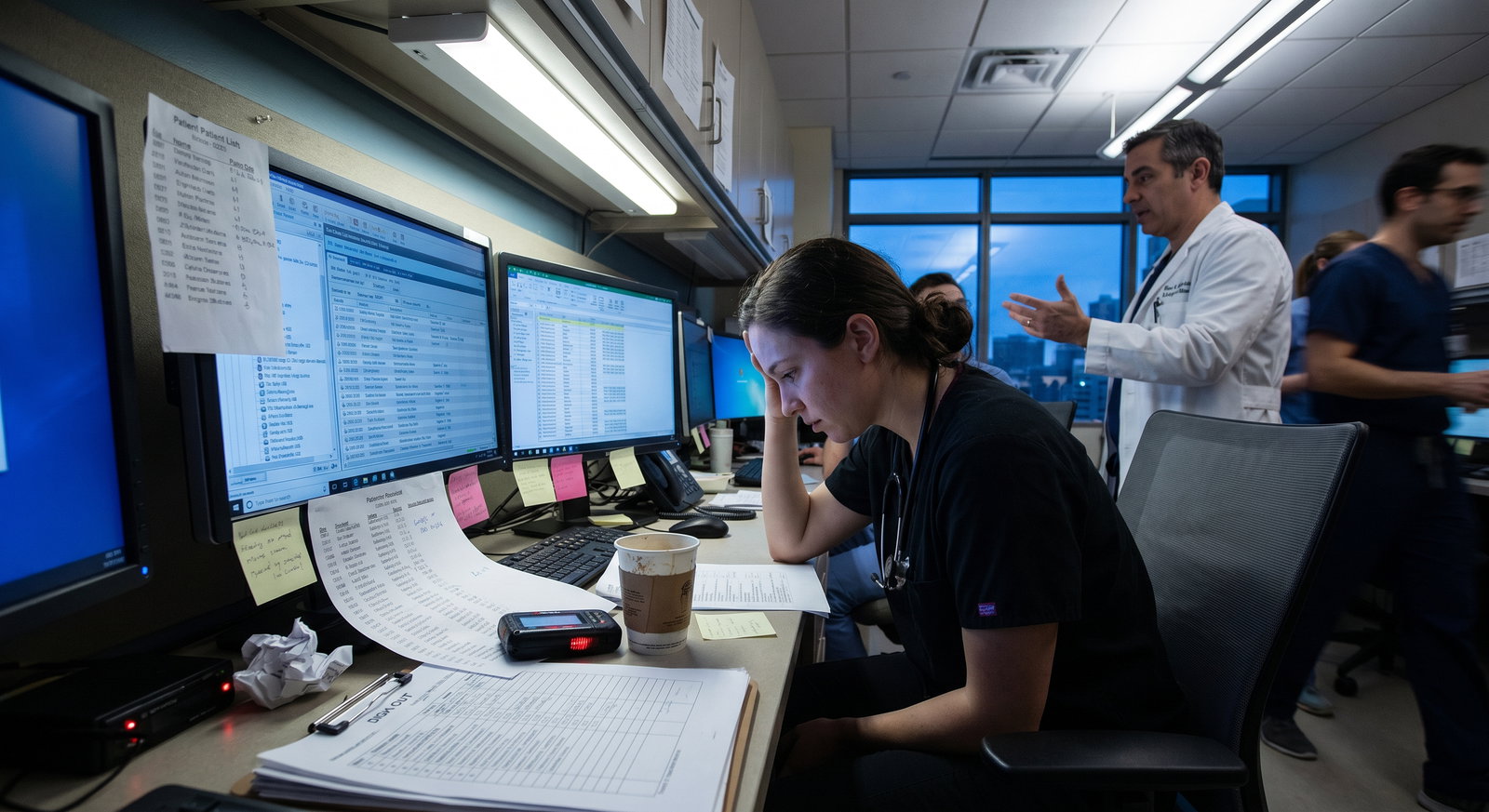
The image above is the fork in the road. One side is the intern who tries to hold everything in their head. The other is the intern who builds systems. Guess which one is still smiling in March.
Action Steps: Your Survival Checklist
You've made it through the transition. Here's your survival kit, distilled.
Daily sign-out ritual, the "Top 3" rule. For every patient on your list, write down three things: the most likely thing to go wrong overnight, the action item still pending, and the anticipated disposition. If you can't fill in these three for a patient, you don't know them well enough. Spend ten more minutes before sign-out closing those gaps.
Weekly review. Every Sunday, spend thirty minutes looking at the week behind you. Where did you lose time? Which patient surprised you? Which workflow failed? I keep a running note in my phone called "workflow fails." It's humbling and useful. The patterns that emerge will show you exactly where to systematize.
The final mental framework. You started intern year as a doer. Every task required your hands. Every decision required your brain. The ward transition is your invitation to become a thinker. Your job is no longer to personally execute every element of care. Your job is to design the system that delivers the care. Delegate aggressively. Document efficiently. Triage relentlessly. Round with intention.

The picture above is the goal. Calm, purposeful, and out the door. You will get there. The transition is brutal because it's unsung. Nobody writes an essay about the existential crisis of switching from two patients to eight. But it's real, and the systems you build in the first two weeks will define your ward months.
One last thing. The skill you're building right now is not ward management. It's pacing intelligence. Knowing when to sprint, when to coast, when to escalate, when to delegate. That skill will outlast every clinical rotation. Build it deliberately.
The Top 3 Takeaways:
- In the ICU, you're a specialized responder. On the wards, you're a system architect. Different brain, different muscle.
- Documentation speed is secondary to patient prioritization. Triage your list every four hours, no exceptions.
- The transition requires you to shift from minute-by-minute reaction cycles to block-based planning. Plan in chunks, not in drops.