
Here's the biggest myth in this entire conversation: if a medical school is legal, respectable, or even prestigious in its own country, that should be enough for the U.S. licensing path. Sounds reasonable. It's also wrong.
The U.S. does not care about vibes, reputation, or how many people in your family say the school is "well known." U.S. licensure runs on a chain of recognition. Break one link and the whole plan collapses. I've seen students discover this far too late, after tuition is paid, after years of study, after Step prep, sometimes after graduation. Brutal.
The real question isn't "Is this school good?" The real question is: does this school, for your specific graduation year and campus, support a pathway that satisfies ECFMG, residency eligibility, and eventually the state medical board where you want to practice? That's the game. Everything else is noise.
You need to check three layers early. First, whether the school is recognized in the way the U.S. system actually verifies. Second, whether you can meet ECFMG eligibility and certification requirements. Third, whether the state board you may ultimately apply to has additional restrictions. Miss any one of those and you're not "almost there." You're stuck.
This is a verification guide, not a pep talk. The honest answer is usually not a clean yes or no. It's often yes, but only if. Or no, despite what the brochure implies.
Step 1: Check Whether the School Is Recognized by the Right Authority
Let's kill another bad assumption: your school does not need to be famous, English-speaking, or located in a country Americans recognize instantly. Those things may affect perception. They do not decide eligibility. Formal recognition does.
Start with the World Directory of Medical Schools. Not Reddit. Not WhatsApp groups. Not a recruiter who assures you that "our graduates are practicing everywhere." The World Directory is one of the key primary verification tools used in this process, and if your school isn't properly listed there, that's a problem immediately.
You're looking for exactness, not approximation. Exact school name. Exact country. Exact campus if there are multiple sites. And critically, any notes tied to eligibility. Name changes matter more than applicants think. So do branch campuses. I've seen schools advertise under one brand name while the clinical training happens through loosely affiliated sites that are much less clear on paper. That's where people get burned.
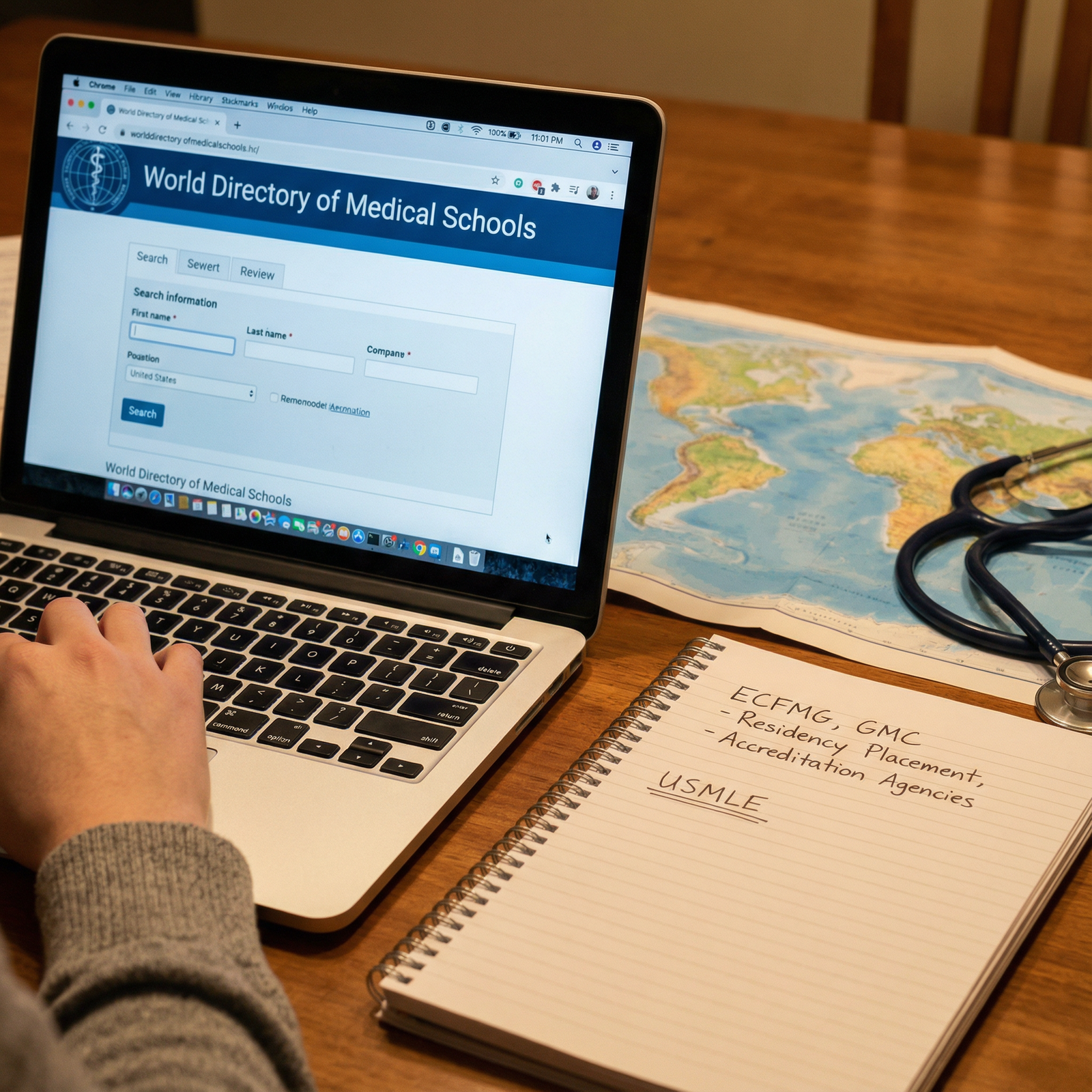
Graduation year is the detail students skip until it's too late. Big mistake. A school may be recognized now and still not help someone who graduated before a certain status took effect. The U.S. system doesn't magically backfill your eligibility because the school later fixed its paperwork, obtained recognition, or cleaned up its status. Your graduation year has to line up with the rules that apply to your cohort.
Watch for red flags. Schools with recent rebranding. Institutions operating in one country but teaching basic sciences in another and clinical rotations in a third. Branch campuses with vague oversight. Programs that say "internationally accredited" without saying by whom, for what, and whether that recognition actually matters to ECFMG or state boards. If the listing is unclear, inconsistent, or missing, don't rationalize it. Ambiguity is not your friend here.
Step 2: Understand ECFMG Eligibility: The Gatekeeper Most People Misread
ECFMG is not some ceremonial stamp you collect after med school. For most international medical graduates pursuing U.S. residency and eventual licensure, it is the gateway. No gateway, no path. Simple.
A lot of applicants reduce ECFMG to "Can I take the USMLE?" That's too simplistic and often outdated. ECFMG looks at the school, your identity, your credentials, and the certification requirements in effect for your application period. Policies evolve. Pathways change. Documentation expectations shift. Anyone giving you a one-line answer based on what happened to their cousin in 2018 is not helping you.
What does ECFMG actually care about? Whether your school meets eligibility requirements. Whether your identity and graduation documents can be verified. Whether you complete the required exams and any current certification or pathway components tied to your situation. This is why passing Step 1 alone proves almost nothing about final viability. I've met students who thought a test score solved the problem. It didn't. The process is bigger than one exam.
Here's what the data actually shows: the applicants who run into avoidable trouble are often not the weakest students academically. They're the ones who assumed eligibility instead of proving it. They trusted forums, school marketing, or old graduate anecdotes instead of checking current ECFMG requirements directly. That's lazy thinking dressed up as optimism.
So verify current rules from ECFMG itself. Not screenshots from years ago. Not a school representative who says "we expect approval." Expectation is not eligibility. Until the current published requirements align with your school and your graduation year, you do not have certainty.
Step 3: Don't Stop at ECFMG, Residency and State Licensure Have Their Own Rules
This is where people oversimplify the path and get wrecked by reality. Even if your school is recognized and you're ECFMG-eligible, that does not mean you're automatically on track for a U.S. medical license.
There are more gates.
You still need to secure a U.S. residency position, typically in an ACGME-accredited program, because state licensure usually requires postgraduate training in the United States. Then you have to satisfy the medical board in the state where you want to practice. And state boards are not clones of one another. Some are stricter. Some want more documentation. Some scrutinize international graduates more heavily around clinical training, instructional format, total weeks or hours, or the precise structure of the curriculum.
That's why checking just one state board, or worse, checking none, is amateur hour. If you think you may train or practice in New York, Texas, California, Florida, Illinois, or anywhere else, look up that board's current rules. Not broad summaries. The actual board requirements.
The practical sequence is boring but non-negotiable: school eligibility first, then ECFMG, then residency, then state licensure. You can't skip a layer because you're motivated. You can't outwork a structural disqualification. Hard truth. Effort matters, but only after the pathway itself is valid.
Step 4: Red Flags, Verification Tactics, and What to Do If Your School Is Borderline
If you want to protect yourself, get obsessive with documentation. I mean the exact legal name of the school, the exact campus, the country of instruction, the graduation year, any changes in ownership or merger history, and whether the school's listing and status align with current ECFMG expectations. Precision beats confidence every time.
Save evidence. Screenshots from authoritative sources. Direct links. Emails from the registrar. Written confirmation from ECFMG when appropriate. If a school representative tells you something important on a call, that's nice. It's also basically worthless unless you can verify it independently.
Borderline schools are where applicants get seduced by wishful thinking. New schools. Recently restructured schools. Schools in countries with evolving recognition systems. Campuses operating under a parent institution with uneven oversight. In these cases, "probably fine" is a dangerous phrase. If you need to spend six figures and several years to test a maybe, the answer is no until proven otherwise.
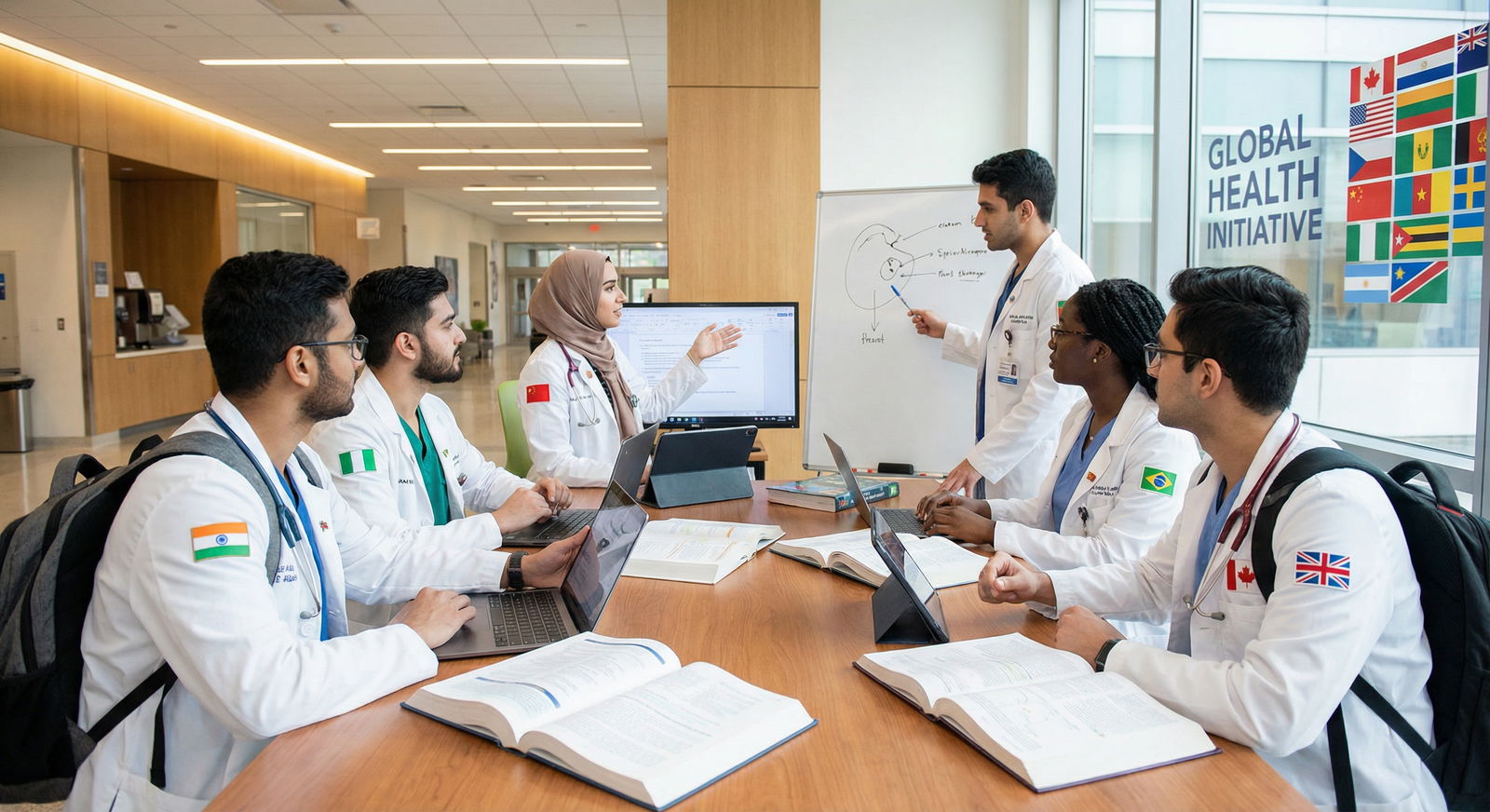
And if the school does not clearly support the U.S. path? Don't gamble because you've already fallen in love with the idea. Consider transferring if feasible. Reapply to an eligible program. Or plan deliberately for a non-U.S. career pathway. That isn't failure. What's foolish is pretending uncertainty will somehow sort itself out after you've spent years and money you can't recover.
How to Make the Final Decision: A Practical Eligibility Checklist
Here's the decision rule. Your international medical school "qualifies" for the U.S. path only if three things are true.
First, the school is properly recognized and listed in the authoritative directory used for verification. Second, that recognition aligns with your graduation year and current ECFMG eligibility requirements. Third, the pathway from that school realistically supports U.S. residency entry and the state licensure rules you expect to face later.
That lets you sort schools into three buckets.
Eligible: the directory listing is clear, the graduation-year alignment checks out, ECFMG requirements are met, and there's no obvious state-board dealbreaker for your intended path. Move forward, but keep records.
Conditionally eligible: the school appears plausible, but there are unresolved issues, new campus, name change, unclear clinical training structure, or uncertain year-specific eligibility. Pause and verify directly before committing.
Not eligible: the school is missing from authoritative listings, fails year-based criteria, cannot support ECFMG certification, or creates obvious licensing barriers. Walk away.
This isn't paranoia. It's basic career survival. Finding out late that your school doesn't fit the U.S. pipeline is one of the most expensive mistakes in medical education. Lost years. Lost tuition. Lost momentum.
The myth is that prestige licenses doctors. It doesn't. Documented eligibility does.
The bottom line is simple. Don't ask whether your school sounds legitimate. Ask whether it clears the actual chain: recognized school, valid ECFMG path, residency viability, state board acceptance. If the answer isn't clearly documented, you do not have a plan yet. You have a hope. And hope is a terrible licensure strategy.