

The emotional fallout from a breakup is hard. Losing your legal status on top of it can be terrifying.
If you’re an IMG in the U.S. (or planning to be) and your visa status depends on a relationship that’s ending, you’re not dealing with a “life lesson.” You’re dealing with a legal and career emergency. And you need to treat it like one.
This is the guide people wish they’d had the moment their spouse said, “I don’t think this is working anymore,” and their first thought was: “Am I going to get deported?”
I’m going to walk you through what to do if you’re:
- An IMG planning your path to the U.S. and currently a dependent on your partner’s visa
- A med student / premed abroad whose future U.S. plans depend on staying married or partnered
- Already in the U.S. on a dependent status (H‑4, F‑2, J‑2, etc.) and your relationship is collapsing
You’re not crazy for thinking, “What happens to my visa?” You’re smart. Let’s handle it.
1. First reality check: your visa is not “yours”
If you’re a dependent, your legal ability to study, do research, or even sit for the USMLE in the U.S. might evaporate the moment the relationship legally ends or the principal’s status changes.
Common dependent statuses you see with IMGs and future IMGs:
| Dependent Visa | Principal Visa | Work Allowed? | Typical IMG Use |
|---|---|---|---|
| F-2 | F-1 | No (usually) | Spouse of student, maybe doing prep |
| J-2 | J-1 | Yes (with EAD) | Research fellow's spouse, [clinical exposure](https://residencyadvisor.com/resources/international-med-schools/no-us-shadowing-building-clinical-exposure-before-going-abroad) |
| H-4 | H-1B | Sometimes | Spouse of physician, using time to prep exams |
| TD | TN | No | Spouse of Canadian/Mexican professional |
| O-3 | O-1 | No | Spouse of “extraordinary ability” physician |
Key point: Your status is derived from the principal. You don’t get to “keep” it independently once:
- The marriage is legally ended (divorce decree)
- You separate and stop living together in some situations (varies, but risky)
- The principal loses their status or leaves the country
That’s the cold legal frame. From here on, everything we talk about is triage: how to protect your ability to become or remain a physician while your personal life is blowing up.
2. Before the breakup is official: buy yourself time and evidence
If the relationship is shaky but not legally over yet, this is your window. Do not waste it hoping things “get better” while making zero contingency plans.
You need two things: time and documentation.
A. Time: pause the emotional decisions, accelerate the legal ones
You can’t stop someone from filing for divorce. But you can:
- Avoid sudden moves that shorten your timeline (like agreeing to quick uncontested divorce without thinking through immigration impact)
- Keep lines of communication functional enough to not be blindsided by a filing date or sudden departure
You do not need to tell your spouse: “I’m only being nice to keep my visa.” But you do need to quietly use this period to prepare Plan B.
B. Documentation: build your own file
Start gathering:
- Your passport, I‑94, DS‑2019, I‑20, I‑797 notices, marriage certificate, prior visas
- Proof you actually lived together and had a real marriage (lease, joint bank, photos, shared bills, travel, messages)
- Any evidence of abuse or control if that exists (texts, emails, threatening messages, police reports, medical notes)
Why? Because certain U.S. immigration options (like self-petitions, VAWA-based filings, hardship waivers) depend on you proving things—without your spouse’s help. I’ve seen people lose months trying to scramble for documents after the relationship turned hostile. Do not wait for that.
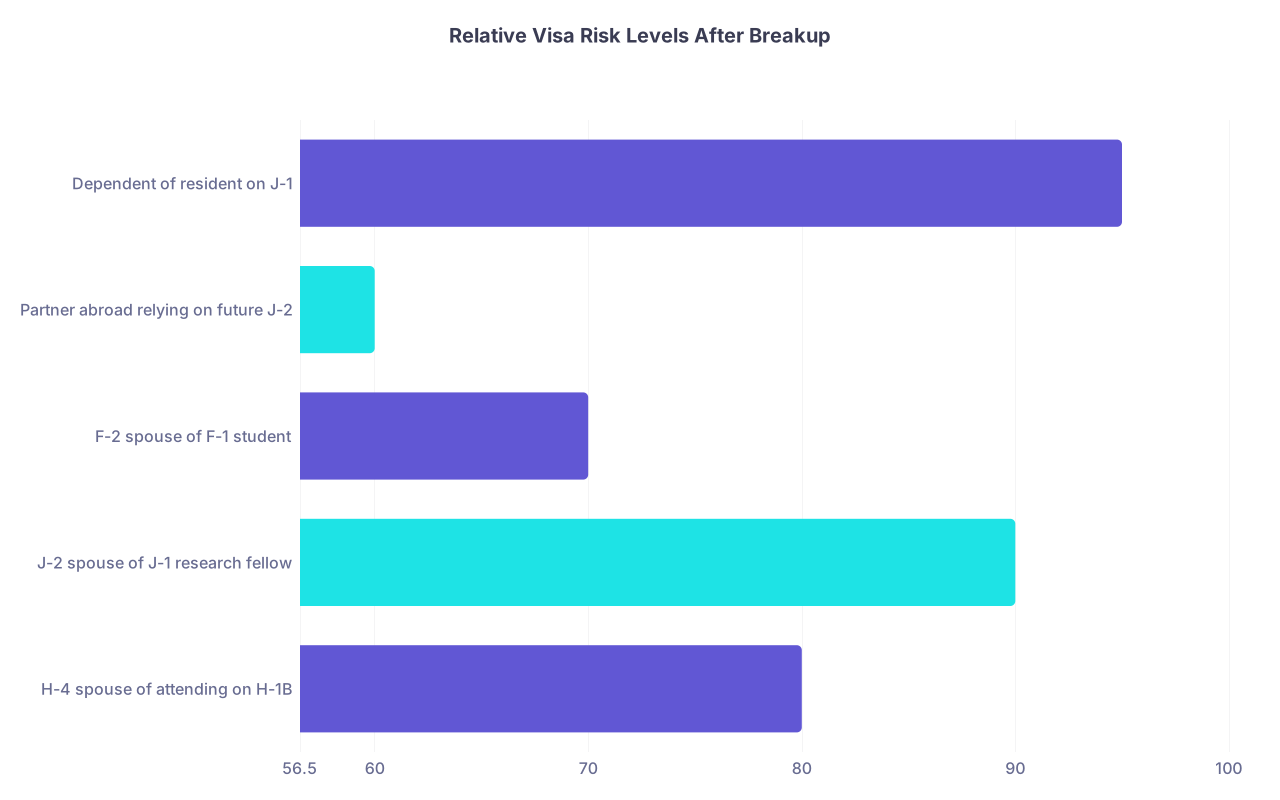
3. Know your specific risk level: status + stage + timeline
Let’s put some structure to your situation. Three variables matter:
- What status are you on now?
- What stage are you in (premed, med school abroad, doing research, applying to residency)?
- How fast could the relationship legally end?
Here’s the blunt version.
| Category | Value |
|---|---|
| H-4 spouse of attending on H-1B | 80 |
| J-2 spouse of J-1 research fellow | 90 |
| F-2 spouse of F-1 student | 70 |
| Partner abroad relying on future J-2 | 60 |
| Dependent of resident on J-1 | 95 |
Interpretation (higher = more urgent risk):
- J-2 spouse of a J‑1: high risk once principal finishes training or marriage ends. But sometimes more options (work authorization, waivers, own J‑1/H‑1B later).
- Dependent of resident on J‑1: extremely time-bound to training. When training ends, status ends fast. Breakup + training end = double cliff.
- H‑4 of an attending on H‑1B: risk is real, but there are more long-term pathways if you move quickly.
- F‑2 or partner still abroad: you’re not losing current U.S. status—but your plans may collapse unless you secure an independent path.
So while you’re panicking, pull out a sheet of paper and literally write:
- Current visa: ____
- Who is principal: ____
- When does their status naturally expire: ____
- Are we legally married still? ____
- Is divorce filed / imminent? ____
This isn’t therapy. This is case evaluation. You need this clarity before you talk to an immigration lawyer or make education/career moves.
4. Immediate actions if the breakup is happening now
If your spouse just said “I want a divorce” or you’re moving out next week, here’s your priority list.
1. Talk to an immigration attorney within 7 days
Not a friend-of-a-friend. Not Reddit. Not the WhatsApp group of other IMGs. A real U.S. immigration lawyer who works with physicians or professionals.
Bring:
- Your full immigration history (copies, not originals if you can avoid it)
- Timeline of relationship and current crisis
- Your medical training status (IMG? Foreign grad? USMLE steps? Any US offers?)
Your main questions:
- After divorce is final, how long do I actually have in valid status?
- Is there any way to file my own application to stay (student visa, own J‑1, own H‑1B, asylum, VAWA, etc.)?
- Do I need to leave and re-enter on a new status, or can I change status inside the U.S.?
- Is there any risk to staying until X date (when I finish Step 2, my research block, etc.)?
Pay for a 30–60 minute consult if you have to. That hour can literally decide whether you’re competitive for a future match or stuck outside the system for years.
2. Stop relying on your spouse for immigration communication
If your only updates about your status are “my wife says the lawyer handled it,” you’re already behind.
- Get your own copy of every immigration document that mentions you
- Make your own USCIS online account if relevant
- Stop having mail only go to your spouse’s address if you may move out
You’re transitioning from “tagalong spouse” to “primary decision-maker about your future.” Act like it.
3. Stabilize your short-term life so you can still function academically
Breakup + visa stress will crush your bandwidth. You need to protect at least:
- A quiet place to study / work on applications
- Internet access
- A way to get to your current hospital / university if you’re already in the system
If you’re premed or in med school abroad, that might mean:
- Staying with a trusted friend short-term instead of spiraling back to your parents’ house and losing access to your current mentors or hospital connections
- Talking quietly with one trusted faculty member: “I’m going through a family/immigration situation that may affect my ability to do observerships in the U.S. on the timeline we discussed. I’m still committed; I may need flexibility.”
You do not need to tell your entire story to everyone. But you can’t pretend nothing’s happening and then expect others to magic a solution once everything collapses.
5. Medium-term: build an independent immigration path
This is the heart of it. Your goal is simple: you want your ability to train or practice medicine in the U.S. to depend on you, not on a romantic relationship.
Options depend on your current stage.
A. If you’re still premed / in medical school outside the U.S.
You actually have more runway than you think. Use it.
Realistic independent paths:
Exchange visitor for research or electives (your own J‑1)
- Line up a U.S. research position or clinical elective with a university that can sponsor J‑1 directly for you
- This has nothing to do with your spouse’s status
- Build your CV now: research at home institution, strong letters, USMLE progress
Future residency J‑1 or H‑1B
- Your long game is: crush USMLE, get interviews, match, then enter on your own training visa
- The breakup may delay your first short-term U.S. exposure, but it doesn’t kill your overall trajectory
Action moves now:
- Double down on exam prep (Step 1/2, OET, whatever applies to your pathway)
- Strengthen your home-country CV (research, leadership, teaching) so that when you apply for U.S. positions they want you, not “the spouse of our current fellow”
- Keep your timeline flexible—maybe you planned to come as a dependent in 2024 and start Step studying in the U.S.; now you may do that from home and come on your own J‑1 in 2025–2026
B. If you’re already in the U.S. on dependent status
You need to explore changing to a status in your own right.
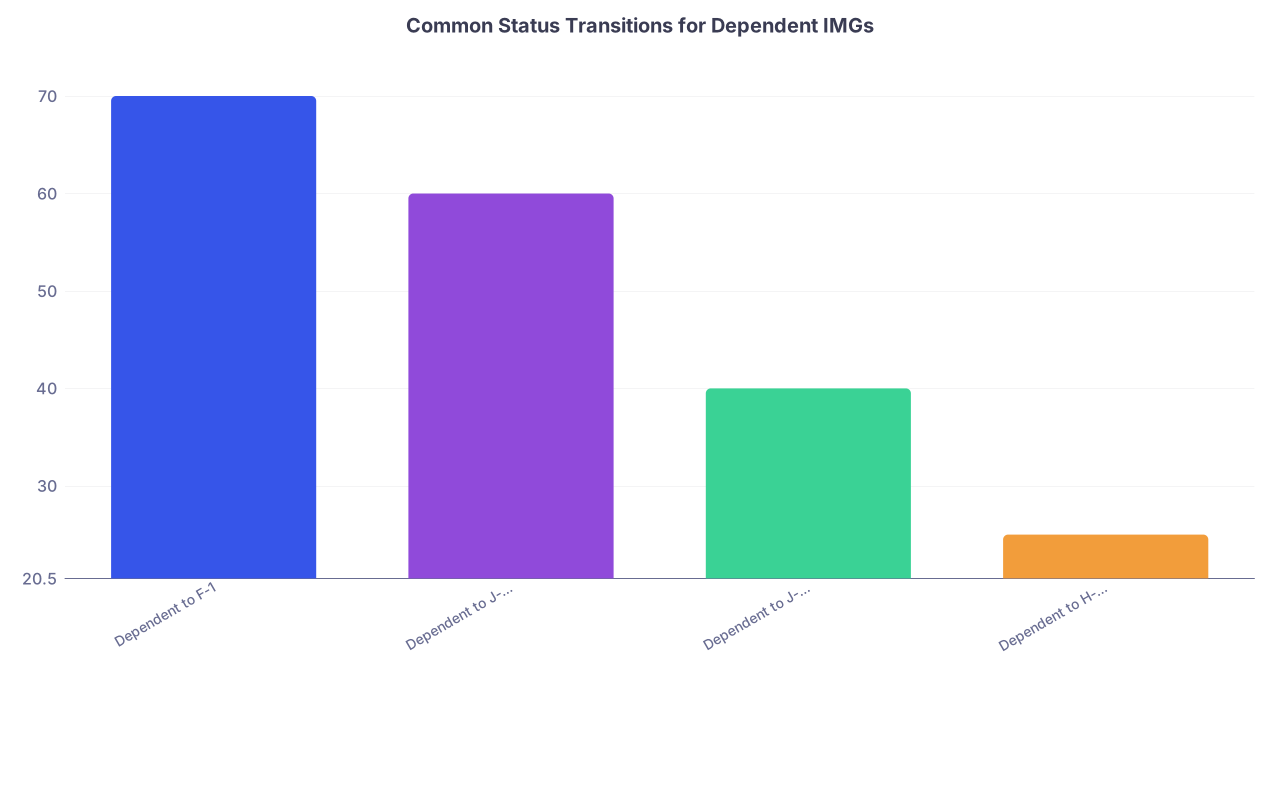
Common realistic transitions:
- Dependent → F‑1 (student)
- Dependent → your own J‑1 (research scholar, short-term scholar, or clinical for residency)
- Dependent → your own H‑1B (if you somehow land a qualifying job, often research if paid and specialty)
| Category | Value |
|---|---|
| Dependent to F-1 | 70 |
| Dependent to J-1 Research | 60 |
| Dependent to J-1 Residency | 40 |
| Dependent to H-1B | 25 |
The percentages here are just indicative of relative feasibility, not literal success rates. F‑1 is often the most accessible if you can pay for school and show ties/funding.
Concrete steps:
- Identify U.S. programs that can sponsor your own status: language programs, master’s degrees (public health, research, etc.), research positions
- Ask explicitly: “Do you sponsor F‑1/J‑1/H‑1B independently for international candidates?”
- Time your change of status application before or while divorce is in progress, not after everything is final and you’ve overstayed
I’ve seen people rescue their careers by quickly enrolling in a serious F‑1 program (like an MPH at a university with strong med connections), then using that period to build the network and CV that leads to residency.
6. If there is abuse or control: you may have more rights than you think
Some IMGs stay in awful, unsafe relationships because they’re convinced: “If I leave, I’m deported. No choice.” That’s not always true.
If your spouse is a U.S. citizen or permanent resident and there is abuse (emotional, physical, financial, immigration-related threats), you may have paths like:
- VAWA self-petition
- Certain waivers that let you continue an immigration process without them
If they’re not a citizen or green card holder, options are narrower but still might exist (asylum angles, independent visas, humanitarian options). This absolutely requires a specialized lawyer.
Signs you should bring up abuse/control in your consult:
- They threaten to cancel your visa or “send you back” if you don’t obey
- They control all your immigration documents and refuse to let you see them
- Physical violence or threats
- They isolate you from friends or colleagues, especially other doctors or students
Do not self-censor here out of shame. Tell the lawyer plainly. The legal definition of abuse is broader than just being hit.
7. Protecting your medical trajectory while everything burns
You’re not “just” trying to avoid leaving the U.S. You’re trying to stay on a competitive track as an IMG. That takes deliberate moves while your life is messy.
Keep your exams moving
Depending on where you are:
- If you’re registered for USMLE Step 1/2 or similar: do not casually postpone for a year because “I’m going through a lot.” Postpone if needed, but with a new concrete date.
- Use your emotional energy as fuel: I’ve seen people study like their life depended on it—because in a way, it did.
Maintain continuity in your story
Residency programs hate chaos without explanation. They’re okay with hardship when it has a narrative.
You want to be able to say in a future personal statement or interview:
- “During my spouse’s medical training in the U.S., I was on a dependent visa and used that time to do X, Y, Z.”
- “After a divorce that changed my immigration status, I returned to [home country] where I continued clinical work and research in [field]. This experience reinforced my commitment to….”
What kills applications is big unexplained gaps and incoherent moves. So even if your plan shifts, keep doing something aligned with medicine: research, local clinical work, teaching, public health.
8. Study plans and timing: adjust, do not abandon
Let’s say you’re:
- In year 4–5 of med school abroad
- Were about to move to the U.S. as an H‑4 spouse
- Planned: “I’ll prep Step 1 and 2 in the U.S. while my partner is in fellowship”
Then they end the relationship.
Your instincts will say: “It’s over, I’ll never match in the U.S.” That’s wrong.
New strategy might look like this:

| Step | Description |
|---|---|
| Step 1 | Relationship ends |
| Step 2 | Finish current med school year strong |
| Step 3 | Plan exam timeline from home country |
| Step 4 | Take Step 1/2 or equivalent |
| Step 5 | Apply for research / observerships on own J-1 |
| Step 6 | Apply for residency with independent visa |
You can still:
- Sit for exams in Prometric centers outside the U.S.
- Apply for research positions and observerships sponsored independently
- Build the same application—slightly delayed, but intact
The key is to stop romanticizing “being in the U.S. on my spouse’s visa” as your only viable route. Tons of matched IMGs never had that advantage at all.
9. Financial reality: you need money and a budget, now
Breakup + loss of dependent benefits often equals: no more shared income, no more health insurance through spouse, new legal costs.
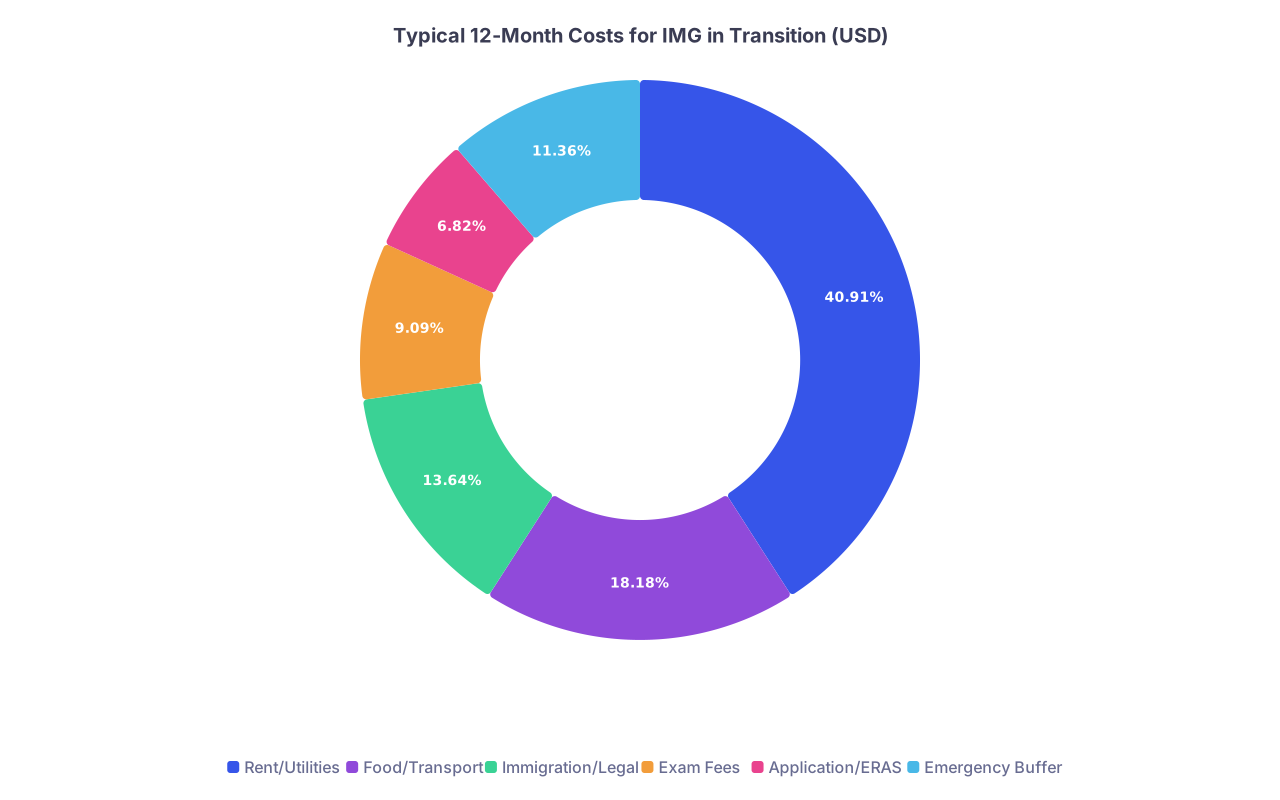
For IMGs in this position, I push a very unromantic exercise: a 12–18 month survival budget.
| Category | Value |
|---|---|
| Rent/Utilities | 18000 |
| Food/Transport | 8000 |
| Immigration/Legal | 6000 |
| Exam Fees | 4000 |
| Application/ERAS | 3000 |
| Emergency Buffer | 5000 |
Adjust numbers for your location, but the structure stands.
You need to know:
- Can you fund your own exams, applications, and any status changes if your spouse refuses to help?
- Do you need to move home temporarily to save money while studying?
- Are there scholarships, family help, or part-time work options in your home country that keep you afloat?
I’ve watched people lose two application cycles because they never did this math and then realized, too late, they couldn’t afford exam fees after paying emergency legal costs.
10. Mental health without self-sabotage
You’re dealing with:
- Grief from losing a relationship
- Fear of losing your future in a country you’ve pinned your hopes on
- Pressure from family, sometimes guilt or stigma around divorce
Some people respond by:
- Abandoning medicine entirely in a single dramatic decision
- Jumping into a new relationship immediately just for a potential visa
- Staying indefinitely in a toxic situation “for the dream”
All three are bad options.
Better moves:
- Short-term therapy if you can access it (many universities and training hospitals have low-cost counseling)
- Telling 1–2 trusted people in medicine what’s happening so you’re not hiding everything
- Setting a 3–6 month rule: “I will not make any irreversible decision about my career for 6 months. I will work the plan we laid out with the immigration lawyer and reassess.”
You’re allowed to be devastated. You’re not allowed (if you want this career) to burn the decade of work you’ve already invested because of one person.
11. If you’re still abroad and considering tying your status to a relationship
Let me be blunt: building your entire U.S. medical future on being someone’s dependent is a bad primary strategy.
If you’re a med student in India, Nigeria, Brazil, etc., dating or married to someone who’s going to the U.S. first, and the “plan” is:
- “You come on my H‑4/J‑2/F‑2 and then figure things out”
You need an independent track in parallel:
- Your own exam timeline
- Your own research / academic achievements
- Your own target for independent sponsorship (fellowship, research, residency)
Use the dependent option as a bonus, not the backbone. That way, if the relationship ends, your trajectory factually hurts, but doesn’t die.
12. What to tell programs, deans, and mentors (and what not to)
Eventually, a dean, PD, or mentor will ask about:
- A gap in training
- A sudden move back to your home country
- A visa complication
You don’t owe them your divorce decree. But you should have a clean, practiced, honest-but-brief explanation.
Something like:
- “There were unexpected family and immigration changes that required me to return to [country] for a period. During that time, I continued to work clinically in [specialty] and completed [research/project]. Those experiences ultimately strengthened my commitment to training in the U.S.”
If pressed:
- “I went through a divorce that changed my visa status. It was a challenging period personally, but I used that time to stay clinically engaged and prepare academically for U.S. training.”
What you avoid:
- Blaming your ex extensively
- Sounding bitter or chaotic
- Oversharing dramatic details
Programs want to see that you can survive a crisis and stay functional, not that your life has been easy.
13. Quick recap: what you do from here
If you skimmed, here’s the essence.
- Your dependent status can disappear with the relationship. Face that now, not later.
- Get a real immigration attorney involved early; build your own file and timeline.
- Shift your strategy from “spouse in tow” to “independent candidate” as fast as you can—through exams, research, or new visa options in your name.
You can survive the breakup and still become a doctor in the U.S. The relationship was one path. Not the only path.


