

Understanding the Job Search Landscape for US Citizen IMGs in Cardiothoracic Surgery
For an American studying abroad and returning to the United States for cardiothoracic surgery residency and fellowship, job search timing is not a trivial detail—it’s a strategic process that can significantly shape your early career. As a US citizen IMG, you occupy a unique position: you have the legal right to work in the US, but you may carry some of the same perceived disadvantages as non‑US IMGs (less familiar medical school, fewer home‑institution mentors, smaller domestic network).
In cardiothoracic surgery—where training is long, jobs are relatively few, and the physician job market is highly network‑driven—starting your attending job search at the right time is crucial. Aim too early, and you may not yet have the operative experience or letters that showcase your full potential; aim too late, and the best positions may already be filled.
This article walks through a year‑by‑year and month‑by‑month roadmap for when to start your job search, how to pace it, and how to leverage your status as a US citizen IMG so you graduate into a satisfying and sustainable role.
The Training Timeline: Where Job Search Fits in Cardiothoracic Surgery
Before discussing when to start job search activities, it helps to clarify the typical training paths for cardiothoracic surgery and where job search naturally fits in.
Common Training Pathways
Most US cardiothoracic surgeons follow one of these broad routes:
Traditional Path
- 5 years: General Surgery Residency
- 2–3 years: Cardiothoracic Surgery Fellowship (ACGME‑accredited)
- Total: 7–8 years post‑medical school
Integrated I‑6 Pathway
- 6 years: Integrated Cardiothoracic Surgery Residency (starts after medical school)
- Total: 6 years post‑medical school
4+3 Pathway (Less common, but present at some institutions)
- 4 years: General Surgery Residency
- 3 years: Cardiothoracic Surgery Residency
Regardless of the specific route, you will usually start your attending job search during your final 12–18 months of cardiothoracic training, not during your general surgery years (unless you’re planning a general surgery job).
How Being a US Citizen IMG Changes the Picture
As a US citizen IMG, you:
- Do not need visa sponsorship—this is a distinct advantage in the physician job market and should be highlighted.
- May have:
- Fewer US mentors from medical school
- Less visibility to domestic chairs and program directors
- More dependence on residency/fellowship mentors for networking
This means:
- You should start building your US network earlier than many US‑trained peers.
- Your job search timing needs to account for time to grow your reputation in the US system (presentations, research, away rotations, elective experiences, mentor introductions).
Global Timeline: When to Start the Attending Job Search
The right timing depends on your pathway and career goals (academic vs. private, adult vs. congenital, etc.), but a general rule of thumb for cardiothoracic surgery:
- Ideal window to start serious job search:
12–18 months before training completion - Absolute latest to start active search:
6–9 months before completion (risk of limited options) - Initial exploration and relationship‑building:
Begins 2–3 years before you finish.
Below is a structured guide, assuming a 7–8 year total training path (5+2 or 5+3). You can adjust by 1–2 years if you’re in an I‑6 program, but the principles are similar.
Phase 1: Early Cardiothoracic Training (Years 1–2) – Laying the Groundwork
At this stage, you are not applying for attending jobs yet. Your focus is on visibility, reputation, and skill acquisition—all of which will dramatically influence your later job search.
Key Priorities
Build a strong clinical and operative foundation
- Become known as reliable, prepared, and technically sound.
- Volunteer for cases, especially complex or high‑yield ones.
- As a US citizen IMG, this is your chance to counter any implicit bias about foreign medical school training through your day‑to‑day performance.
Identify long‑term mentors and sponsors
- Aim for at least:
- 1–2 cardiothoracic surgeons who know your operative skills and judgment.
- 1 academic mentor (even if you plan to go private practice).
- Ask directly:
- “I’m a US citizen IMG and I want to be intentional about my career planning. Would you be willing to mentor me as I think about heart surgery training and long‑term jobs?”
- Aim for at least:
Start academic and professional engagement
- Obtain involvement in:
- Manuscripts, case reports, or quality improvement projects.
- Presentations at STS, AATS, or regional CT meetings.
- This expands your recognizability beyond your institution, critical in a niche field like cardiothoracic surgery.
- Obtain involvement in:
Quietly observe the physician job market
- Periodically scan:
- CTSNet job board
- STS and AATS job postings
- Major physician job sites (e.g., NEJM Career Center, PracticeLink, Merritt Hawkins listings)
- Don’t apply yet; just observe:
- Typical job requirements
- Case mix (adult cardiac, thoracic, aortic, congenital)
- Geographic trends (where are most openings?)
- Types of practices: community, academic, hybrid, hospital‑employed
- Periodically scan:
This phase is about positioning yourself so that when it’s time to start the attending job search, you have a strong CV, credible endorsements, and name recognition.

Phase 2: Mid‑Training (Years 3–4) – Strategic Positioning and Early Exploration
By mid‑training, you start to align your future job with your strengths and interests, while still not actively applying.
Clarify Your Career Direction
By this stage, you should be articulating answers to:
- Adult vs. congenital vs. thoracic‑heavy practice
- Academic vs. private practice vs. hybrid
- Desired geographic regions or states
- Lifestyle priorities:
- Call schedule tolerance
- Case volume preferences
- Family needs, partner’s career, schools, etc.
Your identity as a US citizen IMG should be framed as:
- A surgeon with broad international perspective, trained abroad and refined in the US system.
- Logistically easier to hire (no visa issues).
- Adaptable and resourceful—qualities often honed when navigating multiple systems.
When to Start Job Search Activities in This Phase
Timing: About 2–3 years before completion, focus on soft exploration, not formal applications.
Actions:
Informal Conversations with Mentors
- Ask:
- “When should I start my attending job search for cardiothoracic surgery?”
- “Given my background as a US citizen IMG, are there locations or institutions where I would be especially competitive?”
- Get candid feedback about:
- Your operative readiness
- How you’ll be viewed in the physician job market
- Whether you should consider an additional subspecialty fellowship (e.g., structural heart, aortic, transplant)
- Ask:
Targeted Networking at Meetings
- Attend STS, AATS, regional STS/AATS‑affiliated meetings.
- Ask your mentors:
- “Is there anyone you could introduce me to from institutions where you think I may be a good fit after training?”
- Do not open with “Are you hiring?” yet. Instead:
- “I’m a mid‑level fellow/resident interested in an adult cardiac practice in the Midwest when I graduate. Could I ask you about what your group looks for in a new hire?”
Refine Your CV and Online Professional Profile
- Bring your CV up to date with:
- Presentations, publications, leadership roles
- Operative logs (summary)
- Create or refine:
- Professional LinkedIn profile
- Basic presence on CTSNet if applicable
- Bring your CV up to date with:
Assess Your Competitiveness
- Obtain honest feedback from trusted mentors:
- “If I were on the market today, what types of jobs would I likely match well with?”
- Use feedback to guide:
- Additional research productivity (if academic)
- More case exposure in needed areas (e.g., aortic, CABG, valve)
- Obtain honest feedback from trusted mentors:
This mid‑training phase sets up the information and relationships you will rely on once you begin sending applications and interviewing.
Phase 3: Final 18–24 Months – When to Start the Real Job Search
This is the critical window. Your job search timing decisions here will define your transition to attending practice.
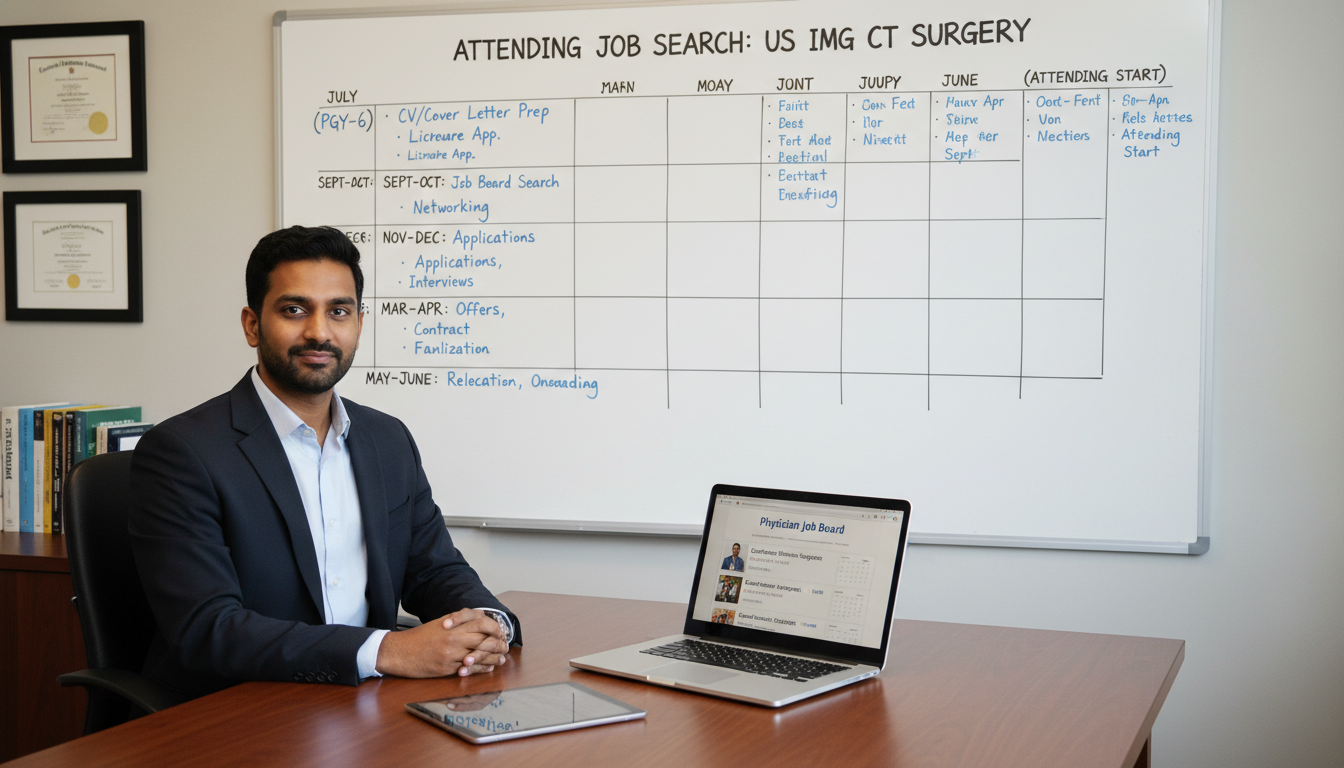
Optimal Timeline: Month‑by‑Month
Assume you finish training in June of Year X. A reasonable cardiothoracic surgery attending job search timeline might look like this:
July – December of Year X–2 (24–18 months before completion)
- Intensify conversations with mentors about realistic job targets.
- Start a structured list: desired locations, practice types, target institutions.
- Quietly let close mentors know:
“I’m planning to start my formal job search around [Month, Year]. I’d be grateful for any leads you think might fit my skills and interests.”
January – June of Year X–1 (18–12 months before completion)
- This is often the best time to start reaching out to potential employers, especially in cardiothoracic surgery where hiring can be slow and deliberate.
- Begin cold or warm emails to:
- Division chiefs
- Department chairs
- Program directors at faculty‑run groups
- You may also begin to see postings on:
- CTSNet, STS job board, NEJM, etc.
July – December of Year X–1 (12–6 months before completion)
- Peak interview season for many CT jobs.
- Start onsite interviews and serious negotiations.
- Some offers may arrive 6–9 months before graduation.
January – March of Year X (6–3 months before completion)
- Finalize offers, contracts, and non‑compete details.
- Arrange licensure, credentialing, and hospital privileging.
April – June of Year X (3–0 months before completion)
- Late phase for jobs; options may be more limited.
- Focus shifts to logistical preparation for your new position.
Why 12–18 Months Is the Sweet Spot
Cardiothoracic surgery groups and departments often:
- Need long lead time to:
- Secure hospital approval
- Adjust coverage models
- Align with strategic service line planning (e.g., building a TAVR or ECMO program)
- Want to see:
- More mature operative logs
- Letters reflecting recent complex cases
For you as a US citizen IMG, this window:
- Provides time to counter any bias with concrete data:
- Case volume
- Complexity of procedures
- Quality of recommendations
- Lets you demonstrate long‑term commitment to the US system.
Practical Steps: How to Time and Execute Your Job Search
Step 1: Clarify Your Non‑Negotiables (12–18 Months Before Completion)
List your top 3–5 non‑negotiables, such as:
- Region(s): East Coast vs. West vs. Midwest vs. South
- Type of practice:
- Academic tertiary center vs. community hospital
- Mostly adult cardiac vs. thoracic vs. mixed
- Call expectations and support:
- Availability of partners
- Presence of advanced practice providers
- Family and lifestyle:
- Proximity to relatives
- Spouse/partner job opportunities
- Schools and cost of living
Write these down before you start interviewing, so you don’t get swayed purely by salary or flattery.
Step 2: Signal Your Interest to Mentors and Sponsors
When you’re 12–18 months out, have direct conversations:
- “I’d like to start my attending job search this fall. Here’s the kind of practice I’m looking for. Would you be comfortable mentioning my name if you hear of appropriate openings?”
- For you as a US citizen IMG, ask:
- “Are there programs where my international background might actually be a strength—e.g., patient populations with diverse backgrounds or systems building?”
Mentors often know about positions well before they are posted publicly.
Step 3: Engage with the Visible and Hidden Physician Job Market
The physician job market in cardiothoracic surgery has two segments:
1. Visible Market
These are jobs you’ll see posted on:
- CTSNet
- STS/AATS job boards
- NEJM Career Center
- Recruiter emails
- Hospital/health system career pages
Timing strategy:
- Start monitoring daily or weekly around 18–12 months before graduation.
- Apply aggressively to positions that meet your criteria.
- Keep a tracking spreadsheet:
- Institution
- Contact person
- Date contacted
- Response
- Interview dates
- Offer status
2. Hidden Market
Many cardiothoracic positions never make it to public posting, especially at:
- Well‑known academic centers
- Stable regional cardiac programs
- Highly desirable metro areas
Access comes through:
- Program directors and division chiefs
- Conference networking
- Prior fellows from your program
Timing strategy:
- Begin cultivating this 2–3 years in advance.
- At 12–18 months out, ask explicitly:
- “If you hear of any positions that might be a fit, would you be willing to introduce me?”
Step 4: Craft a Targeted Introductory Message
When you’re ready to start your attending job search, send concise, targeted messages to potential employers:
Example email:
Subject: Interest in Cardiothoracic Surgery Position – [Your Name], Finishing [Month, Year]
Dear Dr. [Last Name],
I am currently a [Final-Year Fellow / Resident] in cardiothoracic surgery at [Institution], completing training in [Month, Year]. I am a US citizen IMG with broad operative exposure in [adult cardiac / thoracic / aortic / etc.], including [brief highlight: e.g., CABG, valve, complex aortic, ECMO].
I am seeking a position beginning [month/year] in a [community/academic/mixed] practice with a focus on [clinical interests]. Your program’s [specific feature – e.g., volume, ECMO program, TAVR, multidisciplinary team] aligns strongly with my goals.
I would be grateful for the opportunity to speak with you about potential opportunities, now or in the near future. I have attached my CV and a brief summary of my operative experience.
Sincerely,
[Name, MD]
[Current position, Institution]
[Phone number]
[Email]
Your US citizen status should be included in your CV and, when appropriate, in discussion—highlighting that you do not require visa sponsorship.
Step 5: Coordinate Timing of Interviews
Most cardiothoracic practices will arrange:
- Initial video or phone call
- 1–2 onsite interviews (all‑day or multi‑day)
To balance interviews with your training:
- Try to schedule the heaviest interview period during:
- Lighter rotations
- Electives
- Give your program director ample notice about needed days off.
In terms of timeline:
- Aim for first interviews roughly 9–12 months before graduation.
- Expect second visits and offer discussions around 6–9 months before graduation.
Step 6: Evaluate and Negotiate Offers with Timing in Mind
When evaluating offers, beyond salary and location, consider:
- Start date:
- Is there flexibility if boards are delayed?
- Does the group support onboarding time for:
- State licensure
- Hospital privileging
- Operative ramp‑up plan:
- Are there established referrals?
- Will your practice build slowly or quickly?
- Protected time:
- For academics: research and teaching
- For everyone: early practice development and mentorship
Because you’re a US citizen IMG, clarify:
- Whether they have had IMGs before.
- What support they offer for:
- Integration into local professional communities
- Access to mentors and senior partners
Common Pitfalls in Job Search Timing (and How to Avoid Them)
1. Starting Too Late
Risk: Limited geographic or practice‑type options; rushed decision‑making.
Avoid by:
- Beginning serious searching and outreach at least 12–18 months before training completion.
- Letting mentors know your timeline early.
2. Over‑Prioritizing Prestige Over Fit
As a US citizen IMG, you may feel pressure to “prove” yourself with a high‑profile institution. But:
- A “big‑name” job that doesn’t fit your interests or lifestyle can lead to early burnout.
- Community or regional programs can offer exceptional case volume and autonomy.
Use your non‑negotiables list to keep perspective.
3. Underestimating the Time Needed for Licensure and Credentialing
Even after signing, it can take 3–6 months or more to:
- Obtain state medical license
- Get hospital privileges
- Complete payer enrollment
When discussing start dates, factor this into your timing so you’re not left unpaid or unable to operate.
4. Not Highlighting the Advantages of Being a US Citizen IMG
You may focus on your IMG status as a liability. Reframe it as:
- You understand multiple healthcare systems and patient populations.
- You bring resilience, adaptability, and diverse training experiences.
- You are logistically easier to hire than a non‑citizen IMG.
These points are worth explicitly articulating when discussing your candidacy.
Frequently Asked Questions (FAQ)
1. As a US citizen IMG in cardiothoracic surgery, when should I start my attending job search?
Begin serious, active job searching 12–18 months before you complete training. This means sending CVs, emailing division chiefs, and scheduling interviews. However, you should start relationship‑building and informal exploration 2–3 years before finishing, particularly through conferences, research collaborations, and mentor introductions.
2. Does being a US citizen IMG delay my job search compared to US‑trained graduates?
No. In fact, your legal work eligibility (no visa sponsorship required) makes you competitive with US‑trained peers in terms of timing. The gap is usually in networking and visibility, not legality, so you should begin building relationships early, but you can follow a similar application timeline: 12–18 months before graduation.
3. How does the cardiothoracic surgery physician job market look right now?
The physician job market in cardiothoracic surgery is niche but stable. There is steady demand in:
- Community and regional centers needing adult cardiac surgeons
- Programs expanding structural heart, aortic, or transplant services
Competition is higher in major academic centers and large metropolitan areas. For a US citizen IMG, demonstrating strong operative experience, good communication skills, and strong references is key to accessing both academic and community roles.
4. When should I consider subspecialty training versus going straight into the job market?
This depends on your career goals and the local job market:
- If you want a highly specialized practice (e.g., advanced aortic, transplant, structural heart), additional training can be valuable.
- If your operative logs already show strong, broad exposure and you prefer an adult cardiac or mixed practice in a community or regional academic setting, you may be ready to enter the job market directly.
Discuss this decision 2–3 years before training completion with trusted mentors, as it will shift the timing of your attending job search.
For a US citizen IMG in cardiothoracic surgery, the question of when to start the job search is not just about dates—it’s about using each phase of training to build the credentials, network, and clarity you need to step confidently into your first attending role. Start early, stay organized, and make timing decisions as deliberately as you plan your operations.


