
Understanding Job Search Timing as a Non‑US Citizen IMG in Diagnostic Radiology
Timing your job search is one of the most strategic decisions you will make as a non-US citizen IMG in diagnostic radiology. Unlike many of your US citizen peers, you are navigating an additional layer of complexity: immigration rules, visa start dates, hospital credentialing, and sometimes a more skeptical employer audience. Poor timing can leave you scrambling to secure a position before your visa expires; good timing can put you in a position of strength, with multiple offers and enough lead time to complete licensing and visa processing.
This article walks through an optimal timeline from PGY‑2 through fellowship and beyond, specifically tailored to the non-US citizen IMG and foreign national medical graduate aiming for a successful diagnostic radiology match–to–attending transition. The goal is to help you know exactly when to start your job search, what to do at each stage, and how your visa status affects everything.
The Big Picture: How Early Should You Start?
For most non-US citizen IMG radiologists, the ideal timeline is:
If going straight into practice (no fellowship):
- Start career planning: early PGY‑3
- Start active job search: mid–PGY‑4 (about 12–15 months before start date)
If doing a fellowship:
- Start career planning: late R2/PGY‑3 (during DR residency)
- Start active job search: Summer–Fall of your fellowship year, ideally 12–18 months before your target start date (depending on visa type)
If on a J‑1 visa requiring a waiver job:
- Start targeted research: at least 18–24 months before completion
- Start active applications for waiver‑eligible jobs: as early as positions are posted, typically 12–24 months before you finish (waiver timing can be unforgiving)
Why so early? Because as a non-US citizen IMG:
- You need extra time for:
- State licensing
- Hospital credentialing
- Visa preparation and processing (H‑1B, O‑1, J‑1 waiver steps, or green card)
- Many employers unfamiliar with visa processes need:
- Time to consult their legal teams
- Time to get internal approval to sponsor
In a competitive physician job market, radiology remains relatively strong, but visa requirements narrow your options. Starting early preserves leverage and reduces stress.
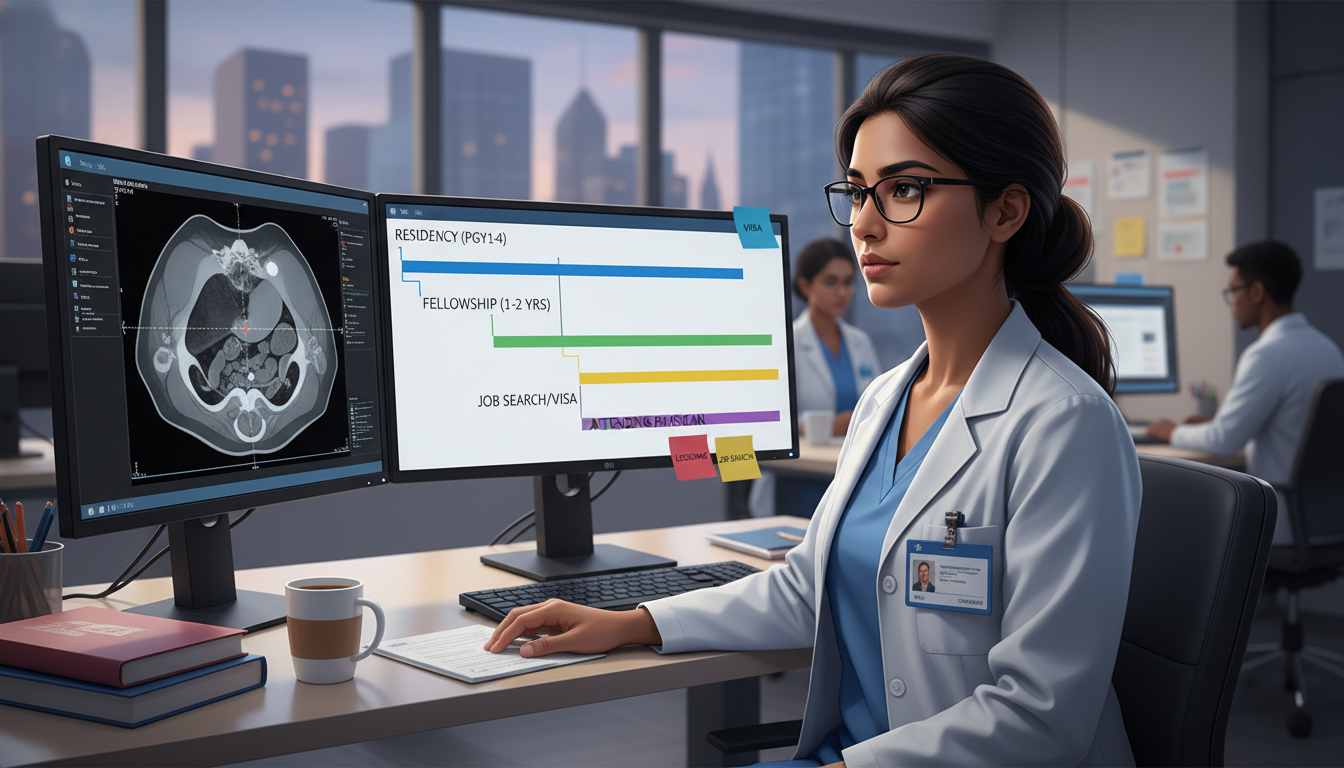
Year-by-Year Timeline: From Residency to First Attending Job
Below is a practical timeline for a non-US citizen IMG in diagnostic radiology, assuming a traditional path: 4-year diagnostic radiology residency + 1-year fellowship.
Adjust forward by one year if you plan to enter practice directly after residency.
R1 / PGY‑2: Foundation and Long-Term Positioning
Focus: Build your profile and understand the landscape; no aggressive job search yet.
Key actions:
Clarify your long-term immigration trajectory
- Identify your current visa: J‑1 vs H‑1B (or rare others like O‑1).
- Discuss with your program’s GME office and, if possible, an immigration attorney:
- Whether you’ll likely need a J‑1 waiver job (if on J‑1)
- Whether H‑1B sponsorship is feasible for fellowship and/or attending roles
- Strategies for long-term green card planning
Learn the basics of the physician job market in radiology
- Follow radiology job postings (even if you’re not applying yet):
- Sites: ACR Career Center, RSNA Career Connect, RADWorking, major hospital systems, and large radiology groups.
- Note:
- Common job types: academic, hospital-employed, private practice, teleradiology
- Usual requirements: fellowship training, board eligibility, state license
- Follow radiology job postings (even if you’re not applying yet):
Start strategic networking
- Attend national conferences (RSNA, ARRS, subspecialty meetings).
- Introduce yourself to faculty who are well-connected in your subspecialty.
- Build a basic LinkedIn profile emphasizing “Non-US citizen IMG / Diagnostic Radiology Resident” so recruiters can find you.
At this stage, you are not yet applying, but you are collecting information and laying groundwork.
R2 / PGY‑3: Clarifying Career Goals and Visa Constraints
Focus: Decide on fellowship plans, begin aligning your path with visa reality.
Confirm your fellowship strategy early
- Diagnostic radiology is highly fellowship-driven; most employers expect subspecialty training.
- By early R2, you should be targeting:
- Neuroradiology
- MSK
- Body imaging
- Interventional radiology–independent (if that’s your track)
- Breast imaging
- Or a niche relevant to your target job market (e.g., rural generalist vs academic subspecialist)
Consider how fellowship location and visa type affect your first job
- If on J‑1:
- Expect to need a J‑1 waiver job after training (usually in a designated shortage area or underserved region).
- Start loosely tracking J‑1 waiver-eligible radiology jobs and where recent graduates from your program have gone.
- If on H‑1B:
- Clarify whether future employers will be willing to transfer your H‑1B or sponsor an O‑1 or green card.
- Know that some large private practice groups and academic centers are comfortable with H‑1B, but many smaller groups are not.
- If on J‑1:
Build your “employability profile”
- Aim for:
- Strong professional references (program director, chief, subspecialty faculty)
- Evidence of reliability and productivity (call coverage, case logs, feedback)
- Any research, quality improvement work, or teaching you can highlight
- Aim for:
Still no active job search yet, but you’re building a “future recruitable attending” profile and aligning it with your visa/immigration reality.
R3 / PGY‑4: Transitioning from Planning to Early Exploration
If you will complete a fellowship, PGY‑4 is your “pre-fellowship” year. It’s not time to apply aggressively yet, but it is time to position yourself.
Finalize fellowship and think one step beyond
- When you rank or accept your fellowship:
- Consider the local job market where that fellowship is located.
- Ask: “If I like this city/region, how easy will it be to stay here on my visa type?”
- When you rank or accept your fellowship:
Start soft exploration of the attending job market
- Attend conferences as “Chief Resident” or senior resident and:
- Visit career fair booths.
- Ask recruiters: “When do you typically start hiring for radiologists graduating in [year]?”
For many employers, the answer is 12–18 months in advance.
- Join radiology-related professional organizations and their job boards.
- Attend conferences as “Chief Resident” or senior resident and:
Talk openly with mentors about timing
- Ask your program director, fellowship director, or trusted faculty:
- When non-US citizens from your program typically start job hunting
- Where recent foreign national medical graduates have matched for jobs
- Which employers in their network routinely sponsor visas
- Ask your program director, fellowship director, or trusted faculty:
By the end of PGY‑4, you should have:
- A clear idea of your fellowship path
- A rough plan: academic vs private practice, geography, and visa approach
- Awareness of how early some groups recruit (e.g., large private groups may recruit 18–24 months ahead for high-demand markets)

Fellowship Year: The Critical Window for Job Search Timing
Your fellowship year is almost always the pivotal period for your attending job search. For a non-US citizen IMG in diagnostic radiology, this is when timing becomes most important.
12–18 Months Before Your Start Date: Begin Active Searching
Assume you will finish fellowship on June 30 of Year X. Count backward:
- July–September of Year X‑1 (your fellowship start)
→ Start active job search activities and initial outreach.
Key steps:
Clarify your earliest feasible start date
- For most: July–September after fellowship.
- Factor in:
- Board exam timing
- Visa transfer/change of status
- State license issuance
- Credentialing timelines (often 3–6 months)
Update your CV and online presence
- Emphasize:
- “Fellow in [Subspecialty], completing [Month, Year]”
- Visa status clearly: “Currently on J‑1/H‑1B; seeking J‑1 waiver / H‑1B transfer / O‑1 sponsorship”
- Skills and modalities: CT, MRI, US, procedures, call experience
- Tailor to radiology employers by including:
- Reading volumes
- Types of studies you’re comfortable with independently
- Any niche skills (e.g., prostate MRI, cardiac CT, advanced neuro applications)
- Emphasize:
Start approaching mentors and program leadership
- State your goals clearly:
- “I am a non-US citizen IMG on J‑1 finishing neuroradiology fellowship in June [Year]. I’m looking for a J‑1 waiver-eligible position in [regions]. When should I realistically aim to sign a contract?”
- Ask them to:
- Connect you with alumni working in your target regions or groups
- Alert you when they hear of visa-friendly opportunities
- State your goals clearly:
J‑1 Waiver–Specific Timing Considerations
If you are on a J‑1 visa, the J‑1 waiver process dominates your timing:
- Many J‑1 waiver employers (especially in rural/underserved areas) recruit very early, sometimes:
- 18–24 months before your training completion
- States and federal waiver programs (e.g., Conrad 30) have:
- Yearly application cycles
- Limited slots
Implications for timing:
- Start seriously exploring J‑1 waiver-eligible positions 18–24 months before completion.
- Have your shortlist of potential waiver employers ready by the start of fellowship.
- Plan backward from:
- When your target states accept J‑1 waiver applications
- How long your future employer’s legal team needs to prepare the application
If you wait until 6–9 months before graduation, many of the best J‑1 waiver slots will already be taken.
9–12 Months Before Your Start Date: Interviews and Shortlisting
This roughly corresponds to Fall–Winter of your fellowship year for the typical July start.
Key activities:
Apply broadly, but strategically
- Use your visa status as a filter:
- Explicitly target positions that have:
- A history of hiring IMGs
- Large institutional support (academic centers, big hospital systems, big groups)
- Explicitly target positions that have:
- Craft emails that include:
- Your fellowship completion date
- Visa status and desired sponsorship
- Subspecialty skills
- Geographic preferences
- Use your visa status as a filter:
Schedule interviews with an eye on timing
- Try to cluster interviews in Fall–early Winter, so you:
- Receive offers with enough time to compare
- Avoid signing the first offer out of fear
- Virtual interviews are now common; this makes multiple interviews easier.
- Try to cluster interviews in Fall–early Winter, so you:
Ask explicit timing questions during interviews
- “When do you typically expect new hires to start?”
- “How long does your credentialing and onboarding process usually take?”
- “How much experience does your organization have sponsoring H‑1B/J‑1 waivers/O‑1?”
If a practice seems vague or uncomfortable about visas, that’s a red flag. As a non-US citizen IMG, you need employers who understand the process and can work within your timeframe.
6–9 Months Before Start Date: Offers, Negotiation, and Contracts
For most non-US citizen IMG diagnostic radiologists, you should aim to:
- Receive offers: 9–12 months before intended start date
- Sign a contract: 6–9 months before intended start date
This leaves adequate time for:
- State medical license
- DEA registration
- Visa transfer/waiver/processing
- Credentialing at hospitals and payers
Negotiation tips for the foreign national medical graduate:
- Compensation and schedule matter, but immigration security matters even more.
- Clarify in writing:
- Type of visa the employer will sponsor
- Who pays attorney and filing fees
- Timelines and responsibilities (e.g., state waiver filing, premium processing)
- Ask how they have handled previous non-US citizen hires:
- “How many radiologists on visas have you successfully onboarded in the last 5 years?”
How Visa Type Shapes Your Ideal Job Search Timing
Timing is not one-size-fits-all. Your specific visa will significantly affect when to start your job search and which employers you should prioritize.
On a J‑1 Visa (Residency and/or Fellowship)
Key points:
- J‑1 Home Residence Requirement: Most J‑1 physicians must:
- Return home for 2 years OR
- Obtain a J‑1 waiver via Conrad 30, federal programs, or other mechanisms
- Employers may only be interested if:
- They are in an underserved area
- They are eligible for a waiver program
- They have experience with the process
Timing implications:
- Begin serious waiver job research at least 18–24 months before graduation.
- Be prepared to commit earlier than H‑1B peers, because waiver-friendly spots are limited and competitive.
- Engage an immigration attorney early in fellowship to:
- Map out which states/programs fit your timeline
- Avoid missing key filing windows
On an H‑1B Visa
If you already have H‑1B status (often via residency or fellowship):
- Many employers find H‑1B transfers easier than fresh H‑1Bs.
- Important timing considerations:
- Cap-exempt vs cap-subject:
- University hospitals and some non-profit institutions may be cap-exempt.
- Private practices and community hospitals may be cap-subject.
- Start early (12–18 months ahead) to:
- Identify employers willing to handle an H‑1B transfer
- Avoid missing the April filing window if you need a cap-subject H‑1B
- Cap-exempt vs cap-subject:
Pursuing O‑1 or Direct Green Card
If you have strong academic credentials or unique skills, an O‑1 or early green card can:
- Expand your employer options
- Reduce the urgency of waiver requirements
But this path requires:
- Even earlier planning (sometimes starting in late residency)
- Careful documentation of your achievements
Common Mistakes in Job Search Timing for Non‑US Citizen IMGs in Radiology
Being aware of typical pitfalls can save you from major stress later.
Starting the search too late
- For J‑1 holders, waiting until 6–9 months before graduation to look for waiver-eligible jobs can leave you with:
- Unfavorable locations
- Weak contract terms
- Risk of visa gaps
- For J‑1 holders, waiting until 6–9 months before graduation to look for waiver-eligible jobs can leave you with:
Not aligning job search with visa and licensing timelines
- Accepting an offer without:
- Checking if the state’s license board is on track
- Ensuring the employer can file waiver or H‑1B paperwork in time
- Accepting an offer without:
Keeping visa status vague with employers
- Some candidates fear that being open about their visa will hurt them.
- In reality, vague or late disclosure often destroys trust and leads to rescinded offers.
- Be clear and proactive; target employers that are willing and able to sponsor.
Relying solely on job boards
- Many of the most visa-friendly roles are filled through:
- Word-of-mouth
- Personal networks
- Faculty connections
- Use job boards, but also actively network.
- Many of the most visa-friendly roles are filled through:
Ignoring practice stability for the sake of location
- A beautiful city with a financially unstable group is not a good trade-off if:
- You risk job loss and visa instability early in your career.
- As a non-US citizen IMG, practice stability and visa support should rank above marginal geographic preferences in your first job.
- A beautiful city with a financially unstable group is not a good trade-off if:
Practical Strategies to Optimize Your Job Search Timeline
Build a “Job Search Calendar” Early
Create a simple calendar that includes:
- Residency and fellowship end dates
- Board exam windows
- Key visa deadlines:
- State J‑1 waiver application openings
- H‑1B cap deadlines (if applicable)
- Target dates:
- Start of active job search
- Goal for interviews
- Contract signing window
Update this calendar annually and review it with:
- Your program director or fellowship director
- An immigration attorney (if possible)
Use Conferences Strategically
National and subspecialty conferences are essential for timing:
- As a late resident / early fellow:
- Attend career fairs to gather market intelligence:
- When groups are hiring
- What they look for in new hires
- Their visa comfort level
- Attend career fairs to gather market intelligence:
- As a fellow:
- Use conferences for targeted networking:
- Arrange meetings with potential employers 6–12 months before your start date.
- Carry an updated CV and be prepared to talk concretely about your timeline.
- Use conferences for targeted networking:
Maintain Regular Communication with Mentors
Mentors can:
- Alert you early to upcoming opportunities in their networks
- Provide honest feedback on the competitiveness of your profile
- Help you negotiate timelines so you’re not forced into premature decisions
Revisit your job search progress with mentors every 2–3 months during fellowship.
FAQs: Job Search Timing for Non‑US Citizen IMG in Diagnostic Radiology
1. When should I start my attending job search if I am a non-US citizen IMG finishing a diagnostic radiology fellowship?
You should begin active searching 12–18 months before your intended start date. If you finish fellowship in June, that usually means starting applications and networking no later than the prior July–September. On a J‑1 visa, particularly if you need a J‑1 waiver, start researching and targeting waiver-eligible positions 18–24 months in advance.
2. I’m on a J‑1 visa. Is it too early to talk to potential employers two years before I finish?
Not for J‑1 waiver positions. Many states and employers plan waiver hires 2 years out, especially in underserved areas. Early outreach allows:
- Time to confirm waiver eligibility of the position
- Alignment with state/federal waiver submission deadlines
Waiting until your final year often means competing for the last remaining or least desirable slots.
3. What if I don’t have any job offers by 6 months before graduation?
At 6 months out, things become time-sensitive, but options still exist. You should:
- Widen your geographic scope and consider less saturated markets.
- Lean heavily on mentors’ networks for last-minute opportunities.
- Contact recruiters who specialize in visa-sponsored physician placements.
- Work with an immigration attorney to identify any backup plans (e.g., short-term academic positions that can maintain your status).
But the best solution is to avoid this scenario by starting 12–18 months ahead.
4. How does the physician job market in radiology affect timing for a foreign national medical graduate?
Diagnostic radiology remains in relatively high demand across much of the US, which is favorable for you. However:
- Competitive metro areas and purely remote positions can still be tight.
- Visa requirements reduce the pool of employers able or willing to hire you.
Because of this, the general strength of the physician job market does not fully offset visa-related limitations. For a non-US citizen IMG, that means starting early, being flexible with geography, and targeting visa-experienced employers is still essential for a smooth transition from trainee to attending.
Planning ahead is your greatest asset. If you treat your job search as a structured, multi-year project rather than a last-minute scramble, you can navigate the diagnostic radiology job market—and its visa complexities—with confidence and control.