
The biggest financial mistake new attendings make is signing RVU-based contracts they do not actually understand.
Let me be very clear: RVU-based compensation is not mysterious, but it is absolutely weaponized against people who are too busy, too tired, or too trusting to read the fine print. You will be one of those three if you are coming straight out of residency.
This guide is meant to fix that.
1. RVUs 101: What They Are (And What They Are Not)
Work RVUs (wRVUs) are not dollars. They are a standardized unit of physician work built into the Medicare relative value unit system. Your employer converts them to dollars with a simple formula:
Compensation from RVUs = (Total wRVUs) × (Dollar per wRVU rate)
There are three flavors of RVUs in the Medicare system, but for your paycheck, you really care about:
- wRVUs (work RVUs) – the core of your productivity pay
- Total RVUs – wRVU + practice expense + malpractice components (important for billing departments, less so for your personal comp)
Most physician contracts peg compensation to wRVUs per CPT code, using the Medicare fee schedule as the baseline.
Let’s be specific.
Common examples:
- 99213 (established outpatient visit, low complexity): ~0.97 wRVUs
- 99214 (moderate complexity): ~1.50 wRVUs
- 99233 (subsequent hospital care, high complexity): ~2.00 wRVUs
- 45378 (diagnostic colonoscopy): ~3.36 wRVUs
- 92928 (PCI with stent, single vessel): ~23–24 wRVUs
These values change slightly over years with CMS updates, but the principle is fixed: more complex or time-intensive work yields more wRVUs.
What RVUs are not:
- They are not a guarantee you will get paid. You only get paid if:
- The service is billable
- It is documented and coded correctly
- It passes audits and payer rules
So if you are churning high-complexity notes with garbage documentation, your theoretical wRVUs and your actual credited wRVUs will not match.
2. The Core Formula: How Your RVU Pay Is Actually Calculated
Strip away the HR fluff. The structure usually boils down to:
- Base salary (often tied to an expected wRVU threshold)
- Productivity bonus for wRVUs above that threshold
- Sometimes a draw against future productivity
A common academic or large health system model for a new attending:
- Guaranteed base for 1–2 years
- A target number of wRVUs per year
- A conversion factor (CF) in dollars per wRVU
- Then bonus or repayment depending on your actual productivity
Example:
- Base salary: $260,000
- Target: 5,000 wRVUs/year
- Conversion factor: $50/wRVU
- Year-end reconciliation:
- If you generate 6,000 wRVUs: 1,000 excess × $50 = $50,000 bonus → total $310,000
- If you generate 4,000 wRVUs and your contract has a true-up against the base, you could technically “owe” back 1,000 × $50 = $50,000. Most systems for new grads will not claw back in year one, but some will. You need to know.
Here is where people get burned: they see the base and CF, but they never ask what the wRVU expectation is or how realistic it is with the actual clinic template, support staff, and call structure.
3. Understanding “Dollar per wRVU”: The Critical Benchmark
Your “$ per wRVU” rate is the most important number in the entire contract. It is also the number that gets manipulated the most creatively.
| Setting Type | Typical $/wRVU Range |
|---|---|
| Academic, primary care | $38–$50 |
| Academic, procedural | $45–$60 |
| Community hospital, non-proc | $50–$65 |
| Community, procedural | $60–$80 |
| Rural / high-need markets | $65–$90 |
Are these exact? No. But if you see $32/wRVU in a busy community practice, that is a red flag. If someone waves $80/wRVU for outpatient internal medicine in a saturated metro area, there is a catch.
Two key variables to sanity-check $/wRVU:
- Specialty – Procedural specialties typically have higher $/wRVU, but they may also have high overhead and variable case availability.
- Market – Smaller or undesirable locations often pay more per wRVU because they know recruitment is painful.
I have seen this dynamic repeatedly:
- Academic IM outpatient: $42–$48/wRVU
- Same physician, 10 miles away in community: $58–$65/wRVU
The academic job sells “mission” and “teaching”. The community job sells cash. You just have to be honest with yourself about which currency you care about.
4. How Many RVUs Are Realistic? Targets by Specialty
The next trap: insane RVU expectations baked into “average pay”.
Your annual wRVU volume is a function of:
- Clinic template (slots per half-day)
- No-show rate
- Payer mix
- Time carved out for admin, teaching, research
- Procedure room access and turnover (for proceduralists)
- Call volume and shift structure
Here are rough, real-world annual wRVU ranges for full-time attendings once established, assuming typical U.S. practices:
| Specialty | Common Annual wRVU Range |
|---|---|
| Outpatient IM/FM | 4,000–7,000 |
| Hospitalist (7-on/7-off) | 4,000–7,000 |
| Cardiology (non-invasive) | 7,000–12,000 |
| GI | 8,000–14,000 |
| General surgery | 7,000–12,000 |
| Hem/Onc (mixed clinic) | 6,000–10,000 |
| Neurology (outpatient) | 4,000–7,000 |
| Psych outpatient | 3,500–6,000 |
If your contract demands 10,000 wRVUs as a general outpatient internist with 45-minute new visits and 20-minute follow-ups, that is fantasy. Or it requires unsafe volume.
New attendings also forget ramp-up. Year 1 volumes are typically lower:
- Building a panel
- Figuring out workflow
- Figuring out EMR
- Teaching responsibilities (if academic)
- Getting procedures on the schedule
If they are tying your base salary to full productivity in year 1 with no ramp protection, that is harsh.
5. How Your Daily Work Translates to RVUs
Let me break it down at the “clinic day” level, where the rubber actually meets the road.
Say you are outpatient internal medicine.
You have:
- 8 half-days of clinic per week (1 full admin day)
- Template: 20-minute follow-ups, 40-minute new visits
- 18 patients per full day (let's assume 75% established, 25% new)
Realistic coding mix if you are careful:
- Established: mostly 99213/99214
- New: mostly 99203/99204
Approximate wRVUs:
- 99213 → ~0.97
- 99214 → ~1.50
- 99203 → ~1.60
- 99204 → ~2.60
Let’s assume this pattern per day:
- 14 established visits: 7 coded 99213, 7 coded 99214
- 4 new visits: 2 coded 99203, 2 coded 99204
Daily wRVUs:
- 7 × 0.97 ≈ 6.8
- 7 × 1.50 = 10.5
- 2 × 1.60 = 3.2
- 2 × 2.60 = 5.2
Total ≈ 25.7 wRVUs/day
Work 4 full days per week in clinic, 46 weeks/year:
- 25.7 × 4 × 46 ≈ 4,730 wRVUs from clinic
Then add some hospital rounding, procedures, etc., maybe you hit 5,000–5,500 wRVUs.
Now look at how this interacts with pay.
If your contract is $50/wRVU and you end up at 5,000:
- 5,000 × $50 = $250,000 “theoretical” wRVU comp
If they are paying you $250k with no bonus at 5,000, you are being paid right at the line. No upside. If they pay a base of $230k with $50/wRVU above 4,600, then:
- Base: $230,000
- Bonus: (5,000 – 4,600) × $50 = 400 × $50 = $20,000
- Total: $250,000
Same total, but the incentive is different. You need to understand those thresholds.
6. The RVU-based Contract: Clauses That Matter
This is where most of the exploitation hides. The wording is dry; the impact is not.
Key clauses you must identify and decode:
a) Productivity Period and True-Up
Questions you should have answers to:
- Is productivity measured annually, quarterly, or monthly?
- Is there a reconciliation (true-up) at the end of the period?
- If you are below target, is there a clawback?
I have seen contracts where:
- Year 1: “guarantee” but they still track RVUs; no clawback.
- Year 2: still have a base, but any shortfall below target must be repaid out of future bonuses or even written as negative balance.
You do not want to discover in March of year 3 that you are -$40,000 because year 2 was slow.
b) How wRVUs Are Credited
This looks trivial until it is not.
- Are wRVUs credited based on billed or collected services? It should be billed, not collected, because you do not control payer denials and lag.
- What about shared visits or team-based care? In hospitalist groups, for example, you may rotate with an APP. Does the APP’s work count to you? To no one? Split?
- What about teaching services?
- In some academic centers, resident-run clinics credit only attending of record for every visit. That is nice.
- In others, wRVUs are “for the department” and the individual attending does not see all of it reflected.
If teaching is 30–50% of your time and you get no RVU credit for it, your effective hourly wage is lower.
c) Nonclinical Time
Big one for academics and “hybrid” jobs.
- How much protected time (research, admin, teaching) is built in?
- Is that time compensated as part of your base without RVU expectations? Or do they still assign you an RVU target as if you were full-time clinical?
If you have 0.7 FTE clinical and 0.3 FTE research, but your RVU target is written like a 1.0 FTE, that is a trap.
A fair model would:
- Set an RVU target proportional to clinical FTE
- Compensate nonclinical FTE with a fixed, transparent rate
d) Changes to Compensation Plan
You will see language like:
“The employer reserves the right to modify the compensation plan, including wRVU conversion factors and thresholds, on 90 days’ written notice.”
Translation: they can cut your $/wRVU or jack up your target whenever they like. I have seen systems drop conversion factors by 10–20% in one year across a service line.
You want:
- Clarity on how often they adjust RVU metrics
- History of changes for your specialty in that organization
- At minimum, some guaranteed floor or gradual ramp for changes, not a cliff.
7. Collections, Payer Mix, and “We Don’t Care About Payers” Lies
Some employers love to say: “We pay purely on RVUs, so you do not need to worry about payer mix.”
Half-truth.
It is accurate that in a pure RVU model, your bonus math doesn’t directly depend on collections. But:
- If the service line or department is losing money consistently because of bad payer mix, guess what they will change first? Your conversion factor. Your staffing. Your templates.
- If denial rates are high because coders are overloaded or documentation is weak, it will eventually show up in their willingness to pay you top dollar per RVU.
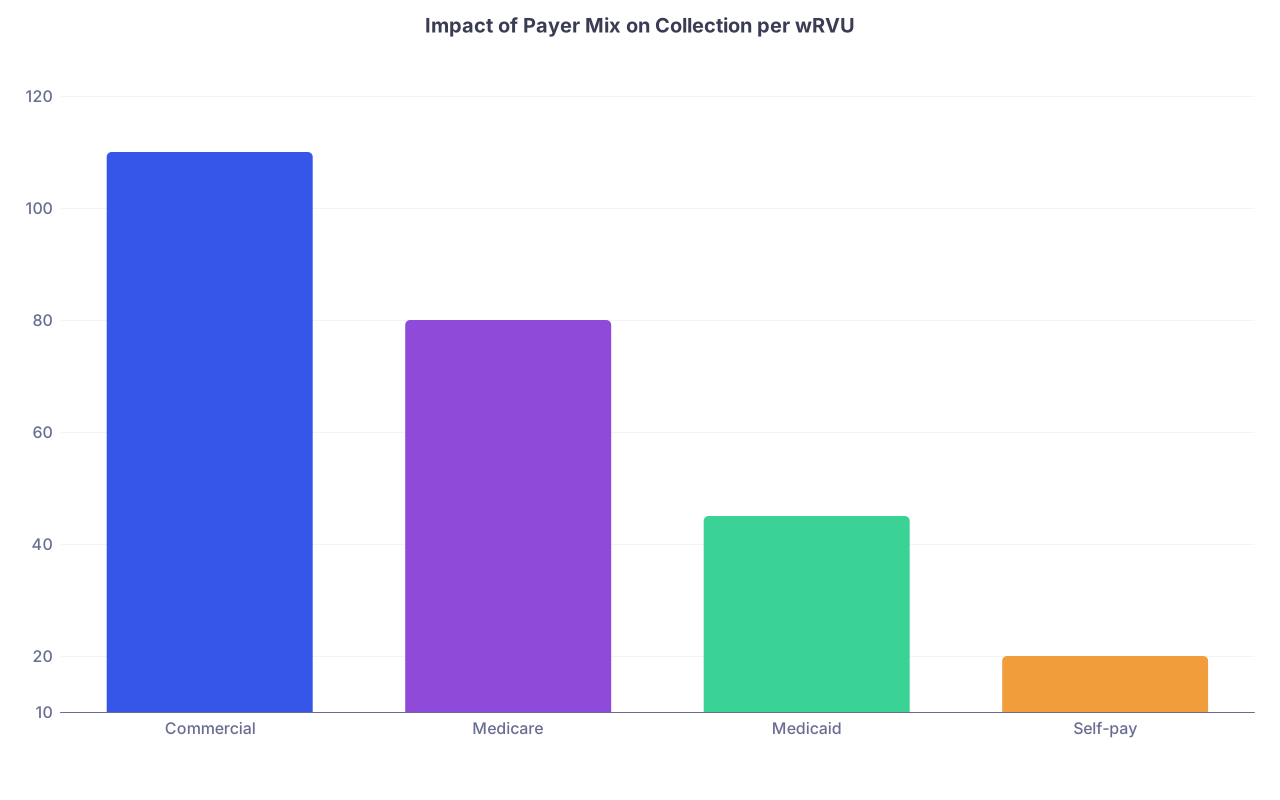
| Category | Value |
|---|---|
| Commercial | 110 |
| Medicare | 80 |
| Medicaid | 45 |
| Self-pay | 20 |
What this means for you:
- If a job offers high $/wRVU in a market that is 70–80% Medicaid/uninsured, I assume instability.
- If a job is heavily commercial and still offers mediocre $/wRVU, I assume greed.
You do not need to be a billing expert, but you do need to ask blunt questions:
- What is your average collection per wRVU in this specialty?
- What is your payer mix for this clinic or service line?
- Have you changed the wRVU conversion factor in the last 3 years? Up or down?
If they dodge, that tells you a lot.
8. Comparing Two RVU Offers: A Concrete Example
Let me show you why just comparing “base salary” is amateur hour.
Two outpatient cardiology jobs:
Job A – Academic center
- Base: $350,000
- Target: 8,000 wRVUs
- $/wRVU: $48 above 8,000
- Panel building is slow, 30% teaching, 1 day/week in echo lab with limited reading volume
Job B – Community hospital group
- Base: $275,000 (2-year guarantee)
- Target: 9,000 wRVUs
- $/wRVU: $70 above 9,000
- Aggressive clinic templates, full echo + stress + some cath time
Year 3, when you are fully ramped:
Job A: you manage 8,500 wRVUs
- Base $350,000 + (500 × $48) = $24,000 → $374,000 total
Job B: you manage 11,000 wRVUs
- Theoretical wRVU comp: 11,000 × $70 = $770,000
- But base is $275,000 + (11,000 – 9,000) × $70 = 2,000 × $70 = $140,000 bonus → $415,000
On raw earnings, Job B wins. But.
You need to know:
- How are those 11,000 wRVUs generated?
- 20-minute new patient slots, 15-minute follow-ups, double-booked?
- Turnover expectations in the lab? Late nights?
- What does burnout look like in that group?
- Are you comfortable being in a pure volume engine?
You cannot just say “Job B pays more”. You have to translate RVUs into real daily life.
9. Advanced Tactics: Reading and Negotiating an RVU Contract
You do not need to become a healthcare economist, but you should absolutely behave like a professional evaluating a multi-hundred-thousand-dollar business relationship. Because that is what this is.
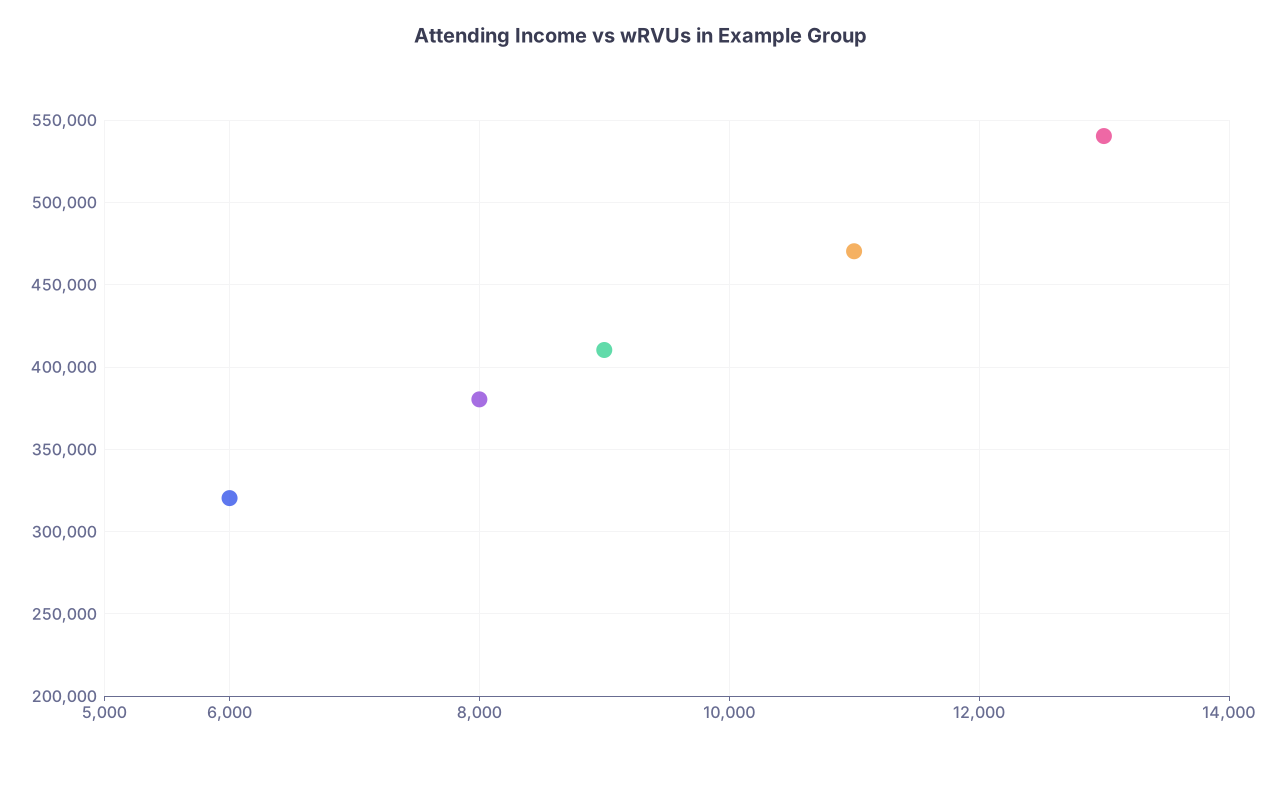
Step 1: Get the Actual Numbers, Not Vibes
When a recruiter says, “Our cardiologists make $450–$600k easily,” your immediate response should be:
- “What is the wRVU threshold for that range?”
- “What is the average annual wRVU for someone in my position?”
- “What is the distribution: 25th, 50th, 75th percentile?”
- “What is the $/wRVU?”
| Category | Value |
|---|---|
| Phys A | 6000,320000 |
| Phys B | 8000,380000 |
| Phys C | 9000,410000 |
| Phys D | 11000,470000 |
| Phys E | 13000,540000 |
If they cannot or will not show you real numbers, I treat every compensation claim as marketing.
Step 2: Normalize Everything to “Total Potential Comp at Realistic RVUs”
For each job:
- Estimate a realistic annual wRVU number for you, given:
- Your speed
- Nonclinical duties
- Clinic structure
- Apply their formula.
- Include call pay, stipends, sign-on, loan repayment, etc., but separately. Do not let a $20k sign-on blind you to a bad $/wRVU rate that will cost you hundreds of thousands over 5 years.
Step 3: Negotiate the Right Levers
Things that are often negotiable (not always, but often):
- Target wRVUs for bonus thresholds
- Conversion factor ($/wRVU)
- Length and terms of initial guarantee period
- Call stipends and how call RVUs are credited
- Protected nonclinical time and whether it reduces RVU targets
Things that are much harder to move:
- Overall RVU structure of the group
- Institutional policies on academic time credit
- Global compensation plan language (they often say it must be “standardized”)
Most new attendings do the opposite: they negotiate an extra $10k of base salary and ignore the RVU mechanics that will define their income for the next decade.
If you have leverage (multiple offers, in-demand specialty, rural/unpopular location), aim that leverage at:
- Higher $/wRVU
- Lower RVU threshold for bonus
- Guaranteed stability of RVU terms for at least 2–3 years
10. Common Landmines I See New Attendings Step On
Let me run through the mistakes I see repeatedly in people 6–18 months out of residency.
Landmine 1: “The Guarantee Will Always Be There”
A 2-year guarantee is not a promise about years 3–10. It is a honeymoon, after which they can:
- Ratchet up your RVU targets
- Slice your $/wRVU
- Cram more patients on your schedule without adding support staff
You must know what the plan looks like once the guarantee ends. That is your real job, your real pay.
Landmine 2: Misunderstanding FTE and Targets
People sign “0.8 FTE” for better life balance, but their RVU expectations are quietly written as if they were 1.0 FTE, or close.
Then they are “low producers.”
Your RVU target must be explicitly scaled to FTE. If full-time target is 5,000 wRVUs, then 0.8 FTE target should be around 4,000, not 4,800.
Landmine 3: No Credit for Huge Chunks of Work
Patterns I have seen:
- Inpatient consults done “for free” for surgical teams with no RVU credit.
- Teaching services where residents do all documentation; attending is present but RVUs credited to “the department”.
- Admin duties that slowly expand while your RVU target does not shrink.
Every significant work bucket needs:
- Clear time allocation
- Clear compensation (fixed salary vs RVU vs stipend)
- Clear expectation about RVU impact
Landmine 4: “Everyone Here Makes X…”
Whenever you hear, “Our docs make around $450k,” you respond: “On what RVUs and over what timeframe?”
Because “everyone” often means:
- Two senior partners with huge panels and lots of procedures
- One unicorn who lives at the hospital
- Plus three mid-career people quietly making much less but not saying it around the recruit
Ask:
- “What did your last three hires make in years 1, 2, and 3? Approximate ranges are fine.”
- “How many left in the first 3 years, and why?”
If that feels awkward to ask, remind yourself: you are about to sign a contract worth more than a house.
11. Quick RVU Reality Checks Before You Sign
You are busy. Let me give you a short set of hard filters to run any RVU-based job through.
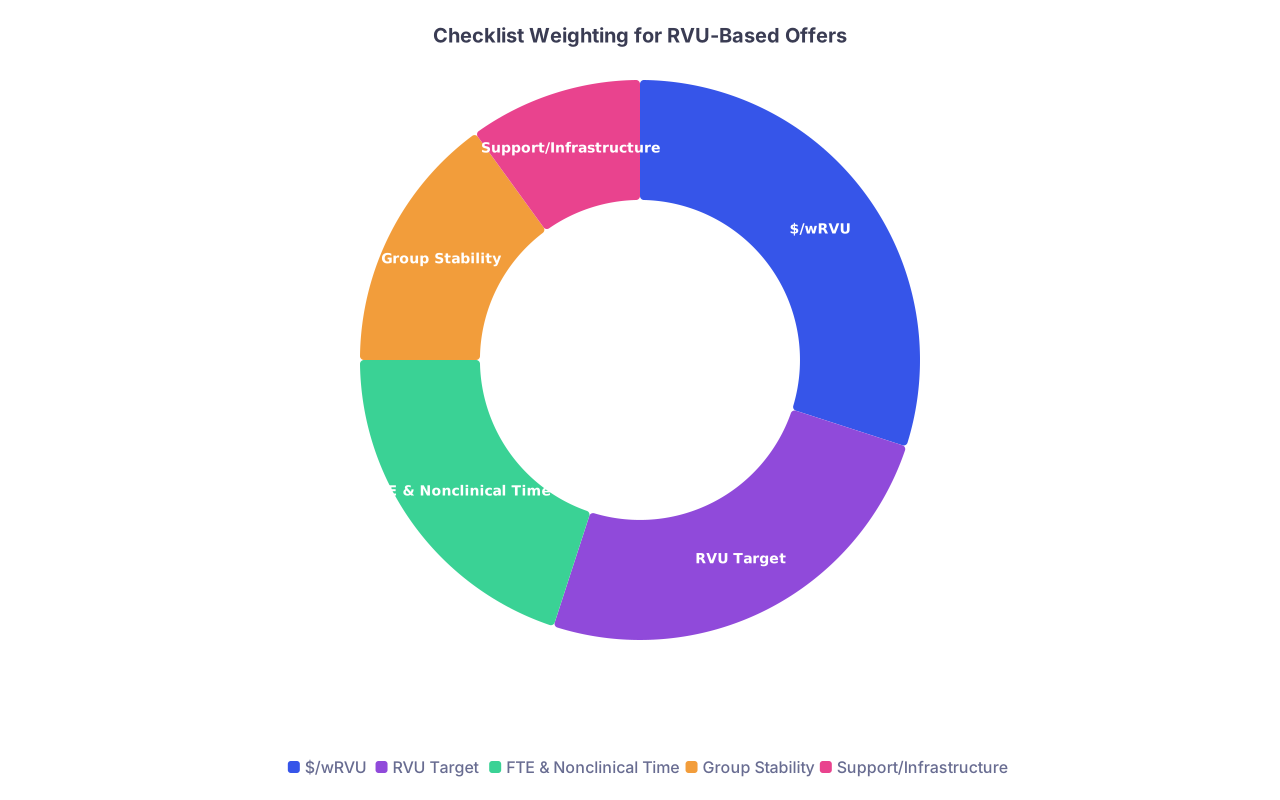
| Category | Value |
|---|---|
| $/wRVU | 30 |
| RVU Target | 25 |
| FTE & Nonclinical Time | 20 |
| Group Stability | 15 |
| Support/Infrastructure | 10 |
Ask these questions, and walk if the answers are vague or bad:
What is the $/wRVU?
- Compare to MGMA or specialty norms. If it is bottom of market, they better be offering lifestyle or location you love.
What is the expected annual wRVU volume for me, at my FTE, in year 3?
- Get a number. Then ask how many people in the group actually hit it.
How is nonclinical time handled?
- Protected? Compensated? Does it reduce RVU expectations?
Is there a clawback if I do not meet the wRVU threshold during the guarantee?
- If yes, you are effectively taking a loan, not a guarantee.
What is your history with this compensation plan?
- Any major changes in the last 3–5 years? Why?
If they bristle at these questions, that tells you what you need to know.
12. One Last Piece: Aligning RVUs With Your Actual Life
There is a subtle but crucial point here. RVU-based comp systems are built to reward volume and complexity. They are not built to reward:
- Spending an extra 20 minutes with a distressed family
- Fixing broken workflows
- Mentoring students
- Being the mensch who always answers curbside questions
If you choose an aggressive RVU model and still practice like you are in a slow academic clinic with open-ended visits and lots of unpaid side work, you will under-earn and over-burn.
You have three basic options:
Lean into the RVU game
- Tight templates, strong documentation, efficient workflows, full MA/RN support
- You will make a lot but work like it
Choose a model that pays for non-RVU work
- More academic/VA/Government jobs, often lower $/wRVU but stable salaries and better protected time
Hybrid
- Negotiate fixed pay for nonclinical roles (medical directorships, teaching stipends) plus RVU for clinical
The mistake is pretending you are in model #2 while being paid like model #1.
Key Takeaways
- RVU-based compensation is fundamentally simple math: wRVUs × $/wRVU, but the contract details (targets, FTE scaling, nonclinical time, clawbacks) decide whether that math works in your favor or theirs.
- Do not sign any RVU contract until you know your conversion factor, realistic wRVU volumes, and how your specific duties are credited—and you have modeled your likely income in years 1–3.
- Choose a job whose compensation structure actually matches how you want to practice; if you ignore that mismatch, the RVU system will eventually make the decision for you, usually by burning you out.