
The way most hospitals talk about “medical director” roles is misleading. The titles sound grand, the stipends look attractive on paper, and the fine print quietly eats your time, your energy, and sometimes your reputation.
Let me break this down specifically.
You need to understand exactly what you are selling when you take on a medical director or leadership stipend role: your clinical credibility, your nights and weekends, and your political capital. Sometimes this trade is absolutely worth it. Sometimes it is a soft trap.
This is the post‑residency job market most attendings are not prepared for.
1. What “Medical Director” Actually Means (Not the HR Version)
Forget the glossy job description for a minute. In practice, “medical director” usually means four overlapping buckets of responsibility:
- Clinical governance
- Operational firefighting
- Quality/safety oversight
- Political buffering between clinicians and administration
Most jobs emphasize one or two of these, but you will touch all four eventually.
Typical real‑world director roles:
- ED Medical Director
- Hospitalist/Nocturnist Medical Director
- ICU/Stepdown Medical Director
- Service line director (Cardiology, Oncology, Ortho)
- Clinic/ambulatory site medical director
- Quality/Patient safety medical director
- Informatics/CMIO‑adjacent roles
- Program medical director (stroke, sepsis, chest pain, trauma, HF, etc.)
These are not “mini‑CMO” jobs. They are working leadership roles built on top of your clinical FTE.
And yes, that word “on top” is doing a lot of work.
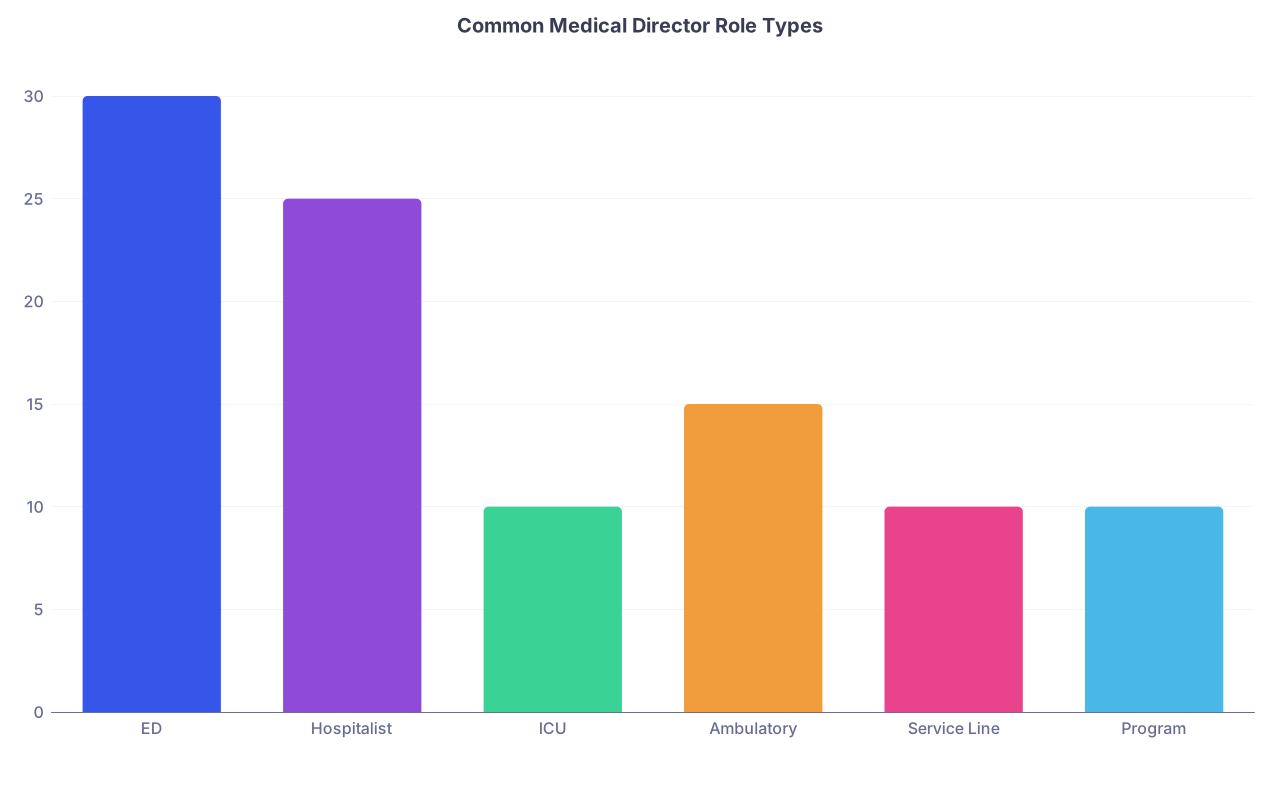
| Category | Value |
|---|---|
| ED | 30 |
| Hospitalist | 25 |
| ICU | 10 |
| Ambulatory | 15 |
| Service Line | 10 |
| Program | 10 |
That rough distribution is what I actually see when groups hire: ED and hospitalist leadership dominate, with the rest sprinkled across larger systems.
2. Stipends and FTE: How the Money Really Works
The first thing you should ask when you see “Medical Director” on a job posting is not “What’s the stipend?” It is:
“How many protected FTEs are allocated and what exactly am I not doing clinically because of this role?”
Common compensation models
Most U.S. groups use one of the following patterns:
Flat stipend only
- Example: “ED Medical Director – $60,000 annual stipend”
- No formal FTE reduction, just “administrative time” somewhere between 0.1–0.25 FTE “expected” but not explicitly carved out.
- Translation: you will work almost a full clinical schedule and do admin work on your “off time,” evenings, and early mornings.
Stipend + admin FTE
- Example: 0.2 FTE admin + $40,000 stipend + 0.8 FTE clinical pay.
- This is more honest. Your base clinical FTE is reduced, and the admin time is actually scheduled.
Pure FTE conversion (no extra stipend)
- Example: You drop from 1.0 to 0.8 clinical FTE and the 0.2 is paid at your usual rate to do director tasks.
- Financially clean, politically weaker. You are “just another doc” paid to do admin.
Productivity carve‑outs
- Usually in RVU‑based models: “We will credit you with X RVUs per month for director work.”
- This is often the worst. RVU equivalents are underestimated, and you are paid as if you were seeing patients, but you lose control over your time.
| Model | Typical Admin FTE | Extra Stipend Range | Risk of Unpaid Work |
|---|---|---|---|
| Flat stipend only | 0.0–0.1 | $20k–$80k | Very high |
| Stipend + admin FTE | 0.1–0.4 | $20k–$60k | Moderate |
| FTE conversion only | 0.1–0.5 | $0 | Low–moderate |
| RVU carve‑out | Unclear | RVU credits only | High |
If you remember nothing else about compensation, remember this:
At least half of the work in bad director jobs is invisible and unpaid.
You are not paid for reading 2 a.m. angry emails, calming a nurse manager on Sunday afternoon, or answering random “can you hop on this quick call?” requests from the CMO.
Realistic dollar ranges
By specialty and site, in current markets (2024):
- ED Medical Director: $40k–$120k stipend, 0.2–0.4 FTE admin in well‑run groups; 0.1 FTE in exploitative ones.
- Hospitalist Director: $30k–$80k stipend, 0.1–0.3 FTE admin.
- ICU Director: $25k–$75k stipend, 0.1–0.3 FTE.
- Program Director (stroke, chest pain, sepsis): $10k–$40k, often with 0.05–0.1 FTE.
- Ambulatory site director: $20k–$50k stipend, 0.1–0.2 FTE.
The top end of those numbers usually goes with larger multi‑hospital systems or very high volume sites. The bottom end goes with, frankly, desperate “we need someone, anyone, to put their name on the line for this.”
3. Time Burden: The Part They Soft‑Pedal
The most common failure mode I see is underestimating the time and cognitive load of the role.
You will be told some version of this:
“It’s around 8–10 hours a week, mostly meetings and emails.”
That line is fiction in at least half of jobs.
Break the time down yourself. For a typical mid‑sized hospital director role (single department, say 40–70k ED visits or a 20–40 FTE hospitalist group), realistic average weekly time:
- Standing meetings:
- Department + operational: 2–4 hours
- System/medical staff/leadership: 1–3 hours
- Personnel issues (recruiting, evaluations, conflicts): 1–2 hours
- Quality/safety (chart reviews, incident follow‑up, PI projects): 1–3 hours
- Email / asynchronous admin: 1–3 hours
- Random fires: 0–3 hours
You are looking at 6–15 hours per week, with spikes during:
- Contract renewals or RFPs
- Major quality failures (never events, mortality reviews)
- Epic/EMR go‑lives or upgrades
- Payor or regulatory surveys (Joint Commission, CMS, stroke center certification, etc.)
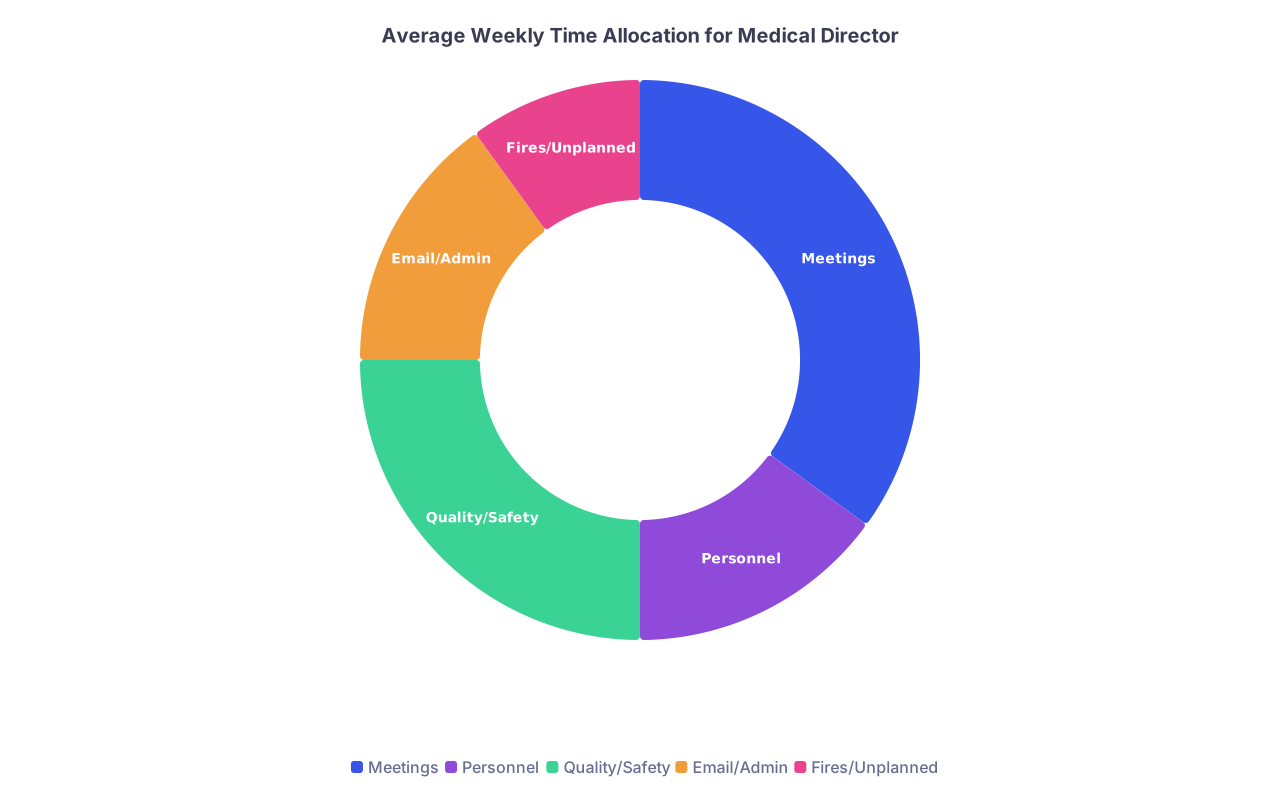
| Category | Value |
|---|---|
| Meetings | 35 |
| Personnel | 15 |
| Quality/Safety | 25 |
| Email/Admin | 15 |
| Fires/Unplanned | 10 |
If they offer 0.1 FTE (about 4 hours/week) and your realistic workload is 10–12 hours, you are donating 6–8 hours every single week. Do the math at your effective hourly clinical rate. For many attendings, this is a four‑figure monthly volunteer gig dressed up as “leadership.”
4. What You Are Actually Responsible For (When Things Go Wrong)
Medical director is a high‑visibility, high‑blame role. You need very clear boundaries.
Core domains you own, explicitly or implicitly:
Clinical standards and protocols
- Order sets, policy approvals, care pathways.
- If a bad protocol causes harm, your name is on it.
Peer behavior and performance
- Late notes, chronic under‑productivity, disruptive behavior, competence concerns.
- You sit in the awkward middle: colleagues on one side, admin/legal on the other.
Quality metrics
- For hospitalists: LOS, readmissions, mortality.
- For ED: door‑to‑doc, LWBS, boarding, sepsis bundle compliance.
- For ICU: VAP, CLABSI, CAUTI, mortality, vent days.
Regulatory and accreditation
- Stroke or chest pain centers have specific medical director requirements.
- Surveyors will ask for your name, your credentials, your policies, and your minutes.
Recruitment and retention
- Interviewing candidates, onboarding, sometimes off‑boarding.
- You are expected to “fix” morale without control over compensation.
When a sentinel event occurs, or a core measure tanks, or a surgeon screams at nurses in the OR, leadership will look at you first and say:
“What is your plan to address this?”
Notice the wording. Not: What happened? But: What is your plan?
You own the plan.
5. Political Reality: You Work for Everyone and No One
The real job description for most medical directors is this:
“Be the person everyone blames but no one fully empowers.”
You report, at least on paper, to:
- The group or practice (e.g., national EM group, hospitalist company, or local practice)
- The hospital CMO / VPMA / service line leader
- Sometimes a dyad partner (nurse director, service line administrator)
You are also accountable informally to:
- Your physician colleagues
- Nursing leadership
- Ancillary services who see you as “the doc in charge”
And yet you do not usually control:
- Salaries or bonuses
- Staffing ratios (nursing, techs, APPs)
- Capital spending (monitors, beds, ED expansion)
- EMR build budgets
- Major contractual terms between the group and hospital
You are the translator and shock absorber between those with power and those with day‑to‑day clinical reality.
If you hate politics, you will either:
- Become very effective and very tired, or
- Become invisible and quickly irrelevant
I have sat in meetings where a department’s entire quality profile for the year is reduced to two slides and one line: “We need your group to lower LOS by 0.3 days.” No discussion of bed capacity, SNF access, social work coverage, or weekend discharge bottlenecks. Your job is to push that pressure down without destroying your relationship with your own clinicians.
That is the political reality.
6. When Taking a Stipend Role Is Actually Smart
It is not all doom. Some medical director roles are excellent career accelerators. The key is timing, clarity, and fit.
Good reasons to take a director role
You want a future in leadership, not just “a bit less clinical.”
You are eyeing CMO, VPMA, service line leadership, or health system roles in 5–10 years. Medical director is your residency in leadership.You want structured influence over your practice environment.
Instead of complaining about throughput, documentation burdens, or quality metrics, you want the seat in the room where those things get shaped.You are mid‑career and trading raw income for control and variety.
Clinical full‑time at 15 years out can be grinding. A solid 0.2–0.3 FTE leadership role can extend your runway.The deal on paper is actually good.
- Clear FTE carve‑out
- Reasonable, written expectations
- Access to data, support staff, and a real dyad partner
- Leadership training or tuition support for formal programs (e.g., MHCDS, MBA, MHA)
You need CV credibility for external opportunities.
Health plan roles, quality organizations, informatics jobs, regional medical director in industry – all of these look first for real‑world leadership titles and measurable outcomes.

| Step | Description |
|---|---|
| Step 1 | Full time clinician |
| Step 2 | Small program director role |
| Step 3 | Department medical director |
| Step 4 | Service line leader |
| Step 5 | System CMO or VP role |
Notice what is not on this path: “Random ad hoc committee work forever.” Titles and defined roles matter.
7. Red Flags That the Role Is a Trap
Here is where you protect yourself. You can spot most bad roles before you sign anything.
Big red flags:
No written role description with time expectations.
If the answer to “How many hours per week?” is vague or minimized, expect scope creep.Stipend only, no tangible FTE reduction, high demands.
You keep full clinical load “for now” and later maybe they will give you admin time. No, they will not.You are inheriting a role with rapid turnover.
Ask point blank: “How long was the last director in the role, and the one before that? Why did they leave?”
If the answers are nervous or fuzzy, there is a systemic problem upstream.You do not get direct access to data.
You are held to metrics but must beg for basic dashboards. Weak signal about support.No administrative partner.
A good director role has a strong nurse manager, service line admin, or operations counterpart. If you are asked to manage everything from staffing grids to budget variances alone, they are looking for a savior, not a partner.High‑stakes regulatory program with low pay.
Stroke center medical director for $8,000 a year and no time? Hard pass.You are “too early” and they want a cheap title.
Brand‑new attending roped into being medical director because “you’re organized and everyone likes you.” Translation: you are naive enough to take on big risk for small money.
8. How to Evaluate and Negotiate a Specific Offer
Treat a medical director offer like a second job, not an add‑on.
Concrete steps:
Clarify the FTE structure.
Ask: “What is my clinical FTE and what is my administrative FTE?”
Get numbers. 1.0? 0.8/0.2? You want them written into your contract.List of defined responsibilities.
Request a bullet‑level responsibility list: hiring, scheduling oversight, performance reviews, QA reviews, committee participation, policy sign‑off, etc.
Push back on anything that is too vague: “help with throughput”, “lead culture,” “improve satisfaction.”Quantify metrics and how they are used.
Ask: “Which metrics will my performance be judged on, what are the current baselines, and what is the time horizon for improvement?”
If they say “just do your best,” assume they will blame you later without context.Understand support structure.
Who builds reports? Who schedules meetings? Who handles minutes and follow‑up tracking? Who manages HR processes and performance documentation?
A director without even minimal admin support is being set up to drown in logistics.Negotiate for development.
Reasonable asks:- Leadership course or certificate program
- Attendance at one leadership conference per year
- Protected time for internal leadership academies
Ask about conflict authority.
When a clinician is problematic, what authority do you actually have? Can you suspend? Recommend non‑renewal? Or are you just a messenger to HR and medical staff leadership?
You want a clear escalation path that does not leave you alone in the crosshairs.
9. Common Role Types and Their Quirks
Let’s get more granular. Different director roles feel very different day to day.
ED Medical Director
Reality:
- Heavy on operations: throughput, staffing, patient flow, boarding.
- Constant negotiation with nursing, hospitalists, consultants.
- Schedule battles: nights, weekends, APP vs MD coverage.
- Very high email volume, high visibility.
Pros:
- Strong leverage; ED is revenue‑critical.
- Clear metrics and dashboards.
- Often best paid director roles in community settings.
Cons:
- Burn rate is high.
- Blamed for issues (boarding) that are hospital‑wide.
- Conflict with both hospital admin and your own group over staffing costs.
Hospitalist Medical Director
Reality:
- Emphasis on LOS, readmissions, discharge by X a.m., mortality.
- A lot of daily blocking and tackling: coverage gaps, SNF relationships, consultants complaining.
- Typically deeper collaboration with case management and nursing.
Pros:
- Significant potential to improve system function if you are supported.
- Often a clean path to system leadership roles.
Cons:
- You own metrics largely determined by external bottlenecks (beds, post‑acute, social factors).
- Weekend, holiday coverage discussions are politically toxic.
ICU/Service Line Director
Reality:
- High‑stakes quality metrics: infections, device utilization, mortality.
- Heavy protocol work: sepsis, sedation, vent weaning, RRT.
- More academic flavor if in a teaching center (M&M conferences, research tie‑ins).
Pros:
- Deep clinical impact and strong identity.
- Often strong nurse leadership partners.
Cons:
- Death and complications are part of the territory; continuous moral and legal risk.
- Calls and texts after every major adverse event.
Ambulatory / Clinic Medical Director
Reality:
- Panel management, access, no‑show rates, chronic disease metrics (A1c, BP, screening rates).
- More HR‑style issues: staffing, office flow, front‑desk and MA conflicts.
Pros:
- More predictable hours, fewer true emergencies.
- Good training ground for population health or health plan jobs.
Cons:
- Endless pressure to “see more patients faster” while also “improving quality and patient satisfaction.”
10. Long‑Term Career Value: Where This Actually Gets You
If you use these roles deliberately, they become real leverage later.
Skills that translate directly:
- Running meetings that do not waste everyone’s time
- Understanding budgets and business cases (you will be dragged into them)
- Negotiating with nursing and operations leaders
- Reading quality dashboards and asking the right questions
- Documenting performance issues in a way HR and legal can actually use
- Surviving when plans fail and metrics do not move the way executives expected
This is the toolkit CMOs and service line leaders are hired for.
Large systems, insurers, and health tech companies often recruit from:
- Successful ED and hospitalist medical directors
- System‑wide program directors (stroke, HF, sepsis, telehealth)
- Physicians who can point to concrete metrics: “We reduced LOS by 0.3 days over 2 years,” “We cut LWBS in half,” “We brought CLABSI rate to zero for 18 months.”
If your goal is a portfolio career – part clinical, part leadership, maybe some consulting or industry – then a well‑chosen medical director role is a very efficient entry ticket.
If your goal is just “more money without more shifts,” this is almost never the right move.
11. How to Step Down Without Burning Bridges
One last piece most people ignore: you might need to exit.
Reasons you might step down:
- Role expanded beyond what was agreed and no one will fix it.
- You discovered you hate leadership work.
- Leadership above you changed and the culture became toxic.
- Personal or family constraints – you need fewer headaches.
Step down like a professional:
- Give a clear time horizon (3–6 months is typical for a stable group).
- Offer to help define the successor role and onboard them.
- Put in writing what was unworkable – not angrily, but factually. Document mismatch between FTE, scope, and resources.
- Protect your clinical reputation. Do not become the bitter ex‑director who trashes leadership on rounds.
You want the reference. You also want the lessons.
FAQ (Exactly 4 Questions)
1. How much should a reasonable medical director stipend be for a mid‑sized community hospital?
For a single‑site ED or hospitalist group at a mid‑sized hospital, a reasonable band in today’s market is roughly $50,000–$90,000 annually, paired with 0.2–0.3 FTE of protected admin time. Below $40,000 with minimal time protection for a full‑responsibility role is under‑market and usually signals they undervalue the work or expect you to donate significant unpaid hours. Above $100,000 is usually tied either to very large volume, system responsibilities, or political pressure that nobody else wanted.
2. Is it smart for a brand‑new attending to take on a medical director role?
Usually not, unless it is a very small, well‑bounded program director role with mentorship and minimal scope (for example, sepsis champion with 0.05 FTE in a supportive group). The first 2–3 years out of residency you should be mastering clinical work, understanding how the system operates, and building credibility. New attendings thrown into full director roles often become the scapegoat for pre‑existing problems they had no chance to understand or fix.
3. How do I know if the time expectation is realistic before accepting?
Ask three specific questions: (1) “How many hours per week did the last director actually spend on this role?” (2) “Which recurring meetings am I required to attend? Can I see that calendar?” and (3) “What are the big projects on deck for the next 12 months?” Then talk directly to the outgoing director or a peer in a similar role at another hospital in the system. If leadership will not connect you or gets defensive, assume the time burden is higher than advertised.
4. Will being a medical director reduce my burnout or make it worse?
It can go either way. If you get real control over your schedule, meaningful say in how care is delivered, and enough protected time to do the work without constant crisis mode, burnout can actually improve – you feel agency instead of helplessness. If instead you are handed responsibility without authority, constant pressure over metrics you cannot influence, and endless unpaid evening work, burnout will escalate fast. The balance between control, support, and realistic scope determines which side you land on.
Key points to keep:
You are not just trading shifts for a stipend; you are trading autonomy, time, and reputation for responsibility.
The only good medical director roles are those with explicit FTE, clear scope, real support, and metrics you can influence.
Use these jobs strategically – as deliberate steps in a leadership trajectory – or walk away when the math and politics do not add up.