
It’s late July. You just finished residency, your inbox is full of “final” offers, and your co-residents are bragging about signing bonuses and RVU guarantees they barely understand. You have a 24-page contract in front of you, half of which looks like it was written to confuse you on purpose.
Your PD told you, “Looks standard.”
Your co-fellow said, “I just signed; it’s fine.”
Your gut is saying: you’re about to step into something you do not fully grasp.
You’re right.
Let me walk you through what actually happens on the employer side of physician contracts—the conversations behind closed doors you are never in the room for. Because the biggest mistakes physicians make in contract negotiation happen before they ever send back “I accept.”
The First Rule: The Initial Offer Is Not Sacred
Here’s what you are not told: every serious employer expects you to push back at least once. When you just sign the first draft, you’re not being “easy to work with.” You’re leaving money and leverage on the table—and they know it.
I’ve sat in meetings where the CFO said, almost word for word:
“Start them at X. If they push, we can go up 10–15%. If they don’t, great.”
That 10–15% is built into the game. It is not a special gift. It’s the “we assumed you’d ask” bucket.
For hospital-employed jobs in particular, there’s usually a band:
“New grad IM hospitalist: 280–320k total comp” or
“New GI: 500–650k after ramp.”
You’re shown 280. Or 500. Everyone at the table knows they can justify higher—if you make them.
Where new attendings screw this up:
They mistake “This is our standard contract” for “This is non-negotiable.”
Translation from admin-speak: “This is our starting point. Prove you’re worth deviating.”They negotiate only salary and sign-on, and ignore the things that quietly matter more: tail coverage, non-compete radius, call schedule, wRVU thresholds, partnership track timing.
They think asking is rude. Let me be blunt: the people hiring you do not think it’s rude. They think it’s normal business. The only folks who think it’s rude are physicians who were trained their whole lives to be “team players” and not “difficult.”
You don’t have to be a jerk. You do have to counter.
The Second Rule: They Care Less About Fairness Than Predictability
Your residency trained you to think in “fairness”: same schedule, same pay, same call. Admin does not think like that. Admin wants predictability and budget stability.
That’s why they like:
- Fixed salaries with small bonuses
- Long notice periods
- Productivity targets with “clawback” language
- Broad non-competes
Executives sit in a conference room with spreadsheets. Their real questions are:
- “What does this doctor cost us in year 1, 2, 3?”
- “What happens if they leave at 18 months?”
- “What if they don’t hit the RVUs we modeled?”
They do not sit around worrying whether your contract looks “similar” to someone else’s down the hall. In fact, at many places, only 1–2 people even know everyone’s comp numbers.
You, meanwhile, are asking, “Is this fair?”
They’re asking, “Can we live with this number and this risk profile if this doctor flames out or leaves?”
Once you understand that, the strategy shifts.
You stop just asking for “more money” and start framing what you want in language they actually respond to:
- Lower tail risk for them
- Predictable productivity ramp
- Stability over time
- Reduced recruitment costs
For example:
“If we can increase the guaranteed base in years 1 and 2, I’m comfortable with a lower bonus upside. I care more about stability, and this way you have predictable cost while I’m building volume.”
To them, that’s workable. Predictable. Easier to sell up the chain.
Versus:
“I need 50k more, because that’s what my friend got.”
That goes nowhere.
The Third Rule: RVUs Are A Weapon If You Don’t Understand Them
The RVU pitch always sounds the same:
“Base of 260k, plus productivity. Our doctors are all hitting above 6,000 wRVUs, so you should plan to be in the 300–320k range.”
Here’s what is actually happening when they say that.
Somewhere in the background, someone used MGMA / AMGA data to set three things:
- Your base salary
- The wRVU threshold where bonus kicks in
- The conversion rate ($ per wRVU over threshold)
What they do not tell you clearly:
- Whether your base is already “buying” some RVUs (compensation per wRVU implied by your base)
- Whether the threshold matches reality for a new doc with zero patients
- How much control you actually have over your schedule, template, and support staff
Let’s put some numbers in a table, because this is where people get quietly screwed.
| Scenario | Base Salary | wRVU Threshold | $ / wRVU Over Threshold | Realistic Outcome |
|---|---|---|---|---|
| A | 260k | 5,000 | $45 | Needs high volume + efficient group |
| B | 300k | 5,500 | $50 | Better protection in low-census months |
| C | 240k | 4,000 | $40 | Lower floor, easier bonus but more risk |
Behind the scenes, admin is modeling revenue like this:
“He generates 8,000 wRVUs a year at $90–110 collected per wRVU. Gross revenue 720–880k. We can afford 35–45% comp ratio. So 260–350k all-in is safe.”
If they set your threshold at 6,000 and your clinic template is built like garbage with:
- 30-min new visits that constantly no-show
- Poor referral patterns
- Slow MA support
- Limited procedures
You will not see those bonuses. Yet reality at the negotiating table is often:
Recruiter: “Our docs all comfortably hit 7,000+.”
Actual partner six months later: “Yeah, but that’s after they cut out all the low-paying stuff and built niche clinics over 5–7 years. You won’t see that year one.”
You must do three things before you sign:
- Ask for actual distribution of RVUs for new hires in the last 2–3 years, not just the “average doctor”.
- Clarify whether your base implies a certain wRVU level. Sometimes they’ll quietly say, “Your base covers you up to 4,000.” Good. Get that in writing.
- Confirm your template and scope: How many clinic days? Procedures? Inpatient? Outreach clinics? The RVU model without operational details is a fairy tale.
You do not need to be a spreadsheet wizard. You do need to smell nonsense.
The Fourth Rule: The Real Money Is Not Always In The Base Salary
Let me tell you a secret that annoys HR people: the easiest dollars to get are often not in the “base salary” line.
They’re hiding in:
- Sign-on bonuses
- Relocation assistance
- Loan repayment
- Stipends for leadership / directorships
- Extra call stipends
- Retention bonuses at 2–3 years
Why? Structure.
Base salary increases can blow up internal equity issues and HR comp bands. Someone has to sign off, and they’ll drag their feet.
But a one-time bonus? A slightly higher relocation package? A “medical directorship” for 10k a year and 4 hours a month of “admin time”? Those are easier to slip through.
On calls, I’ve literally heard:
“We can’t bump their base, but just put 20k more into the sign-on and an extra 10k relocation. That keeps them in range.”
So when you’re negotiating, phrase asks creatively:
Instead of just:
“I’m looking for 25k more in base.”
Try:
“I’m comfortable with this base if we can enhance the sign-on and relocation, and consider a year-2 retention bonus. That minimizes my early financial risk while I ramp.”
Or:
“This call schedule is heavier than what I’m seeing at comparable groups. Either we reduce the call frequency or add a call stipend to recognize that workload.”
You’ll be shocked how often that works.
The Fifth Rule: Tail Coverage And Non-Competes Are Where Futures Go To Die
Residents obsess over the salary number and skim right past the paragraphs that decide whether you’re trapped in three years.
Two landmines: tail coverage and non-compete.
Tail Coverage
For malpractice claims-made policies, someone has to pay tail when the policy ends. That’s not theoretical. That’s a 30–80k real bill in many specialties. I’ve seen surgeons quoted over 100k.
Common reality:
- Employer pays tail if they terminate you without cause
- You pay tail if you resign or are terminated with cause
- Sometimes they “split” it, which is still a lot of money when you’re trying to move
No one explains this clearly to you in residency. They just stick it on page 17 in a paragraph that looks like boilerplate.
Behind closed doors, here’s the conversation:
“If we eat tail for everyone who leaves after 18 months, we’ll bleed money. Make the doc responsible unless we fire them for business reasons.”
Your job is simple: you push.
Ask for:
- Employer-paid tail after a certain tenure (2–3 years)
- Or a decreasing share: 0% year 1, 33% year 2, 66% year 3, 100% after
- Or an explicit promise they'll pay tail if they materially change your compensation or job structure and you leave
If they refuse all tail flexibility, that’s data. That means they expect turnover and want you to finance it.
Non-Compete
The non-compete is less about “protecting trade secrets” and more about making it painful to leave.
Real story: I’ve watched a hospitalist group hire three residents with a 50-mile, 2-year non-compete. They all found out the hard way that every reasonable alternative job was inside that radius. They either moved states or paid massive buyouts.
Here’s the unspoken truth:
Non-competes are often drafted way broader than what is actually enforceable in that state. The hope is you never challenge it.
You should negotiate like they’re fully enforceable, because you don’t want to be the test case.
Push on:
- Radius: 50 miles is absurd in most urban settings. 5–15 is more standard.
- Duration: 1 year is far more defensible than 2.
- Scope: restrict to the specific practice site / service line, not “any practice of medicine.”
And if they say, “Everyone signs this, we never change it”? I don’t buy that. I’ve seen enough redlines to know they absolutely change them—when someone pushes hard enough and they need that recruit.
The Sixth Rule: Verbal Promises Mean Nothing If They Don’t Survive Redline
You will hear a lot of soothing language during recruitment.
“We never make people work more than 1:4 call.”
“You’ll probably be clinic-only after the first year.”
“We’re very flexible with remote work.”
“We always bonus at year-end.”
If it’s not in writing, assume it does not exist.
I’ve sat in rank meetings where the CMO literally said:
“We can’t put that in the contract, but just tell them we’re flexible on that.”
That’s admin-speak for: “We might do this if it helps us at the time, but we are not promising a damn thing.”
So in negotiation, your move is:
- “Earlier you mentioned call is 1:4 max. Let’s reflect that in the call language.”
- “You said I’d have 1 admin day per week as clinic director. Let’s specify 0.2 FTE protected time and the stipend amount.”
- “You said you’d sponsor H-1B/green card. That needs to appear clearly.”
If the response is, “We don’t put that in contracts,” they are telling you how binding that promise actually is. Believe them.
The Seventh Rule: Who You’re Negotiating With Matters More Than You Think
You think you’re talking to “the hospital.” You’re not. You’re talking to individual humans with different degrees of power and different incentives.
Roughly, here’s how the internal game works:
- Recruiter: Paid to fill the spot. Minimal real authority. They’ll promise the moon, then “take your requests to leadership.”
- Service line chief / practice leader: Worried about coverage and culture. They want you to say yes, but they also don’t want to blow up the comp grid.
- CFO / comp committee: Worried about budget, internal equity, and audit trails. They sign off on anything that affects salary bands.
- Legal: Templates, risk, policy. They care about keeping the contract aligned with system standards.
You tailor your asks:
- Operational stuff (schedule, clinic template, procedures, call) – push with the service line chief. They care and can actually help.
- Money structure (sign-on, relocation, bonuses) – recruiters and chiefs can often move these without starting a war.
- Base salary / RVU structure / non-compete – that’s comp / legal territory; expect slower change but still push.
The unwritten rule: the more they’ve already invested in recruiting you (multiple interviews, flown in, committee meetings, discussed you in leadership), the more leverage you have. Every week they go without coverage, they’re bleeding.
So no, you are not “bothering them” by negotiating after all that. They already spent money. They want a close.
The Eighth Rule: A Contract Review Attorney Is Necessary—but Not Sufficient
Everyone parrots the line: “Get a contract lawyer to review.” That’s baseline, not high-level play.
Here’s the truth: many attorneys give you a 6-page memo with red flags and boilerplate conclusions, then dump it back on you to decide what to push on. They don’t sit in your shoes thinking, “What does a realistic counter look like for a new pulm/crit attending with two kids and 300k in loans?”
You need three things from a lawyer:
- Issue spotting – tail, non-compete, termination cause, compensation language, partnership track, call.
- Priority ranking – what is truly dangerous vs just suboptimal.
- Concrete counter language – how to actually word changes.
But the strategic stuff—what you truly care about, where you’re willing to walk, what tradeoffs you’ll accept—that’s on you.
I’ve seen smart doctors sabotage good offers by demanding insane changes (“remove all non-compete and give me guaranteed 500k for 5 years”) because someone told them “everything is negotiable.” It’s not. Not equally.
The move is: identify your top 3–5 non-negotiables and be prepared to flex on the rest. If tail and non-compete are critical to you, maybe you accept a slightly lower starting salary. If location is non-negotiable, your economic leverage drops and you compensate by tightening everything else.
Your lawyer can help. But you still have to drive the strategy.
The Ninth Rule: How You Negotiate Signals How You’ll Be To Work With
Directors won’t say this out loud to you, but I’ve heard it behind closed doors dozen of times.
They read your negotiation behavior as a preview of:
- How you’ll respond to scheduling conflicts
- How much drama you’ll create when things aren’t perfect
- Whether you’re going to be a chronic complainer or a reasonable adult
Two extremes hurt you:
- Doormat – you accept everything, ask for nothing. They assume you either don’t read contracts or you’ll just take whatever. Good for them short-term, but it doesn’t actually earn you respect.
- Combative litigator – 60 redlines, aggressive demand language, inflexible stance. They start asking, “Are we about to hire a problem?”
The sweet spot is firm, clear, and professional:
- You know what you’re asking for and why
- You bundle sensible requests instead of dripping tiny edits for weeks
- You tie your asks to patient care, stability, and retention—not just “I want more”
Something like:
“I’ve reviewed the contract with a healthcare attorney. There are four areas I’d like to discuss: non-compete radius, tail coverage structure, call expectations, and a modest adjustment to sign-on and relocation to be closer to current market. If we can get those to a place that works for both of us, I’ll be comfortable signing and coming on board long-term.”
That sounds like someone they want to work with.
The Tenth Rule: Timing Is Leverage
You think the leverage is in the size of the system or your specialty. That matters. But timing is what tips things.
Behind the curtain, here’s what shifts leverage into your hands:
- They’ve had an unfilled position for >6–9 months
- Other physicians are burning out from extra call / shifts
- Next fiscal year budget is already locked and they need you booked in
- They’ve already lost one candidate over contract issues
So you don’t rush to sign the first redline “to be polite.” You move reasonably, but you allow the clock to extract a bit for you.
At the same time, you don’t negotiate forever. There’s a point where dragging on starts to annoy people and smell like flakiness. You want one or two rounds of clear, consolidated counters—not a dripping faucet of tiny edits over 8 weeks.
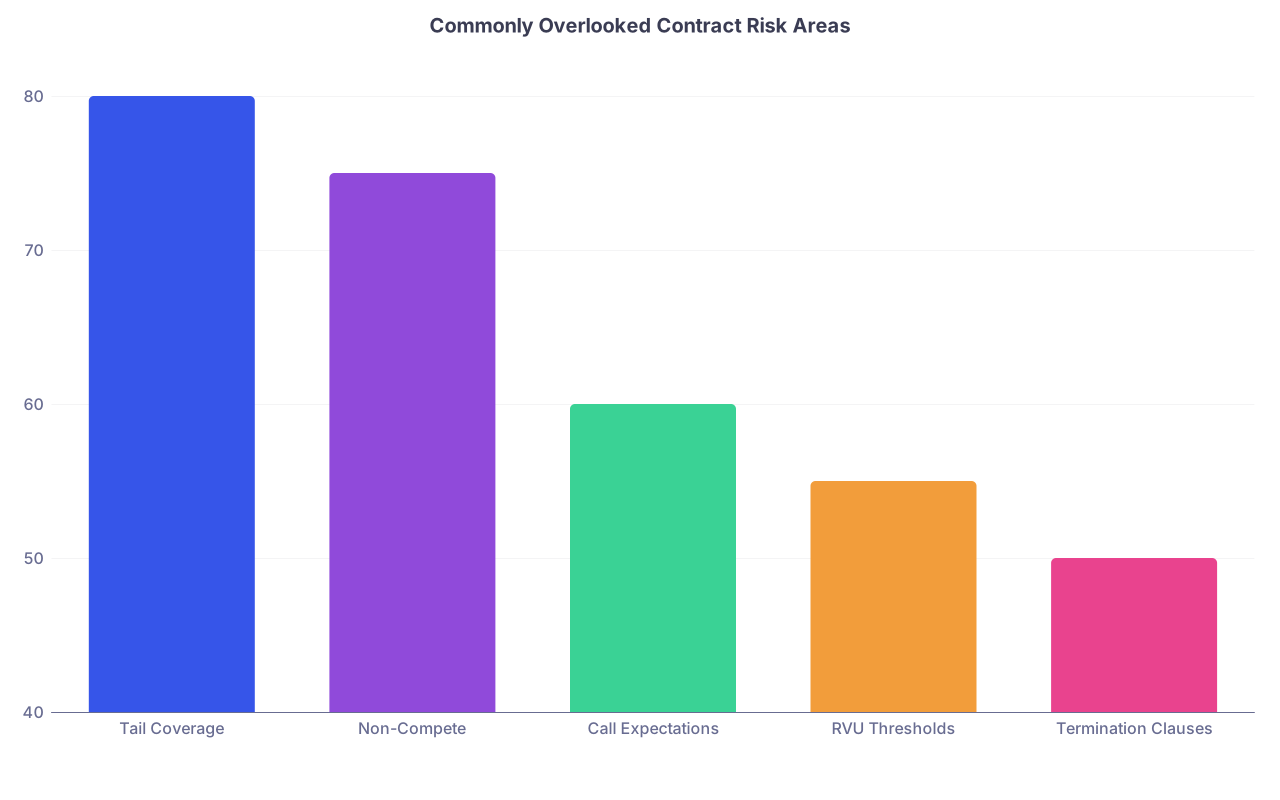
| Category | Value |
|---|---|
| Tail Coverage | 80 |
| Non-Compete | 75 |
| Call Expectations | 60 |
| RVU Thresholds | 55 |
| Termination Clauses | 50 |
Putting It Together: A Simple Negotiation Flow That Actually Works
Let me give you a simple structure I’ve seen work repeatedly for new attendings.

| Step | Description |
|---|---|
| Step 1 | Receive Offer |
| Step 2 | Request Full Contract |
| Step 3 | Attorney Review |
| Step 4 | Identify Top Priorities |
| Step 5 | Draft Consolidated Counter |
| Step 6 | Call With Recruiter Chief |
| Step 7 | Receive Revised Contract |
| Step 8 | Sign Contract |
| Step 9 | Final Counter or Walk |
| Step 10 | Major Issues Fixed |
You’re not trying to “win” every clause. You’re trying to build a contract you can live with for the next 3–5 years without feeling trapped or resentful.
Focus your energy on:
- Exit costs (non-compete, tail, repayment of bonuses)
- Real schedule / call / RVU expectations
- How quickly you can adjust if reality doesn’t match the sales pitch
The rest—minor PTO differences, CME budget slightly lower than your friend’s, a weaker-than-ideal bonus structure—you can often tolerate if the big pieces are solid.
FAQ (Exactly 4 Questions)
1. How much can I realistically negotiate as a brand-new attending with no prior experience?
More than you think, less than the legends you hear. In most hospital-employed settings, a 5–15% swing in total comp (via base, sign-on, relocation, and bonuses) is very achievable if you’re in a reasonable specialty and not anchored to one tiny geographic area. Contract terms (non-compete, tail, call) are often more movable than raw dollars, especially if you come with a clean, prioritized ask. The exception: hyper-competitive metro areas with a surplus of your specialty. There, your leverage is weaker and you may need to accept more standard terms while watching exit costs very closely.
2. Should I tell one employer what another offer is paying me?
Yes—strategically. Anchoring with another real offer helps, but you have to be honest and specific. “I have an offer at 325k base plus 40k sign-on in a similar market; if we can be in that range with better tail / non-compete terms, I’d prefer to be here” is reasonable. What backfires is bluffing numbers that are obviously unrealistic or presenting comp data without context (e.g., quoting private-equity urgent care money to a nonprofit academic hospital). Admins see hundreds of offers a year; they know the ranges.
3. Is it ever okay to sign a ‘bad’ contract just to get experience and move later?
It can be, if you’re honest with yourself about the exit cost. If the non-compete is narrow, tail is employer-paid after 2–3 years, and the penalties for leaving early are mild, a less-than-ideal first job is survivable and sometimes strategically fine. But signing a contract with a 2-year, 50-mile non-compete, full tail on you, and massive sign-on clawbacks “just for experience” is how people end up stuck, bitter, or moving states against their will. The exit clauses tell you whether a “starter job” is actually a trap.
4. What if I negotiate and they rescind the offer—is that a real risk?
It’s rare in good-faith negotiations. When I’ve seen offers pulled, it was usually because the candidate was either blatantly dishonest, wildly unrealistic (demanding partner-level pay as a new grad), or dragged negotiations out for months while stringing along multiple groups. If you’re professional, responsive, and clear about your priorities—and you’re not asking for unicorn terms—they won’t yank the offer just because you pushed back. If they do? That tells you exactly what kind of people you were about to work for.
With these unwritten rules in your pocket, you’re no longer just the grateful new grad taking whatever lands in your inbox. You’re starting to act like what you actually are: the revenue-generating professional they need more than they admit.
You’ve handled the first serious contract in your career with your eyes open. Next up comes the harder part: walking into that first job and figuring out, fast, whether reality matches what you signed on paper—and what to do when it doesn’t. But that’s a story for another day.