
The way physician recruiters rank new grads is not “objective,” and it’s definitely not what they tell you on the glossy recruitment brochures. It’s a quiet hierarchy built from risk, politics, and pattern recognition.
You think they care most about “clinical excellence” and “passion for patient care.” They don’t. They assume that as a given if you finished residency. What actually moves you up or down the list is much more unspoken: where you trained, how much trouble they expect you to cause, and whether the hiring physician can picture you surviving the first year without imploding or walking.
Let me walk you through how it really works.
The Real Sorting Hat: How Recruiters Build Their Shortlists
Here’s the part nobody says out loud: by the time you get that first phone call, you’ve already been silently ranked.
Most large employers (hospital systems, big groups, academic-affiliated practices) have some version of this informal funnel:

| Step | Description |
|---|---|
| Step 1 | CV Received |
| Step 2 | Initial Screen by Recruiter |
| Step 3 | Quiet Rejection |
| Step 4 | Soft Ranking by Risk |
| Step 5 | Forward to Medical Director |
| Step 6 | Shortlist for Interview |
| Step 7 | Ranked for Offer Priority |
| Step 8 | Meets Hard Filters |
At each step, you’re being sorted. Not always consciously, not always fairly, but very consistently.
The first pass is usually a recruiter with a mix of HR and sales background. Some are excellent and understand medicine frighteningly well. Others barely know the difference between hospitalist and intensivist. But they’re all using a set of informal “rules.”
Here’s what they’re really looking at before you ever speak:
- Where you trained
- Any red flags in your training timeline
- Visa status and licensing complexity
- Alignment with what their medical director explicitly said they want
- How “risky” or “high maintenance” you seem on paper
If you think your personal statement or “philosophy of care” paragraph is swaying anyone at this stage, it’s not. They are skimming for risk and fit, not poetry.
The Hierarchy of “Where You Trained” (That Nobody Admits Exists)
Program directors lie to you about this because they’re incentivized to protect the brand. Recruiters and department chairs are more blunt when the doors are closed.
There’s a very real, informal pecking order when they see your training:
| Training Background | Typical Initial Reaction |
|---|---|
| Big-name academic + strong reputation | High confidence, low perceived risk |
| Solid regional academic/community hybrid | Good bet, dependable |
| Pure community, known busy program | Safe workhorse, watch for autonomy |
| Unknown/small community, no local reputation | Hesitation, ask more questions |
| Questionable or scandal-associated program | Red flag, often filtered out |
They won’t tell you this in an interview, but behind the scenes:
If you trained at a big, recognizable academic center (think Mayo, Cleveland Clinic, Mass General, strong state flagships), you start the race ahead. Even if the actual job is in a community setting. Why? Reputation implies someone else already filtered you hard and pressured you for years. Recruiters and chairs like that. It feels safe.
If you trained at a solid, regionally known program, they’ll trust you can handle bread-and-butter and won’t embarrass the hospital. These candidates form the bulk of actual hires. Reliable, predictable.
If you come from a small community program nobody in their system has heard of, they don’t automatically reject you—but they get cautious. I’ve watched department chiefs lean back and say, “Anyone know this place?” If no one in the room can vouch for that program, your interview becomes a vetting mission. You must prove what your program didn’t signal.
And if your program has been in the news for the wrong reasons—ACGME issues, staffing scandals, toxic leadership—that follows you. People say, “It’s not the candidate’s fault,” and then quietly nudge you down the list.
Recruiters do not have a nuanced, fellowship-level understanding of training quality. They use shorthand: brand, reputation, and whatever their last hire from that program looked like. And that last part matters more than you think.
The Hidden Filters: Risk, Cost, and “Headache Potential”
Once you’re past the “are you real” screen, the actual ranking starts. This is not a spreadsheet with scores. It’s a running mental list of priorities shaped by three things: risk, cost, and headache potential.
Let’s break those down.
1. Risk
Risk is everything in physician hiring.
Risk you’ll leave in 12 months.
Risk you’ll burn out and drag the group down.
Risk you’ll cause patient safety or legal issues.
Risk you’ll be a political problem.
They look for proxies:
- Sporadic training path: gaps, transfers, unexplained off-cycles
- Strange geography decisions: constantly jumping regions, multiple short stints
- Malpractice history (for older grads)
- Disciplinary hints: unprofessional conduct, extended leaves with thin explanations
I’ve watched a candidate from a top-10 program get moved below two “average” grads because their CV read like chaos: multiple leaves, vague reasons, disjointed timeline. The recruiter literally said, “The CMO has no appetite for drama this year.”
Your competition isn’t just “better training.” It’s “less perceived risk.”
2. Cost
Recruiters care about compensation structure more than you realize, because they get hammered by leadership about budgets and wRVU expectations.
New grads are attractive because:
- You’re cheaper than laterals
- You’re more flexible on schedule
- You’re more moldable to the system’s expectations
But within new grads, they still rank:
- Candidates with realistic salary expectations higher
- Candidates who understand productivity models higher
- Candidates who won’t demand “day 1 lifestyle of a 20-year partner” higher
I’ve literally heard an executive say after a debrief, “This one’s good, but she wants to work 0.8 FTE and no weekends. We need a workhorse. Move her down the list.”
They’re not punishing boundaries. They’re filtering for how well you match the job they’re actually trying to fill, which is rarely the “beautiful balance” they pitch on the brochure.
3. Headache Potential
This is the most subjective category—and the one that tends to bite new grads who think they’re “being assertive.”
On calls and interviews, recruiters quietly score you for headache potential:
- Are you argumentative about small details?
- Do you ask questions like a colleague or like a suspicious auditor?
- Do you sound like you’ll complain about everything that isn’t perfect?
- Do you name-drop lawyers, contracts, “my attorney said,” on the first call?
Advocating for yourself is good. Acting like an adversary before you’ve even met the team is not. The moment a recruiter writes “may be difficult” in your note, you’ve lost ground. I’ve seen candidates essentially knocked out by a single line in the CRM: “Strong candidate but very demanding, may not fit culture.”
They share those notes with the medical director. You never see them.
How Medical Directors Re-Rank You After Recruiters Are Done
Recruiters build an initial order. Then they walk into a meeting (or Zoom) with the medical director, service line chief, or department chair. This is where the real ranking happens.
The clinical leaders don’t care about some of the HR noise. They care about one central question:
“Will this person make my life easier or harder in the next 12–24 months?”
Here’s what they’re actually paying attention to in that discussion:
- How fast you can be credentialed and on the schedule
- Whether you can handle the volume and acuity they already know is coming
- Whether you look like someone they’d trust on call at 2 AM
- Whether you’ll align or fight with their dominant group culture
This is where fellowships, niche skills, or academic aspirations can either help you or hurt you.
- If they need a pure workhorse hospitalist, the “future researcher” who keeps talking about grants and protected time goes down the list.
- If they’re trying to build a subspecialty program, the fellow with a clear agenda for that niche jumps up, even with less “productive” vibes.
I’ve sat in on these calls. It’s blunt. It sounds like:
“Candidate A is from a big name, but I think they’re gone in two years.”
“Candidate B isn’t fancy, but she’ll grind and stay local. I want her first.”
“Candidate C asked three questions about ICU autonomy—I don’t want another scope creep problem.”
So you might assume academic pedigree is everything, but for a lot of real-world jobs, “will stay, will work, won’t break stuff politically” outranks prestige.
What Interviews Actually Signal to Recruiters and Chairs
You think you’re being evaluated on how smart or clinically deep you sound.
By the time you get to an interview, they’ve already assumed your baseline competence based on training and references. The interviews are really sorting for culture, stability, and risk.
During the site visit, they’re collecting signals:
- Do nurses and staff like you by the end of the day, or are they rolling their eyes?
- Do you talk trash about your current program or colleagues? That’s almost an automatic downgrade.
- Do you ask any questions that show you understand how the business side works?
- Do you seem emotionally steady, or keyed up and brittle?
Recruiters will often circle back with the medical director afterwards and say things like:
“She asked really good questions about support staff and onboarding. I felt like she gets what first year looks like.”
or
“He seemed very negative about his residency. Red flag for how he’ll talk about us later.”
That’s the stuff that moves you up or down the final priority list, more than your answer about your “greatest strength.”
The Stuff They Won’t Tell You Matters (But It Absolutely Does)
Let me pull back the curtain on a few under-the-table ranking factors new grads rarely see coming.
Local roots vs “wanderer” profile
If you have genuine ties to the region—family, partner’s job, grew up nearby—you’re immediately perceived as more likely to stay. That’s gold.
A candidate with average credentials but strong local ties frequently gets ranked above a superstar who’s clearly just “passing through” for a few years. I’ve heard it said outright: “We’re tired of being a stepping stone. Take the one who will buy a house here.”
Social media and online presence
Yes, they check. Not always formally, but often.
A recruiter or younger partner will Google you. If they see:
- Openly trashing prior institutions
- Extreme unprofessional ranting about patients or coworkers
- A ton of public instability or drama
You don’t just drop; sometimes you disappear from consideration altogether. Nobody emails you to say that’s why.
Reasonable advocacy, thoughtful commentary, being a human online? Fine. They’re not that fragile. But unfiltered chaos? That’s a quiet no.
How you treat non-physicians during the process
This one is brutal and very real.
If you’re impatient or rude with:
- The recruiter
- The scheduler coordinating flights
- The office manager arranging your visit
Word gets back instantly: “He was short with our coordinator.” That translates straight into “potential jerk in clinic,” and you fall down the list.
I’ve watched a candidate be dropped after a site visit purely because they were dismissive to the MA who was showing them the clinic layout. The medical director literally said: “If she can’t be nice today, what happens when she’s behind on notes and three patients are late?”
A Quiet Scoring System: What Actually Pushes You Up
Let me flip this. Here’s what consistently pushes new grads up the behind-the-scenes ranking.
Not fantasy. Actual, repeated patterns I’ve seen:
You move up when:
- You clearly understand the job you’re applying for. Not just “I want balance,” but “I understand this is a 7-on/7-off, high-volume, mostly nocturnal hospitalist role, and here’s why that fits me right now.”
- You ask sharp, practical questions that show you’ve done your homework: onboarding, support staff, call distribution, wRVU benchmarks, how they support new docs in the first 6 months.
- You don’t overplay your leverage. You negotiate like a colleague, not like a litigator trying to win every clause.
- Your references are aligned and specific. The best references say things like, “We trusted her with our sickest patients and she never folded,” not just “hard worker, team player.”
And this one matters more than you think:
You send prompt, professional follow-up. Recruiters track who goes dark, who responds quickly, who’s organized. They infer how you’ll behave with credentialing paperwork, scheduling, and charting.
The person who answers emails in a clean, timely way is perceived as lower risk. It’s crude, but it’s true.
Who Actually Gets the First Offer When There Are Multiple Good Candidates?
Picture this: they have three solid new grads. All could do the job. Only one slot.
How do they really choose?
I’ve seen this breakdown over and over. The offer usually goes to the candidate who scores highest on a blend of these:
- Perceived likelihood of staying at least 3–5 years
- Smoothest onboarding path (licenses, visas, start date)
- Best cultural fit with the existing group personalities
- Lowest “drama risk” based on CV, conversations, and gut feel
- Adequate (not necessarily best) credentials for the job’s needs
The “best resume” does not always win. The “least risky, easiest to plug in, likely to stay” often does.
To visualize it, think of how they mentally weigh factors:
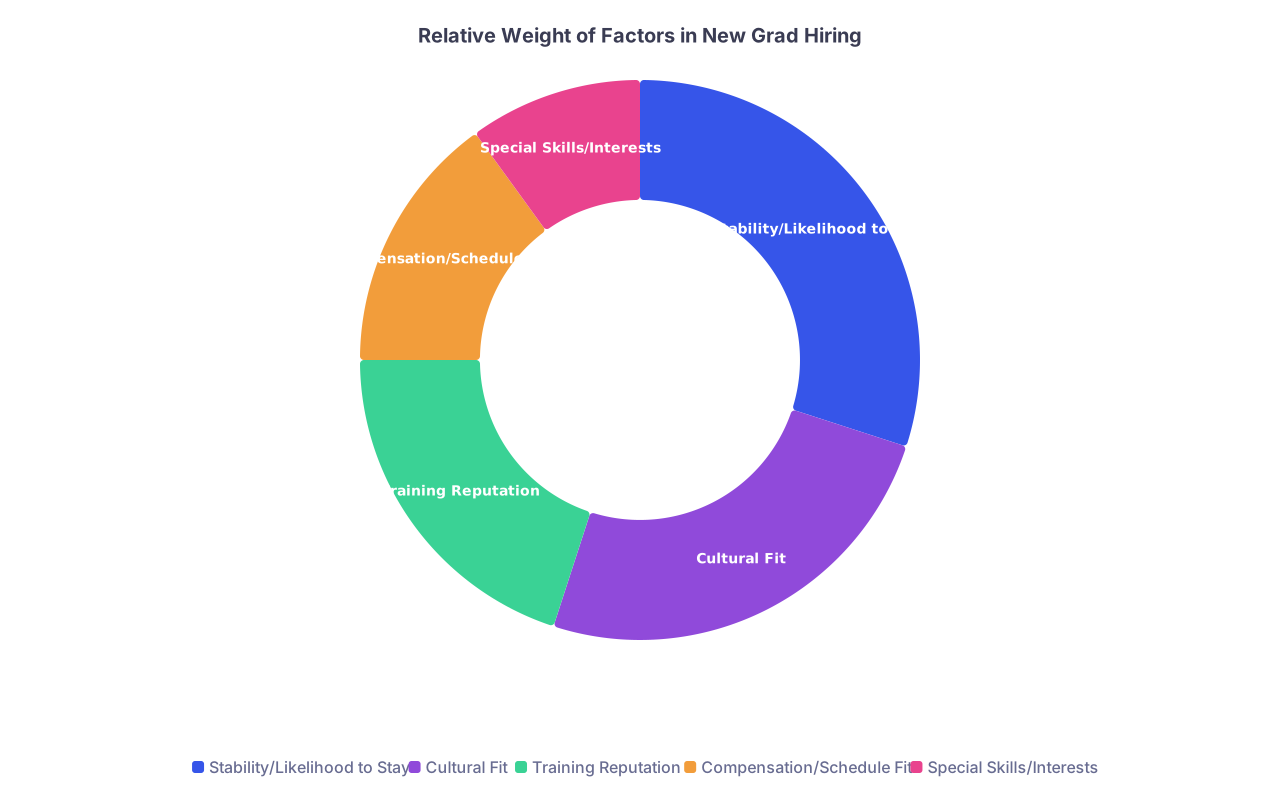
| Category | Value |
|---|---|
| Stability/Likelihood to Stay | 30 |
| Cultural Fit | 25 |
| Training Reputation | 20 |
| Compensation/Schedule Fit | 15 |
| Special Skills/Interests | 10 |
They’d rather have a very good doc who stays five years than a brilliant one who leaves in 18 months and leaves them scrambling again.
How to Play This Game Without Selling Your Soul
You can’t control everything they’re whispering in conference rooms. But you’re not powerless either.
You tilt the ranking in your favor by doing three things well:
First, you present as low-risk, high-reliability. That means a clean, coherent CV. Reasonable, consistent answers about your career plans. No mystery gaps. No wild swings in your story depending on who you talk to.
Second, you show that you actually understand what the job is. You’ve looked at the call schedule, the volumes, the clinic templates. You’re asking the kind of questions someone who’s actually going to be there in the trenches would ask, not only lifestyle slogans.
Third, you behave like someone they’d be happy to see on a bad day. Respectful to staff. Calm under minor annoyances. Direct but not combative when you negotiate.
You don’t need to be perfect. You just need to avoid the silent red flags that push you down the list while the next person—no more talented than you—slides into that first offer.
The Bottom Line
Behind the carefully curated language, physician recruiters and medical directors rank new grads on a few blunt realities:
- You’re judged first on risk and stability, not just pedigree or passion.
- Your behavior with recruiters, staff, and your story consistency quietly moves you up or down more than your fellowship poster.
- The candidate who looks easiest to plug in, least likely to cause headaches, and most likely to stay usually gets the first call and the first offer.