The reference call your residency PD takes about you is not “just a formality.” It is the real interview you never see.
Let me walk you through what actually gets said when a hospital calls your program director to ask whether they should hire you. Because I’ve heard those calls from both sides of the door, and the gap between what residents think happens and what actually happens is massive.
1. How These Calls Really Happen (Not How HR Describes It)
You imagine some polished, standardized reference form.
What really happens is this: a busy PD, between clinic and an afternoon meeting, gets a call from a medical director, section chief, or sometimes HR “on behalf of” them. The caller says something like:
“Hey, I’ve got one of your former residents applying here—Dr. X. Do you have a few minutes to chat off the record?”
Those last three words—“off the record”—are where the truth starts.
Hospitals pretend everything is formal and documented. Program directors live in the real world. They know certain things never make it into written evaluations because GME, legal, and HR would lose their minds if they did. The call is where that buried information surfaces, in coded language.
Two things to understand right away:
- These calls almost never get fully documented in writing. Notes might be brief or nonexistent.
- People on both ends know exactly what they’re doing. This is a risk-management conversation disguised as a courtesy call.
And yes, they absolutely remember you. They may need to pull up MedHub/New Innovations to refresh dates, but if there was anything notable—good or bad—it is already loaded in their mind as they pick up the phone.
2. The Unspoken Rating Scale: How PDs Actually Classify You
Before they say a single word, your PD has already sorted you into one of a few mental buckets.
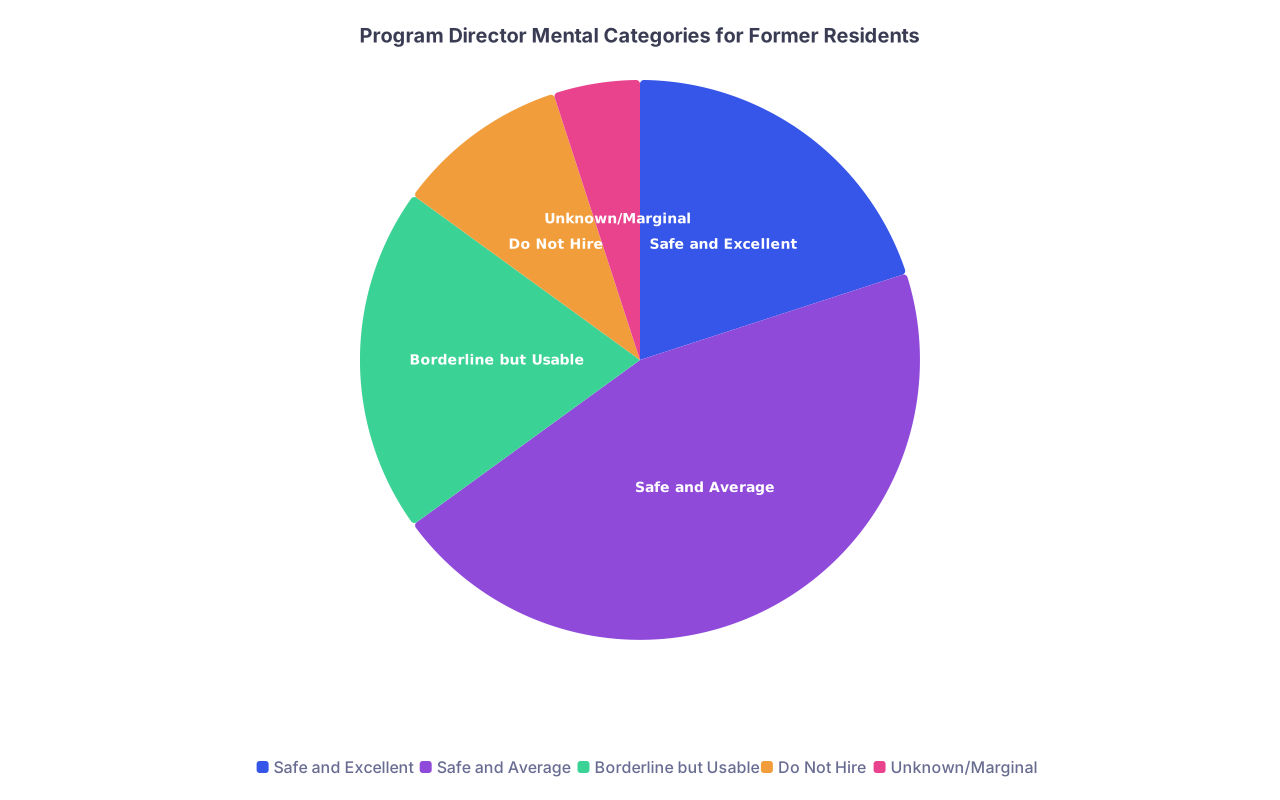
| Category | Value |
|---|---|
| Safe and Excellent | 20 |
| Safe and Average | 45 |
| Borderline but Usable | 20 |
| Do Not Hire | 10 |
| Unknown/Marginal | 5 |
They will never say “he’s a 2 out of 5” on the phone, but trust me, that’s exactly how they think.
Here’s the rough taxonomy, translated into the language they actually use on calls:
Safe and Excellent – “Take this person”
- Keywords: “I’d hire them myself,” “One of our stronger graduates,” “Very dependable,” “No concerns.”
- Reality: PD is comfortable with you representing the program anywhere. Made chief? Strong faculty relationships? Took feedback well? You’re here.
Safe and Average – “Solid, no red flags”
- Keywords: “Good, solid clinician,” “Reliable,” “No significant issues during training,” “Would be a safe hire.”
- Reality: You did your job, didn’t crash the car, maybe weren’t a star. PD isn’t going to push you hard, but won’t block you either.
Borderline but Usable – “Depends on the setting”
- Keywords: “Would do well in the right environment,” “Benefits from good supervision,” “Needs clear expectations,” “More suited for [X] than [Y].”
- Reality: There were issues. Performance, professionalism, or interpersonal. PD is warning the caller, but in coded language.
Do Not Hire – “No way in hell”
- Keywords: “I’d be cautious,” “We had some challenges,” “I’d recommend exploring other options,” “I can’t say I’d enthusiastically recommend.”
- Reality: The PD is telling them not to hire you, as clearly as they can without getting legal involved. The receiving medical director hears this loud and clear.
Unknown / Marginal – “I barely remember this person”
- Keywords: “I don’t recall any major issues,” “Completed the program,” “No significant concerns documented.”
- Reality: You were invisible or forgettable. That is slightly negative; great residents stick in PDs’ minds for years.
Your entire future job market depends on which bucket you live in.
3. What PDs Are Really Asked (And Why HR Scripts Are a Joke)
HR likes to pretend these calls are about verifying dates of training and “would you rehire.” That’s the decoy.
Here’s what actually gets asked once the HR person leaves the room or the medical director calls the PD directly.

| Step | Description |
|---|---|
| Step 1 | Hiring Physician calls PD |
| Step 2 | Discuss strengths and fit |
| Step 3 | Discuss issues in coded language |
| Step 4 | Any major concerns? |
| Step 5 | Hire or not |
Common real questions:
- “Would you hire this person into your own group?”
- “How did they handle autonomy as a senior?”
- “Any concerns about judgment, professionalism, or behavior?”
- “How did they handle nights and high-stress situations?”
- “If you had an opening tomorrow, would you be excited, neutral, or hesitant to bring them back?”
And then the one that tells you everything:
“If I take them and it goes badly, am I going to regret this call?”
That’s the malpractice-and-headline test. No PD wants their name attached to, “Well, Dr. PD said they were fine” after a disaster.
When PDs hear those questions, they aren’t thinking about your Step scores or how many posters you had. They are replaying specific incidents:
- The night you melted down on cross-cover.
- The time a nurse complained you were “rude and dismissive.”
- The patient complaint that went to risk management.
- The remediation meeting about documentation.
- The time you came in late three days in a row and the chief had to “talk” to you.
Those stories never fully die. They just wait for the right phone call.
4. Decoding PD Language: What Those Phrases Really Mean
You’re not on the call, so let me translate the code.
| PD Phrase | What It Really Signals |
|---|---|
| "I’d hire them without hesitation." | Strong endorsement; green light. |
| "I’d hire them if we had the right spot." | Supportive, maybe not a superstar, but safe. |
| "They completed our program." | Bare minimum. Neutral at best. Check for hidden issues. |
| "No *major* concerns." | There were concerns. Caller should dig deeper. |
| "Would do well in the right environment." | Needs structure, supervision, or low-acuity. |
| "We had some professionalism conversations." | Red flag. Behavior or attitude issues. |
| "I’d be cautious in a very independent setting." | Do not send them to rural, solo, or high-autonomy roles. |
Program directors rarely say outright, “Don’t hire them.” But they absolutely know how to telegraph that message. Phrases like:
- “I’d be careful in a high-volume, unsupervised environment.”
- “They’re clinically capable but needed more support than average.”
- “We had to put in some extra work around communication and teamwork.”
Hiring physicians hear that as: proceed at your own risk.
On the other hand, truly stellar residents get unambiguous, almost glowing comments:
- “We tried to keep them; they chose to move for family reasons.”
- “One of those residents you remember ten years later.”
- “If you don’t hire them, send them back to me.”
Those phrases move your application from the maybe pile to “call them today.”
5. What PDs Care About Most (It’s Not Your CV)
Let me kill a myth: at this stage, nobody cares about your med school ranking or USMLE scores. That was residency-era currency. Now, what matters is: can you be trusted with independent practice?
The PD is silently scoring you on five things when they talk:
-
- Did you know when to call for help?
- Did you miss obvious stuff? Document things poorly?
- Were there cases they still remember because they had to bail you out?
Reliability
- Did you show up? On time? Follow through?
- Did nurses trust that if they paged you, you’d do something reasonable?
- Were you the senior others wanted on nights—or the one they dreaded?
Professionalism
- Any write-ups. Any disciplinary meetings.
- Patterns of conflict with nurses, consultants, or peers.
- Rumors of substance issues, inappropriate behavior, or chronic attitude problems.
Team Fit / Interpersonal Skills
- Did you poison the well or raise the bar?
- Could you work with difficult attendings without exploding?
- Were you coachable, or did you argue every piece of feedback?
Reputation among Faculty
- A single loud attending strongly for or against you matters.
- If three attendings spontaneously say, “Great doc,” PD remembers.
- If three say, “Smart but rough to work with,” PD definitely remembers.
That’s the data your PD is using on the reference call. Not your case logs. Not your conference attendance certificate.
6. The Stuff PDs Will Say “Off the Record”
You think legal and GME policy stop program directors from saying negative things about you. They don’t. They change how those things are said.
Here’s what gets shared under the “off the record” umbrella:
Heavy professionalism issues
Chronic tardiness, disappearing on nights, fighting with nurses, major attitude problems. Rarely emailed. Frequently spoken.Serious but quiet clinical concerns
Recurrent near-misses, sloppy notes that almost got the hospital in trouble, repeated failure to escalate.Pattern, not one-off
PDs forgive one bad night. They don’t forgive patterns of the same problem across PGY2–3.Remediation stories
“We had to put a formal plan in place around their documentation and clinical reasoning” usually does get mentioned, at least in summary.How you responded to being corrected
Did you get defensive? Angry? Vanish? Or did you fix it and improve? That reaction is often the biggest predictor of how you’ll behave as faculty.
I’ve literally heard lines like:
“Look, if you’ve got a big, structured group and can put them with a strong partner for a while, they’ll be fine. I wouldn’t put them alone in a small community shop.”
Or:
“Great with patients, sometimes rubs staff the wrong way. If you have a high-tolerance, thick-skinned culture, it’ll be okay. If your nurses run the place, they’re going to clash.”
That is not in any written evaluation. It does get said on the phone.
7. How Hiring Committees Interpret These Calls
Here’s the part residents do not see: what happens in the room after your PD hangs up.

The medical director or department chair usually walks back in and summarizes in one or two sentences. Something like:
- “PD loves them, would hire them back. Sounds like a no-brainer.”
- “Good, safe, nothing special but no red flags.”
- “Some concerns about professionalism and needing structure. Might not be great for our busiest site.”
- “He was pretty lukewarm. I’m not feeling great about this one.”
That one-sentence summary carries more weight than your 10-page CV.
If there were any negative hints, someone on the committee will say:
“We have other candidates without questions. Why take the risk?”
And that’s it. You are done at that site. No one emails you, “Your reference hurt you.” You just get a vague, “We’ve decided to move in a different direction.”
You never find out the real reason. Residents always blame “the market” or “oversupply.” Sometimes that’s true. Often it’s not. Often it’s this phone call.
8. How To Set Yourself Up Years Before That Call
This part is harsh, but accurate: you start shaping your PD’s future reference about you in PGY-1. Whether you realize it or not.
Here’s what PDs actually remember when the phone rings:
- The resident who owned their mistakes and improved.
- The one nurse managers loved because “they always came when we called.”
- The resident who was toxic at the beginning and never truly changed.
- The one whose name came up in every pre-GME meeting for the wrong reasons.
If you’re still in residency or early post-residency, you can change your trajectory. Quickly.
Three high-yield moves that directly change what your PD will say:
Make their life easier, not harder.
PDs notice who is constantly on their radar because of firefighter-level problems versus who quietly runs their service well. If your name only surfaces in positive ways—chief, awards, patients sending compliments—your future call goes much better.Fix the thing they’ve already talked to you about.
If your PD has ever pulled you in to “chat” about something, that’s already part of your unofficial record. Your entire goal from that day forward is to make that conversation a one-time event that clearly improved you. Not the beginning of a pattern.Ask, late in residency, “What would you honestly say about me?”
Done respectfully, one-on-one, not in email. Something like, “I’m starting to look at jobs. I’d really value knowing how you’d honestly describe me to a hiring chair. Anything I should tighten up before graduation?”
If they’re even mildly honest, you just got a cheat sheet for what they would say—and what you need to correct fast.
9. What To Do If You Suspect Your PD Won’t Back You
This is the part no one talks about publicly because it’s uncomfortable. Some of you know your PD would not sing your praises. You feel it. Maybe you earned that. Maybe politics or personality played a role. Either way, here’s the behind-the-scenes playbook.
Build alternate references proactively.
A subspecialty attending who loved working with you. A site director from an away hospital where you rotated. The APD who was actually in the trenches with you. Those people can sometimes carry as much weight as the formal PD, especially in subspecialty or niche roles.Steer your job search to people who know you directly.
Places where you did locums, moonlighting, or a senior away. “We know them first-hand” can outrun a lukewarm PD call, especially if the hiring chair trusts their own eyes more than another PD’s cautious comments.Consider geographies where your PD has less informal influence.
PDs talk regionally. The Northeast IM PDs know each other. Same with EM in the Midwest, etc. If you had a rough residency, going to a different region or system where no one is in that text chain can dilute the damage.Have a direct, adult conversation.
Painful, but I’ve seen it work.
“I know I had some bumps early on. I’ve really tried to correct them. I’d like to ask if you’d be comfortable being listed as a reference. Are there specific concerns you still have that I should be aware of?”
Their tone and body language will tell you everything. And sometimes, that conversation upgrades you from “borderline” to “safe.”Time and distance help. A little.
Five years out, your current partners’ opinions start to matter more than your PD’s. Early jobs are where you build a new reference ecosystem. If you can get that first hospital to vouch for you strongly, later employers lean more on them than on your residency leadership.
10. The Quiet Reality: Most PDs Want You To Succeed
Here’s the part that might surprise you: most PDs are not trying to tank you. They’re trying to be honest enough to protect patients and their own reputation, while not permanently ruining your career.
They walk a tightrope:
- Be too positive about a problematic grad → risk patient harm and professional embarrassment.
- Be too negative about a marginal-but-improving one → crush a career that could have been fine.
So they use softening language, qualifiers, and context. But make no mistake—between experienced physicians, the message comes through clearly.
If you were consistently solid, mentored juniors, took responsibility, and didn’t leave a trail of scorched-earth interactions with nurses, your PD will usually go to bat for you harder than you realize.
If you weren’t…that call becomes the quiet reckoning.
FAQ: What Your Residency PD Really Says
1. Can my PD legally say negative things about me on a reference call?
Yes. They’re allowed to share truthful, experience-based observations. What they avoid is defamatory statements, speculation, or unverifiable accusations. So they frame concerns around “we observed,” “we had to address,” “there was a pattern of.” That’s both honest and legally safer.
2. Will they mention that I was on remediation or probation?
If you were on formal remediation or probation, high chance it comes up indirectly: “We had to put a plan in place around X, but they responded and completed training.” Whether they say the literal word “probation” varies. But the core issue that led to it? That’s almost always described in some form.
3. Do hiring hospitals always call the PD, or can I just list faculty I like?
For real attending jobs, especially hospital-employed or large groups, someone almost always calls the PD or APD informally, even if you didn’t list them. People know each other. They text, email, or call “just to ask.” You can’t fully route around residency leadership.
4. My PD and I never really interacted. Is that good or bad?
Neutral at best, mildly negative in reality. If they barely remember you, their default will be generic: “Completed the program, no major concerns.” That doesn’t kill you, but it doesn’t help when you’re competing against people whose PD says, “One of our best.” Blur is not your friend.
5. How do I know what my PD will actually say about me?
You’ll never hear the exact words, but you can infer. Ask them directly, late in residency, how they’d describe you to an employer. Pay attention to their first three adjectives. Also, listen to how strongly they respond if you ask, “Would you be comfortable being a reference for me?” Any hesitation is data you should take seriously.
Key takeaways: Your PD’s reference call is the real, invisible interview that can make or break your first few jobs. They speak in code, but hiring physicians understand the code perfectly. Your daily behavior in residency—reliability, professionalism, judgment—writes the script they’ll read from when that phone rings.