The way most new attendings “look for jobs” is broken.
Endless scrolling on PracticeLink and DocCafe is not a strategy. It is procrastination dressed up as effort.
You can build a clear, targeted, realistic physician job search plan in a single weekend. Not a vague idea. A concrete roadmap with names of systems, roles, contacts, and timelines.
Here is exactly how to do it.
The One-Weekend Framework
You have 48 hours. You are tired from residency or fellowship. You do not need a six-week introspection retreat. You need a structured sprint.
We will split the weekend into six blocks:

| Step | Description |
|---|---|
| Step 1 | Sat AM - Reality Check |
| Step 2 | Sat Midday - Define Targets |
| Step 3 | Sat PM - Market Research |
| Step 4 | Sun AM - Asset Building |
| Step 5 | Sun Midday - Build Pipeline |
| Step 6 | Sun PM - Execution Schedule |
Overview:
- Saturday AM – Reality check and constraints
- Saturday Midday – Define your target job profile
- Saturday PM – Research and map your actual market
- Sunday AM – Fix your CV, LinkedIn, and story
- Sunday Midday – Build your application and networking pipeline
- Sunday PM – Create your 8-week execution schedule
You will finish with:
- A specific geographic and job-type target list
- A list of 20–40 actual employers and postings
- A cleaned-up CV and basic LinkedIn profile
- An email + outreach template bank
- A realistic schedule for the next 8 weeks
Step 1: Saturday AM – Reality Check and Constraints
Start by killing the fantasy version of your job hunt.
1.1 Define Your Non-Negotiables (60 minutes)
These are not “preferences.” These are the things that, if violated, you will be miserable and looking again in 12 months.
Write them down. One page, no more.
Consider five buckets:
- Location
- States or metro areas only. Not “somewhere warm.”
- Be honest about family, spouse job, visas, kids’ schools.
- Schedule
- Max hours per week (typical attendings in busy specialties run 55–65).
- Call: home vs in-house, frequency, weekends.
- Nights: acceptable or not.
- Compensation floor
- Base salary minimum or realistic total comp minimum.
- Decide now if you would trade money for lifestyle or vice versa.
- Practice style
- Academic vs community vs private vs employed.
- Procedures you must keep. Patient population you want or cannot handle.
- Visa / licensing constraints
- J‑1: know waiver states and timelines.
- H‑1B: know who typically sponsors in your specialty.
- Licensure: states where you already have or can quickly obtain a license.
Be specific. “Good work–life balance” means nothing. “No more than 1 in 4 weekend call, no in-house nights, post-call day off” is something you can screen for.
1.2 Face Your Numbers (30–45 minutes)
This is where most residents lie to themselves. You can skip that part.
- List:
- Board status (BE/BC, exams passed, dates)
- Visa status
- Any red flags:
- Gaps in training
- Failed boards
- Terminated contracts
- Need for part-time only
Then anchor your expectations with rough compensation ranges:
| Setting | Typical New Attending Range* |
|---|---|
| Academic (major metro) | 60–80% of community rates |
| Large health system | Market median or slightly + |
| Private practice partner-track | Often higher but variable |
| Locums full-time | Highest hourly, no benefits |
*Different specialties will shift these up or down, but the relativities hold.
If you have unrealistic expectations (“I want Manhattan, no call, $500k as a hospitalist, fresh out of training”), you need to adjust here. Better to correct now than waste months.
Step 2: Saturday Midday – Define Your Target Job Profile
Now you translate “things I think I like” into a specific target profile that can guide actual searches.
2.1 Pick 1–3 Job Archetypes (45–60 minutes)
Most physicians fit one of a few archetypes:
- High-comp, high-volume community work
- Academic with teaching and research
- Hybrid community-academic
- Lifestyle-focused (urgent care, telemedicine, part-time)
- Procedural/OR dominant
- Rural generalist with broad scope
Choose up to three possible archetypes. Rank them: A, B, C.
Example:
- A: Community hospitalist, 7-on/7-off, Midwest, $300K+
- B: Hybrid pulmonary/critical care with sleep, medium city, 60% ICU, 40% clinic
- C: Academic nephrology with protected research time, East Coast
Your search will prioritize A, but you will keep B and C in the mix if reality demands flexibility.
2.2 Translate Archetypes into Search Filters (30 minutes)
Most job boards and recruiter databases use filters. Build your filter set now:
- Specialty / subspecialty
- States or regions
- Practice type: academic, hospital employed, private, FQHC, locums
- Setting: inpatient, outpatient, mix
- FTE: full-time, 0.8 FTE, etc.
- Procedures required / supported
Write these filters into a 4–6 line “target job statement.”
Example:
“I am targeting full-time hospitalist roles in the Midwest and Southeast, hospital-employed or large multi-specialty groups, 7-on/7-off or equivalent block schedule, no more than 1:4 weekend coverage, with compensation at or above MGMA median for hospitalists.”
This is the sentence you will use with recruiters, mentors, program leadership. It makes you sound focused instead of lost.
Step 3: Saturday PM – Map Your Actual Market
Now we stop thinking and start collecting data.
3.1 Use Real Market Data, Not Gossip (60–90 minutes)
Open:
- 1–2 major physician job boards (e.g., PracticeLink, NEJM CareerCenter)
- 1 recruiter aggregation platform (e.g., Doximity jobs)
- Your specialty society job board (e.g., ACR, AAN, ACC, etc.)
Filter with your target job statement. Create a simple spreadsheet:
Columns:
- Organization
- City, State
- Practice type (academic/community/private/FQHC/locums)
- Role title
- Contact name & email
- Source (which site)
- Notes (visa, salary, sign-on, schedule, red flags)
Aim for 20–40 entries that genuinely fit (or almost fit) your filters.
This list is your “Market Map 1.0”. It will evolve, but you can act on it now.
3.2 Benchmark Compensation and Lifestyle (45 minutes)
Your expectations should not be based on the loudest person in your residency WhatsApp group.
Pull at least two independent data sources:
- MGMA or specialty society reports (often via your department or mentors)
- Medscape compensation survey (free, rough but directionally useful)
- Doximity compensation map (again, rough but better than guessing)
Look at:
- Median and 75th percentile starting comp for your specialty
- Regional differences (Midwest/South often higher pay, lower COL; coasts opposite)
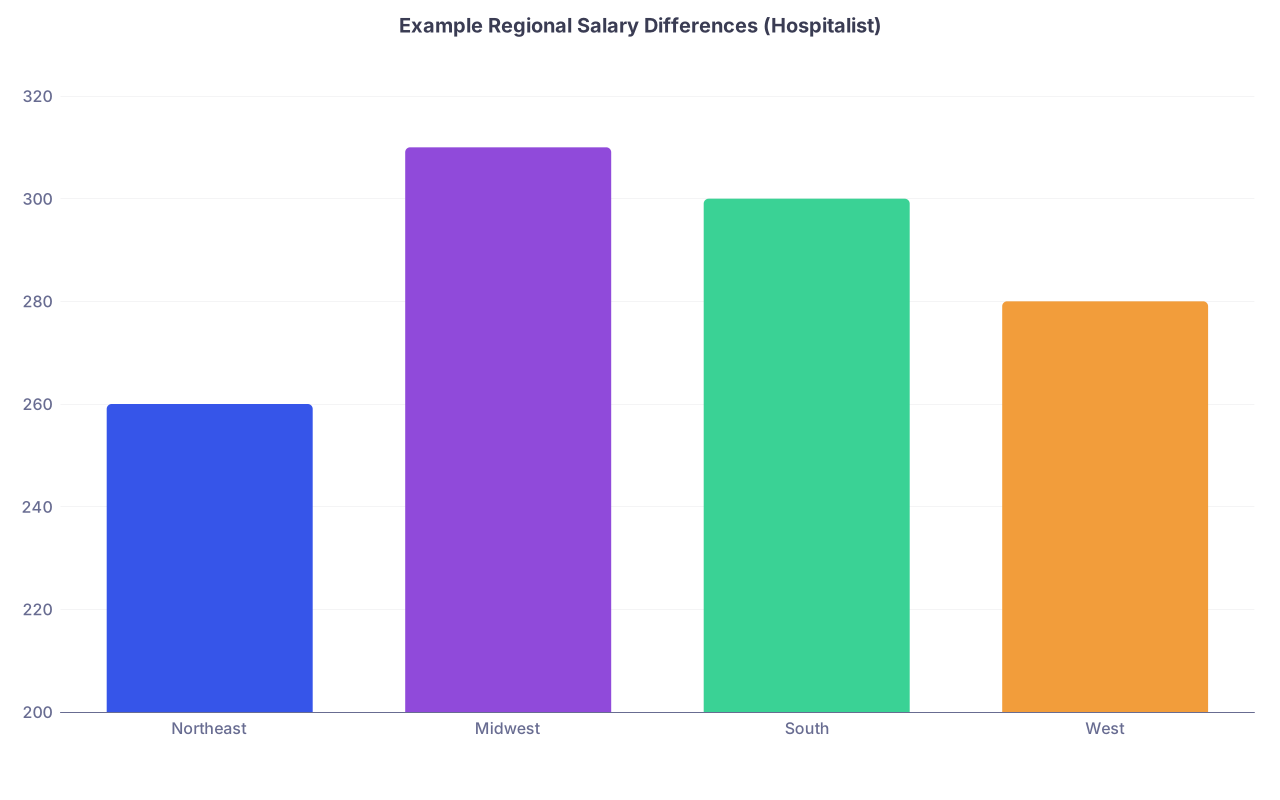
| Category | Value |
|---|---|
| Northeast | 260 |
| Midwest | 310 |
| South | 300 |
| West | 280 |
Now compare:
- Your compensation floor from Step 1
- Actual numbers in postings and data
If your floor is unrealistic, adjust it. Not down to despair. Down to reality.
3.3 Identify 3–5 Priority Markets (30 minutes)
Stop trying to be “open to anything.” It wastes everyone’s time.
From your spreadsheet, pick:
- 2–3 primary markets (regions / states / metro areas)
- 1–2 backup markets you would accept if primary ones fail
Criteria:
- Density of jobs in your specialty
- Lifestyle match (commute, schools, partner job market)
- Visa friendliness (if applicable)
Update your target statement to include your chosen markets explicitly.
Step 4: Sunday AM – Fix Your CV, LinkedIn, and Story
You cannot run a targeted job search with a sloppy, residency-era CV and no online presence.
4.1 Create a Clean, Attending-Ready CV (60–90 minutes)
You do not need a graphic designer. You do need clarity.
Structure:
- Name and contact info (professional email, cell, city/state preferred)
- Current status: “PGY-3 Internal Medicine Resident, XYZ Hospital – finishing June 2026”
- Education and training (reverse chronological)
- Licensure and certifications
- Clinical experience and procedures (include volumes if strong)
- Research, publications, presentations (if non-trivial)
- Leadership, teaching, and committee roles
- Languages, special skills
Pitfalls I see constantly:
- 7-page CV for a new attending. Cut aggressively. Aim for 2–3 pages.
- Outdated or unprofessional email. Use something like firstname.lastname MD at Gmail.
- No mention of visa status until the last line in 8-point font. Be upfront.
- No specifics: “Performed procedures” instead of “Average 12–15 central lines/year.”
Tone: factual, unembellished. You are not writing a personal statement. Keep verbs concrete.
4.2 Build a Minimal but Solid LinkedIn Profile (45–60 minutes)
You do not need to become an “influencer.” You do need to not look like a ghost.
Bare minimum:
- Professional headshot (clean background, scrubs or business-casual, neutral expression)
- Headline: “Cardiology Fellow, [Institution] – Seeking Noninvasive Cardiology Roles in [Regions]”
- About section (3–5 sentences):
- Training background
- Clinical interests
- Basic job search focus (region + role type)
- Experience section that matches your CV
- Location set to one of your target markets or “Open to work”
Then:
- Turn on “Open to work” for recruiters only
- Add 10–20 connections:
- Co-residents
- Attendings you trust
- Program leadership
- 1–2 recruiters you like (not 40 random ones)
This makes you discoverable without looking desperate.
4.3 Craft Your 30-Second Story (30 minutes)
You will keep repeating this to recruiters, emails, and at conferences. Might as well get it right.
Template:
- Who you are and where you are in training
- What you actually want (role + setting + geography)
- What you bring (1–2 strengths, not your life story)
Example:
“I am a PGY-3 internal medicine resident at [Hospital], finishing June 2026. I am looking for a hospitalist position in the Midwest or Southeast, ideally 7-on/7-off in a community or health-system employed setting. I enjoy high-acuity inpatient work, have strong procedural skills including central lines and paracentesis, and I am particularly interested in hospitals that support quality improvement work.”
Write it. Say it out loud three times. Adjust until it sounds like you, not a brochure.
Step 5: Sunday Midday – Build Your Application & Networking Pipeline
Now you convert all this planning into an actual pipeline of opportunities.
5.1 Prioritize Employers and Roles (45 minutes)
Go back to your spreadsheet. Add two columns:
- Priority (A/B/C)
- Status (Not contacted / Emailed / Interviewing / Offer / Closed)
Mark:
- A: Strong match (location, comp, schedule, practice type)
- B: Acceptable but not ideal
- C: Backup / “only if desperate”
You want:
- 10–15 A-priority entries
- 10–20 B-priority
- A few C’s for safety
| Priority | Description | Goal Count |
|---|---|---|
| A | Strong match, top markets | 10–15 |
| B | Acceptable, some compromises | 10–20 |
| C | Backup / safety / rural overreach | 3–5 |
5.2 Build Your Outreach Templates (60 minutes)
Stop rewriting the same email 25 times. Write three core templates and adapt.
- Direct application email to hiring contact
Subject: [Specialty] position – [Your Name], finishing [Date]
Dear [Dr./Mr./Ms. Last Name],
I am a [PGY-/Fellowship year] [specialty] at [Institution], finishing in [Month, Year]. I am very interested in the [Job title, e.g., Hospitalist] position at [Hospital/Group], particularly given [1 specific reason that matches your target – e.g., location, schedule, patient population].
My background includes [1–2 key strengths or experiences]. I have attached my CV for your review and would welcome the opportunity to speak further.
Thank you for your time and consideration.
Sincerely,
[Name, credentials]
[Phone]
[Email]
- Recruiter introduction email / LinkedIn message
Hi [Name],
I am a [specialty] [resident/fellow] completing training at [Institution] in [Month, Year]. I am targeting [role type] positions in [regions], ideally [brief schedule/practice description].
Do you currently work with organizations that are hiring for this type of role? I have attached my CV and would be happy to schedule a brief call.
Best regards,
[Name]
- Warm outreach to alumni / attendings / contacts
Hi [Name],
I hope you have been well. I am finishing my [residency/fellowship] in [specialty] at [Institution] in [Month, Year] and am starting a targeted search for [role type] positions in [regions].
I have always appreciated your perspective on [clinical/academic/practice topic], and I would value any advice or connections you might be willing to share regarding opportunities in these areas.
If you have 15–20 minutes for a brief call sometime in the next few weeks, I would be grateful. I have attached my CV for context.
Thank you,
[Name]
Store these in a document. These three will cover 80% of situations.
5.3 Decide How You Will Use Recruiters (30 minutes)
Some physicians over-rely on recruiters. Others avoid them completely. Both extremes are mistakes.
Quick structure:
- Use recruiters as a supplement, not your primary search engine.
- Prefer:
- Recruiters referred by colleagues
- Those who specialize in your specialty or region
- Avoid:
- Anyone pushing you toward obviously bad fits
- Recruiters who refuse to give written details (comp, schedule) early
Plan:
- Identify 3–5 recruiters to work with
- Send your recruiter template to them
- Log who has your CV and what markets they are covering
Step 6: Sunday PM – Create Your 8-Week Execution Schedule
You now have a plan. It is useless if it sits in a folder. You need a simple, brutal execution schedule.
6.1 Estimate Your Time Budget (15 minutes)
Be honest:
- How many hours per week can you devote to your job search?
- Typical: 2–4 hours for busy residents
- When will you protect this time?
- Two evenings per week? One long weekend block?
Write it:
“I will spend 3 hours per week on job search: Tuesdays 7–8:30 p.m., Saturdays 9–10:30 a.m.”
6.2 Build an 8-Week Activity Plan (45 minutes)
Your goal each week:
- New outreach
- Follow-up
- Interview prep (as needed)
- Market refinement
Here is a simple version:
| Week | New Outreach Targets | Follow-ups | Other Tasks |
|---|---|---|---|
| 1 | 10 A-priority roles | 0 | Final CV + LinkedIn tweaks |
| 2 | 8 B-priority roles | 10 | Connect with 2 recruiters |
| 3 | 6 mixed A/B | 8 | Research 3 new markets |
| 4 | 6 mixed A/B | 6 | Prepare for interviews |
| 5 | 4 targeted | 6 | Update priorities list |
| 6 | 4 targeted | 4 | Deepen alumni outreach |
| 7 | 3 selective | 4 | Reassess comp expectations |
| 8 | 3 selective | 3 | Decide on serious options |
Attach specific names from your spreadsheet to each week.
6.3 Build a Simple Tracking Tool (30 minutes)
Overcomplicated CRMs will just give you a new thing to procrastinate with.
Use:
- One spreadsheet or Notion page with:
- Employer
- Role
- Contact
- Priority
- Status
- Last touch date
- Next action + due date
And a basic visual overview:
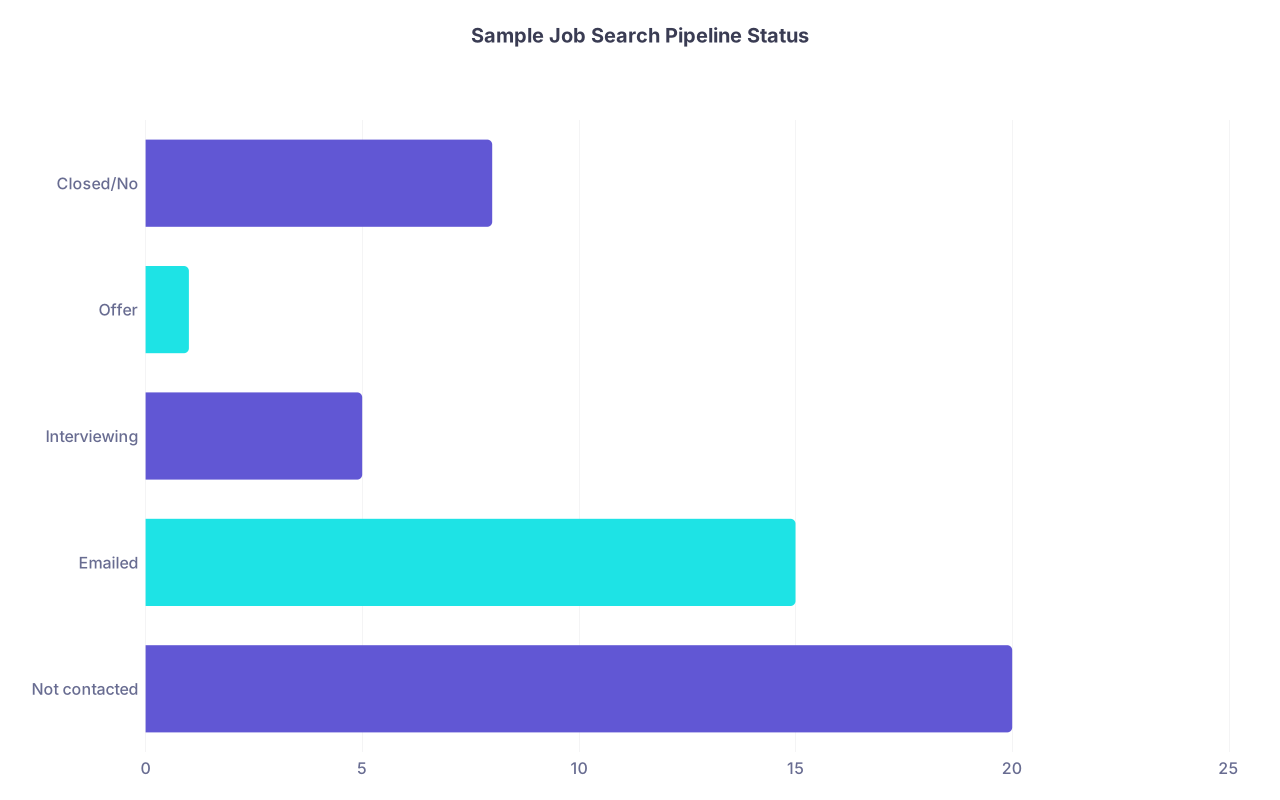
| Category | Value |
|---|---|
| Not contacted | 20 |
| Emailed | 15 |
| Interviewing | 5 |
| Offer | 1 |
| Closed/No | 8 |
Update this once a week during your scheduled time. That is it.
6.4 Set Hard Review Points (15 minutes)
Decide now when you will reassess:
- After 4 weeks:
- If you have zero interviews → expand geography or adjust comp/schedule expectations.
- After 8 weeks:
- If you still have no serious leads → involve program leadership, consider locums stopgaps, widen your search substantially.
Do not keep doing the same thing for 6 months and then panic in March.
Common Pitfalls You Will Avoid with This Plan
You are not just building a plan. You are dodging landmines I see all the time.
1. Being Vague with Everyone
Bad: “I’m open to anything.”
Result: Recruiters send you garbage. Mentors have nothing specific to help with.
Your fix: A 2–3 line target statement and clear markets.
2. Waiting for the “Perfect” Job Posting
If you only apply when a posting looks like your fantasy job, you will still be on resident pay next year.
Reality: Many good jobs are:
- Poorly written
- Barely advertised
- Only visible to recruiters and local networks
Your fix: Use your archetypes and markets as guides, not prisons. Apply to “almost fits,” then clarify by asking direct questions.
3. Ignoring Backchannel Information
Job ads do not say:
- “Our last two hospitalists quit over schedule abuse.”
- “Partnership track is mythical; no one has made partner in 6 years.”
Your fix:
- Use alumni, co-fellows, and attendings to backchannel.
- Ask, “Have you heard anything about [Hospital/Group] in [City]?”
- Pay attention to consistent patterns, not single anecdotes.
4. Over-Indexing on Compensation Alone
High starting salary with toxic culture and no staff support is a trap. I have seen people walk away from $400K after 18 months because they were dying inside.
Your fix:
- Use comp data to set floors and identify outliers.
- Evaluate:
- Staffing ratios
- Turnover rate
- Leadership stability
- Support for PTO, CME, and schedule sanity
5. Treating This Like a Side Quest
Attendings who land solid first jobs treated this like a project, not a wish.
Your fix:
- Dedicated weekly time
- Concrete weekly targets
- A simple, living tracker
Visualizing the Whole Weekend
If you are a “show me the map” type, here is the high-level workflow.

| Step | Description |
|---|---|
| Step 1 | Reality and Constraints |
| Step 2 | Target Job Profile |
| Step 3 | Market Mapping |
| Step 4 | CV and Profile Upgrade |
| Step 5 | Pipeline and Outreach Templates |
| Step 6 | 8 Week Execution Schedule |
| Step 7 | Ongoing Weekly Review |
FAQ (Exactly 3 Questions)
1. How early in my final year should I do this weekend planning sprint?
Ideally 9–12 months before your expected finish date. For July finishers, that means September–November of your final year. Earlier than 12 months and the market is still forming; later than 6 months and you are competing with people who already signed. If you are already inside that window, do it this coming weekend. Do not wait for some mythical “lighter rotation.”
2. What if I am completely undecided between hospitalist, fellowship, and non-clinical roles?
Then you do a narrower version of this plan focused on information gathering, not applications. Build three separate 1-page target profiles (one for each path). Use the same outreach templates, but your ask becomes: “I am deciding between X, Y, and Z for after residency. Can I get 20 minutes to hear about your experience?” Give yourself a hard deadline (e.g., January 15) to decide, then run the full weekend plan on the chosen path.
3. How do I handle red flags like a failed board exam or terminated contract in this plan?
You do not hide them and pray. You build your plan around them. Target more flexible markets (often smaller cities, rural, or underserved areas), involve trusted attendings early to help with references and framing, and be ready with a concise, non-defensive explanation. In your weekend sprint, add a specific task: draft a 3–4 sentence explanation that takes responsibility, shows remediation, and moves on. Then practice saying it out loud until it sounds calm and confident.
Key points:
- You can build a real, targeted, data-driven physician job search plan in one focused weekend if you stop being vague and sentimental about it.
- The plan only matters if you attach an 8-week execution schedule with protected time, clear numbers, and a simple tracking system.
- Reality beats fantasy: align your constraints, your archetypes, and the actual market, then adjust based on feedback instead of hoping the “perfect job” appears.