
It is June 30th. You are finishing your last night float block as a senior resident. On your second screen, you have Epic open. On the first screen, an email from the hospitalist group you have been moonlighting with for the past year:
“We’d love to talk about bringing you on full-time once you’re done with residency.”
You like the group. The nurses actually call you by name. You know the charge nurse’s coffee order. The money is solid, the drive is short, and you already know the quirks of the EMR and the politics of the place.
You are also aware that turning a casual, per-shift moonlighting gig into your first true attending job can go very right… or very wrong. The shift-to-shift freedom you love can evaporate into a rigid schedule, RVU pressure, and call burden you did not see coming. Or you negotiate well, lock in a favorable deal, and buy yourself years of sane, predictable attending life.
Here is how to do the second one.
Step 1: Treat Your Moonlighting Like a 6–12 Month Interview
If you are still in residency and just thinking this might become a full-time role, you are in the best possible position. You are already auditioning. Every shift.
Stop thinking of it as “extra money” and start seeing it as:
- A long-form job interview
- A live site visit
- A stress test for your future working life
Your goals over the next 6–12 months:
Collect data on the job.
Not vibes. Not anecdotes. Structured data.Shape your reputation.
You want them thinking: “We need this person here full-time.”Quietly test boundaries.
How they respond to reasonable asks while you are moonlighting is a preview of how they will treat you as core faculty.
What to Evaluate While Moonlighting
Make this systematic. Create a simple note on your phone or spreadsheet and log after shifts.
Core domains to track:
Workload and intensity
- Average census per shift
- New admissions per night / day
- Typical acuity – are you constantly in the ICU, or is this mostly floor work?
- How often you feel “unsafe” or stretched beyond reason
Support and resources
- APP coverage: when and how many?
- In-house specialists vs. call-only
- Pharmacy, respiratory, and lab responsiveness
- Radiology availability (overnight reads, turnaround times)
Culture and politics
- How leadership responds to concerns
- How bad news is delivered (“Admin wants us to pick up 4 more patients each…”)
- Physician turnover – who left and why?
- How nurses and staff talk about the group when they think you are not listening
Operational realities
- Documentation time per patient
- EMR efficiency or pain points
- Admission/transfer criteria clarity
- Discharge pressure – is every morning a fire drill?
Lifestyle alignment
- Commute time during actual work hours
- Parking, call room quality, food availability at night
- How you feel the next day – functional or wrecked?
If you are already done with residency and have been moonlighting for a while, walk back through these items retrospectively. Then start tracking prospectively for a couple of months before negotiating a full-time role.
Step 2: Understand the Financial Reality Before You Get Seduced by the Hourly Rate
Moonlighting rates usually look juicy. $140–$220/hour for hospitalist or ED shifts in many areas. You get used to simple math: “Ten shifts a month = X.”
Full-time compensation does not work like that. If you do not run the numbers, you will feel blindsided.
Build a Side-by-Side Comparison
Use this as a framework.
| Factor | Moonlighting | Full-Time Role |
|---|---|---|
| Pay structure | Hourly or per shift | Base + RVU/bonus |
| Benefits | Usually none | Health, retirement, CME |
| Malpractice | Typically covered per shift | Covered with/without tail (varies) |
| Schedule control | You pick shifts (to a point) | Fixed blocks, holidays, call |
| Job security | Low to moderate | Higher, contract-based |
| Admin duties | Minimal | Committees, QI, meetings |
| Career growth | Limited | Promotion, leadership options |
Now quantify things.
1. Calculate your true moonlighting hourly
Include:
- Unpaid time: signout, charting after the “paid” shift ends
- Travel time door-to-door
- Uncompensated admin tasks you occasionally get pulled into
If your “12-hour” shift is reliably 13.5 hours on site + 0.5 hours commute each way, that is 14.5 hours invested. That $180/hour drops fast.
2. Deconstruct the full-time offer
You want:
- Base salary
- Expected total compensation (base + incentives)
- Productivity expectations (RVUs/year, patients/shift, admissions/shift)
- Shift numbers and duration (number of 12s, 10s, or 8s per month)
Then do the math:
Effective hourly rate = total comp / total actual hours (clinical + required admin).
Include:
- Scheduled clinical hours
- Regular overage (how late do people actually leave?)
- Required committee meetings, QI projects, teaching, etc.
If you do not know these numbers, ask the group’s current attendings privately. Not in front of leadership. You want the real version, not the brochure.
Step 3: Map the Risk–Reward of Staying vs. Going All-In
Staying with your moonlighting site as full-time staff has real advantages:
- You already know the EMR, workflows, and politics
- You have social capital with nursing and staff
- The group knows your work and (hopefully) wants you
But there are hidden risks:
- They may see you as “cheap labor turned full-time” and lowball you
- They may lock you into the worst shifts because “you are used to nights”
- They may be in quiet crisis mode (volume increasing, margins shrinking) and see you as a stopgap
You need a blunt risk–benefit analysis.
Core Questions to Answer Honestly
If this exact moonlighting job became my default week, would I be content for 3–5 years?
Not “could I survive,” but “would I not hate my life.”Do I trust this leadership team?
Think about specifics:- Did they keep pandemic promises?
- How have they handled staffing shortages?
- Do they hide or share bad news?
What is the exit plan if this goes sideways?
- Local job market strength in your specialty
- Contract restrictive covenants (non-compete radius, time limits)
- Portability of your skills and reputation
If your honest answers are:
- “I like the work and could live with this for a few years.”
- “Leadership is not perfect but fundamentally decent.”
- “If it goes bad, I am not trapped geographically or contractually.”
Then converting to full-time is worth structuring properly.
Step 4: Shift Your Identity From “Per-Diem Help” to “Future Core Physician”
This is the soft-skill piece people ignore. Then they are surprised when they get pitched the leftover shifts and a mediocre contract.
You want the group to see you as:
- Reliable
- High quality
- Not a complainer
- But also not a doormat
Behaviors That Signal “This Person Is Core Material”
Consistency
- Show up early; do not scramble in at start time
- Turn in clean notes that do not generate coder complaints
- Be predictable in your availability patterns
Ownership without martyrdom
- Volunteer for reasonable committee/QI involvement occasionally, especially around topics you care about
- Do not volunteer for every extra shift or crisis; they will anchor on that
Communication
- Give leadership measured, data-based feedback (“Our discharges are backed up because imaging is delayed by X hours on weekends”)
- Avoid hallway whining; save concerns for 1:1 conversations
Strategic visibility
- Ask a partner you respect to grab coffee and talk “what it is really like as core staff here”
- Show interest in the group’s direction, not just your pay
You are building leverage before you ever sit down to negotiate.
Step 5: Structure the Conversation About Going Full-Time
Do not wait for a generic “we’d love to have you” and then accept the first PDF they send.
You need a deliberate sequence:
Signal interest, not desperation.
“I’ve really liked working here and I am seriously considering a full-time role after residency, but I want to understand what that would look like in detail.”Ask for a formal discussion.
“Can we set up a meeting to go over a potential full-time structure—compensation, schedule, expectations?”Prepare questions in advance.
Bring a one-page list. Use it.
Non-Negotiable Topics to Cover
Here is a direct checklist. If a topic is “we do not really talk about that,” that is a red flag.
Compensation structure
- Base salary
- RVU or productivity bonus details (thresholds, per-RVU rate)
- Quality or citizenship bonuses – metrics and payout history
- How often pay structure has changed in the last 5 years
Schedule and coverage
- Number of shifts per month and shift length
- Nights, weekends, and holidays distribution
- Current call or cross-coverage expectations
- Protected admin or teaching time and how it actually works
Support
- APP staffing – real schedules, not “we plan to hire”
- In-house vs. call-only consultants
- Ancillary staff reliability
Contract terms
- Contract length and termination clauses
- Non-compete radius and duration
- Tail coverage responsibility (who pays, under what conditions)
- Moonlighting or external work policies (locums, telehealth, etc.)
Growth and stability
- Turnover rate for physicians in the last 3–5 years
- Planned expansion, mergers, or service line changes
- Pathway to leadership (if you care about that)
Take notes during the meeting. You are not being “difficult.” You are being a professional.
Step 6: Negotiate Like an Adult, Not a Grateful Trainee
Residency trains you to say “thank you” for scraps. The job market does not reward that.
Let me be blunt:
If you go from $180/hour moonlighting with full nights and insane admissions… to $240k/year full-time with heavy nights and RVU pressure… you probably just took a pay cut in disguise.
You are not trying to be adversarial. You are matching your value to their need.
Key Levers You Can and Should Negotiate
You rarely get everything. You can usually get something in each category:
Money
- Higher base salary
- Better RVU rate or lower threshold
- Sign-on bonus (with repayment terms spelled out)
- Relocation stipend
Schedule
- Fewer nights in year 1, with re-evaluation in year 2
- No “stretched” shifts stacked back-to-back (e.g., no 7 consecutive 12-hour nights)
- Protected vacation blocks guaranteed in writing
Support and load
- Max census per physician, explicitly stated
- APP support present on specific shifts or hours
- Limits on cross-cover scope at night
Career track
- Path to leadership or teaching roles with timelines
- Defined FTE allocation for admin/education and what that means for RVU expectations
Tactics That Actually Work
Anchor with data.
“Based on current MGMA data and offers I have received, I was expecting a base in the X range with a total comp upside of Y given your volume.”Package asks, do not nickel-and-dime.
“If we can get the base to X, clarify tail coverage, and limit nights to Y per month in year 1, I am comfortable signing for 3 years.”Use your insider status.
“I have been working here for a year. You know my work. I am not a question mark for you, and that should count for something.”
If they refuse to move on anything, remember: how they treat you now, when they want you, is the best version you will see.
Step 7: Design a Staged Transition Instead of a Hard Flip
One advantage of converting a moonlighting site into your full-time job: you can often stage the transition.
That means:
- Avoiding sudden financial cliff edges
- Testing full-time reality before burning bridges elsewhere
- Keeping leverage a bit longer
Example Staged Plan

| Step | Description |
|---|---|
| Step 1 | Final 6 months of residency |
| Step 2 | Increase moonlighting shifts |
| Step 3 | Negotiate full-time offer |
| Step 4 | Sign with start date + ramp plan |
| Step 5 | First 3 months 0.8 FTE |
| Step 6 | Performance and workload review |
| Step 7 | Increase to full FTE or adjust terms |
A realistic version:
Last 6 months of residency
- Maintain or slightly increase moonlighting at the target site
- Signal serious interest and start contract conversations
First 3–6 months post-residency
- Start at 0.8–0.9 FTE if possible (especially if you are doing boards, moving, or handling life changes)
- Keep some flexibility for locums/other shifts if allowed
Formal 3–6 month review
- Built into contract or agreed in writing
- Revisit census expectations, nights, and comp adjustments
You want the transition to feel like turning up a dimmer, not flipping on a blinding overhead light.
Step 8: Protect Against Burnout and Backdoor Obligations
The biggest trap I see: people go full-time where they moonlighted, then discover a second job’s worth of “unpaid extras” glued on.
Examples I have personally seen:
- “We need everyone to do one committee, it is just part of being a team player.”
- “Can you cover these extra shifts while we recruit? It is temporary.” (It is never temporary.)
- “We are rolling out a new documentation initiative; you will need to attend a series of meetings.”
You guard against this up front.
Put Guardrails in Writing
Non-exhaustive list, but you want these in the contract or attached documents:
- Expected number of required committees / admin roles
- Approximate admin hours per month and whether they are compensated or included in base
- Policy on temporary coverage during shortages – is there any cap? Incentive differential for extra shifts?
- Max expected clinical load (patients/shift, admits/shift) “under normal staffing”
You will still occasionally stretch. That is real life. But you want your default to be sustainable.
Step 9: Plan Your Identity Shift – From Extra Help to Core Stakeholder
The day you go full-time, you are no longer “the moonlighter.” You are one of them.
That means two parallel responsibilities:
- Owning your practice and boundaries.
- Contributing to the group’s long-term health.
What Changes Day 1
- You have real say in protocols, workflows, and quality projects. Use it.
- Your relationships with nursing and ancillary staff matter more; you are now consistent, not transient.
- Your communication with leadership goes from “per diem feedback” to “I am invested in this place.”
Do not wait 2 years to start acting like a core physician. Start week one:
- Pick one process you know is broken from your moonlighting days and offer a concrete fix.
- Ask to shadow a senior partner in a non-clinical responsibility (committee, QI, teaching) once.
- Set your personal boundaries clearly: when you are available, when you are not, how you prefer to handle cross-coverage.
You want to be seen as both reasonable and firm.
Step 10: Keep Optionality Alive – Even After You Commit
Signing a full-time contract does not mean you marry the job forever. But physicians often behave like they did.
You want an option-rich life:
- Financially
- Professionally
- Geographically
Concrete Ways to Preserve Optionality
Avoid crushing non-competes.
If they insist on a wide radius and long duration, shorten one or the other. 5–10 miles for 12–18 months is very different from 50 miles for 2 years.Maintain your professional brand outside one site.
- Present at a regional or national meeting once a year
- Stay active in your specialty society
- Keep in touch with mentors at your residency program
Do not immediately inflate your lifestyle to your max income.
Leave space in your budget so you can walk if the job becomes toxic. Golden handcuffs are real.Reassess annually.
Once a year, sit down and ask:- Is this job still serving my goals, or am I just coasting?
- Has the deal (formally or informally) changed?
- If I had to leave in 6 months, what would I need ready?
Quick Visual: Where Your Work Hours Actually Go
You might feel like all your time is patient care. Reality is more skewed.
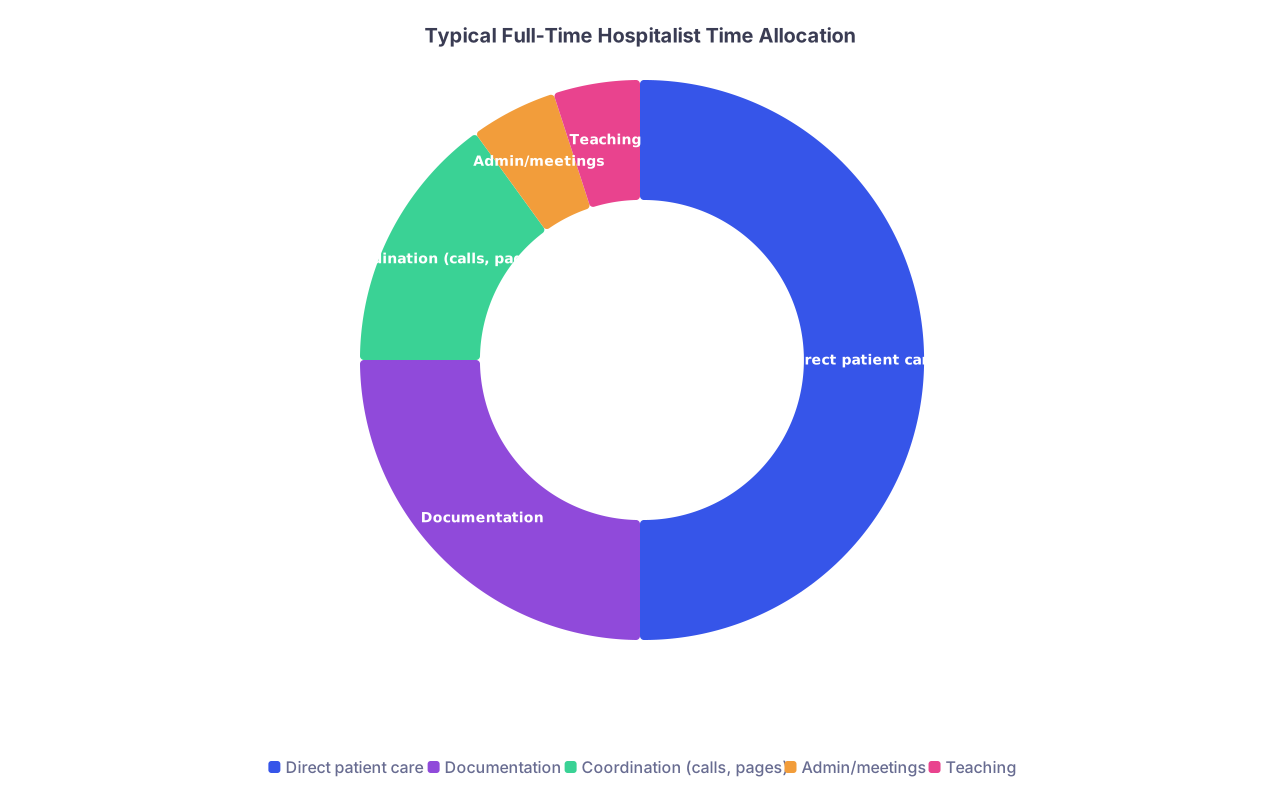
| Category | Value |
|---|---|
| Direct patient care | 50 |
| Documentation | 25 |
| Coordination (calls, pages) | 15 |
| Admin/meetings | 5 |
| Teaching | 5 |
Use this to sanity-check any offer. If they build comp assuming 90% of your time is billable face-to-face care, they are living in fantasy land, and you will pay for their denial.
Sample 6-Month Action Plan
To make this concrete, here is a simple blueprint you can adapt.
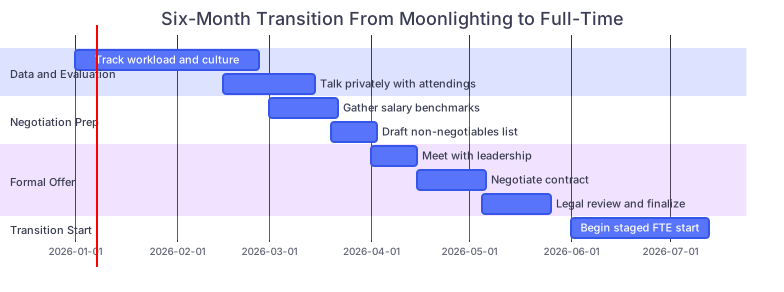
| Task | Details |
|---|---|
| Data and Evaluation: Track workload and culture | a1, 2026-01-01, 8w |
| Data and Evaluation: Talk privately with attendings | a2, 2026-02-15, 4w |
| Negotiation Prep: Gather salary benchmarks | b1, 2026-03-01, 3w |
| Negotiation Prep: Draft non-negotiables list | b2, 2026-03-20, 2w |
| Formal Offer: Meet with leadership | c1, 2026-04-01, 2w |
| Formal Offer: Negotiate contract | c2, 2026-04-15, 3w |
| Formal Offer: Legal review and finalize | c3, 2026-05-05, 3w |
| Transition Start: Begin staged FTE start | d1, 2026-06-01, 6w |
You are not going to follow this to the exact day. The point is to stop “sliding” into a job and start deciding into one.
FAQ (Exactly 3 Questions)
1. Should I tell other potential employers I am considering staying where I moonlight?
Yes, but selectively and without oversharing. You can say, “I have been moonlighting at a site where there is potential for a full-time offer, but I am seriously exploring other positions to find the best fit.” That signals you are in demand without sounding locked in. It also keeps your leverage intact when you circle back to your moonlighting site with real market data and alternative offers.
2. Is it a mistake to accept lower pay to stay where I am comfortable?
Not automatically. Comfort, known workflows, and a tolerable culture have real value. The mistake is accepting significantly lower pay and worse schedule and vague promises of “future upside.” If staying where you moonlight pays a bit less than a higher-paying but clearly toxic job, that can be rational. Just be explicit with yourself: you are paying for stability and fit. Make sure the price you pay is proportional to what you get.
3. How long should I stay in my first post-residency job before moving on?
If the job is safe, decent, and aligned enough, 2–3 years is a healthy target. That gives you time to build experience, pay down some debt, and clarify what you actually want long term. If the job is actively harmful—unsafe ratios, abusive leadership, chronic bait-and-switch on expectations—your timeline shrinks. Your license, sanity, and reputation matter more than some arbitrary “you should stay X years” rule. Plan your exit thoughtfully, line up the next role, and then leave cleanly.
Key points to walk away with:
- Treat your moonlighting job as a long audition and data-gathering mission, not just extra cash.
- Structure and negotiate the full-time transition deliberately—on compensation, schedule, support, and contract terms—based on real numbers, not feelings.
- Protect your long-term options: reasonable non-compete, sustainable workload, and financial flexibility so you can leave if the “dream job” stops being one.