
The fastest way to regret your first attending job is to “go with your gut” on multiple offers without a system.
You are stepping into the most leveraged decision of your early career. The difference between a great offer and a terrible one is often hidden in the fine print, the compensation model, and what nobody says out loud. You do not need more vague advice. You need a repeatable, ruthless comparison process.
Here is that process.
Step 1: Set Your Non‑Negotiable Criteria Before You Compare Anything
If you start by reading contracts, you will get anchored by numbers and prestige. Wrong sequence. First you decide what actually matters to you. Then you evaluate offers against that.
1.1 Define your “hard no” and “must have” items
Open a blank page and list:
Location constraints
- Must be within X miles of partner’s job or family
- States you refuse to practice in (licensing, malpractice climate, personal reasons)
Practice type constraints
- Will not do: 100% call, solo coverage in unsafe setting, >1:4 call, 24‑hour in‑house call after age X
- Must have: at least Y% of time in specific subspecialty, certain procedures, academic component, etc.
Compensation floor
- Absolute minimum guaranteed base you would accept
- Absolute minimum total comp you would accept (base + expected bonus)
Lifestyle requirements
- Maximum number of nights/weekends you will tolerate
- Maximum average weekly hours
- PTO minimum (for most attendings, <4 weeks is a problem)
Be specific. “Good work-life balance” means nothing. “No more than 1 weekend per month and average <55 hours/week” is usable.
1.2 Rank your priorities with weights
You are going to score each job later. That only works if you know how much each domain matters to you.
Use a 100‑point budget and assign weights:
- Location / family: 0–30
- Compensation: 0–30
- Schedule & call: 0–25
- Practice environment / support: 0–20
- Career growth / academic / leadership: 0–20
- Culture and leadership trust: 0–20
Make it add up to 100. If you are buried in loans, maybe compensation gets 30, location 15. If partner’s job is fixed, location may be 30.
Write your weights down now. Do not change them later to justify a shiny offer.
Step 2: Build a Comparison Grid Before You Talk Yourself Into Anything
You need everything side‑by‑side. Same fields. Same structure. No exceptions.
2.1 Create a master comparison table
Use Excel, Google Sheets, or a physical notebook. The key is consistency.
At minimum, create columns like these:
- Employer name
- Practice type (private, hospital employed, academic, FQHC, etc.)
- Location (city, state, urban/suburban/rural)
- Base salary / guarantee (duration in years)
- Productivity model (wRVU, collections %, hybrid)
- Signing bonus
- Relocation assistance
- Loan repayment (employer vs. external program)
- Expected total comp year 1, 3, 5 (your estimate)
- Call details (frequency, in‑house vs home, post‑call expectations)
- Clinic hours, inpatient load, procedures, panel size expectation
- PTO / CME days / CME dollars
- Benefits (health, disability, 401k/403b/457b, match, malpractice tail)
- Non‑compete (radius, duration, scope)
- Term / termination clauses (without cause notice period)
- Support (NP/PA, scribes, MA ratio, ancillary staff)
- Culture notes (red flags, things you liked)
- Your gut score (1–10, but only after you do the math)
Use one row per job offer.
| Factor | Job A | Job B | Job C |
|---|---|---|---|
| Base Salary (Year 1) | 260k | 300k | 240k |
| Productivity Model | wRVU | Collections | Hybrid |
| PTO (weeks) | 4 | 6 | 5 |
| Call | 1:6 | 1:3 | No call |
| Non-compete Radius | 20 mi | 50 mi | None |
Do not leave fields blank. If you do not know, mark it as “UNKNOWN – ASK.”
Step 3: Force Clarity on the Money – Normalize Compensation
Most physicians compare base salaries and signing bonuses. That is how you get fooled.
You need to compare expected total compensation over time, adjusted for workload and risk.
3.1 Break the compensation structure into components
For each offer, explicitly list:
Base salary / guarantee
- Amount per year
- Length of guarantee (1, 2, 3 years?)
- What happens after guarantee (pure productivity? lower base + incentive?)
Productivity pay
- Model (wRVU, collections, quality bonus, capitation)
- Threshold (e.g., bonus after 5,000 wRVU)
- Rate (e.g., $50 per wRVU above threshold or 30% of collections)
One‑time payments
- Signing bonus (and repayment obligations if you leave early)
- Relocation (taxed or not, repayment terms)
Ongoing extras
- Medical director stipends
- Call stipends
- Quality or citizenship bonuses (what are actual payout rates among current physicians?)
3.2 Convert to an “expected annual total comp” number
Ask for – or estimate – realistic productivity based on:
- What similar physicians there actually earn (not “potential up to $700K”)
- Typical wRVU production in your specialty for that system
- How long it takes to build a panel
Then calculate:
- Year 1 expected total comp = Base + realistic bonus + call stipends + other known add‑ons
- Year 3 expected total comp (after ramp‑up)
- Year 5 expected total comp
If they refuse to give real production numbers from current physicians, that is a red flag.
Now chart your own estimates.
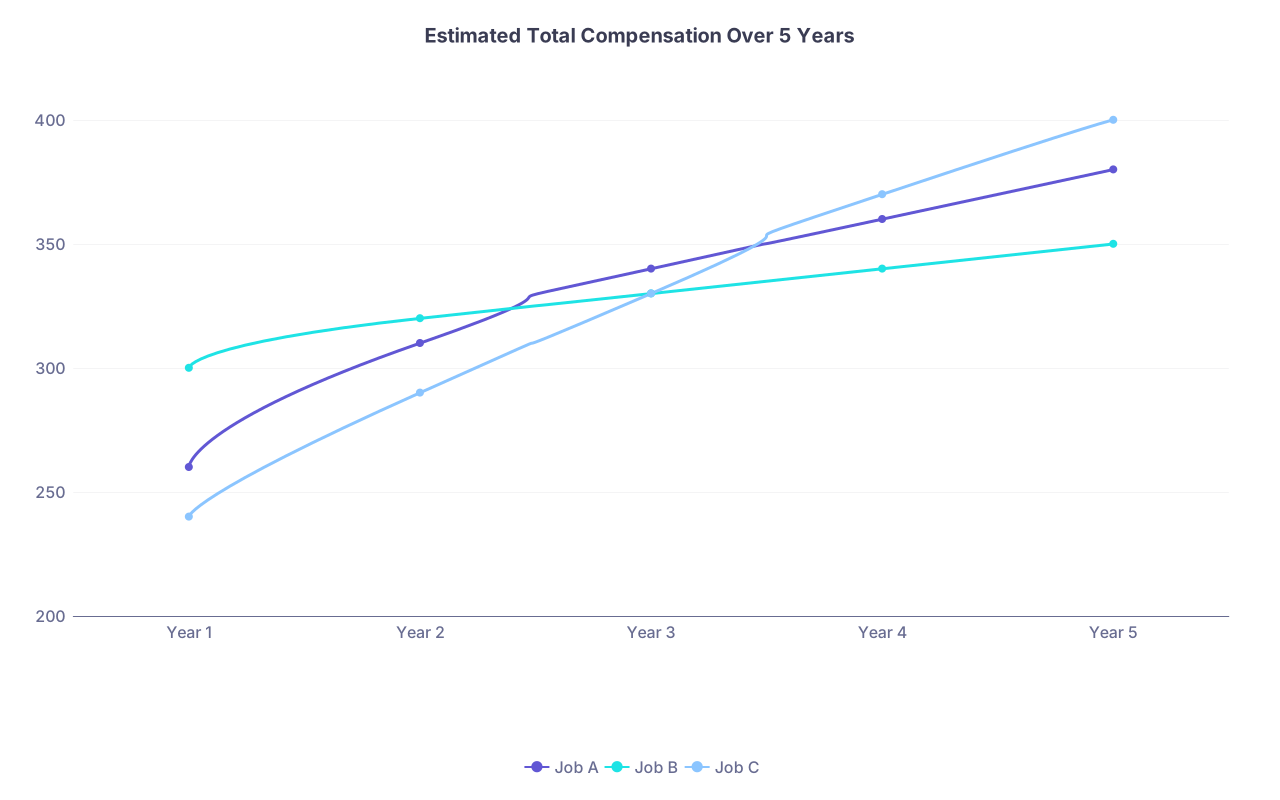
| Category | Job A | Job B | Job C |
|---|---|---|---|
| Year 1 | 260 | 300 | 240 |
| Year 2 | 310 | 320 | 290 |
| Year 3 | 340 | 330 | 330 |
| Year 4 | 360 | 340 | 370 |
| Year 5 | 380 | 350 | 400 |
You care about the shape of those lines, not just the first dot.
3.3 Adjust for workload and risk
A 400K job with 70‑hour weeks, 1:2 call, and unstable payer mix is not automatically better than a 320K job with 50‑hour weeks and stable employed model.
Rough heuristic: create an “effective hourly rate.”
- Estimate weekly hours (clinical + admin + charting at home)
- Multiply by 48 working weeks (assuming 4 weeks off)
- Divide expected total comp by total hours
Now you see which job pays more per actual hour of your life.
Step 4: Quantify Lifestyle – Schedule, Call, and PTO
“Schedule is reasonable” means nothing. Numbers or it does not count.
4.1 Dissect the schedule
For each offer, nail down:
- Clinic hours (start/stop times; late clinics; weekend clinics)
- Inpatient / OR days vs. clinic days
- Average patients per day (and expected ramp‑up timeline)
- Admin/protected time (is this real or mythical?)
You want explicit statements like:
- “8 half‑day clinics per week with 18–20 patients per half‑day”
- “One half‑day per week of protected admin time, not double‑booked with meetings”
4.2 Get brutal clarity on call
Ask:
- Call frequency (q? nights per month, weekends per year)
- In‑house vs home call
- Post‑call expectations (do you have clinic the next day?)
- Who covers when partners are on vacation
- Call pay (if any)
Translate to an annual burden:
- Number of call nights per year
- Number of full weekends on call per year
You can sketch it out:
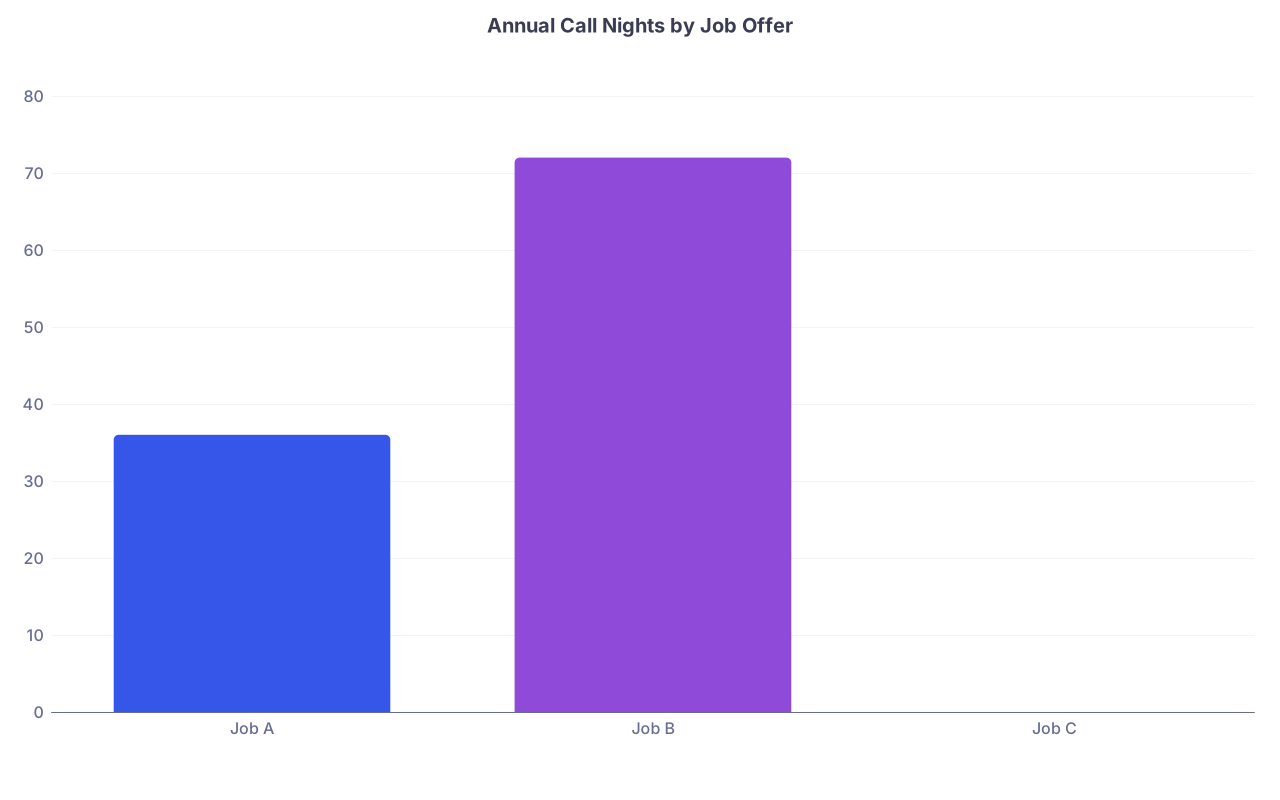
| Category | Value |
|---|---|
| Job A | 36 |
| Job B | 72 |
| Job C | 0 |
The bar chart often shocks people. Many “well‑paid” jobs are just high‑call jobs dressed up.
4.3 Compare PTO and real time off
Record:
- PTO weeks (AND whether holidays are included or separate)
- CME days and dollars
- Parental leave (paid vs unpaid; how people actually use it)
Important: ask how often people are denied vacation due to coverage. A theoretical 6 weeks that you cannot use is a lie.
Step 5: De‑risk the Fine Print – Non‑Competes, Termination, and Malpractice
This is where nice‑sounding jobs become landmines.
5.1 Non‑compete and restriction analysis
For each offer, extract:
- Radius (in miles)
- Duration (months/years after leaving)
- Scope (any practice of your specialty vs specific sites vs employed relationships)
Record them clearly:
| Job | Radius (miles) | Duration (years) | Scope |
|---|---|---|---|
| A | 20 | 1 | Any practice |
| B | 50 | 2 | Employed only |
| C | 0 | 0 | None |
Then ask yourself: If this job is miserable and you leave in 18 months, can you realistically work near your family? If not, that is a massive cost.
5.2 Termination clauses
Look for:
- Without‑cause termination notice requirement (90 days? 180 days?)
- Employer’s right to change compensation or duties unilaterally
- Conditions that trigger “for cause” termination
Short version: Longer noticed periods help you. Clauses that let them radically change your schedule or comp mid‑contract hurt you.
5.3 Malpractice coverage and tail
This part is non‑negotiable. You must know:
- Claims‑made vs occurrence coverage
- If claims‑made, who pays for tail upon departure?
- Typical tail cost for your specialty (often 1.5–2.5 times annual premium)
If you are responsible for tail and it could cost $60K–$120K to leave, that should absolutely be factored into your comparison.
Step 6: Evaluate Support, Culture, and Stability Like an Insider
This is the stuff they will not put in writing but will define your daily reality.
6.1 Clinical support and infrastructure
You want to know:
- MA / RN / NP / PA ratios
- Scribe support (real or “future plan”?)
- EMR (friend or foe)
- Onsite services (imaging, lab, PT, etc.)
- Referral network (do you have easy access to consultants?)
Simple rule: more support staff = more productivity with less burnout.
6.2 Leadership and culture – what you can actually measure
Do not rely on the smiling CMO’s speech. Get data:
- Turnover rate of physicians in the last 3–5 years
- Reasons people left (ask current docs, not admin)
- How long current partners/attendings have been there
- How disagreements about scheduling, call, or comp are handled
Talk to:
- At least 2–3 physicians currently in similar roles
- At least 1 physician who left in the last 2 years (if possible)
Ask blunt questions:
- “If you could go back, would you sign the same contract again?”
- “What is the one thing that makes you most frustrated here?”
- “Where do people burn out in this system?”
Take notes. You are looking for patterns, not isolated gripes.
Step 7: Turn All of This into a Scoring System
You now have a mountain of data. Time to convert it into something you can act on.
7.1 Build a weighted scoring model
Use the weights you set in Step 1. For each domain, rate each job 1–10.
Example domains and sample weights:
- Compensation – 30
- Schedule/call – 25
- Location – 15
- Practice environment/support – 15
- Culture/leadership trust – 10
- Career growth/academic potential – 5
For each job:
- Give a domain score (1–10) based on all your data (not vibes).
- Multiply by the weight.
- Sum for a total out of 1000 (if weights sum to 100 and scores are 1–10).
Example:
Job A:
- Compensation: 8 × 30 = 240
- Schedule: 6 × 25 = 150
- Location: 9 × 15 = 135
- Support: 7 × 15 = 105
- Culture: 8 × 10 = 80
- Growth: 6 × 5 = 30
Total: 740 / 1000
Do this for each job.
Then visualize the scores:

| Category | Compensation | Schedule | Location | Support | Culture | Growth |
|---|---|---|---|---|---|---|
| Job A | 240 | 150 | 135 | 105 | 80 | 30 |
| Job B | 270 | 90 | 60 | 80 | 50 | 40 |
| Job C | 210 | 220 | 120 | 110 | 90 | 25 |
The stacked bar shows you where each offer is strong or weak, not just the final number.
7.2 Add a “dealbreaker check” layer
Now run each offer against your non‑negotiables from Step 1.
If any offer violates a true hard line (e.g., non‑compete would make you move states to leave; call is q3 when you said q6+ only; base is below your minimum), flag it.
You can:
- Remove it entirely from consideration, or
- Keep it with a big red asterisk, clearly noted as “only acceptable if X terms are changed in negotiation.”
Step 8: Use the System to Negotiate – Not to Daydream
This is not a thought experiment. The grid and scoring model are now your negotiation weapon.
8.1 Identify your high‑impact negotiation targets
Look at each job and ask:
- What 2–3 changes would most improve its score for you?
- Are those plausible asks in that setting?
Common high‑yield negotiation points:
- Increase guarantee length from 1 to 2 or 3 years
- Clarify and raise productivity rates or lower wRVU thresholds
- Reduce non‑compete radius or duration
- Improve call schedule (lower frequency, add call pay, eliminate in‑house requirement)
- Add or increase signing bonus, relocation, or loan repayment
- Increase PTO from, say, 3 to 4 weeks
Be specific: “Based on other offers and MGMA data, I would be comfortable signing if we could do X.”
8.2 Script the conversation
You are not begging. You are presenting a rational comparison.
A calm script:
“I am very interested in this position. I have a couple of other offers, so I built a comparison to keep myself honest. On compensation and culture, you are very competitive. The main gap for me is the non‑compete radius and the call schedule. If we could reduce the radius from 50 miles to 20 and move from 1:3 to 1:4 call, I would be ready to sign.”
That is clear. No whining. No vague “Can you do better?”
Step 9: Sanity Check with an Outside Expert
You are too close to this decision to see all the angles alone.
9.1 Get the contract reviewed properly
You need both:
- A physician‑side health care attorney in that state to review the contract language
- A senior physician mentor (ideally in your specialty, ideally not employed by that same group) to sanity‑check the deal, not just the English
Have them specifically comment on:
- Non‑compete enforceability and risk
- Compensation fairness for your specialty and region
- Hidden traps (RVU targets, unilateral changes, “other duties as assigned”)
Do not cheap out here. A few hundred or thousand dollars now is trivial compared to getting stuck in a bad contract.
9.2 Run a “five‑year future” scenario
Imagine it is five years later in each job:
- What is your day like?
- Where are you living?
- How much are you earning?
- Are you burned out, or energized?
- Could you leave easily if circumstances changed?
Sometimes this mental exercise will expose a mismatch your spreadsheet cannot.
Step 10: Make the Decision – With Eyes Open, Not Emotionally Hijacked
By this point, if you have done the work, there will usually be a front‑runner or two.
Use this simple decision approach:
- Eliminate any job that violates your true non‑negotiables.
- Look at your weighted scores and top risks for each remaining job.
- Ask: “If this goes badly, which downside can I live with?”
- Choose the job where both the expected upside and the worst‑case scenario are acceptable.
Then stop shopping. Decide, sign (after contract revisions), and commit.
A Quick Visual: The Whole Process in One Flow

| Step | Description |
|---|---|
| Step 1 | Define non negotiables |
| Step 2 | Build comparison grid |
| Step 3 | Clarify compensation |
| Step 4 | Analyze schedule and call |
| Step 5 | Review legal terms |
| Step 6 | Evaluate support and culture |
| Step 7 | Create weighted scores |
| Step 8 | Negotiate key terms |
| Step 9 | Get expert review |
| Step 10 | Make final decision |
Your Next Move (Today, Not “Someday”)
Open a spreadsheet right now and create three sections:
- Top: your weighted priorities (must add to 100).
- Middle: the comparison grid headers listed in Step 2.
- Bottom: a row for “Total Score” and one for “Dealbreakers.”
Then take your first (or only) offer and fill in every single field you can from the written offer and your emails. You will instantly see what is missing, what is vague, and where you need answers.
Once the second offer arrives, you are not starting from scratch or relying on your gut. You are running it through a system built to protect your time, your career, and your sanity.