
The worst contract you will ever sign is the one you were too intimidated to edit.
If you walk into your first attending job thinking, “I am just grateful to have an offer, I probably should not rock the boat,” you have already lost thousands of dollars and years of leverage.
You are a physician. You are not a temp worker on a 3‑month trial. The way you request contract changes determines your pay, your schedule, your malpractice tail, your moonlighting flexibility, and sometimes whether you can work in your own city if things go sideways.
This is fixable. You need two things:
- A simple structure.
- Exact phrases that keep you sounding collaborative and professional while you push back hard on bad terms.
Let me give you both.
Step 1: Set Up the Conversation Correctly
If you start contract negotiations by editing PDFs and emailing redlines, you are doing it backwards. First you talk. Then you send language.
Use this script to convert an offer into a negotiation meeting.
Email to request a contract discussion
Subject: [Your Name] – Employment Agreement Questions
Hi [Name],
Thank you again for sending over the employment agreement. I am excited about the opportunity to join [Group/Hospital Name] and think it is a strong fit.
Before signing, I have a few questions and minor points I would like to review together so I understand the expectations clearly.
Would you have 30–45 minutes this week for a quick call to walk through the agreement? I am available [two time options].
Best,
[Your Name]
Notice the key moves:
- You open with enthusiasm.
- You call them “questions” and “minor points,” not “demands.”
- You ask for a call with a specific time frame. This frames it as routine and finite.
On the call, your opening line should sound like this:
“I appreciate the offer and I want to make this work. I went through the agreement carefully and there are a few sections I was hoping we could adjust or clarify so we are aligned from the beginning.”
You are not apologizing for having questions. You are making it clear that:
- You read the contract.
- You are serious.
- You want a long-term relationship, not a fight.
Step 2: Know Your Levers Before You Speak
You cannot negotiate everything at once. You will lose the other side. Pick your top 3–5 items.
Most new attendings underestimate what is actually negotiable. Here is a quick reality check.
| Term | Typical Negotiability |
|---|---|
| Base salary | Moderate to High |
| Signing bonus | Moderate |
| Non-compete radius | Moderate |
| Non-compete duration | High |
| Call schedule | Moderate |
| Tail coverage | High in many settings |
You need a short priority list. Example:
- Non-compete (radius and duration)
- Tail coverage
- Base salary or RVU rate
- Schedule/call expectations
- Signing bonus/relocation
Write your list before the call. Literally on paper.
Then your positioning line on the call is:
“I reviewed the agreement and there are four areas that matter most to me: the non-compete, malpractice tail coverage, compensation structure, and call schedule. If we can get close on those, I think everything else is workable.”
That sentence does three things:
- Shows you are focused, not nitpicking.
- Signals where they should spend effort.
- Implies you are likely to accept if those are fixed.
Step 3: Exactly What to Say for Each Major Issue
Now the part everyone actually wants: the scripts.
You can adapt words, but do not change the structure:
- Affirm interest,
- Show you understand their perspective,
- Make a specific ask with a concrete alternative,
- Stay quiet and let them respond.
A. Base Salary / RVU Rate
Do not start with “I need more money.” Start with alignment and data.
On the call
“I am very interested in this position. I looked at MGMA and current offers my colleagues are receiving in similar markets. For a [specialty] position in a [community/academic] setting, I am typically seeing base salary in the [$$$–$$$] range.
The current offer is [$$$]. Would you be able to move the base to [specific number] to bring it closer to current market rates?”
You may get the classic answer: “Our base is standardized for new grads.”
Your counter:
“I understand there may be a standard starting point. Given my [fellowship, procedures, prior attending experience, high RVU productivity in residency if applicable], I believe I will contribute at or above that level from day one.
If there is no flexibility on base salary, is there room to adjust either the RVU conversion factor or add a productivity or quality bonus in the first year to better reflect that?”
Two escape hatches for them:
- Improve RVU rate
- Add a guaranteed or easily-achievable bonus
Never ask “Is there any flexibility?” Ask, “How can we structure this?”

| Category | Value |
|---|---|
| Base Salary | 65 |
| Productivity Bonus | 20 |
| Quality Bonus | 10 |
| Call Pay | 5 |
B. Signing Bonus and Relocation
These are often easier to move than base salary.
“I appreciate the $10,000 signing bonus. Given relocation costs and the delay before first collections, it would help a lot to have more up front.
Is there room to increase the signing bonus to $20,000, or alternatively, to add a relocation allowance of [$$$] on top of the current signing bonus?”
If they balk:
“If increasing the total dollars is difficult, another option would be to structure part of that as a forgivable loan or early stipend during my start-up period. The goal for me is simply to have enough runway while I build my panel.”
You are not whining about debt. You are addressing cash-flow and start-up needs. Different tone, more effective.
C. Non-Compete (Geography and Time)
This is the clause that will haunt you if you do not fix it now.
Script to address it:
“I noticed the non-compete limits practice within a 50‑mile radius for two years. I completely understand the need to protect the group’s investment and referral base.
My concern is purely practical. If things did not work out, this would make it very difficult for me to continue my career and family life in this region.
Would you be open to tightening this to a 10‑mile radius from my primary practice location and limiting the duration to one year after employment ends?”
If they say, “We never change our non-compete,” you respond:
“I hear you. A smaller radius and shorter duration would make it much more comfortable for me to commit long term.
If we cannot change both, could we at least:
– Limit it to my primary clinic site rather than every location, or
– Reduce it to one year, or
– Exclude certain settings like telemedicine or moonlighting at unaffiliated hospitals?”
You are offering specific concessions they can say “yes” to without rewriting the whole policy.
Do not leave non-competes “for later.” Later is when you are already in trouble and have no leverage.
D. Malpractice and Tail Coverage
Tail coverage is one of the most expensive surprises for new attendings. If the contract is silent or vague, fix it.
On the call:
“I want to clarify malpractice coverage. The agreement mentions [claims-made/occurrence] coverage, but I do not see clear language about tail if I leave the position.
In my experience, this can create unexpected costs at the end of employment, so I would like to be explicit. Would you be willing to add language stating that the employer will provide and pay for malpractice tail coverage for claims arising from my work here?”
If they refuse to pay full tail:
“If full tail coverage is not possible, could we put in a shared-responsibility structure? For example, the group covers tail if employment ends due to practice closure, non-renewal not for cause, or relocation at the group’s request, and I cover it if I leave voluntarily for another job.
I just want the expectations spelled out clearly so there are no surprises for either of us.”
Again: clarity, not combat.
E. Schedule, Call, and Workload
This is where burnout starts. “Reasonable call” is meaningless. Fix it now.
You start by pinning down the baseline:
“Can we be more specific about clinical expectations? For example, what is the expected number of clinic sessions per week, average patients per day, and typical call frequency for this role?”
Then you move to contract language.
Call example:
“The agreement states ‘equitable call.’ To avoid misunderstandings, would you be open to language like: ‘Physician will participate in a call schedule that is generally no more frequent than 1 in 4, averaged over a quarter’?
That gives both of us a clear benchmark.”
Clinic/OR time example:
“Similarly, for clinic time, I would be more comfortable with a line specifying that my standard schedule will include [X] clinic sessions per week and [Y] OR/procedure sessions, with changes to be mutually agreed upon.”
If they say, “We need flexibility,” you answer:
“I understand the need for operational flexibility. A written baseline helps me plan my life and ensures I am not routinely carrying an unsustainable load. We can always adjust by mutual agreement if the practice grows.”
F. Protected Time, Admin, and Support
Academic or hybrid roles love to promise “protected time” verbally and forget it in writing.
Your script:
“We discussed [0.2 FTE] protected time for [teaching/research/admin]. I do not see that in the contract.
Could we add a line specifying that [0.2 FTE] of my schedule is designated for [activity], with the remainder for clinical duties, and that changes would be by mutual agreement?”
For support staff:
“For this to be sustainable, clinic support is key. Would you be able to specify the standard support I should expect, for example: one MA per room and shared RN coverage, or access to a scribe if patient volume exceeds [X] per day?”
You do not need a novel in the contract, but you need more than vibes.
G. Moonlighting and Outside Work
If you think you might ever do locums, telemedicine, teaching, or consulting on the side, get permission in writing now.
Here is the language to request:
“I see the section on outside employment. I want to be transparent that I may be interested in occasional moonlighting or telemedicine work in the future, as long as it does not conflict with my duties here.
Would you be open to adding language such as: ‘Physician may engage in outside professional activities, including teaching, consulting, or clinical work, provided such activities do not interfere with Physician’s duties to Employer and are disclosed to and approved by Employer in advance, such approval not to be unreasonably withheld’?”
The phrase you care about: “not to be unreasonably withheld.” That gives you something to push on later.
Step 4: Use a Simple, Repeatable Talking Framework
Most new physicians ramble on these calls. They apologize, over-explain, and then end with a vague, weak ask.
Do this instead. For every issue, follow this 4‑sentence framework:
- Anchor in appreciation / fit
- Show you did your homework
- State your concern in one line
- Make a specific, concrete ask
Example for salary:
- “I am excited about this role and see it as a strong long-term fit.”
- “I looked at MGMA data and what my co-fellows are being offered in similar markets.”
- “The current base is below that typical range.”
- “Would you be able to move the base salary to $260,000 to better align with the market?”
That is it. Then you stop talking.
Silence is a negotiation tool. Let them react. Do not immediately fill the space with caveats and backpedaling.
Step 5: Anticipate the Pushback and Have Ready Responses
You will hear the same six lines of resistance everywhere. Have your responses ready so you do not fold.

1. “This is our standard contract for all new physicians.”
“I understand you have a standard template. My requests are focused on a few areas that really impact my ability to commit long term.
I am not asking for anything extreme, just adjustments that align with market norms and provide clarity for both of us.”
2. “If we change it for you, we have to change it for everyone.”
“I appreciate the need for fairness. Many groups handle this by using the same base template but adding individual addendums or offer letters.
Even small clarifying addendums on non-compete radius or call expectations would address my main concerns.”
3. “We cannot change that; it is a system policy.”
Sometimes this is true. Sometimes it is laziness.
“If the formal policy cannot be changed, is there any flexibility in how it is applied to this specific role? For example, could we clarify in an addendum how this policy would work for me in practice?”
If the answer is flat “no” on everything, that is not bad news. It is useful data. A rigid employer during recruitment will not suddenly become generous after you sign.
4. “Other new grads have signed this without changes.”
“I understand. I am taking a very careful approach to my first attending position because I expect to build my career here.
I want to be sure we are aligned on key expectations now, rather than risking misunderstandings later.”
Translation: I am not like your other naive hires. That is a good thing.
5. “If we do that, it will not be fair to existing physicians.”
“Fairness is important. I am comfortable if you match these terms for others over time.
My goal is simply to start in a position that is sustainable and competitive so I can focus on building my practice and staying here long term.”
Call their bluff. Most of the time “fairness” is code for “we do not want to deal with changing anything.”
Step 6: Put Everything Back in Writing
Verbal agreements die quietly. Written agreements live.
After the call, you send one clean summary email. Something like this:
Subject: [Your Name] – Contract Discussion Summary
Hi [Name],
Thank you for taking the time to discuss the employment agreement today. I am excited about the possibility of joining the team.
To make sure I captured everything correctly, my understanding is that we agreed to:
– Adjust the base salary to $260,000.
– Clarify the call schedule as no more frequent than 1 in 4 on average.
– Modify the non-compete to a 10‑mile radius from my primary clinic for 12 months.
– Add language that the group will provide and pay for malpractice tail coverage.Please let me know if that matches your understanding. I look forward to reviewing the updated agreement.
Best,
[Your Name]
You are not being “annoying.” You are locking in what you just worked for.
When the new draft arrives, you or your attorney check that every promised change appears in writing. No exceptions.
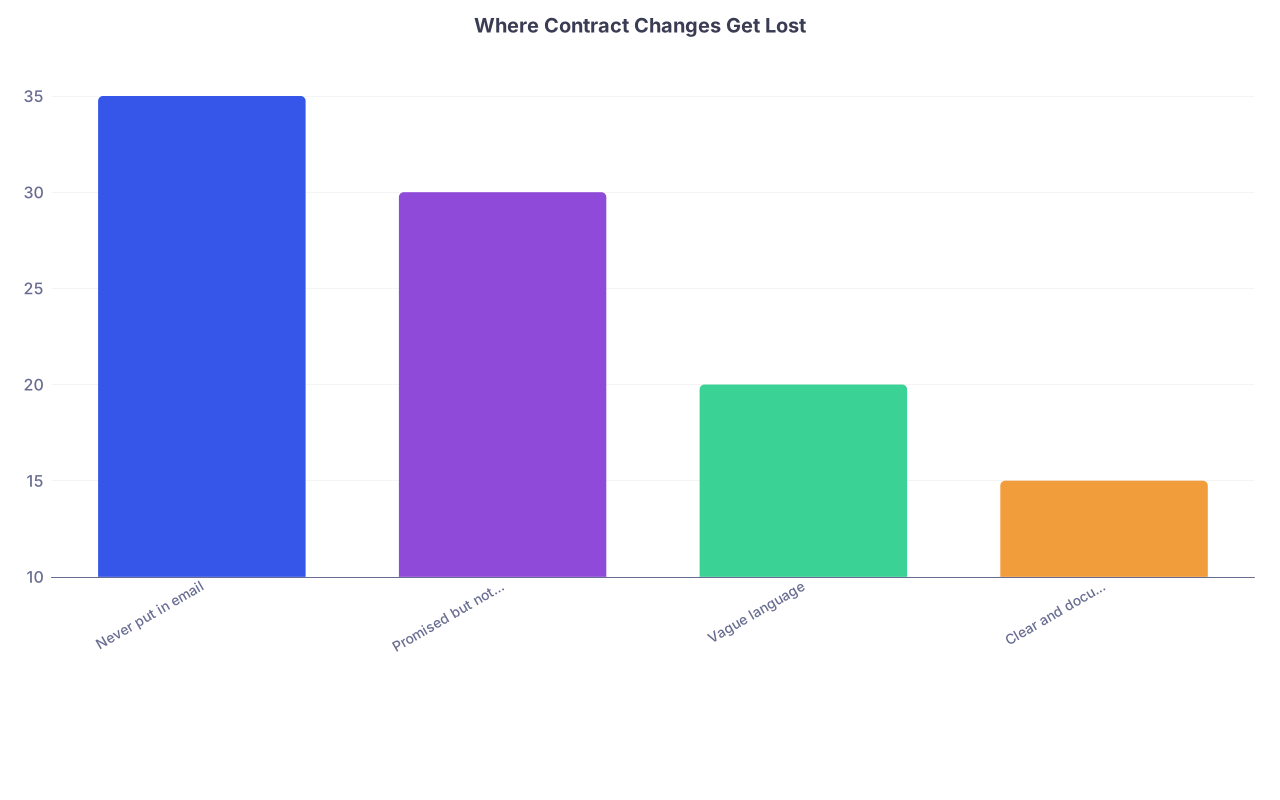
| Category | Value |
|---|---|
| Never put in email | 35 |
| Promised but not in draft | 30 |
| Vague language | 20 |
| Clear and documented | 15 |
Step 7: When and How to Use an Attorney (Without Killing the Deal)
If you can afford it, have a physician contract attorney review before you start asking for changes. Not after you have already used your amateur hour scripts.
Smart way to introduce this to the employer:
“My plan is to have a physician contract attorney review the final draft just to be sure we did not miss anything technical. That is standard practice for me.
I do not expect that to create major changes beyond what we have already discussed.”
If you want the attorney to negotiate directly, warn the employer:
“I am going to have my attorney send over a redlined version reflecting the points we discussed. I am still very interested in the position, and this is just to make sure the language matches our understanding.”
Here is the trap: if your lawyer sends an aggressive, 20‑page redline on a simple community-hospital job, some employers will walk. Choose a lawyer who understands your specialty, your market, and your leverage. Not just someone who gets paid by the hour to pick fights.
Step 8: Know When to Walk Away
You are not obligated to sign a bad contract just because “it is your only offer.” That is short-term thinking.
If, after reasonable back-and-forth, you still have:
- A broad non-compete (e.g., 50 miles for 2 years across multiple clinics),
- No tail coverage or a huge tail cost on your shoulders,
- Vague schedule and call expectations you cannot pin down,
- Compensation well below market with no path to improve,
You say this:
“I appreciate the time and the offer. After looking at the final terms and thinking about my long-term goals, I do not think I can accept the position as written.
If circumstances change in the future, I would be open to reconnecting. Thank you again for considering me.”
Polite. Firm. Door left open.
Walking away once teaches you more about your value than five feel-good webinar talks about “negotiation confidence.”

| Step | Description |
|---|---|
| Step 1 | Receive Offer |
| Step 2 | Review Contract |
| Step 3 | Identify 3 to 5 Priorities |
| Step 4 | Request Call |
| Step 5 | Propose Changes |
| Step 6 | Attorney Review |
| Step 7 | Sign Contract |
| Step 8 | Decline Offer |
| Step 9 | Accept As Is or Reprioritize |
| Step 10 | Key Terms Improved? |
| Step 11 | Deal Breakers Present? |
Final Tightening: Small Phrases That Make You Sound Seasoned
Sprinkle these into your emails and calls:
- “So we do not have different expectations going in…”
- “To make this sustainable over the long term…”
- “Based on current MGMA benchmarks and what I am seeing among my peers…”
- “I want to avoid surprises for either of us later…”
- “If we can get close on these points, I am very comfortable moving forward.”
And when you receive a concession:
“Thank you, that adjustment makes the position much more workable for me.”
You are reinforcing the behavior you want: their flexibility.
The Bottom Line
Three points to keep burned into your brain:
- Silence is expensive. If you do not ask for changes now, you live with the consequences for years. No one will come back later and voluntarily fix your non-compete or tail coverage.
- Specific beats vague every time. “This is below market; can you move the base to $260,000?” is powerful. “Can you do better?” is weak.
- How you ask matters. Confident, collaborative language gets you much further than defensive apologies. You are not begging. You are aligning interests.
Use the scripts. Adjust the numbers. But stop treating your first attending contract like a take‑it‑or‑leave‑it mystery document.
You are not “lucky to be here.” They are lucky you are even considering signing. Act like it.