
Understanding the Big Picture: Why Timing Matters So Much for IMGs in Radiation Oncology
Radiation oncology is a small, highly specialized field with a relatively tight physician job market. For an international medical graduate (IMG), timing your job search correctly can be just as important as your CV, research, or letters of recommendation.
Several factors make timing especially critical for IMGs:
- Visa constraints (J-1 waiver, H-1B cap, permanent residency timelines)
- Long credentialing and licensing processes (often 4–9 months)
- Small specialty with relatively few openings compared to internal medicine or family medicine
- Academic vs community job cycles that don’t always align with the rad onc match calendar
- Board eligibility/board certification timing (ABR vs RCPSC vs other boards)
This article serves as an IMG residency guide specifically for radiation oncology residency graduates, focusing on when to start job search activities, how to phase your efforts, and how to align everything with visas, boards, and the rad onc match cycle.
We will walk through:
- A month-by-month timeline from PGY-3 through end of PGY-5
- Differences between academic, hybrid, and community job timelines
- How visa type (J-1 vs H-1B vs green card) changes your strategy
- Practical steps to avoid gaps between graduation and your first attending job
The Overall Timeline: From PGY-3 to Your First Attending Contract
Radiation oncology residency is usually 4 years of advanced training (PGY-2–5) after an internship. That means your core job search window occurs during PGY-4 and PGY-5, but the best outcomes come when you start preparing even earlier.
Below is a high-level timeline tailored to an IMG in radiation oncology residency in the U.S. (or Canada planning to work in the U.S.), with modest adjustments if you trained abroad and are finishing a U.S. fellowhip.
PGY-3 (or Early PGY-4 for Rad Onc Residents): Laying the Groundwork
Primary focus: Clarify long-term goals, build your profile, and understand visa constraints. You are not actively applying yet, but you should be preparing strategically.
Key timing tasks:
- Clarify your career direction
- Academic vs community vs hybrid
- Geographic flexibility vs “must-have” cities or regions
- Research/teaching interest vs mostly clinical practice
- Meet with mentors
- Program director, chair, and at least one faculty mentor who understands the physician job market in radiation oncology
- Ask specifically about job availability, realistic regions for visas, and salary expectations
- Understand your visa pathway
- Are you on J-1 or H-1B? Do you expect a J-1 waiver (Conrad 30 or other federal waiver) or an O-1?
- How long will you be board-eligible and how does that affect job offers?
- Strengthen your application profile
- Finalize 1–2 research projects, abstracts, or manuscripts
- Start building relationships with future references
- Update your CV quarterly
Why this matters for timing:
If you know early that you’ll need a J-1 waiver in a non–big-city area, you will likely need to start your attending job search earlier than your peers to find suitable options. IMGs cannot usually wait until April of PGY-5 and still expect many choices.
PGY-4: Quietly Positioning Yourself (Soft Job Search Phase)
PGY-4 is when you should move from passive planning to active positioning, even if you’re not yet formally applying.
Ideal timing window:
- Early PGY-4 (July–December) – information gathering and networking
- Late PGY-4 (January–June) – quiet outreach, early signals of interest
Tasks for Early PGY-4 (6–18 Months Before Graduation)
- Refine your CV to “attending ready” format
- Highlight board eligibility date
- List procedures (SBRT, brachytherapy, SRS, proton, pediatrics, etc.)
- Include all publications and presentations
- Attend national meetings with intent (ASTRO, ASCO, ESTRO)
- Go beyond presenting posters: introduce yourself to department chairs and group leaders
- Ask about anticipated openings 12–24 months out
- Collect business cards and connect on LinkedIn
- Track job boards, but don’t rush to apply
- ASTRO Career Center
- ACR job boards
- Large multi-specialty group postings (e.g., Kaiser, Mayo, Cleveland Clinic)
- You’re studying patterns: location, common requirements, visa attitudes.
Tasks for Late PGY-4 (12–15 Months Before Graduation)
This is where soft job search begins.
- Tell your mentors you will begin searching soon
- Ask: “When do you recommend I start applying, considering my visa status?”
- Start informal conversations with potential employers
- Email groups in your target regions:
“I am a PGY-4 radiation oncology resident graduating in [month, year], board-eligible, IMG on [visa type]. I am very interested in learning about potential opportunities in your group over the next 1–2 years.” - This is exploratory, not yet “applying.”
- Email groups in your target regions:
- Clarify licensing timelines for your target states
- Some state medical licenses can take 4–9 months.
- Start gathering needed documents: degree verification, ECFMG verification, transcripts.
- Outline a realistic timeline
- Choose your ideal start date (often July–September after residency).
- Count backward 6–9 months for credentialing and licensing.
- This tells you your “latest safe date” to sign a contract.
Rule of thumb:
For IMGs in rad onc aiming to start in July after graduation, you should be interviewing and negotiating offers no later than October–December of PGY-5, which means active applications often start as early as April–September of PGY-4, especially if you have visa needs or geographic preferences.
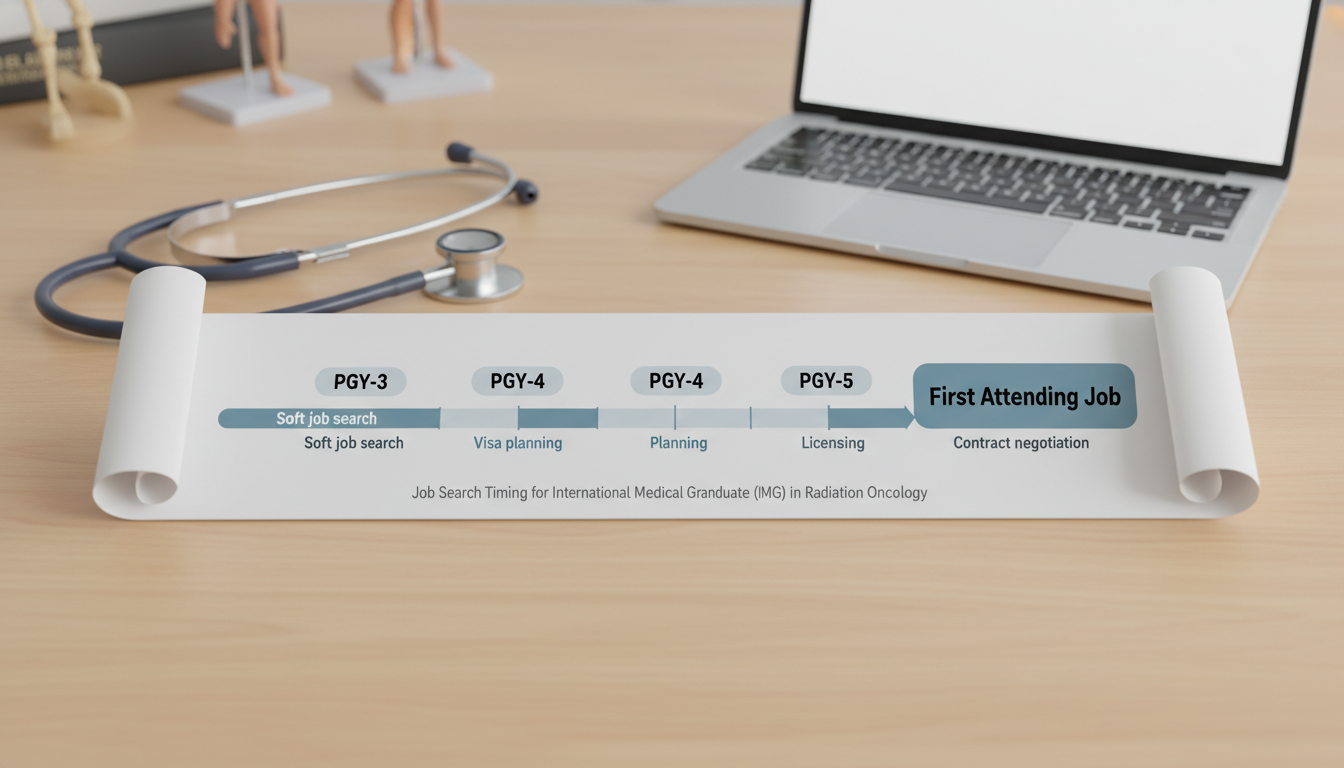
PGY-5: The Critical Year – When to Start Applying and Interviewing
PGY-5 is your decisive job search year. For an international medical graduate, waiting too long is one of the most common and costly mistakes.
Ideal Timeline for Job Search in PGY-5
Assuming graduation in June:
- 12–18 months before graduation (Jan–Jun PGY-4): Planning & light outreach
- 9–14 months before graduation (Jul–Nov PGY-4): Begin targeted applications (early for IMGs needing J-1 waivers)
- 8–10 months before graduation (Sep–Nov PGY-4 / early PGY-5 depending on your calendar): First wave of interviews
- 6–9 months before graduation (Oct–Jan PGY-5): Second wave interviews, negotiate offers
- 4–6 months before graduation (Jan–Mar PGY-5): Finalize contract, start licensing & credentialing
- 0–4 months before graduation (Mar–Jun PGY-5): Focus on boards, relocation prep, and onboarding logistics
Because residency program years and PGY labels sometimes differ by country, always think in terms of months before graduation.
Academic Jobs vs Community Jobs: Different Timing Rhythms
The job search timing differs for academic radiation oncology residency positions vs community group positions.
Academic Radiation Oncology Positions
- Often posted earlier and discussed informally at conferences.
- Some departments plan 1–2 years ahead for new faculty hires.
- For IMGs, academic centers often have:
- More experience with visas (J-1 waiver/H-1B/O-1)
- Slower HR processes but more structured recruitment
Best timing:
- Begin serious conversations 12–18 months before graduation.
- Attend ASTRO and ASCO with a clear agenda:
- Schedule informational meetings with department chairs.
- Ask explicitly: “Are you planning any faculty hires in [year]?”
- Formal applications often happen 6–12 months before start date, but as an IMG, having informal agreements or strong interest earlier can substantially improve your visa and location planning.
Community / Private Practice Positions
- Often respond to immediate or short-term needs (replacement for departing physician, new satellite).
- Some postings appear 6–9 months before desired start, others even 3–6 months before.
- However, for visa-sponsored positions (J-1 waiver), some groups will intentionally recruit 12–18 months in advance.
Best timing:
- For IMGs needing J-1 waiver:
Start searching 12–18 months before graduation. Engage with state health departments and known waiver-friendly employers early. - For IMGs with green card or H-1B:
You might have more flexibility, but you should still start 9–12 months in advance to avoid last-minute visa or licensing delays.
Visa Status: How It Changes Your Job Search Timing
Your visa type is one of the strongest determinants of when to start your attending job search.
J-1 Visa Holders (Most Common for IMGs in U.S. Training)
- Must meet the 2-year home residence requirement or obtain a J-1 waiver (Conrad 30, academic, or federal).
- J-1 waiver jobs are often in underserved or non-metro areas, and spots are limited by state.
Timing implications:
- Research state-specific Conrad 30 programs at least 18–24 months before graduation.
- Many states open applications for J-1 waivers around September to January for the upcoming year.
- To secure a waiver-sponsored job, you often must:
- Sign a contract by late summer or early fall before graduation
- Be ready for your employer to submit waiver paperwork as soon as the state program opens
Practical recommendation:
Start your active J-1 waiver job search 12–18 months before graduation. For some competitive or desirable states, even earlier outreach is wise.
H-1B Visa Holders
- H-1B may provide more flexibility but is tied to cap-exempt vs cap-subject employers.
- Many academic centers are cap-exempt, which can be advantageous.
Timing implications:
- Academic centers can often hire year-round, but internal approvals are slow.
- Private groups who are cap-subject must navigate the H-1B lottery (if not exempt), which has specific filing windows.
Practical recommendation:
Begin job search 9–15 months before graduation to ensure enough time for petitions and potential re-filings if needed.
Green Card or U.S. Citizen
- You have the most timing flexibility, but should still respect:
- State license processing time
- Hospital credentialing schedules
- Many peers in this category may start later and still be fine, but you should not adopt the most relaxed timeline as an IMG.
Practical recommendation:
Start serious applications 9–12 months before graduation; aim to have a signed contract at least 4–6 months before your start date.

Detailed Month-by-Month Plan: From 18 Months Before Graduation
Below is a more granular IMG residency guide timeline for your radiation oncology job search, assuming a June graduation and first attending position in July–September.
18–15 Months Before Graduation
- Clarify your visa strategy (J-1 waiver vs H-1B vs other).
- Identify top 3–5 geographic regions you would accept.
- Inform close mentors that you plan to start the job search early due to visa needs.
- Create a spreadsheet to track:
- Institutions/groups
- Contact persons
- Application dates, responses, interviews, offers
- Visa willingness and practice details
15–12 Months Before Graduation
- Begin initial outreach to your priority regions:
- “I will complete radiation oncology residency in June [year] and am exploring opportunities for [month/year] start.”
- Attend major conferences:
- Schedule short meetings with potential employers.
- Update your CV and draft a basic cover letter template for different job types (academic vs community).
12–9 Months Before Graduation
- Start formal applications to institutions and groups with visible postings.
- For J-1s:
- Focus on waiver-eligible areas and states with favorable Conrad 30 policies.
- Begin first round interviews (virtual or in-person).
- Ask targeted questions:
- “Have you sponsored J-1/H-1B physicians before?”
- “What is your typical timeline from interview to contract?”
- “When do you anticipate needing someone to start?”
9–6 Months Before Graduation
- You should now be in active interview season.
- Aim to have 1–2 strong prospect offers by the end of this window, especially for J-1 waiver roles.
- Start state license applications once you are reasonably sure of your likely practice location; for IMGs this step is often the rate-limiting factor.
- Discuss contract details:
- Salary, RVU expectations
- Call schedule
- Academic title, protected time
- Visa support and legal fees
6–4 Months Before Graduation
- Finalize your employment contract.
- Employer initiates:
- Visa petitions or J-1 waiver processes
- Credentialing and privileging
- You focus on:
- Getting your license approved
- Finishing residency well
- Preparing for boards
4–0 Months Before Graduation
- Complete any remaining paperwork:
- DEA registration
- Hospital privileges
- Payer enrollment (Medicare, Medicaid, commercial)
- Plan relocation and housing.
- Transition mentally from resident mindset to attending mindset:
- Clarify expectations for case mix, new patient volumes, brachy or SBRT responsibilities.
Special Situations: Fellowship, Research Years, and Non-U.S. Training
Not every IMG follows a linear U.S. radiation oncology residency path. Timing also shifts if you’re:
Doing a Post-Residency Fellowship
Examples: Proton therapy, brachytherapy, stereotactic radiosurgery, or global oncology fellowships.
Key timing points:
- Start the attending job search during the fellowship, not after.
- If fellowship ends in June, start searching 9–12 months before fellowship completion, just like residents.
- Clarify with potential employers:
- Whether they value your fellowship training enough to wait for you.
- If you can sign a contract conditional on successful completion of fellowship.
Coming from Non-U.S. Residency with U.S. Fellowship
If you trained in radiation oncology abroad and are doing a U.S.-based clinical fellowship, your pathway might be more complex:
- Identify if you will be board-eligible in the U.S. (ABR alternative pathways, for example) or practicing under a different set of credentialing rules.
- Employers may be unfamiliar with your training system; factor extra time for explanation and credential review.
- Start job search earlier (12–18 months) before your intended attending start date, because of:
- Additional visa complexity
- Potential board-equivalence questions
Attending Job Search Strategy for IMGs: Practical Tips and Common Pitfalls
Practical Strategies
Time-block your job search
- Allocate 1–2 hours weekly during PGY-4/5 solely for:
- Tracking openings
- Sending emails
- Updating your spreadsheet
- Consistency matters more than occasional bursts of effort.
- Allocate 1–2 hours weekly during PGY-4/5 solely for:
Leverage mentors actively
- Ask mentors to directly introduce you to chairs or group leaders.
- A brief email from your program director can move your CV to the top of the pile.
Be transparent about your visa needs—but not apologetic
- State your status clearly in your cover letter and early in conversations.
- Emphasize your commitment to the region and long-term retention.
Use conferences as mini-interview fairs
- Reach out in advance:
- “Will you be at ASTRO? I’d love to grab 15 minutes to discuss potential future needs in your department.”
- These early contacts often turn into early offers, especially in a small field like radiation oncology.
- Reach out in advance:
Common Pitfalls for IMG Radiation Oncologists
- Starting job search too late
- Many IMGs wait until winter or spring of PGY-5, then find that:
- Visa-friendly options are filled
- State license timelines make July start impossible
- Many IMGs wait until winter or spring of PGY-5, then find that:
- Ignoring licensing timelines
- Some states routinely take 6+ months; starting your license application after contract signing can delay your start date and first paycheck.
- Overly narrow geographic preferences
- Being limited to 1–2 major cities can be especially risky for J-1 holders.
- Widen your circle to include mid-sized cities and regional academic centers.
- Not aligning timing with spouse/partner considerations
- Dual-physician or dual-career couples need extra lead time—to coordinate two job searches on different cycles.
How the Physician Job Market in Radiation Oncology Affects Timing
The physician job market in radiation oncology has been under close scrutiny due to:
- Concerns about oversupply of graduates in some regions
- Geographic maldistribution (urban vs rural)
- Increasing use of hypofractionation and SBRT reducing some treatment volumes
For IMGs, these realities mean:
- You must be even more proactive and earlier in your attending job search.
- Being flexible about practice type and location significantly increases your chances of a timely, satisfying job.
Market-sensitive strategies:
- Apply early to underserved or mid-size regions, where groups may be eager to lock in candidates far ahead of time.
- Consider smaller academic centers or hybrid academic–community models, which may have better balance of:
- Visa experience
- Teaching and research opportunities
- Reasonable case volumes
When you think about the rad onc match, remember: matching into residency was only the first competitive step; securing the right attending position—especially as an IMG—requires similar strategic planning and timing.
FAQs: Job Search Timing for IMGs in Radiation Oncology
1. When should I start my job search as an IMG finishing radiation oncology residency?
For most IMGs, especially those with J-1 visas, you should start active job search 12–18 months before graduation. That means you should be:
- Reaching out and having early conversations by mid-PGY-4
- Applying formally and interviewing no later than early PGY-5
- Aiming to sign a contract 4–9 months before graduation
Starting later risks missing out on visa-friendly and geographically desirable jobs.
2. Is the timing different if I want an academic job versus a community job?
Yes. Academic positions often have longer planning cycles and may be discussed informally 12–24 months before the start date. Community jobs can appear closer to need (6–9 months), but for visa-dependent IMGs, many community groups also recruit early for waiver positions.
As an IMG:
- For academic jobs: Start exploratory discussions at least 12–18 months in advance.
- For community jobs: Start targeted outreach and applications 9–15 months in advance, earlier if J-1 waiver is required.
3. How does my visa type change the ideal timing of my attending job search?
- J-1: Start earliest (12–18 months before graduation), due to J-1 waiver requirements and limited waiver spots.
- H-1B: Start 9–15 months before graduation to accommodate petition processing and, if cap-subject, the H-1B lottery.
- Green card / U.S. citizen: You can sometimes start later than your IMG peers, but it’s still wise to begin 9–12 months in advance to handle licensing and credentialing smoothly.
4. What if I don’t have a job by the last few months of residency?
Stay calm but take immediate, structured action:
- Inform your program director and mentors; ask for direct introductions.
- Expand your geographic preferences and consider:
- Rural or underserved areas
- Temporary locum tenens with a plan to convert to permanent
- Engage with recruitment firms experienced in rad onc and IMG placement.
- For J-1s, check remaining Conrad 30 openings in less competitive states.
In most cases, with flexibility and mentor support, you can still secure a position, but your options may be fewer and your start date may be delayed.
By aligning your job search timeline with your visa status, board eligibility, and the realities of the radiation oncology physician job market, you significantly increase the chances of transitioning smoothly from residency to your first attending position. For an international medical graduate in radiation oncology, early, deliberate, and well-planned timing is one of the strongest advantages you can give yourself.