
The myth that anyone is “carefully reading” your CV line by line is fiction.
On a hiring committee, your CV gets about ten seconds of real cognition before you’re silently sorted into three piles: yes, maybe, no. That’s it. The rest is rationalization.
Let me walk you through what actually happens behind those closed conference room doors when you’re a post-residency or early attending applicant.
What Really Happens in Those Hiring Meetings
Most physicians imagine a thoughtful, methodical review: the committee prints your CV, examines every bullet, debates your scholarship, weighs your leadership roles.
Reality is closer to triage in a busy ED.
There’s a stack of CVs. Or a folder of PDFs. The department chair, section chief, and maybe the medical director (plus HR if your system is particularly bureaucratic) sit around a table. There is a time crunch, a clinic schedule, and a vague sense of, “Let’s get through this.”
Here’s how it actually goes:
Someone opens your CV.
There’s a pause that lasts about three seconds.
And then you’ve either passed the “instant impression” test or you haven’t.
They’re not reading yet. They’re scanning. Pattern recognition. Signal detection. I’ve heard countless variations of:
- “Looks clean. Fellowship trained. Good places. Move on.”
- “This is a mess. Where’s the training section? Skip.”
- “Why so many short jobs already? Flag that.”
- “Non-ACGME fellowship… ok but where?”
You get 10 seconds of attention to decide if you are:
- Obviously acceptable
- Clearly problematic
- Worth a longer look later if we do not fill the spot from (1)
That’s the real evaluation.
The 10-Second Scan: What Committees Actually Look For
Let’s break down what really gets processed in those first seconds. Because if your CV is not engineered for this phase, no one will ever get to the details you’re proud of.
1. The Overall Visual Hit
Before anyone reads a word, they react to layout and structure. They will not tell you this. But they absolutely judge you on it.
They’re subconsciously asking:
- Is this clean or chaotic?
- Can I immediately see training, current role, and board status?
- Does this look like a typical physician CV… or some business-school hybrid disaster?
Messy, dense, tiny fonts, weird columns, colored text, lots of boxes and graphics—these all backfire. That might fly in the corporate world. In hospital medicine, it just screams “high maintenance” and “doesn’t get it.”
A clean, boring, conservative CV wins.
2. Where You Trained (and Where You Are Now)
The eyes always snap to:
- Residency
- Fellowship (if you did one)
- Current or most recent position
On every committee I’ve sat on, I’ve watched the same pattern: someone opens the CV, then quickly jumps to the training block.
I have literally heard:
- “Residency at [well-known academic center]? Good.”
- “Caribbean med school, community residency… ok, depends on the rest.”
- “Fellowship at a name-brand place—let’s flag them.”
The actual program names matter less than you think, but they send a shorthand signal:
- Known academic centers = “probably solid baseline training”
- Reasonable community programs = “workable, let’s look deeper”
- Very obscure or problematic programs = “need more justification”
This is not always fair. But it is how the first ten seconds work.
3. Board Status and Licensing
If this is not immediately visible, you’re shooting yourself in the foot.
People rapidly scan for:
- Board certified vs board eligible
- Specialty / subspecialty
- Any obvious gaps or lack of certification
If you’re not clearly marked as “Board Certified in X” near the top of your CV, you’re making the committee work. And they won’t. Not for you. They’ll move to the next file that makes it easy.
4. Time Line and Red Flags
The next micro-scan is for continuity. They look down the dates:
- Med school → residency → fellowship → first job → current job
If the dates walk in a straight line with no unexplained holes and no rapid-fire job hopping, you pass this checkpoint.
What raises eyebrows in seconds:
- Six-month or 1-year attending positions, multiple times
- Gaps with no obvious explanation
- Repeated locums-only history when they want a long-term hire
- “Private practice group – left after 10 months” (yes, we notice)
The committee doesn’t need details at this point. They just need to know whether you’re “easy to explain” or “going to need a story.”
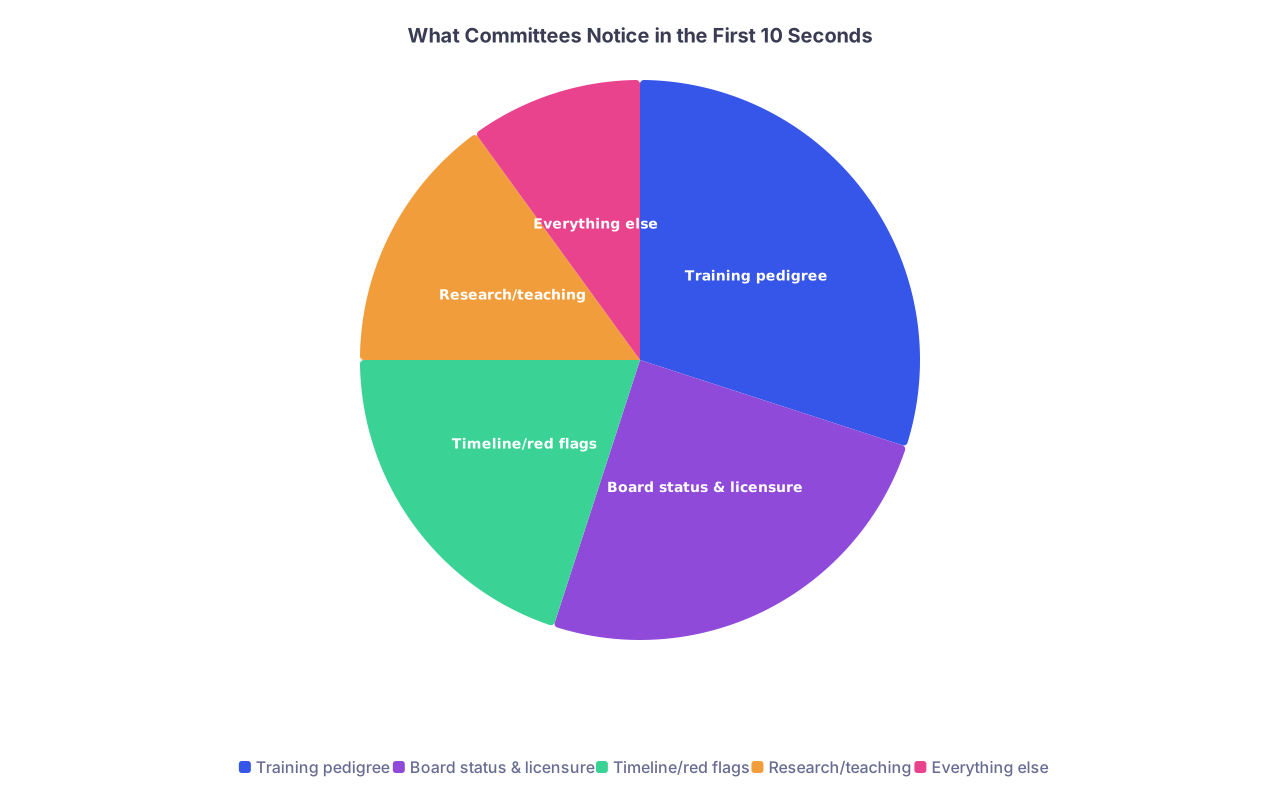
| Category | Value |
|---|---|
| Training pedigree | 30 |
| Board status & licensure | 25 |
| Timeline/red flags | 20 |
| Research/teaching | 15 |
| Everything else | 10 |
The Unspoken Sorting System: Yes, Maybe, No
Most places don’t say they do this. They still do it.
By the time the committee is done with the first scan, each name is already mentally in one of three piles.
The “Yes” Pile (or at Least “Likely Interview”)
These candidates have:
- Clean, linear training
- No weird gaps or chaotic job history
- Obvious alignment with the posted job (e.g., ICU fellowship for an ICU job, not random outpatient)
These CVs are easy to explain at a larger meeting.
You want to be boringly explainable:
- “He’s a chief resident from [X] with a critical care fellowship, wants to stay in the region.”
- “She’s been hospitalist faculty at [Y] for three years, strong teaching record, looking to move closer to family.”
If the committee chair can summarize you in one sentence that makes sense, you’re safe.
The “Maybe” Pile
These are the people who survive because some part of their CV is interesting or strong enough to offset something off-pattern.
Think:
- Caribbean grad with outstanding research or a unique fellowship
- Non-traditional candidate with prior career but a slightly messy timeline
- Multiple short jobs, but all in brutal markets or toxic groups everybody knows about
These candidates get conditional curiosity. The committee marks them for a deeper read later. But remember: if the “Yes” pile fills the interview slots, the “Maybe” pile never gets revisited.
The “No” Pile
These are rarely “bad doctors.” They’re just not worth the committee’s time given 50–200 applicants.
Reasons you fall here in the first 10 seconds:
- Chaotic formatting that reads like “I don’t understand professionalism in this environment”
- Obvious misalignment with the job (e.g., pure outpatient candidate for heavy inpatient job)
- Training or credential gaps that create too many question marks
- So many very short stints that everyone silently thinks: “There’s a story. We don’t have time to find out what it is.”
No one sends you an email saying, “We skimmed your CV for ten seconds and decided you’re not worth the bandwidth.” You just hear: “We went in a different direction.”

How to Design Your CV for the Real Evaluation
Your job isn’t to impress with density. It’s to be legible in ten seconds.
Make the Top Third of Page One Do All the Heavy Lifting
On a screen or paper, committees mostly register the first half to one-third of that first page. That’s your prime real estate. If they have to hunt for basic facts, you’re done.
The top section should make these things immediately obvious:
- Who you are (name, MD/DO, contact info)
- What you are (specialty, subspecialty)
- Board certification and state licensure
- Current role and institution
- One clean training timeline (Residency, Fellowship, Med School)
If your CV starts with an “Objective Statement” or a flowery paragraph, you’re telling them you don’t understand physician hiring norms.
Strip it.
Use Order That Matches How They Think
The committee’s mental schema is:
- Who is this person in one sentence?
- Where did they train and what are they licensed/boarded in?
- What are they doing now?
- Anything special/extra (research, leadership, niche skills)?
So your CV should roughly follow:
- Contact and professional identity (specialty, board status)
- Current position
- Education & training (reverse chronological)
- Licensure & certifications (if not already clearly shown)
- Academic / clinical roles, leadership
- Scholarship, teaching, QI, etc.
Not that fake “functional” resume style you saw on some corporate job site.
Clean, Predictable Formatting Beats Creative Any Day
You’re not applying to a design agency. You’re applying to a group that lives in Epic and dictated notes.
Use:
- One consistent font (no more than two sizes: headings vs body)
- Clear section headings (bold, slightly larger)
- Plenty of white space
- Simple reverse-chronological lists with dates aligned
If I see three different bullet symbols, colored text, and a multi-column layout, my brain just files you under “difficulty I will avoid.”
| Feature | Helps You | Hurts You |
|---|---|---|
| Layout | Simple, linear, single column | Multi-column, graphic-heavy, tiny margins |
| Top section | Board status, current role, training | Objective statement, vague summary, missing licensure |
| Dates & timeline | Clear, continuous, reverse chronological | Gaps, overlapping dates, unexplained short jobs |
| Content density | Focused, readable spacing | Walls of text, huge paragraphs of duties |
| Tailoring to job | Highlighted relevant skills/experience | Generic CV identical for every role |
Red Flags Committees Quietly React To
Nobody will give you this list in an official workshop, because HR would have a stroke. But these are real reactions I’ve heard in those rooms.
1. Multiple Jobs in 2–3 Years Without Clear Logic
If you’ve bounced:
Hospitalist Group A → Locums → Hospitalist Group B → Another Locums → Urgent Care
…in under three years, everyone’s thinking: “Why can’t this person stay anywhere?” Not automatically fatal, but it drops you into the “needs explanation” group.
If there are reasonable explanations—geographic moves for spouse, hospital closing, obvious career pivot—make them discreetly clear in your cover letter, not with defensive paragraphs on your CV.
2. Inflated Titles
A one-year-out attending calling themselves “Medical Director” of a three-person outpatient clinic inside a strip mall raises eyebrows. It looks like title inflation.
Committees are pretty good at sniffing this out. Calling yourself “Chief Medical Officer” of your LLC telemedicine side hustle doesn’t impress; it amuses.
3. Overly Long “Responsibilities” Sections
You do not need six bullet points to explain what a hospitalist does. The committee already knows. If your CV looks like a job posting, it telegraphs insecurity and padding.
You can have one or two bullets for truly differentiating items:
- “Led sepsis QI initiative decreasing LOS by 0.7 days”
- “Super-user for Epic inpatient build, led rollout at site X”
But a whole section of “admit, round, discharge, coordinate care, attend meetings” is wasted space.
4. Amateurish Email or Incomplete Contact Info
If your email is something like spicydoc88@ or you list no phone number, it matters more than you think. It tells me how you present yourself to patients, staff, and external partners.
You are not in residency anymore. Use a serious email. Put your cell. You are being hired as a colleague, not a student.
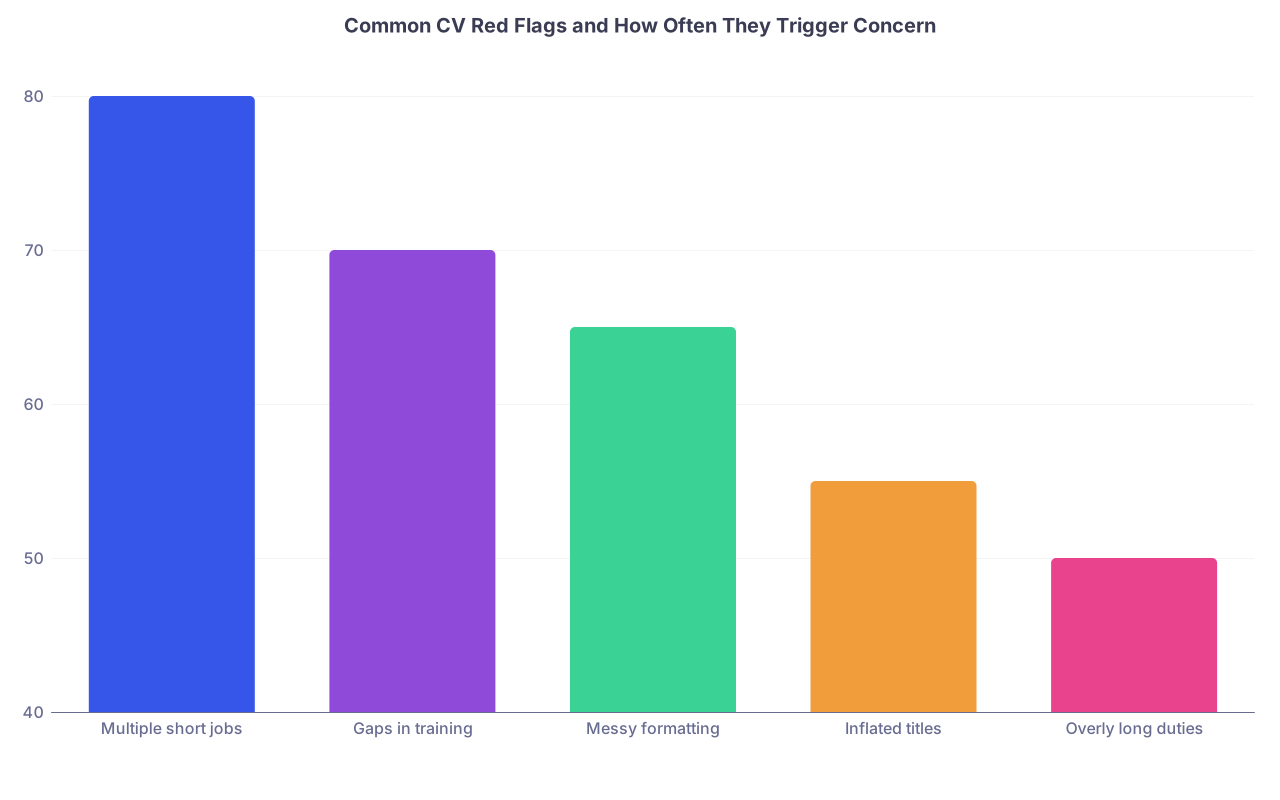
| Category | Value |
|---|---|
| Multiple short jobs | 80 |
| Gaps in training | 70 |
| Messy formatting | 65 |
| Inflated titles | 55 |
| Overly long duties | 50 |
How Committees Actually Decide Who to Interview
The 10-second scan is not the entire process, but it’s the gate. If you pass through, here’s what happens next.
Someone—often the section chief or fellowship program director type—will go back and take a two-to-three-minute read on the survivors. This is where nuance comes in:
- Do you have specific experience that matches their pain points? (Night coverage, ICU, procedures, niche clinic)
- Have you done anything that makes you visible in the field? (Presentations, publications, teaching awards)
- Are there any risk factors they missed on the first pass? (Professionalism issues hinted by phrasing, lots of moves, disciplinary hints)
Committee members split into two camps:
- “Credentials first” people – care about training, publications, pedigree
- “Fit and reliability” people – care about stability, personality clues, references
They fight it out informally. But here’s the crucial piece: none of that debate happens if you lose in the first ten seconds.

| Step | Description |
|---|---|
| Step 1 | CV Received |
| Step 2 | 10 second scan |
| Step 3 | Shortlist for interview |
| Step 4 | 2-3 minute deeper review |
| Step 5 | No further action |
Tactical Moves You Should Make Right Now
If you’re within 6–12 months of finishing residency or fellowship—or already in your first job and eyeing the next one—this is what you do.
1. Rewrite Your First Page Around the 10-Second Reality
Do this ruthlessly. Top half of page one should clearly show:
- Name, MD/DO, contact
- Specialty, subspecialty, board certification
- Current role/institution
- Training (residency, fellowship, med school) with locations and dates
If someone prints only your first page and the bottom gets cut off on the copier, you should still be legible as a candidate.
2. Compress the Obvious, Expand the Differentiating
Everyone has:
- “Inpatient rounding”
- “Outpatient clinic”
- “Supervised residents”
Those don’t distinguish you.
What helps:
- Specific QI/patient safety roles with outcomes
- Niche skills they actually need (ultrasound, advanced endoscopy, high-risk OB, ECMO)
- Real leadership with a number of people or projects attached
You’re building a case that you’re a safe hire who also brings one or two useful extras.
3. Get a Cynical Review, Not a Polite One
Do not ask your closest co-resident to “look it over.” They’ll say it looks great.
Find someone who sits on actual hiring committees—division chiefs, senior attendings, group partners. Ask them, bluntly:
“If my CV came across your desk in a stack of 100, would I make the ‘yes’ pile in 10 seconds? If not, what’s killing me?”
The harsh feedback will be infinitely more useful than polite praise.
FAQ: What You’re Probably Still Wondering
1. How long should my CV be post-residency?
For clinical medicine, length is less important than clarity. Two to four pages is typical in the first five years. I’ve seen six-page CVs from junior people that were unreadable, and three-page CVs that were perfect. If you’re under five years out and your CV is over five pages, you’re almost certainly padding or over-detailing. Cut the fluff.
2. Should I list every poster, abstract, or minor talk?
List what you can stand behind in a conversation without fumbling. Early on, it’s fine to include posters and abstracts, but group them in a way that doesn’t scream “grasping.” Once you have a couple of real publications or substantive presentations, prune the clutter. No one is impressed by 17 local noon conference talks listed as separate line items.
3. How do I handle a gap or a short, bad job on my CV?
You do not need to write an essay on the CV. Keep the dates truthful. Use neutral descriptions. If the gap was for family, health, immigration, or some understandable life event, explain briefly in a cover letter or during the first screening call. For a bad fit job that lasted 6–12 months, be factual and non-defensive when asked. What kills people isn’t the job; it’s the evasiveness.
4. Does the name of my med school or residency really matter that much?
It matters in the first ten seconds as a heuristic, but it’s not destiny. A no-name or lower-tier program doesn’t automatically sink you, especially in non-ultra-competitive specialties. What matters is that the rest of your CV tells a coherent, competent story: stable training, decent evaluations, maybe a couple of standout elements. You can absolutely outcompete someone from a bigger-name place if your CV screams “reliable, low-risk, good colleague” and theirs raises quiet doubts.
Remember the core truths:
Most hiring committees are doing rapid pattern recognition, not literary analysis.
Your CV lives or dies in the first ten seconds by clarity, structure, and red-flag avoidance.
Be boringly solid and easy to explain on page one—and then let your actual strengths do the talking when they finally slow down and read.