
The biggest myth about attending jobs is that CMOs care most about your CV. They don’t. They care about risk.
Let me tell you what actually happens in those closed-door hiring meetings where your name is on the agenda. It’s not just, “Who has the best fellowship?” It’s, “Will this person blow up my email, my quality reports, my nursing staff, or my budget?”
You’re thinking like a clinician. They’re thinking like a risk manager with an MD or MBA.
How a CMO Really Sees You
The CMO does not see “Dr. Patel, chief resident, excellent evaluations, strong research.”
They see a bundle of risks and assets:
- Clinical risk (Are you safe? Are you going to cause sentinel events?)
- Financial risk (Will you generate revenue or quietly bleed the hospital?)
- Cultural risk (Will you poison the staff culture or stabilize it?)
- Reputational risk (Are you a lawsuit or PR nightmare waiting to happen?)
- Operational risk (Will you show up, cover shifts, and not implode at 2 a.m.?)
They’re solving a puzzle you do not see clearly because residency shields you from it. As an attending candidate, your job is to present yourself as low-risk, high-yield across those dimensions.
Let’s break down what they actually look for, not the brochure version.
1. Clinical Competence: “Can I sleep at night with you on call?”
Clinical competence is the first gate. But here’s the nuance: it’s not about brilliance, it’s about predictability.
CMOs sit in meetings reviewing mortality reviews, root cause analyses, and complaint summaries. Names repeat. That’s what haunts them. They’re not afraid of the doctor who occasionally misses a zebroid diagnosis; they’re afraid of the doctor with a pattern.
The questions they’re really asking:
- Do you practice within your lane, or do you cowboy outside guidelines?
- Do you respond when nurses call, or do you ghost them and hope problems disappear?
- Do you document well enough that, if a lawyer reads your note, I’m not sweating?
- Do your outcomes, for your level of experience, look clean… or noisy?
Here’s what they actually look at or ask about behind the scenes:
Informal references from your PD and senior attendings:
“If your mother was sick, would you let this person take care of her?”
I’ve heard that exact question in multiple CMO calls. Bad answer = instant no.Patterns in your training record:
Not just “any issues,” but: Did you have professionalism flags? Late notes? Recurrent nursing complaints? Canceled clinics? Those come up.How you talk through cases in your interview:
When they say, “Tell me about a complication,” they’re not evaluating the complication; they’re assessing your thinking: ownership, humility, systems awareness.
If you’re post-residency, your core clinical question is: “Can I trust you alone at 2 a.m. when there’s nobody to babysit you?” If the answer is anything short of an easy yes, you’re done.
2. Financial Reality: “Will you pay for your own existence?”
Most new attendings have no idea how naked the economics are.
Here’s the blunt truth: your “value” to a CMO is not abstract. They look at you like a P&L line.
How many RVUs can you reasonably generate?
How many patients will you see?
Will your presence reduce locums costs or 24/7 call stipends?
CMOs, especially in private or hybrid systems, care about:
Your willingness to work where the money actually is.
Not the cushy daytime clinic with 12 slots. The admit-heavy ward. The ED consult grind. The OR block that always runs over.Your coding and documentation mindset.
They pay attention when you say things like, “I made a point as chief to learn correct documentation for sepsis, malnutrition, and comorbidities because I saw how much it affected hospital metrics.” That is catnip to a CMO.Your flexibility around schedule and call.
A candidate who says, “I’m fine with 1:4 call initially and I’m used to admitting overnight and managing high acuity independently,” has a much higher practical value than the superstar fellow who wants bank hours and no weekends.
Let me show you what this looks like in their head when comparing two candidates.
| Factor | Candidate A (High Value) | Candidate B (Risky Bet) |
|---|---|---|
| Call coverage | Willing 1:4, takes nights | Wants minimal call, no nights |
| Documentation | Talks about coding, DRG impact | “Our notes are too long anyway” |
| Procedure mix | Comfortable, wants to grow | Avoids procedures |
| Locums replacement | Can replace current locum slot | Adds new cost center |
| Start-up time | Ready to start in 2 months | Wants 6+ months off |
Guess who gets the offer even if they have the lower pedigree? Candidate A. Every time.
3. Culture and Politics: “Will nurses and other doctors survive you?”
Here’s the part residents almost never understand: nurses and staff have enormous veto power over you. Not directly, but through the CMO’s inbox.
A CMO will absolutely pass on a clinically strong candidate if they smell cultural trouble. Because cultural problems multiply.
Patterns CMOs watch for:
Disrespect toward nurses or ancillary staff.
If your training program ever escalated a “nursing conflict” incident, that whispered story travels faster than your research.“I’m the smartest in the room” energy.
I watched a fantastic sub-specialist get quietly blacklisted from a community system because they belittled the ED physicians during an interview lunch. That lunch story was shared with the CMO by three people within an hour.Blame-shifting.
When they ask, “Tell me about a conflict with a colleague or nurse,” they’re waiting to see if you throw the other person under the bus or talk about shared responsibility and process.
CMOs talk to CNOs (Chief Nursing Officers) constantly. A lot of hiring conversations go like this:
CMO: “We’re looking at Dr. X for hospitalist.”
CNO: “We had a traveler here from that hospital. Nurses hated Dr. X. I’d be careful.”
CMO: “Alright, let’s pass unless we’re desperate.”
You never hear that part. You just “don’t get the job.”
Your brand with staff matters more than you think. If a CMO hears, “Nurses love working with her. She’s calm. She calls people by name,” that’s almost as good as a Stack of Publications.
4. Behavior Under Stress: “Are you a meltdown risk?”
CMOs have seen the full spectrum: the attending who performs under fire, and the one who starts yelling, crying, or vanishing when there are five admits and two codes.
The question in their mind: Are you stable?
What they look for in interviews and references:
Emotional regulation.
They listen carefully when you talk about bad call nights, sudden deaths, or conflict. Do you sound rattled, bitter, or vengeful? Or measured, tired-but-functional, and reflective?Patterns of burnout talk.
If your language leans heavily on “toxic,” “abusive,” “unfair,” “overworked,” and nothing about personal coping, boundaries, or growth, you trip their internal risk meter. They’re not unsympathetic to burnout. They’re just terrified of hiring someone ready to crack.Substance or professionalism red flags.
One incident in residency, handled maturely, isn’t automatic death. Repeated whispers about “late, unreliable, always post-call completely useless” absolutely are.
I’ve sat through a CMO final screen where they said, “Her CV is fantastic. But the PD told me off the record she really struggled with coping and had multiple near-miss professionalism issues. I’m not bringing that into our group.” That’s it. Instant no.
5. Strategic Fit: “Do you solve the problem I actually have?”
You think of yourself as “a hospitalist,” “an internist,” “a surgeon.” The CMO thinks in gaps and firestorms:
- Our stroke metrics are bad. We need a neurologist who cares about process.
- Our cath lab is underused. We need an interventionalist who will hustle and build volume.
- We’re losing cases to the competing hospital. We need someone good with referring docs and community physicians.
If you walk into an interview pitching yourself generically, you look interchangeable. If you walk in having done your homework on their actual pain points, you look like a solution.
This is where 90% of candidates miss.
You should know before the interview:
- Are they short on call coverage in a particular area?
- Are they trying to start or grow a particular service line (e.g., oncology program, stroke center, robotics, advanced endoscopy)?
- Are they bleeding to locums in your specialty?
- Are their quality metrics in your area mediocre or under review?
Then, you position yourself like this:
- “In fellowship, I helped develop our rapid pathway for X; I’d love to bring that mindset. I noticed your hospital is aiming for stroke center accreditation—this is exactly the work I enjoy.”
- “I’m very comfortable being part of a growth phase. At my last institution we built up Y procedure volume by partnering with ED and primary care.”
That kind of language rings in a CMO’s ears as: “This one might help me hit my system goals and make my boss happy.”
6. Liability and PR: “Will your name end up in my incident log… or the news?”
Do not underestimate how much time CMOs spend on:
- Serious adverse events
- Lawsuits and complaints
- Social media / press issues
They’re not only hiring a clinician; they’re hiring a public-facing professional.
Red flags they fear:
- History of boundary violations (patients or staff)
- Social media recklessness (posting about patients, mocking staff, wild public behavior)
- Sloppy consent habits, sloppy documentation, sloppy follow-up
They’ll often ask oblique questions:
- “Tell me about a time something went wrong in a case and how you handled it with the patient or family.”
- “Have you ever had a complaint escalate formally?” (If yes, they already know. They want to see your story.)
They’re listening for:
- Ownership instead of deflection
- Clear communication, empathy, transparency
- Ability to work with risk management, not fight them
CMOs remember the attendings who made their worst weeks miserable: depositions, news reporters calling, board investigations. They do not want more of those.
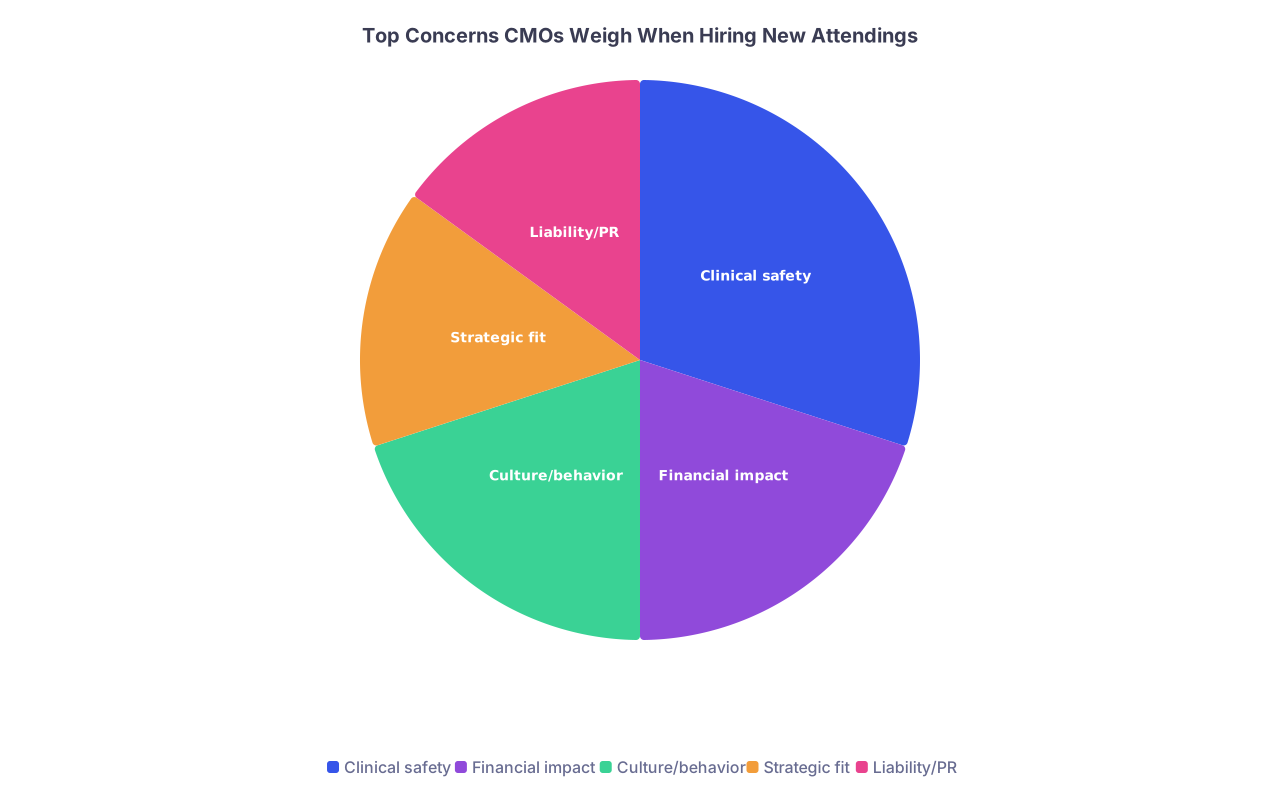
| Category | Value |
|---|---|
| Clinical safety | 30 |
| Financial impact | 20 |
| Culture/behavior | 20 |
| Strategic fit | 15 |
| Liability/PR | 15 |
7. The Informal Backchannel: What You Don’t See
Let me be blunt: your “official” references are not where the real decisions happen.
The real references:
- The CMO texts your PD: “Off the record, would you rehire this person?”
- They ask another attending who rotated through your program: “What’s the story on this guy?”
- They ask the CNO if any of the travel nurses from your hospital mentioned your name.
- They Google you harder than you think.
This is why how you leave residency, fellowship, and your first job matters.
Stories I’ve seen influence hiring:
- A candidate who left their first job mid-contract but the story from the medical staff office was, “They ghosted us, stopped returning calls about coverage, and we had to scramble.” That candidate had a brutal time getting hired again.
- Another candidate who left a job after a real conflict, but everyone said, “They handled it professionally, gave notice, finished strong, and left detailed handoffs.” That person had zero trouble landing elsewhere; the CMO literally said, “Everyone respects how they left.”
CMOs trust patterns and whispers more than a polished CV.
8. How to Present Yourself So a CMO Actually Wants You
So how do you take all this and translate it into something practical, without selling your soul or being fake?
You frame your story around what they really care about.
In your CV and cover letter
Stop writing generic fluff. Instead, quietly signal:
- Reliability: evidence of consistent responsibilities (chief roles, committee work, quality projects you actually followed through).
- Systems thinking: involvement in quality improvement, throughput, documentation initiatives.
- Breadth and flexibility: comfort in the clinical environments they need (ICU exposure, ED consults, procedural experience, underserved settings).
In the interview
You want to project three things:
- Safe and steady
- Low drama, high collaboration
- Attuned to the hospital’s needs, not just your own
That means you say things like:
- “On nights as senior, I learned that nurses are your early warning system. When they’re worried, I take it seriously.”
- “I got interested in documentation when I realized how much it affected both our quality metrics and reimbursement. I’m comfortable adapting to local documentation expectations.”
- “I really enjoy being part of process building. I saw that you’re starting X program—that’s the kind of project where I like to contribute.”
Notice what that implies: competence, systems awareness, alignment.
In your behavior
The CMO is watching you from the minute you walk in:
- How you treat front desk staff and coordinators
- Whether you show up on time
- Whether you listen, or talk over people, or name-drop
I watched a CMO kill an application because the candidate snapped at the scheduler who asked them to fill out a form. The CMO didn’t interview them. Just said, “If they’re rude on the first day, imagine them on a bad call night.”
9. The Hidden Math: Hiring vs. Firing
One more uncomfortable truth you need to know: hiring you is much easier than getting rid of you later.
Every CMO knows that a bad hire can take years, a pile of documentation, and endless political battles to terminate. Once you understand that, you understand why they’re so conservative.
So their internal monologue is:
- “Can I see this person here in 5 years without constant headaches?”
- “If they have a rough transition, will they respond to coaching?”
- “If there’s a complaint, will they be reasonable or immediately adversarial?”
Your job in every interaction is to make “Yes” feel easy.
Not by being servile. By being the kind of professional who’s obviously coachable, stable, and aligned with the hospital’s mission and realities.

| Step | Description |
|---|---|
| Step 1 | Application received |
| Step 2 | Clinical screen |
| Step 3 | Reject |
| Step 4 | Financial and coverage review |
| Step 5 | Culture and behavior check |
| Step 6 | Strategic fit discussion |
| Step 7 | Backchannel references |
| Step 8 | Offer approved |
10. The Part You Control Long Before the Interview
You can’t fix your Step scores or magically edit your past, but you can absolutely shape your future hire-ability, even as a PGY-2 or fellow.
Decisions that matter far more than you think:
- How you talk to nurses on your roughest nights
- Whether you close the loop on test results and follow-ups
- Whether you own your mistakes or hide them
- Whether you learn at least the basics of coding and documentation
- Whether you leave every rotation and every job with people who’d gladly say, “I’d work with them again”
That’s your real portfolio, more than your PubMed listing.
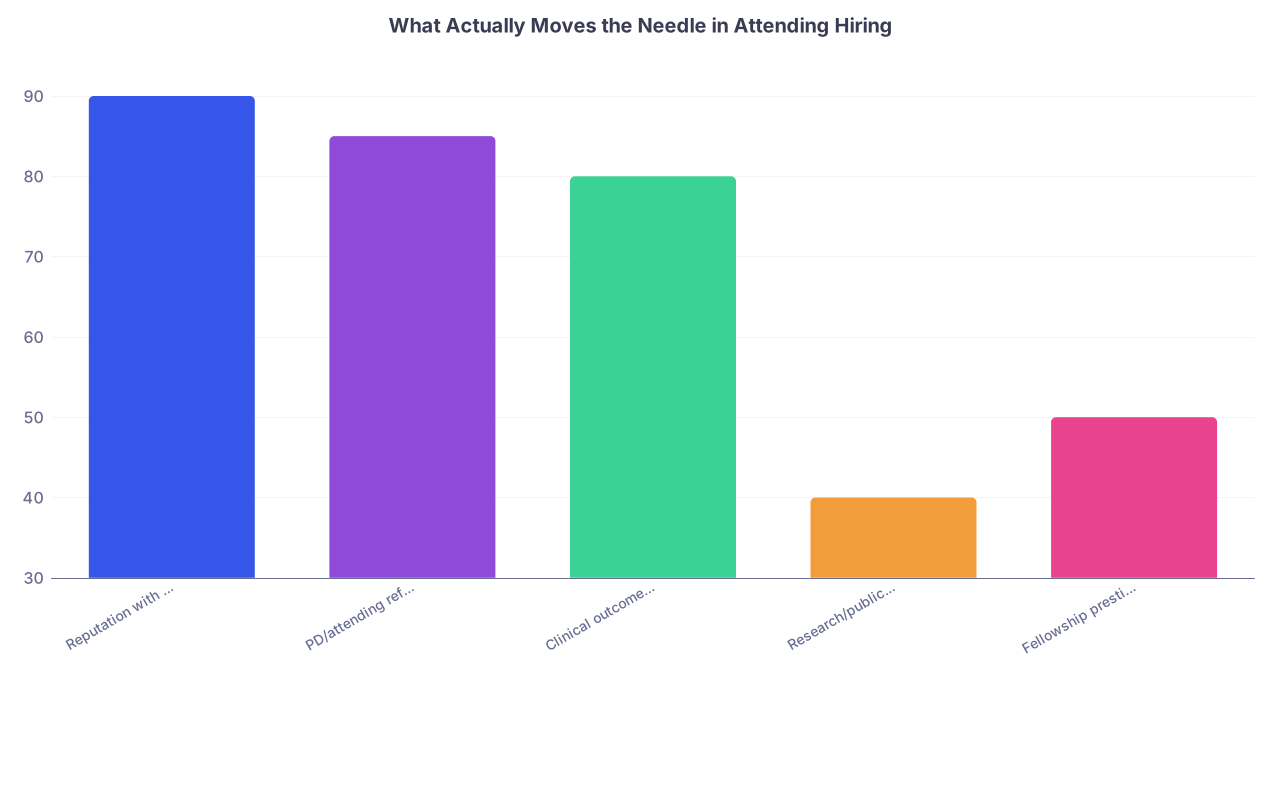
| Category | Value |
|---|---|
| Reputation with staff | 90 |
| PD/attending references | 85 |
| Clinical outcomes pattern | 80 |
| Research/publications | 40 |
| Fellowship prestige | 50 |
Years later, you’ll barely remember half the specific patients you admitted on those brutal nights. You will, however, live with the reputation you built in those years—and that reputation is exactly what CMOs are buying or rejecting when they decide if you get to sign that first attending contract.