Understanding Job Search Timing as an IMG in OB‑GYN
Job search timing is one of the most strategic—and most stressful—parts of the transition from residency or fellowship to practice, especially for an international medical graduate (IMG) in Obstetrics & Gynecology. Unlike some specialties, OB GYN has a steady physician job market, but as an IMG you must also navigate immigration timelines, visa restrictions, and often limited geographic flexibility.
This IMG residency guide will walk you through when to start your job search, how far in advance different steps should occur, and what’s realistic in the obstetrics match-to-attending timeline for international medical graduates.
We’ll frame this around a typical U.S. OB GYN residency pathway, but the principles apply broadly if you trained in Canada or matched via another route.
Big Picture: How Early Should an IMG in OB‑GYN Start the Job Search?
If you remember only one concept from this article, let it be this:
For most IMGs in OB GYN residency, the attending job search should start 18–24 months before graduation.
That may sound surprisingly early, but there are several reasons:
- Visa processing time (H‑1B or O‑1, or transition from J‑1 waiver): 4–10+ months, depending on the case.
- State medical licensure can take 3–6 months (or longer in some states).
- Hospital credentialing and payer enrollment adds another 2–6 months.
- Academic and large health-system positions often recruit 12–24 months ahead.
For a U.S. graduate, a 9–12 month lead can be enough. For an IMG in OB GYN, starting at 18–24 months is safer, especially if you have:
- A J‑1 visa and need a waiver job.
- Narrow geographic constraints (spouse’s job, children’s schools, family support).
- A specific practice type in mind (academic faculty, subspecialty group, or a particular city).
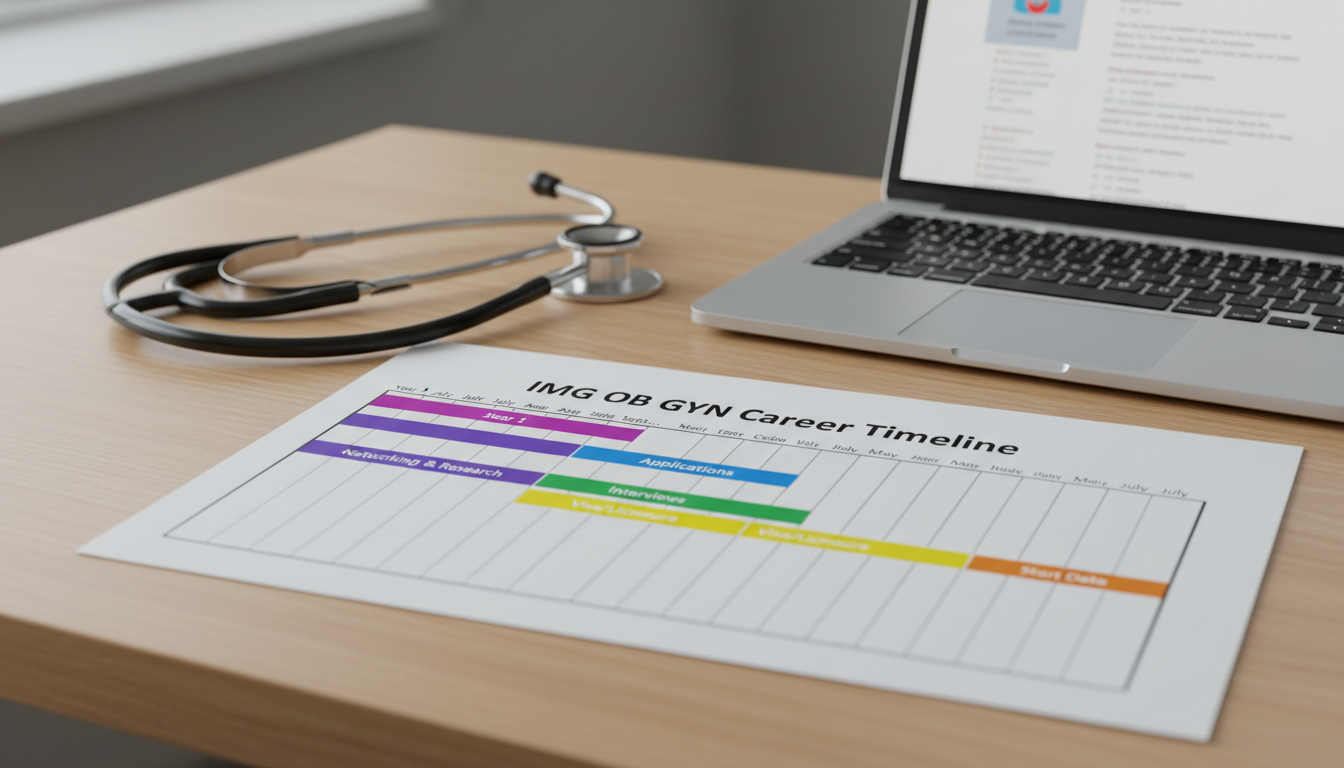
Example: Typical Timeline Snapshot
Assume graduation: June 2027 (end of PGY‑4 in OB GYN residency).
- July–December 2025 (PGY‑3, 18–24 months out):
Self-assessment, target setting, CV prep, gather letters, start networking quietly. - January–June 2026 (PGY‑3, 12–18 months out):
Begin active applications, reach out to recruiters, attend conferences with a job-search mindset. - July–December 2026 (PGY‑4, 6–12 months out):
Interview, negotiate offers, finalize contract, start licensing and visa paperwork. - January–June 2027 (0–6 months out):
Complete credentialing, move logistics, prepare for attending role.
This allows built-in buffers for delays, interview conflicts with call schedules, and immigration complexities.
Phase 1: Laying the Groundwork (18–24 Months Before Graduation)
Clarify Your Career Vision
Before you send any applications, you need clarity. As an international medical graduate, your choices may be influenced by visa realities, but you should still intentionally design your ideal next step.
Reflect on:
Practice setting
- Academic OB GYN department
- Large multi-specialty or health system–employed group
- Community hospital practice
- Private practice (traditional or hospital-affiliated)
- Federally Qualified Health Center (FQHC) or rural clinic
Scope of practice
- Full-scope OB + GYN vs predominantly GYN surgery vs outpatient gynecology
- High-risk obstetrics, minimally invasive GYN surgery, family planning, etc.
- Desire for subspecialty fellowship (MFM, Gyn Onc, REI, FPMRS, Complex Family Planning)
Lifestyle and call
- Willingness to take Q3 or Q4 call
- 24‑hour in-house vs home call structures
- Long-term burnout considerations
For IMGs, visa requirements can initially push you toward underserved or rural areas, J‑1 waiver-eligible practices, or H‑1B–friendly sponsors. Define your “must-haves” versus “nice-to-haves” so you know where you can compromise.
Assess Your CV and Clinical Profile
Recruiters and department chairs will evaluate:
- Case volume and complexity (deliveries, cesareans, laparoscopies, hysterectomies).
- Procedural skills: hysteroscopy, LAVH, TLH, operative vaginal deliveries, VBAC management.
- Academic profile: publications, posters, QI projects, teaching.
- Leadership: chief resident, committee work, advocacy involvement.
Use PGY‑3 as your “optimization” year:
- Fill gaps in important procedures (e.g., laparoscopic skills) by talking to program leadership and scheduling targeted rotations.
- Get involved in at least one scholarly or quality improvement project if you’re aiming for academic or hybrid roles.
- Ask for teaching opportunities (med student teaching, simulation labs) if you want a faculty position.
Prepare Your Application Materials
At 18–24 months out, you should:
Draft a polished CV
- Use a clean, U.S.-style academic or professional format.
- Highlight immigration status transparently but briefly (e.g., “Current immigration status: J‑1 clinical visa, seeking J‑1 waiver position for 2027 start”).
- Quantify: “Performed approximately 250+ deliveries, 100+ cesarean sections, 40+ laparoscopic procedures by mid-PGY‑3.”
Create a tailored cover letter template
- Have a core letter that you can modify for:
- Academic vs community vs rural
- Visa/waiver positions
- Geographic specifics
- Have a core letter that you can modify for:
Identify references early
- 3–4 strong referees:
- Program Director
- Department Chair or service chief
- Senior faculty who supervised you extensively in OB and GYN
- Let them know you’re an IMG and what type of roles and locations you’re targeting.
- 3–4 strong referees:
Begin Strategic Networking
Many OB GYN jobs are filled before they ever reach public job boards. For an IMG, relationships can offset visa-related hesitations.
Start:
- Within your institution
- Informally mention your long-term plans to trusted faculty.
- Ask them which groups or departments they’d recommend in your target region.
- Regionally
- Connect with OB GYNs in community hospitals where your patients are referred.
- Participate in hospital committees that involve community physicians.
- Nationally
- Attend national meetings (ACOG, subspecialty societies).
- Visit the career fair areas and speak honestly about your future visa needs.
You do not need to “announce” your job search at 24 months, but you should start planting seeds, making it clear that you are interested in future opportunities and value guidance.
Phase 2: Active Search and Applications (12–18 Months Before Graduation)
By the beginning–middle of PGY‑3, you should transition from planning to action.
When to Start Job Applications as an IMG in OB GYN
For most IMGs in OB GYN:
Academic positions:
Start applying 15–24 months before your desired start date. Departments plan far ahead, especially if they need to justify visa sponsorship.Large health systems and multi-specialty groups:
Start 12–18 months out. Many recruit on 9–12 month cycles for U.S. grads, but you want extra time for visa and licensing.Rural/underserved/J‑1 waiver positions:
Start as early as 18–24 months in high-demand or restrictive states. Some programs lock in their waiver hires quickly.Fellowship-bound residents (e.g., MFM, Gyn Onc):
Start the attending job search about 12–18 months before fellowship completion, not residency completion.
Where to Look for OB GYN Jobs as an IMG
Use a combination of channels:
Professional associations
- ACOG career center
- Subspecialty society job boards (e.g., SMFM, SGO if you do fellowship)
Hospital and health system websites
- Search by “Obstetrics & Gynecology Physician” and filter by visa-friendly states.
Recruiters
- Large, national physician recruitment firms
- Regional recruiters familiar with J‑1/H‑1B needs
- Be explicit: “I am an international medical graduate in an OB GYN residency, graduating in June 2027, currently on a J‑1. I’m looking for J‑1 waiver opportunities.”
Word of mouth
- Faculty may know groups that have historically hired IMGs.
- Ask OB GYN fellows and recent graduates about their search.
How to Address Your IMG and Visa Status
Hiding your visa status only wastes everyone’s time. You should:
- Mention it briefly in your email or cover letter:
- “I am an international medical graduate completing an ACGME-accredited OB GYN residency in 2027. I am currently on a J‑1 visa and seeking a J‑1 waiver position in an underserved or rural setting.”
- Have a one-sentence explanation ready for calls:
- “I’ll need H‑1B or J‑1 waiver support, and I’ve worked with our GME office to understand the basic steps and timelines.”
Hiring leaders are familiar with IMGs; what they fear is uncertainty. Show that you understand the process and have realistic expectations.
Initial Screening Calls and Fit Assessment
Once your CV hits the right desk, you’ll often have a 20–30 minute phone or video call.
Prepare to discuss:
- Your clinical strengths and any niche interests (e.g., high-risk OB, MIGS).
- Call expectations you’re open to: nights, weekends, in-house coverage.
- Geographic and family considerations.
- Visa status and when you can start.
Use this call to assess:
- Are they comfortable with immigration sponsorship?
- Do they have prior experience with IMGs or J‑1 waivers?
- What is their typical timeline from interview to contract to start date?
If they have never sponsored a visa before and sound unsure, that’s not an automatic deal-breaker—but you’ll need an experienced immigration attorney and extra time.

Phase 3: Interviews, Offers, and Contracts (6–12 Months Before Graduation)
By early PGY‑4 (or early final-year fellowship), your goal is to be interviewing actively and moving toward at least one strong offer.
Timing of OB GYN Job Interviews
Typical patterns:
- Academic departments may cluster interviews in specific months and align with budget cycles.
- Health systems and private groups may interview year-round but aim to finalize contracts 6–9 months before your start date.
- J‑1 waiver roles may need you to sign earlier due to state or federal deadlines.
Try to schedule interviews during:
- VACATION time
- Academic/didactics days when patient load is lower
- Light rotations, with advanced planning and coverage swaps
Talk honestly with your program leadership about your job search—they expect it and can help you navigate schedules.
Evaluating Job Offers as an IMG in OB GYN
Job search timing isn’t only about “when to start” but also about when to say yes and when to wait.
Key elements to evaluate:
- Clinical workload
- Expected deliveries per year
- Surgical volume and OR time
- Outpatient clinic session requirements
- Call
- Frequency, in-house vs home, any laborist model
- How they handle high-risk cases and backup support
- Compensation
- Base salary vs RVU or productivity components
- Sign-on bonus, relocation allowance
- Loan repayment (especially in HPSA or rural sites)
- Immigration support
- Clear commitment to J‑1 waiver sponsorship, H‑1B, or O‑1.
- Who pays legal fees? Who manages paperwork?
- History of successfully retaining IMGs after waivers.
For an IMG, an offer that looks slightly less attractive financially but is reliable on immigration and stable clinically is often safer than a glamorous but uncertain option.
Contract Negotiation and Deadlines
Contract negotiation often takes 4–8 weeks, sometimes longer if:
- The hospital’s legal team is slow.
- Visa language needs clarification.
- You’re comparing multiple offers.
In general, for a June graduation:
- Try to have a signed contract by September–December of PGY‑4 for a clean, on-time transition, especially with visas.
- This allows enough time to start licensing and immigration processes without panic.
If you’re still empty-handed at 6 months before graduation, that’s not catastrophic—but as an IMG, you’re entering a compresses timeline that may limit geographic or practice-type flexibility.
Phase 4: Licensing, Visa, and Onboarding (0–9 Months Before Start Date)
Once you sign a contract, your question shifts from “when to start job search” to “how much time do I need to complete everything before I start practicing?”
State Medical Licensure Timing
State license applications can be slow and variable:
- Average: 3–6 months
- Some states: 2–3 months (fast)
- Others: 6–9+ months (slow, especially if you trained or studied in multiple countries)
As an international medical graduate:
- Prior overseas education and exams can add verification steps.
- Start license applications as soon as your future employer and state are final.
Coordinate with:
- Your employer’s credentialing office
- Your residency GME office (they often have a licensure checklist)
- The state medical board website for specific IMG requirements
Visa and Immigration Timeline
This is the critical variable in an IMG job search for OB GYN.
Common pathways:
J‑1 waiver to H‑1B
- You must secure a J‑1 waiver position, job offer, and state support (depending on program such as Conrad 30).
- Timelines:
- State waiver recommendation: often fall–winter of your final year.
- Federal processing: several months.
- H‑1B petition: additional months.
- Starting your job search 18–24 months ahead is crucial to hit waiver application deadlines.
J‑1 waiver via federal programs (VA, HHS, etc.)
- Some have rolling timelines, others have fixed dates.
- Work closely with a lawyer and your employer’s legal team.
Direct H‑1B (if applicable)
- Common for some IMGs, especially Canadian citizens or those changing status from another visa.
- Timing varies but still needs several months cushion.
O‑1 visa (for individuals with extraordinary ability)
- More complex and document-heavy.
- Often used for academic hires with strong scholarly CVs.
Your attending job search as an IMG is partly about finding employers who already understand these pathways. Ideally, they’ve sponsored multiple IMGs and can share their timelines and success stories.
Hospital Credentialing and Payer Enrollment
Once your license and visa are underway:
Hospital credentialing and privileges
- 2–4 months typical
- Includes background checks, verification of training, procedure logs, references
Insurance enrollment (Medicare, Medicaid, commercial payers)
- 2–4+ months, sometimes concurrent with credentialing
- Many employers start this as soon as feasible after your license is approved
Your future employer’s onboarding team typically coordinates this, but as an IMG, you should ask:
- “When do you usually start credentialing for new OB GYN hires?”
- “What is your typical timeline from contract signing to cleared privileges?”
- “Have you had any delays with IMGs in the past?”
Special Situations and Timing Considerations for IMGs in OB GYN
If You Decide Late to Stay in the U.S.
Some IMGs initially plan to return home, then change their minds in PGY‑3 or PGY‑4. If you are late to the attending job search:
- You may need to:
- Broaden your geographic search (rural, smaller communities).
- Consider starting in a hospital-employed or FQHC role that urgently needs coverage.
- Be prepared to accelerate networking and applications and ask your training program for intensive support.
If You Are Pursuing Fellowship
For those entering MFM, Gyn Onc, REI, or other OB GYN fellowships:
- Your attending job market timing shifts to the final year of fellowship.
- Start exploring job options 18 months before fellowship graduation, especially if:
- You’re still on a J‑1 and need a post-fellowship waiver.
- You are aiming for academic posts at large university centers.
- Leverage your fellowship network: faculty who are known nationally can be your strongest advocates.
If You Intend to Change States or Regions
Licensure is state-specific. Moving between states after residency:
- Starting license applications early in your new state is critical.
- If you’re unsure of your exact location, prioritize:
- States with more straightforward IMG licensure.
- Employers that will help you choose between facilities in different states under the same system.
If the First Job is a “Stepping Stone”
It is common for IMGs in OB GYN to take an initial waiver or underserved position for 3–5 years, then move to a different geographic area afterward.
Plan with this reality in mind:
- Focus first on a legally and professionally solid first job.
- Use that time to:
- Build procedural volume.
- Strengthen your CV with QI, leadership, and teaching.
- Expand your professional network.
- Begin your second attending job search about 18 months before your waiver or initial contract period ends.
Practical Timeline Checklist for the IMG OB GYN Resident
24–18 Months Before Graduation (Mid PGY‑2 to Early PGY‑3)
- Clarify desired practice type and geography.
- Optimize clinical exposure (OR, high-risk OB, outpatient GYN).
- Update CV; draft a general cover letter.
- Identify 3–4 strong references.
- Start networking quietly, particularly with IMG-friendly mentors.
18–12 Months Before Graduation (PGY‑3)
- Begin active search: review job boards, talk to recruiters, contact potential employers.
- Be explicit about visa needs in initial contact.
- Attend ACOG and relevant conferences with a job-search mindset.
- Start exploratory phone/video calls with practice leaders.
12–6 Months Before Graduation (Late PGY‑3 to Early PGY‑4)
- Schedule and complete in-person or virtual interviews.
- Compare offers, emphasizing immigration support and clinical sustainability.
- Aim to sign a contract by 6–9 months before graduation, earlier if J‑1 waiver is involved.
- Work with employer and attorney to map visa steps and documents needed.
6–0 Months Before Graduation (PGY‑4)
- Submit state license applications as soon as possible.
- Launch visa petitions or waiver applications according to program deadlines.
- Begin hospital credentialing and payer enrollment.
- Arrange relocation, childcare, and other personal logistics.
- Transition mentally from resident to attending mindset; seek mentorship on first-year attending challenges.
FAQs: Job Search Timing for IMGs in OB GYN
1. When is the best time for an IMG in OB GYN to start job hunting?
For most international medical graduates in OB GYN residency, an ideal starting point is 18–24 months before graduation. This early lead time accounts for visa processing, state licensure, and the fact that some employers—especially academic centers and J‑1 waiver sites—plan their staffing well in advance. U.S. graduates sometimes manage with 9–12 months, but IMGs generally benefit from a longer runway.
2. I’m on a J‑1 visa. How does that affect my job search timing?
A J‑1 visa adds extra steps and deadlines due to the J‑1 waiver requirement. You’ll need to secure an employer willing to sponsor your waiver and possibly navigate state-level Conrad 30 quotas or federal programs. That process can take many months, so beginning your OB GYN job search two cycles ahead—around 18–24 months pre-graduation—is strongly recommended. The earlier you have a signed contract with a waiver-supporting employer, the easier it is to align with state and federal timelines.
3. What if I don’t have a job offer by the start of PGY‑4?
You still have time, but as an IMG, you’re entering a compressed window. Focus your efforts on:
- Broadening your geographic targets (including rural and underserved communities).
- Working with recruiters familiar with IMGs and J‑1/H‑1B issues.
- Asking your program director and faculty to actively connect you with practices they know.
It’s still realistic to secure a job 6–9 months before graduation, but visa options may become more restricted and you may need to be flexible on location and practice type.
4. When should I start my second (post-waiver) attending job search?
For many IMGs, the first job—especially a J‑1 waiver role—serves as a stepping stone. Begin planning your second attending job search about 18 months before your waiver commitment or initial contract ends. At that point, you’ll have stronger U.S. experience, expanded networks, and potentially more flexible immigration options, making it easier to move to your preferred region or practice model.
By approaching your OB GYN job search with this structured timeline—and by explicitly integrating your IMG and visa-related realities—you can move from resident to attending with far more control and far less last-minute stress. Thoughtful timing not only opens more doors; it also helps you choose a first job that is safe, sustainable, and aligned with your long-term goals in the physician job market.