
Understanding the Unique Job Search Landscape for Non‑US Citizen IMGs in Urology
For a non-US citizen IMG pursuing or completing urology residency in the United States, job search timing is a strategic decision, not just a calendar detail. You are navigating three complex systems at once:
- The highly competitive urology job market
- The immigration system (J-1, H-1B, O-1, or green card considerations)
- The realities of the urology match pipeline and post-residency transitions
Because of this, you cannot afford to start late. The physician job market is competitive in urology, and your visa status adds extra layers of planning that US citizens do not face.
This article will walk you through:
- How the urology hiring cycle works
- When to start job search efforts at each stage of training
- Tailored timelines for J-1 waiver seekers, H-1B holders, and other visa categories
- How to coordinate the urology match, fellowship decisions, and attending job search
- Practical strategies to make your timeline realistic and less stressful
The goal: help you finish residency or fellowship with a signed offer that fits both your career goals and your immigration needs, without last-minute panic.
How the Urology Job Market Works (and Why Timing Is Earlier Than You Think)
Understanding the physician job market in urology will shape your entire strategy and clarify when to start your job search.
Academic vs. Private Practice vs. Hybrid Systems
Each practice type tends to recruit on a slightly different timeline:
Academic centers
- Often plan recruitment 12–24 months ahead
- More likely to sponsor H-1B or eventually a green card
- Hiring committees, department approval, and budget cycles slow down decisions
- May have defined recruitment cycles tied to academic years (July–June)
Private practice / community hospitals
- Often recruit 6–18 months before anticipated start date
- Some are flexible; others move very slowly, especially small groups
- Less uniform willingness to sponsor visas (highly variable; must clarify early)
Large health systems / multispecialty groups
- Often recruit 12–24 months in advance for urology
- Dedicated HR, physician recruiters, and legal teams handle visa issues
- More structured onboarding and immigration support
Because urology is a small, procedural specialty with limited training spots, positions are limited and often filled early—particularly in desirable metropolitan or academic locations.
How Job Offers Typically Evolve by PGY Year
While exact timing varies by program and geography, a rough pattern for urology looks like this (for residents going directly into practice):
End of PGY-3 / Early PGY-4
- Talk with mentors about career goals (fellowship vs. general urology)
- Identify your immigration constraints and options
- Begin informal networking and attending national meetings with “future job” mindset
PGY-4 (main job exploration year)
- Attend conferences (AUA, subspecialty meetings) and visit interested institutions
- Start contacting employers and responding to postings
- Many first offers for post-residency jobs can appear as early as mid‑PGY‑4
PGY-5 (final year)
- If you are not doing fellowship, this is late, not early, to begin
- By the first half of PGY‑5, most ideal jobs—especially those that can handle visas—may already be filled
For fellows, the same logic applies—shift the timeline one step earlier and assume that prime jobs for your finishing year may be decided 12–18 months before graduation.

Job Search Timing by Training Stage: From Urology Match to Your First Attending Role
Your timing depends on where you are: in med school abroad, in residency, in fellowship, or already in practice. This section focuses on urology residency and beyond, but mentions the earlier stages to show why timing stacks up as it does.
During Medical School / Before Urology Match (Non-US Citizen IMG Perspective)
As a non-US citizen IMG interested in the urology match, your immediate focus is:
- Strong US clinical experience (if possible)
- Research and letters in urology
- Understanding visa possibilities for residency (J‑1 is most common, H‑1B less common due to specialty exams and institutional preferences)
While you are not actively job searching as a medical student, you should already be:
- Learning about J‑1 waiver requirements and geography
- Noting which regions have robust urology physician job markets and visa-friendly employers
- Informally tracking which academic centers regularly hire foreign national medical graduates
This early awareness will later shape where you apply for residency and fellowship, and eventually where you are realistically employable as an attending.
During Urology Residency: When to Start Job Search Conversations
PGY‑1 and PGY‑2: Foundation and Exploration
At this stage, do not actively apply for attending positions yet. Instead, focus on:
- Clinical excellence and operative skill acquisition
- Research output and early subspecialty interests (oncology, endourology, female pelvic medicine, pediatrics, etc.)
- Attending major urology meetings (AUA, sectional meetings) when possible
- Quietly observing:
- Which programs employ non-US citizen IMGs as attendings
- Where recent graduates go—especially other foreign national medical graduates
You are building your profile and network, not hunting for contracts yet.
PGY‑3: Clarify Your Post-Residency Path
By PGY‑3, you must start making concrete decisions that affect job search timing.
Key tasks:
Decide (or at least lean strongly) toward:
- General urology practice directly after residency, or
- Fellowship (oncology, MIS, endourology, pediatrics, andrology, etc.)
Meet with:
- Program director
- Interested mentors
- Possibly your institution’s GME office or legal/visa services
Discussion points:
- Your visa status (J‑1, H‑1B, other) and constraints
- Where you ideally want to practice (urban vs. rural, specific states or regions)
- How competitive you are for academics vs. private practice vs. fellowships
Timing implication:
If you are headed directly into practice, your serious job search should begin by early to mid‑PGY‑4, which means PGY‑3 is your planning year.
PGY‑4: Your Critical Job Search Launch Year
For many non-US citizen IMGs in urology, PGY‑4 is the most important year for job search timing.
What you should be doing by early PGY‑4:
Clarify your target job type and geography
- Academic vs. private practice vs. hybrid
- States likely to have J‑1 waiver urology positions (if on J‑1)
- Regions with documented history of hiring foreign national medical graduates
Update your CV and build a basic application package
- Urology-specific CV
- Personal statement-style paragraph about your goals (can adapt for emails)
- Preliminary list of references (mentors, program leadership)
Start networking deliberately
- At AUA and regional meetings, treat conversations as pre-job-search networking
- Ask mentors: “Where do you know of urology groups that have hired non-US citizen IMGs or are visa-friendly?”
By mid‑PGY‑4 to late PGY‑4:
- Begin responding to job postings
- Begin proactive outreach to:
- Academic chairs
- Hospital-employed urology groups
- Large private groups in areas that need urologists
You should introduce your interest and timeline:
“I am a PGY‑4 urology resident graduating in June 20XX, currently on a J‑1 visa, exploring opportunities for a position starting summer 20XX+1. I am especially interested in X (oncology, endourology, general urology) and would like to understand whether your group has potential openings and experience with visa sponsorship.”
This timeline—12–18 months before completion—is especially important for:
- Academic jobs
- Positions requiring visa sponsorship and/or J‑1 waiver arrangements
PGY‑5: Final Residency Year – Refinement, Not Start
By the start of PGY‑5, you should ideally:
- Have active leads
- Have done one or more interviews
- Be working toward one or more offers
If you only start your attending job search in mid or late PGY‑5, you may still find something, but:
- Your geographic flexibility likely must increase
- Visa-friendly employers may already have filled slots
- You may miss optimal J‑1 waiver timelines or H‑1B cap cycles
For a non-US citizen IMG, waiting this long significantly compresses your immigration and job planning, which can cause gaps in employment or forced choices to accept suboptimal positions.
Visa-Specific Timing Strategies: J‑1, H‑1B, and Others
Your visa category dictates how early and how aggressively you must approach the urology job market.
1. J‑1 Visa Holders: The Most Time-Sensitive Group
Most non-US citizen IMGs in urology residency are on J‑1 visas sponsored by ECFMG. This means that after training you must:
- Return home for two years, or
- Secure a J‑1 waiver job in a qualifying US location (or other waiver categories like VA, federal agencies, etc.)
When to Start Job Search on a J‑1 Visa
For a J‑1 urology resident planning to avoid the two-year home requirement, you should:
- Begin serious job search at least 18 months before completion of residency or fellowship
- In practice, that often means:
- Start in early PGY‑4 (for those going straight into practice)
- Start in the first half of fellowship (for those doing subspecialty training)
Why So Early?
- J‑1 waiver positions in urology are limited and often in rural or underserved areas
- Employers must go through:
- State Conrad 30 waiver processes
- Federal waiver processes (if applicable)
- Later transition to H‑1B or another status
Each step is time-consuming; missing deadlines can delay your start date by a year.
Practical Tips for J‑1 Urology Graduates
Target states known to use their Conrad 30 slots for surgical and specialty fields, not only primary care
Engage a healthcare immigration attorney early (often during PGY‑4) to understand:
- State-specific Conrad rules
- Timeline for your target year
- What your contract must include for waiver support
Clarify with each prospective employer:
- “Do you have experience sponsoring J‑1 waivers for specialists, particularly urologists?”
- “Do you have legal counsel already, or would you be open to working with my attorney?”
Because of these steps, a J‑1 foreign national medical graduate in urology should never wait until PGY‑5 to begin exploring job options.
2. H‑1B Visa Holders: Still Early, but Slightly Less Rigid
Some urology residents and fellows are on H‑1B visas, especially if they are:
- Graduates of US medical schools
- Sponsored directly by their training institution
Timing for H‑1B Urology Job Search
You can technically search later than J‑1s, but the urology market and H‑1B cap still favor early action:
- Start active job search 12–18 months before your intended start date
- Academic centers and large systems often want this much lead time for:
- Credentialing
- Institutional visa processing
- H‑1B cap or cap-exempt strategy
Key Questions to Ask as an H‑1B Holder
- Is the employer cap-exempt (e.g., academic institutions, some nonprofit hospitals)?
- Do they regularly sponsor H‑1Bs for specialists?
- Are they willing to port your H‑1B from training to practice?
- What is their green card policy and timing?
Even with more flexibility than J‑1, do not assume that you can comfortably delay. Urology positions are finite, and visa-friendly ones are fewer.
3. O‑1 and Other Categories
A small subset of urology physicians may qualify for O‑1 (extraordinary ability) or other stable statuses. If you are in this category:
- You may have more geographic and temporal flexibility
- However, the job market realities (limited positions, early academic hiring) still support starting 12–18 months before your transition
For all categories, meeting with an experienced immigration attorney early in PGY‑4 (or early in fellowship) can prevent:
- Gaps in employment
- Inability to start on time due to delayed waiver or petition approval
- Forced returns abroad while cases are pending
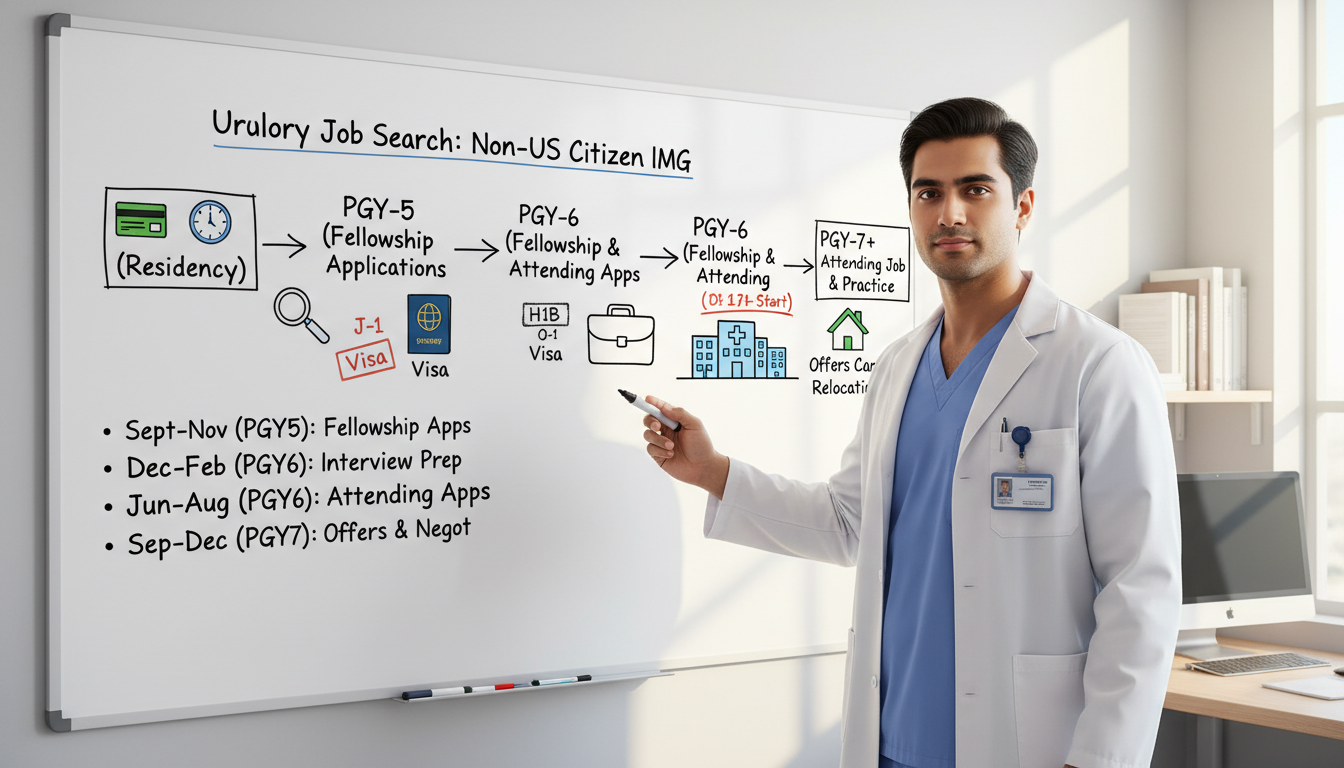
Coordinating Fellowship, Urology Match Outcomes, and Attending Job Search
Many urology residents, including non-US citizen IMGs, will pursue fellowship. This adds another layer to when to start job search.
If You Plan Fellowship: Staggered But Overlapping Timelines
During Residency (Planning Fellowship)
- Fellowship applications typically occur 2 years before fellowship start (depending on subspecialty and match rules)
- As you apply for fellowship, keep your ultimate job goals in mind:
- Are you aiming for a subspecialized academic career?
- Or do you plan to join community practice but want extra skills?
During Fellowship: When to Start the Attending Job Search
You cannot treat fellowship as a “fresh start” in timing. For a one-year urology fellowship, a realistic timing plan is:
First 3–4 months of fellowship
- Set your job target (academic vs. private, geography, visa path)
- Update CV with new fellowship details
- Discuss with fellowship director and mentors your need to start early because of visa status
By month 4–6 of fellowship
- Begin active job applications for positions starting after fellowship
- Attend national or subspecialty conferences with a clear job search agenda
- If J‑1: identify potential J‑1 waiver employers now, not later
By month 8–10 of fellowship
- Aim to have offers under serious discussion or in process
- Immigration steps should already be initiated for J‑1 waivers or H‑1B petitions
Because fellowship is short, you do not have the luxury of waiting until late fellowship year to start exploring the attending job market, especially as a foreign national medical graduate.
Example Timelines
Example 1: J‑1 Resident, No Fellowship
- PGY‑3: Decide to go directly into practice
- Early PGY‑4: Start targeted job search, focused on waiver-eligible states
- Mid PGY‑4: Interview, identify 2–3 serious prospects
- Late PGY‑4 to early PGY‑5: Sign contract with J‑1 waiver support
- PGY‑5: Complete waiver paperwork with employer and attorney; credentialing and state licensure in progress
- Post-graduation: Start J‑1 waiver job on time
Example 2: H‑1B Fellow in Endourology
- PGY‑4: Match into 1-year endourology fellowship
- PGY‑5: Finish residency, start fellowship on H‑1B
- Month 3 of fellowship: Begin job search for academic positions
- Months 4–7: Interview at multiple academic centers
- Month 8–10: Negotiate offer, finalize H‑1B transfer plan and start date
- After fellowship: Begin attending job with no gap
Practical Strategies to Make Your Job Search Timely and Effective
1. Use a Backward Timeline
Start with your anticipated graduation date and work backwards:
- 18–24 months before: Mentorship and planning
- 12–18 months before: Active job search, especially for J‑1 or academic roles
- 6–12 months before: Finalizing offers, contracts, immigration filings
- 3–6 months before: Licensing, credentialing, relocation plans
Put these milestones in your calendar early and review them with your program director.
2. Be Transparent (Strategically) About Visa Status
Employers cannot plan for what they do not know. Early in conversations (but after establishing interest), you should:
- Disclose that you are a non-US citizen IMG
- Specify your current visa type and estimated graduation date
- Briefly summarize what support you will need (e.g., “J‑1 waiver sponsorship then H‑1B”, or “H‑1B transfer and eventual green card”)
The earlier employers understand your needs, the less likely you are to waste time on impossible leads.
3. Treat Conferences as Structured Networking Events
When you go to AUA, SUO, or subspecialty meetings:
- Schedule short meetings with department chairs or group leaders in advance
- Prepare a concise introduction:
- Who you are (non-US citizen IMG, training background)
- Graduation timeline
- Subspecialty interests
- Visa status in one sentence
These brief interactions often lead to formal interviews months later.
4. Use Recruiters Wisely, Not Passively
Some large health systems and recruiting firms have specific experience placing non-US citizen IMG urologists. They can:
- Help identify visa-friendly markets
- Match your timing to open positions
However, do not rely solely on recruiters:
- Many high-quality academic and private positions are filled through direct networking, not posted ads
- Your mentors may know about positions long before they become public
5. Avoid Common Timing Mistakes
Common errors for non-US citizen IMGs in urology include:
- Waiting until PGY‑5 or late fellowship to start the attending job search
- Ignoring J‑1 waiver deadlines or assuming “there will be something” without early planning
- Underestimating the time required for:
- State licensure
- Hospital credentialing and privileging
- Visa or waiver petition processing
Building in several extra months as a buffer is almost always necessary.
FAQs: Job Search Timing for Non-US Citizen IMGs in Urology
1. When should I start my attending job search as a non-US citizen IMG urology resident?
If you plan to go directly into practice after residency, you should start serious job exploration 12–18 months before graduation (early to mid‑PGY‑4). If you are on a J‑1 visa, aim closer to 18 months because of waiver requirements. For fellows, this usually means starting within the first half of fellowship.
2. I’m on a J‑1 visa. Can I wait to find a J‑1 waiver job until my final year?
You should not wait that long, especially in a small specialty like urology. J‑1 waiver positions are limited and have rigid timelines. Begin targeting waiver-eligible jobs about 18 months before you finish residency or fellowship. Engage an immigration attorney early and seek employers with a proven track record of sponsoring J‑1 waivers for specialists.
3. I’m an H‑1B holder. Is my job search timeline more flexible?
You have more flexibility than J‑1 holders, but timing still matters. Start your job search 12–18 months before your planned start date. Academic centers and large employers will want that time for credentialing and H‑1B planning (cap-exempt vs. cap-subject). Starting earlier also gives you more choices and negotiation room.
4. How does fellowship affect my job search timing?
Fellowship does not reset the clock; it compresses it. For a one-year urology fellowship, begin your attending job search within the first 3–6 months of fellowship. If you wait until the end, you risk missing academic hiring cycles and facing visa-related delays. Always work backward from your fellowship end date and plan your applications 12–18 months prior to your desired attending start.
By understanding how the urology job market, the urology match pipeline, and the immigration system intersect, you can choose when to start your job search with intention rather than guesswork. As a non-US citizen IMG and foreign national medical graduate, early planning is your greatest leverage—protects your options, aligns your first attending role with your long-term career goals, and keeps your transition from trainee to urologist as smooth as possible.