
The way most new doctors think about “where to live” is quietly wrecking their careers.
You are not just choosing a city. You are choosing your future leverage, income ceiling, lifestyle options, and how trapped you will feel at 40.
Let me be blunt: blind geographic commitment is one of the most common, and most expensive, mistakes new attendings make. They box themselves into one city, one region, or one very narrow set of “acceptable” locations—and then spend the next decade trying to claw their way out of the corner they painted themselves into.
You can love a place. You just cannot let that love negotiate your contract for you.
The Core Problem: You Treat Location Like a Non‑Negotiable Identity
I have watched this play out countless times:
- “My partner’s job is in this city, so I have to stay here.”
- “My whole family is here; I am not leaving.”
- “We bought a house during residency; we are committed now.”
- “I only want to be in a major coastal city. Nothing else.”
You take a huge, complex life decision and reduce it to a single line: “I must stay here.”
That is not loyalty. It is self-inflicted leverage loss.
Once you declare—out loud or in your own head—“I have to stay in X city,” you tell every employer in that market three things:
- You are captive.
- You are unlikely to walk away.
- You probably will not seriously compare offers elsewhere.
They might not say it, but they hear it. And the offers they give you reflect it.
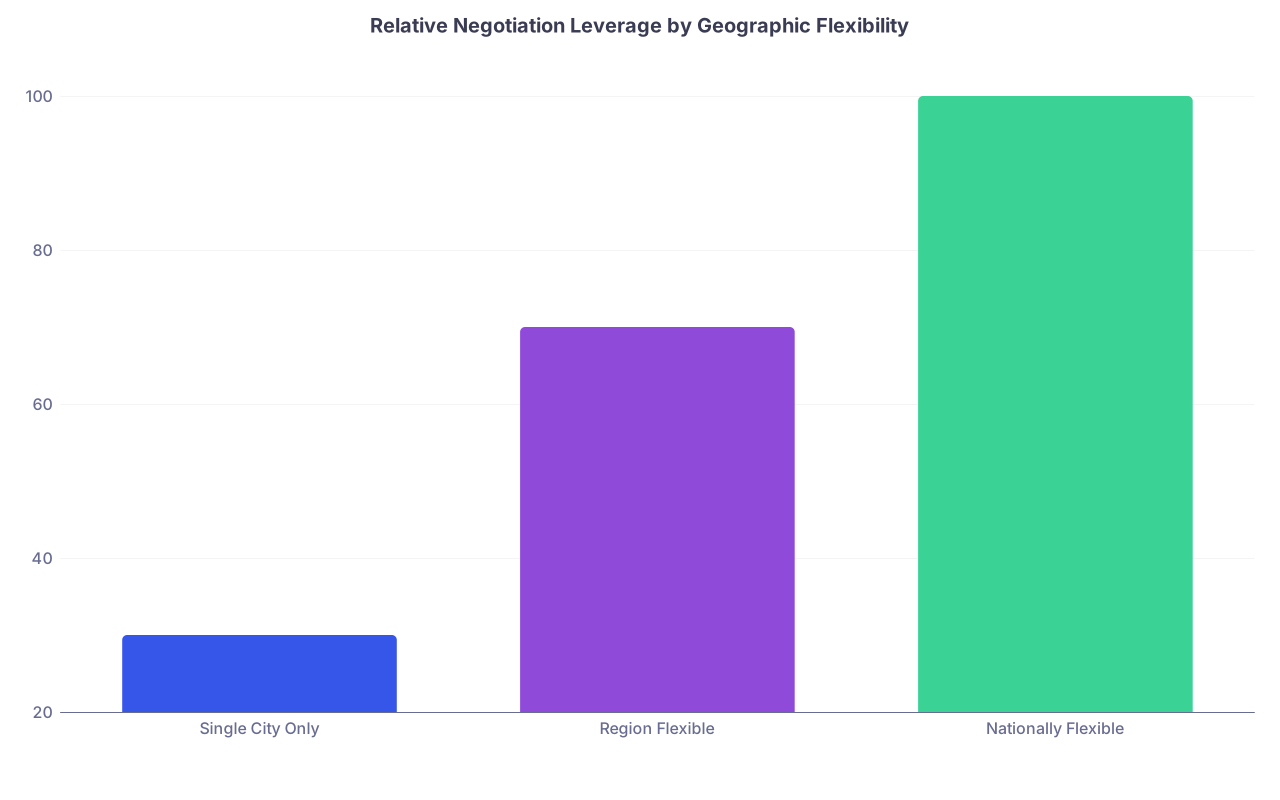
| Category | Value |
|---|---|
| Single City Only | 30 |
| Region Flexible | 70 |
| Nationally Flexible | 100 |
The narrower your geographic commitment, the weaker your negotiating position. Employers know who is stuck.
Mistake #1: Locking Into a City Before You Understand Its Market
The worst pattern I see: residents and fellows decide on a city first, then discover the job market details later. Backwards.
Here is what that looks like in practice:
You decide you “have to” stay in a hot metro—Boston, Seattle, Austin, San Diego—because:
- You trained there and built a social life.
- Your partner finally got a decent job.
- You like the restaurants and hiking and airport.
Then, you start job hunting and learn this charming set of facts:
- Every graduating fellow and their cousin also wants to be there.
- Private groups are saturated and not hiring partners for years.
- Academic jobs pay poorly and promote slowly.
- Call schedules are brutal and non-negotiable.
- Housing costs are absurd, and your attending salary does not stretch.
But by the time you figure this out, you have already committed in your mind. Maybe you even bought a house. Now every bad offer feels “better than moving.” That is exactly how you get underpaid and overworked.
The smarter sequence is the reverse:
- Understand your specialty’s national market.
- Identify where demand is high and supply is lower.
- Look at compensation, call, and lifestyle across multiple cities.
- Only then start narrowing locations based on personal preference.
Make geography one factor, not the starting dogma.
Mistake #2: Confusing “Roots” With “Chains”
A lot of new attendings weaponize their own family ties against themselves.
“I am close to my parents; I cannot leave.”
“Our kids are in school; moving would be too disruptive.”
“We already built a support system here.”
All understandable. Very human. But if you let those statements become absolute rules, you turn roots into chains.
Here is the part nobody likes to say out loud:
The cost of staying in a bad market, in a toxic group, or in a chronically underpaying system compounds over time. It does not just hurt you for a year or two. It shapes your entire financial and professional trajectory.
I have seen physicians stay in a “home” city for:
- $80–150k less per year than they could earn elsewhere.
- Double the call burden.
- Minimal support staff.
- No protected time and hostile administration.
They tell themselves, “We are saving money by not moving” while losing seven figures over a decade.
Sometimes the right move is staying put. But you should decide that after you run the numbers and compare alternatives—actual offers, not fantasies.
| City Type | Typical Base ($) | Call Burden | Partnership/Bonus Potential |
|---|---|---|---|
| Major Coastal Metro | 260k–320k | Heavy | Limited/slow |
| Mid-size Regional | 320k–400k | Moderate | Decent |
| Tertiary Hub City | 350k–450k | Moderate | Strong |
| Smaller City/Rural | 400k–550k+ | Variable | Very strong |
Is being 20 minutes from your parents worth $100k–200k per year and a worse call schedule? Sometimes yes. Sometimes absolutely not. But do not pretend there is no trade-off.
Mistake #3: Equating “Nice Place to Live” With “Good Place to Work”
One of the most dangerous illusions: assuming that because you enjoy living somewhere as a resident, you will enjoy working there as an attending.
Residency is not real life. Your salary is low, but expectations are also different. You are training, not building long-term equity, not negotiating buy-ins, not worrying about production RVUs, wRVU thresholds, or partnership tracks.
I have seen this mistake in places like Denver, Portland, Nashville, Austin—cities that exploded in popularity. Residents fall in love with the lifestyle and culture. They do not see the underside yet:
- Overcrowded job markets.
- Groups cutting compensation as supply surges.
- Worsening payer mix and delayed collections.
- Ownership sold to private equity, slashing autonomy.
You are not choosing a vacation spot. You are choosing a labor market. A fun city with a miserable job is a miserable life.
Flip the question you ask yourself:
Not “Do I like spending weekends here as a trainee?” but
“Can I see myself practicing here for 10+ years on these terms, with this compensation and call?”
If the answer is no, stop pretending the breweries and hiking trails will compensate for a broken job.

Mistake #4: Declaring “Hard Lines” You Have Not Really Thought Through
New graduates like to make absolute statements:
- “I will never live in the Midwest.”
- “No way I am moving to a small city.”
- “I refuse to work anywhere more than 30 minutes from a major airport.”
- “I hate the South; not happening.”
Most of the time, when I push on these, they crumble. The person has never actually:
- Spent extended time in those regions as an adult.
- Looked at actual jobs and compensation there.
- Visited with their partner to test real lifestyle.
- Compared cost of living adjusted income.
They are operating off stereotypes, old experiences from childhood, or what co-residents joked about.
Here is the mistake: turning your untested preferences into non-negotiable constraints. You kill options before they even exist.
I have watched physicians do a 180° when they actually interview and visit “off-limits” cities:
- The supposed “boring” Midwestern city has a short commute, great schools, affordable homes, and a collegial group that pays $150k more than offers on the coasts.
- The “never the South” position softens when they realize there is a progressive, diverse, mid-size city with a thriving medical hub and lower burnout.
Again, I am not telling you where to live. I am telling you not to let lazy, unexamined preferences box you into mediocre options.
Mistake #5: Buying Real Estate Too Early and Becoming a Geographic Hostage
Huge one. And painfully common.
New attendings (or even senior residents/fellows) buy a house in their training city because:
- “Rates are going up, we need to buy now.”
- “We want to start building equity.”
- “Rent is a waste of money.”
- “We will probably stay here anyway.”
Then the job market reality hits:
- Best job offers are in other cities.
- The local options are lower paying, worse call, or toxic culture.
- The “dream group” has a slow or nonexistent partnership track.
But now they have:
- A large, expensive home that has not appreciated enough to offset costs.
- Closing costs, realtor fees, moving costs if they leave.
- Emotional resistance: “We just settled in; we cannot move again.”
So they take a worse job to justify the house. The tail wags the dog.
This is one of the most financially destructive patterns I see. You prioritize imaginary housing “savings” over actual, massive, ongoing income differences.
You can rent a nice place for a few years while you explore. If you end up staying, then you buy. If you do not, you just saved yourself from paying a six-figure penalty for needing to move quickly.
Do not let a mortgage decide your job market.
Mistake #6: Ignoring Spouse/Partner Career Reality Until It Is Too Late
The dual-career trap is real and brutal. Here is how it goes wrong:
- You both assume your partner “can work anywhere.”
- They actually have a niche career that depends on a handful of cities, industries, or universities.
- You lock in geographic constraints for their job, without doing the math on what that costs your career.
- Or the opposite: you treat your attending income as the only one that matters and drag them to a city where they are underemployed and resentful.
Neither extreme works.
The real mistake: failing to map out both careers explicitly and honestly. Not just where they could theoretically work, but where they can realistically thrive. With actual salary bands, job availability, commute feasibility, and advancement paths.
Sometimes the optimal move is clear: e.g., your partner is in tech and must be in a few hubs, while your specialty is in high demand everywhere. So you accept less leverage and negotiate harder within those hubs, knowing your range is tighter.
Other times, your earning difference is so large that sacrificing $100k–200k of your income so your partner can earn an extra $20k makes no sense.
You cannot avoid trade-offs, but you can avoid blind ones. The mistake is not doing the analysis.
Mistake #7: Failing to Use Geography as a Strategic Tool
Geography can be a weapon or a weakness. Most new attendings let it become a weakness.
Here is what using geography strategically looks like:
- You apply broadly, including cities you are less emotionally attached to but that have strong demand.
- You generate multiple serious offers in different markets—some “A cities” for you, some “B cities” that are better financially.
- You use the stronger compensation structures from higher-demand markets as comparison data—even if you do not plan to move there.
- You walk into local negotiations clear: “I like this city, but I will not work here at a massive discount. Here is what my other offers look like.”
Programs and groups respect that. They might not match everything, but they know you are not boxed in, and they adjust.
What you do not do:
- Only apply locally.
- Tell every recruiter upfront that you “must stay here.”
- Never explore in-person interviews elsewhere.
- Accept the first half-decent offer because it is close to your favorite brunch spot.
You are a physician in a system that constantly looks for ways to reduce costs—yes, that includes your compensation. Assumptions about your mobility are part of their calculus. Use that knowledge.

| Step | Description |
|---|---|
| Step 1 | Identify Graduation Year |
| Step 2 | Research National Market |
| Step 3 | Apply Broadly |
| Step 4 | Map Local Market in Detail |
| Step 5 | Obtain Multiple Offers |
| Step 6 | Compare Compensation and Lifestyle |
| Step 7 | Negotiate Hard Locally |
| Step 8 | Reconsider Location Constraints |
| Step 9 | Any geographic flexibility? |
| Step 10 | Is chosen city worth trade off? |
How to Avoid Boxing Yourself In
Here is the protective mindset I want you to adopt:
“I may have preferences, but nothing is a hard line until I have data.”
Then build a simple, ruthless process.
Start with specialty demand, not city love.
For your field (e.g., hospitalist, EM, ortho, GI, psych), talk to senior attendings, recruiters, and look at neutral data (MGMA, state workforce reports). Where are jobs plentiful? Where are they scarce?Create three tiers of locations.
Tier 1: Places you are most excited about.
Tier 2: Places you are neutral on but open to.
Tier 3: Places you think you would not like but will at least investigate if compensation and lifestyle are strong.
Do not delete Tier 3 before you have seen real offers.Get actual numbers, not vibes.
For each serious location, push for specifics: base, bonus structure, call schedule, RVU thresholds, partnership track, benefits, PTO, CME, sign-on, relocation.Do cost of living adjusted comparisons.
A $320k job in a low-cost city can be “worth” more than a $380k job in a coastal HCOL area. Run the math on housing, taxes, childcare, loans.Ask yourself the 10-year question.
Not “Can I tolerate this for 2–3 years?” but “Would I be okay if we ended up staying here a decade?”Delay major geographic anchors.
Avoid buying a house, locking kids into very specific schooling setups, or making huge local financial commitments until you are sure this job and this region are not just training inertia.Be careful what you signal.
With recruiters and potential employers, avoid announcing: “I need to stay in [City].” Say: “These regions are my current preference, but I am open to the right opportunity elsewhere.” Then actually mean it.

Frequently Asked Questions
1. What if my partner’s job really does anchor us to one city?
Then treat that as a real constraint, but do not surrender all your leverage. You can still:
- Apply to all viable employers in that metro and nearby suburbs.
- Compare offers aggressively and use hard data when negotiating.
- Be willing to say no to bad jobs, even if it means a temporary locums or part-time situation.
- Consider medium-term planning: could your partner change roles, go remote, or shift industries in 3–5 years to open up new markets?
You may have less flexibility than a single, unattached colleague. That does not mean you should accept the first poor offer that fits your ZIP code.
2. Is it really that bad to prioritize being near family after training?
It can be great. Or it can be an expensive trap. The mistake is not prioritizing family; it is doing so without:
- Understanding the local job market.
- Comparing real offers in other cities.
- Acknowledging that you might be trading away hundreds of thousands of dollars and more humane working conditions.
If you compare and still choose to be near family, that is a rational decision. If you never compare and just default home, you are guessing and hoping it works out.
3. Should I do a “short stint” in a high-paying less-desirable area, then move back to my favorite city?
This is a common plan. It can work, but people underestimate the friction:
- You build a life and friendships in the “temporary” city.
- Your kids settle into schools.
- You get used to the bigger house and lower stress.
- Moving back to the expensive, competitive city later feels like a downgrade.
Also, your original city might be even more saturated in 3–5 years. If you adopt this plan, be honest that “temporary” might turn into “permanent” if the trade-offs are too steep.
4. How broad should I apply if I think I know where I want to be?
At minimum, add 3–5 cities or regions that you are not emotionally attached to but that:
- Have strong demand for your specialty.
- Offer higher compensation or better schedules.
- Are at least livable for you and your family.
You are not committing to move there. You are buying information and leverage. Worst case, you say no after learning more. Best case, you discover a better life you had not even considered.
5. What is one concrete step I can take this week to avoid geographic regret?
Make a simple two-column list:
Left column: your currently “preferred” city or region.
Right column: three alternative cities/regions you would consider if compensation, call, and lifestyle were clearly better.
Then, this week, email or call at least two recruiters or groups in each right-column region and ask for:
- Current hiring status in your specialty.
- Typical compensation ranges.
- Call burden and schedule.
You are not signing anything. You are testing assumptions.
Open a spreadsheet and start filling it with real numbers, not feelings. That single act breaks the mental box you are in.
Open your notes app right now and write this sentence at the top:
“Location is a factor, not a cage.”
Then list every city you think is “off the table” for you—and next to each, write why. If your reasons sound vague or emotional rather than specific and data-driven, you just found your first big career risk. Fix that before you sign anything.