The way you handle email and phone calls after residency can quietly destroy job leads you never even knew you had.
Not your CV. Not your fellowship pedigree. Your inbox and your voicemail.
I have watched highly qualified physicians get frozen out of great positions because they treated professional communication like texting a friend. And no one ever told them what they did wrong. The recruiter just “moved on to other candidates.”
Let’s make sure that is not you.
1. The “Black Hole” Inbox: Not Responding Like a Professional
The most common career-killing mistake? Acting like you still have a resident’s relationship with email: chaotic, reactive, and optional.
Here is what quietly kills you:
- Taking 4–7 days to answer basic emails
- Missing scheduling links
- Ignoring vague subject lines because “I’ll get to it later”
- Letting your personal inbox sit at 4,000 unread messages
Recruiters and medical directors read slow response as one thing: lack of interest or poor reliability.
You think: “I was on nights, I’ll respond this weekend.”
They think: “If they are like this about interviews, how will they be about patient messages and admin communication?”
Red flags you are making this mistake
- You sometimes find important emails by searching “interview” or “position” weeks later.
- You tell yourself, “If it is really important, they’ll call again.”
- You regularly see messages like “Just following up on my previous email” from recruiters.
How to fix it before it costs you offers
Create a clean, professional email address
Do not apply with anything that looks like undergrad.Bad:
Good:
Set a strict response standard
During your job search, you respond to all job-related emails within 24 hours. Even if only to say:“Thank you for reaching out. I am on service this week but very interested. I will review the details and respond with availability by [date].”
Separate job search from personal chaos
Use:- One dedicated email for job applications only
- Filters for keywords like “offer,” “contract,” “interview,” “credentialing,” “employment”
Stop letting subject lines fool you
I have seen offers and interview invites buried under subject lines like:- “Quick question”
- “Touching base”
- “Follow-up”
You do not get to ignore generic subject lines during a search. Open them.
2. Subject Lines and First Impressions: Sounding Sloppy or Desperate
Recruiters scan hundreds of emails a week. Your subject line and first two sentences decide whether you sound like a colleague… or a problem.
The mistakes that quietly flag you as “unpolished”
- No subject line at all (yes, people still do this)
- Vague, needy lines: “Help finding a job,” “Looking for work,” “Desperate for position”
- Overly casual: “Hey there,” “Quick thing,” “Got a sec?”
- Aggressive follow-ups: “3rd email – no response yet” in the subject
These are the emails that get opened last. If at all.
How to write subject lines that work
You are not drafting clickbait. You are communicating like a peer.
Better options:
- “Internal Medicine – Inquiry about Hospitalist Position”
- “Family Medicine – Following Up on Interview Availability”
- “Neurosurgery – Clarification on Contract Clause”
- “Emergency Medicine – Thank You for Interview on 3/12”
This tells them:
- Who you are
- What you want
- Whether this is a new inquiry, follow-up, or thank-you
The body: where many physicians quietly undermine themselves
Bad openers I have actually seen variants of:
- “Hey, checking in about the job thing you emailed me about.”
- “I’m free anytime, just lmk what works.”
- “So I haven’t heard back and I have other offers so…”
You are not texting your co-resident about swapping call.
Professional, concise openers:
“Dr. Smith,
Thank you for reaching out regarding the hospitalist opportunity at XYZ Medical Center.”“Ms. Johnson,
I appreciate your email. I remain very interested in the outpatient cardiology position we discussed.”
You only need three things in that first message:
- A direct acknowledgment of their previous communication
- A clear statement of interest (or lack thereof)
- A specific next step or question
3. Tone Problems: Sounding Entitled, Disorganized, or Fearful
You can absolutely kill an opportunity with the wrong tone even if your content is correct.
Three tone traps that sabotage physicians
- Entitled / Demanding
Phrases that read badly:
- “I need to know the salary before I waste time interviewing.”
- “I expect a signing bonus given my background.”
- “Please send me the contract to review before we talk.”
Do you need salary transparency? Yes.
Do you lead with ultimatums over email? Absolutely not.
- Disorganized / High-maintenance energy
Signals that you will be exhausting to work with:
- Constant rescheduling: “Something came up, can we move again?”
- Long, chaotic emails asking 14 questions in one block of text
- “Sorry just seeing this” repeatedly, even when they emailed days ago
- Fearful / Self-sabotaging
Lines that weaken you:
- “I know I am not as experienced as others…”
- “Sorry for bothering you again…”
- “Not sure if I am what you are looking for, but…”
Recruiters want to place confident, functional physicians. Not projects.
A simple structure that keeps your tone sharp
When in doubt, use this format:
- Thank / acknowledge
- Confirm interest or state your position
- Provide necessary info or ask 1–2 focused questions
- Close with a clear next step
Example:
“Thank you for sending the details of the outpatient cardiology position. I remain very interested, especially in the opportunity to develop a heart failure clinic. I have availability for a virtual interview on Monday 3–5 pm or Wednesday 9–11 am Central. Please let me know which works best, or share alternative times. I look forward to speaking with you.”
Clean. Decisive. Easy to work with.

4. Phone Etiquette Disasters: How One Call Can Close Doors
Physicians underestimate how much damage one sloppy phone interaction can do.
Here is what happens behind the scenes: after you hang up, the recruiter may write a one-line note in their ATS (tracking system):
- “Late, distracted, not prepared.”
- “Unclear on priorities. Talks in circles.”
- “Rude to staff on initial call.”
That note follows you.
The calls you must stop mishandling
- Unscheduled calls from unknown numbers
You see “Unknown” or an out-of-state area code while you are:
- On rounds
- Driving
- Running between cases
You pick up anyway. Big mistake.
You answer distracted, say, “Hello?” like it is a spam call, then proceed to half-listen:
- “Yeah yeah, I am interested, can you just email me?”
They do. And they quietly prioritize candidates who did not sound annoyed to hear from them.
If you’re not in a position to have a professional conversation, let it go to voicemail. Then call back promptly when you can focus.
- Rambling, unstructured calls
You finally get the 20-minute screening call. And you:
- Have not reviewed the job posting
- Cannot remember which group this is
- Have no prepared questions
- Start monologuing about fellowship politics, residency drama, or your personal life
What they want to hear is clarity:
- What you are looking for
- When you are available
- What locations you will or will not consider
- Whether you understand the role
- Being rude to anyone who is “not important”
If you are short with:
- The front desk person who transfers the call
- The coordinator who is “just doing scheduling”
- The recruiter assistant who asks basic questions
Assume it will be noted.
One practice manager told me bluntly: “If they cannot be polite to my staff on the phone, I don’t care what their CV looks like.”
Simple rules that prevent phone call self-destruction
- Do not answer when you cannot give full attention. Call back within the day.
- Start every call by confirming who you are speaking with and the position:
“Hi, this is Dr. [Name], thanks for calling. Is this regarding the outpatient rheumatology position in [City]?” - Have a 15-second summary ready: what you want, when you can start, basic location preferences.
- Never multitask on these calls. They can hear typing, driving, and hallway noise. It reads as “you are not important to me.”
5. Voicemail and Missed Calls: The Silent Reputation Killers
Physicians forget that their voicemail is part of their professional brand.
And some of the worst damage is done here.
The dysfunctional voicemail setup
Common red flags:
- “The mailbox is full” when they try to leave a message
- No voicemail greeting at all – just the generic system voice
- Casual greetings: “Hey, it’s Alex, you know what to do”
- Two different numbers listed on your CV, one of which you never check
- You return calls from an unknown number with no context: “Hi, someone called me from this number?”
To a recruiter, this looks like you cannot manage basic communication. They will not say that to you directly. They just stop trying.
Fix your voicemail today
You need:
- One primary number on your CV and applications
- A clean, short, professional greeting
- A mailbox that is never full
Script you can steal:
“You have reached Dr. [Full Name]. I am unable to answer the phone right now. Please leave your name, number, and a brief message, and I will return your call as soon as possible.”
Then live up to it. Return messages within 24 hours during your search.
How to return missed calls without sounding scattered
Do not call back with:
“Hi, I missed a call?” and then silence.
Try this:
“Hi, this is Dr. [Name]. I missed a call from this number earlier today. I am currently searching for [specialty] positions starting [month/year], so I wanted to see if this was regarding employment opportunities.”
You sound organized. They know who you are. They can quickly place you.
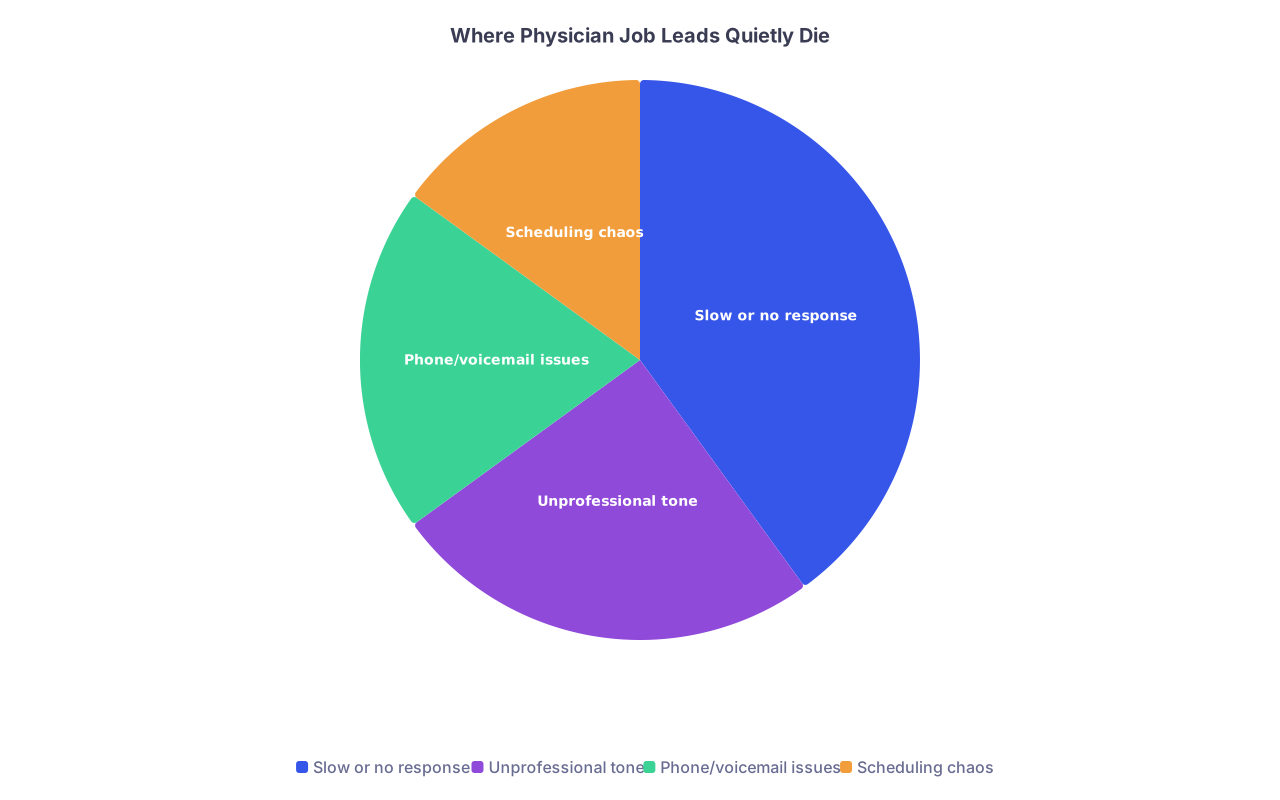
| Category | Value |
|---|---|
| Slow or no response | 40 |
| Unprofessional tone | 25 |
| Phone/voicemail issues | 20 |
| Scheduling chaos | 15 |
6. Scheduling Chaos: The “High-Maintenance” Candidate Problem
You can be perfectly polite and still kill your candidacy by being logistically painful.
Patterns that scream “this will be a nightmare to work with”:
- Offering zero specific windows: “My schedule is crazy, just tell me what works.”
- Cancelling interviews 2–3 times at the last minute
- Not reading time zones in calendar invites
- Showing up late to phone or Zoom calls by even 5–10 minutes without acknowledgment
Recruiters and chiefs of staff keep mental lists of “candidates who are too much work.” You do not want to be on that list.
How to stop looking disorganized
- Give structured availability
Instead of:
“I’m pretty open, just let me know.”
Try:
“I am available for a 30-minute call:
- Tuesday between 1–4 pm Central
- Thursday between 9–11 am or after 4 pm Central
Please let me know what works best, or share a scheduling link.”
- Use one calendar
Not scraps of paper, half-remembered notes, and a vague sense that “next week should be fine.” The job search phase is not the time to wing it.
- Treat every call like a consult
On time, prepared, with relevant information in front of you. That is the standard.
7. Content Mistakes: Saying Too Much, Too Little, or the Wrong Thing
Even if your tone and timing are fine, what you actually say can wreck you.
Oversharing personal issues
Some residents and fellows over-correct on “being honest” and dump their entire life context:
- “I am going through a divorce and need to be near my kids, so I am desperate for something in this area.”
- “I am burned out from my last job; that place was toxic.”
- “I have some health issues, so I really need lighter call.”
You just turned a neutral employer into a cautious one.
You owe them clarity on your professional constraints (cannot take in-house call, need part-time, must be in X city). You do not owe them your entire personal history in the first emails and calls.
Trashing your current or prior program
You think you are venting. They think:
- “Will they talk about us this way next year?”
- “Do they bring drama?”
- “Were they part of the problem?”
Do not say:
- “My program director was a nightmare.”
- “The administrators are clueless.”
- “The other attendings just dumped everything on me.”
You can be honest without being toxic:
- “I am looking for a more supportive clinical environment with a reasonable patient volume and real mentorship.”
- “I would like a setting where quality is prioritized over sheer volume.”
Being vague about what you want
You might think flexibility looks attractive. It does not. It looks indecisive.
Vague:
“I’m open to anything really – hospital, clinic, whatever.”
Better:
“I am primarily interested in a hospitalist role with a 7-on/7-off schedule, but I would consider a hybrid inpatient-outpatient position if there is adequate support and reasonable patient volume.”
Specific but not rigid.

8. Follow-Up Mistakes: Either Ghosting or Harassing
You can absolutely lose a job lead both by saying nothing and by saying too much.
Ghosting after initial interest
Common disaster:
- You have a decent phone screen.
- They email to suggest next steps.
- You take too long to decide whether you are truly interested.
- You do not respond for 2–3 weeks.
By the time you circle back with, “Is the position still available?” they have moved on and mentally labeled you as unreliable.
If you are unsure, say so like a grown professional:
“Thank you for the interview and for sharing more about the position. I am very interested, but I am also in late-stage discussions with another institution. I expect to have more clarity within 2 weeks. If that timeline does not work on your end, I understand.”
Honest, respectful, and gives them a choice.
Harassing follow-ups
On the other extreme, some physicians send:
- “Just following up” emails every 48 hours
- Passive-aggressive lines: “I assume you are not interested since I have not heard back.”
- CC’ing multiple people to pressure a response
No one owes you same-day updates after every internal meeting. And you cannot bully your way into a good working relationship.
Reasonable follow-up cadence:
- After an initial email: 5–7 business days
- After an interview: 7–10 business days
- After they give you a specific decision date: follow up 2–3 days after that date if you have not heard
Your follow-up should be short:
“I wanted to briefly follow up on our discussion about the [specialty] position. I remain very interested and would appreciate any updates on next steps when available.”
No guilt. No drama. Just clear interest.
9. The Silent Filter: How Recruiters Really Use Your Communication
Here is the part no one tells you during residency:
Once your training and credentials clear the baseline, your email and phone etiquette become the tiebreaker.
I have sat in on conversations that go like this:
“We have three candidates with similar training.
Candidate A replies within hours, is concise, and easy to schedule.
Candidate B takes a week to answer and is vague.
Candidate C has rescheduled twice already.
Let us move forward with A and keep B as backup. Drop C.”
No one tells Candidate C what happened. They just stop getting calls.
Your goal is not to be perfect. It is to avoid sending any signal that you will be:
- Hard to reach
- Hard to schedule
- Emotionally volatile
- Administrative dead weight
Your Next Step Today
Do not leave this as “good advice I’ll remember someday.”
Do this now:
Open your CV and applications, and check:
- What email and phone number are listed?
- Are they the ones you actually monitor daily?
Then pick up your phone:
- Call your own number.
- Listen to your voicemail greeting.
- If it does not sound like a physician you would hire, re-record it.
Finally, open your email:
- Create one clean, professional signature with your name, specialty, and contact info.
- Turn on notifications for that account during your job search.
Your training opened doors. How you handle email and phone communication decides whether those doors stay open long enough for you to walk through.