
The fastest way to hate your first attending job is to sign a contract built on a productivity model you barely understand.
Let me be blunt: new attendings get burned on compensation far more from misunderstanding RVU/productivity structures than from low base salary. You’re used to fixed resident pay. Suddenly you’re in RVU land, collections percentages, “blended models,” thresholds, and “potential” bonuses. And the people explaining it to you? Their job is to get you to sign, not to make sure you actually understand.
You’re stepping into a game that’s been running for years. The rules are written in legalese and “industry standard” half-truths. If you skim this part, you’ll pay for it in lost income, lost time, and a lot of resentment.
Let’s stop that now.
1. The First Big Mistake: Confusing “Base Salary” With “Total Comp”
New attendings fixate on the base salary number. It’s comforting. It feels familiar. That’s exactly why groups and hospitals lean on it in recruiting pitches.
The trap: the real engine of your pay is usually the productivity model layered under or on top of that base. And that’s where the landmines are.
Classic bait I’ve seen over and over
- “Starting salary $260k, potential to make $400k+ with productivity.”
- “We have partners making $450–500k easily.”
- “Most of our docs hit bonus by month 6–9.”
Sounds great. Until you find out:
- The RVU targets are based on a 20-year workhorse with a full referral network.
- They’re counting procedures and codes you’re not credentialed for yet.
- The “partners” they’re quoting are using advanced practice providers and have block time you don’t.
- Call is crushing, but doesn’t generate much billable work.
If you remember nothing else from this section, remember this: “Potential” money is fake until you can realistically map out how you’ll generate it, with math that makes sense for a new attending, not the superstar outlier.
2. RVUs: The Black Box That Will Eat Your Paycheck If You Ignore It
RVU-based compensation isn’t evil. But misunderstanding it is.
What you think RVUs are
“More work → more RVUs → more money. Got it.”
Not quite. The issues are:
Which RVUs?
You get credit for work RVUs (wRVUs). The hospital gets technical and facility fees too. They might keep all of that and pay you off just the wRVUs at a fixed rate.At what rate?
“We pay $50 per RVU” is meaningless until you know:- What’s the national benchmark?
- What’s the expected annual wRVU volume?
- Is that realistic based on your schedule and scope?
When does it start to matter?
Are you:- Straight RVU from day one?
- Base + RVU bonus once you pass a threshold?
- Draw against RVUs that later gets reconciled (yes, this can get ugly)?
| Model Type | Base Salary | RVU Rate | Threshold (annual) |
|---|---|---|---|
| Pure RVU | $0 | $60 | 0 |
| Base + Bonus | $250,000 | $50 | 6,000 |
| Draw Against RVUs | $280,000 | $55 | 5,500 |
| High Base, Low RVU | $320,000 | $35 | 7,000 |
The dangerous blind spots
Here’s where new attendings get quietly fleeced:
RVU inflation without rate adjustment
Codes change. RVU weights change. If your contract doesn’t say your compensation per RVU will be recalibrated when CMS changes values, you can be doing more work for the same or less pay.Unclear crediting rules
Things to clarify in writing:- Who gets the RVU if a resident or NP/PA is involved?
- Do you get RVU credit for supervision, procedures done by APPs, or only personally performed work?
- What about shared visits and split billing?
Thresholds based on fantasy numbers
If median wRVUs for your specialty are 7,000/year and your threshold is 10,000 before bonus kicks in, that’s not a productivity plan. That’s a pay cut disguised as “incentive.”
3. Collections Models: “Eat What You Kill” Without Knowing What You’re Hunting
Collections-based comp is another minefield. It sounds fair. You keep a percentage of what you “bring in.” But you don’t control half the variables.
Here’s the uncomfortable truth: if you don’t know the payer mix, denial rates, billing efficiency, and lag time in a practice, you have no business signing a collections-based contract. It’s like agreeing to be paid a percentage of a number no one can show you.
Major traps in collections models
No historical data provided
If they won’t (or “can’t”) show:- Last 2–3 years of average collections per physician
- Payer mix (Medicare/Medicaid/commercial/self-pay)
- Average days in A/R
That’s a red flag. Do not sign until you see data.
Low percentage that looks okay—but isn’t
“You’ll get 30% of collections” sounds good until:- Overhead is bloated.
- Billing is sloppy.
- Denials are high.
You’re absorbing all the risk of a badly run revenue cycle.
Long delay before you see real money
New attending + new patient panel = slow ramp. Many contracts:- Have guarantees only for 6–12 months
- Let that guarantee “convert” to a draw you later have to “pay back” if collections are low
You can finish year 2 owing them money, or taking a massive pay drop.
4. Hybrid / “Blended” Models: Where Confusion Is a Feature, Not a Bug
The most dangerous contracts I see are the “hybrid” ones that throw together base + RVU + quality + call + “citizenship” bonuses. Not because hybrids are inherently bad, but because they’re often intentionally convoluted.
If you can’t explain your comp plan to a co-resident in 2–3 sentences with actual numbers, you don’t understand it yet.
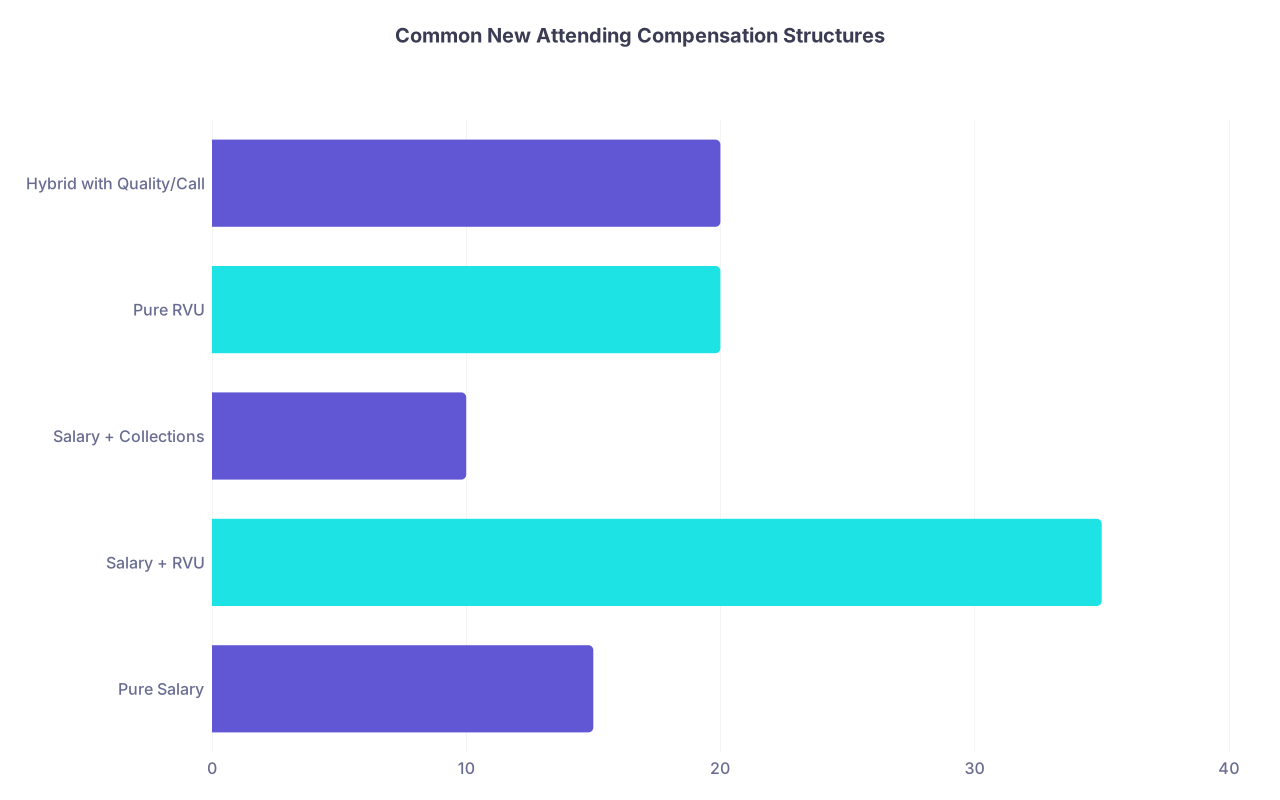
| Category | Value |
|---|---|
| Pure Salary | 15 |
| Salary + RVU | 35 |
| Salary + Collections | 10 |
| Pure RVU | 20 |
| Hybrid with Quality/Call | 20 |
Things that get buried in blended models
Unclear weighting
“Up to 20% of your compensation is quality-based.”
Ok, but:- Who sets the metrics?
- Are they achievable as a new doc with zero established panel?
- Can they change the metrics yearly without your agreement?
Group vs individual metrics
If 50–100% of your bonus depends on group performance, understand:- Are you joining a strong, stable group?
- Or one with chronic underperformers you’ll now be subsidizing?
Citizenship requirements
“Failure to attend meetings, complete notes on time, or participate in committees may impact bonus.”
Vague language like “may impact” gives them a giant lever to cut your pay for almost anything.
5. Fake “Guarantees” and Quiet Clawbacks
One of the nastier tricks: the “guaranteed salary” that isn’t really guaranteed.
Here’s the pattern:
- Year 1: “We’ll guarantee you $280k while you ramp up.”
- Year 2: “Your pay converts to pure RVU/collections, and we’ll reconcile what we paid you against what you generated in year 1.”
- Translation: If your collections don’t cover what they advanced you, future earnings get docked until they’re “whole.”
You thought you were getting security. What you actually signed was a loan with no clear terms.
Red flags in guarantee clauses
Look for these phrases:
- “Advance against future productivity”
- “Subject to reconciliation”
- “Draw”
- “True-up”
None of those are inherently bad, but you must understand:
- How is the reconciliation calculated?
- Is there a written example in the contract or an addendum? If not, ask for one.
- What happens if you leave before they “recoup” their advance?
- Do you owe them money?
- Do they forfeit it?
- Is there a cap on how much they can claw back?
If they can’t explain it with a simple numerical example on one sheet of paper, they either don’t understand it or don’t want you to.
6. Volume Expectations and Time: The Part That Breaks You
The other half of productivity models isn’t in the comp section. It’s in your schedule.
New attendings regularly underestimate what it takes to hit RVU/collections targets without destroying their life.
You need to line up:
Clinic template
- How many patients per half day?
- New vs follow-up slots?
- Procedure time?
OR / procedural time
- Guaranteed block?
- Competing with senior partners for cases?
Support staff
- Scribes? NPs/PAs?
- Dedicated MA or shared?
- Call room and post-call expectations?

| Step | Description |
|---|---|
| Step 1 | Sign Contract |
| Step 2 | Underestimate RVU Target |
| Step 3 | Overbook Schedule |
| Step 4 | Longer Hours |
| Step 5 | Burnout and Errors |
| Step 6 | Lower Productivity and Quality |
| Step 7 | Miss Bonus and Feel Trapped |
If your RVU target assumes:
- 24–28 patients per clinic day
- VA-level documentation demands
- No scribe
- EHR you’ve never used
You’re going to pay for that “great earning potential” with your sanity.
Ask them flat out:
- “How many patients per day does a typical doc see here?”
- “What did the last new hire average in years 1–2?”
- “What RVUs did they hit, and what did that pay?”
If they dodge, you have your answer.
7. Benchmarks: The Numbers You Should Know Cold
You don’t need to be a health economist. But you do need to know what’s normal.
For your specialty, look up (via MGMA, AMGA, or specialty society data – ask mentors if you don’t have access):
- Median and 75th percentile wRVUs
- Median and 75th percentile compensation
- Typical wRVU rate range
Then compare:
- If they’re offering you:
- RVU target = 90th percentile
- Compensation = median
- Support = substandard
That’s not a “great opportunity.” That’s exploitation.
On the flip side, if:
- RVU target ~50th percentile
- Pay ~50–60th percentile
- Good support
That’s actually reasonable for a first job, especially if you’re learning and building.
8. Questions You Must Ask Before Signing
Here’s where you avoid the big mistakes. Do not be shy. You are about to commit years of your life.
On RVUs / Productivity:
- What is my expected annual wRVU/collections target?
- How many patients per day and procedures per week does that typically require here?
- What did the last 2–3 new hires generate in years 1 and 2?
- How is RVU/collections credit assigned when APPs or trainees are involved?
- Is RVU rate fixed for the entire contract? What happens if CMS changes RVU values?
On Guarantees / Draws:
- Is my base/guarantee a true guarantee or an advance against future productivity?
- Are there any reconciliations or clawbacks if I leave early or underperform?
- Please show me a written numerical example of how my pay would be calculated at:
- 80% of target
- 100% of target
- 120% of target
On Transparency:
- How often will I receive a detailed productivity report?
- Can I see a de-identified sample of what that report looks like?
- Will I have access to my RVU/collections data in real time or only quarterly?
If the answers are vague, slow, or defensive, don’t rationalize it. That’s the same behavior you’ll face after you sign.
9. How to Protect Yourself (Without Burning Bridges)
You don’t need to be hostile. You do need to be firm.
Here’s what smart new attendings do that others don’t:
Get the contract reviewed by someone who understands physician comp
- A healthcare attorney who does physician contracts regularly
- Or a trusted senior doc who’s seen multiple comp models
Generic contract review is not enough. You need someone who understands RVUs, payor mix, and hospital games.
Ask for written clarifications, not just verbal promises
“Oh, don’t worry, no one ever actually hits that clawback.”
Fine. Put that in writing:- “Employer agrees not to pursue negative reconciliation at termination”
Or cap it explicitly.
- “Employer agrees not to pursue negative reconciliation at termination”
Push for concrete numbers and examples
Ask them to show you:- Example monthly statement with:
- RVUs generated
- Rate per RVU
- Total comp
- Historical productivity for comparable docs
- Example monthly statement with:
Be willing to walk
If the model is:- Opaque
- One-sided
- Dependent on “trust us, it’s fine”
You’re being set up. There are always other jobs.
10. The Psychological Trap: “I Don’t Want To Look Difficult”
This is the silent killer. You’ve spent your entire training in a hierarchy where pushing back feels dangerous. You don’t want to “rock the boat” or seem “ungrateful.”
Hospitals and groups know this. They bank on it.
Here’s the mindset shift you need:
- You are not a resident. You are revenue.
- There is no bonus for being the least informed person who signs the fastest.
- Any group that punishes you for asking rational questions about how you’ll be paid is a group that will absolutely shortchange and overwork you later.
You’re not being “difficult” by asking for clarity on a productivity model. You’re being a professional. If they bristle at basic transparency now, that’s your preview of coming attractions.
FAQ (Exactly 3 Questions)
1. Should I completely avoid RVU or productivity-based contracts as a new attending?
No. RVU and productivity models can be very fair, even lucrative, if the expectations, support, and math make sense. The mistake isn’t choosing RVU; it’s signing an RVU contract where:
- Targets are unrealistically high for a new doc,
- The RVU rate is low compared to benchmarks, and
- You don’t clearly understand how your work converts into pay.
If you can’t sit down with a calculator and forecast your income at different volumes, you aren’t ready to sign it.
2. Is it normal for the first year to be a guarantee and later years to be productivity-based?
Yes, that’s common. The danger is in the fine print. A true guarantee means you keep that money regardless of productivity. A “guarantee” that’s actually a draw or advance against future work can result in:
- Massive pay cuts in year 2–3, or
- Owing money back if you leave “early” or underperform.
You want that structure, and any potential reconciliation or clawback, spelled out explicitly with clear numerical examples.
3. What if I really like the group but hate the comp model?
Then negotiate or walk. You can:
- Push for a longer true guarantee period.
- Ask for a lower RVU/collections threshold in the first 1–2 years.
- Request data and written clarifications that close the loopholes.
If they refuse to adjust anything and won’t make the model transparent, they’re telling you that your confusion is part of their margin. That’s not a culture you want to build your first attending job on.
Key points to walk away with:
- Never sign a productivity-based contract until you can explain exactly how your daily work turns into dollars using real numbers.
- Guarantees, RVU rates, and “bonuses” are meaningless without clear thresholds, historical data, and written examples.
- If a group won’t be transparent about productivity expectations and pay, they’re betting your inexperience will make them money. Don’t let them be right.