You just finished a long clinic day as a senior resident. Your phone buzzes: an email from the department chair of a hospital where you rotated last year.
“We loved having you here. If you want to join us after residency, we’ll make a spot for you.”
Later, on a quick Zoom call, the chair says the magic words: “Don’t worry, we will take care of you. You have a job here if you want it.” No contract yet. No numbers. But it sounds… solid. You relax a little. You tell your partner, maybe your parents: “I basically have a job lined up.”
That is where people get burned.
This is exactly the moment where physicians make one of the most expensive mistakes of their careers: treating verbal job promises after residency as if they are real offers.
Let me be blunt:
If it is not in writing, with details, signed by both sides, it is not a job. It is a nice conversation.
Let’s walk through where people get hurt, what those “soft offers” really mean, and how to protect yourself before you end up jobless in April with a lease ending in June.
The False Security of “We’ll Take You”
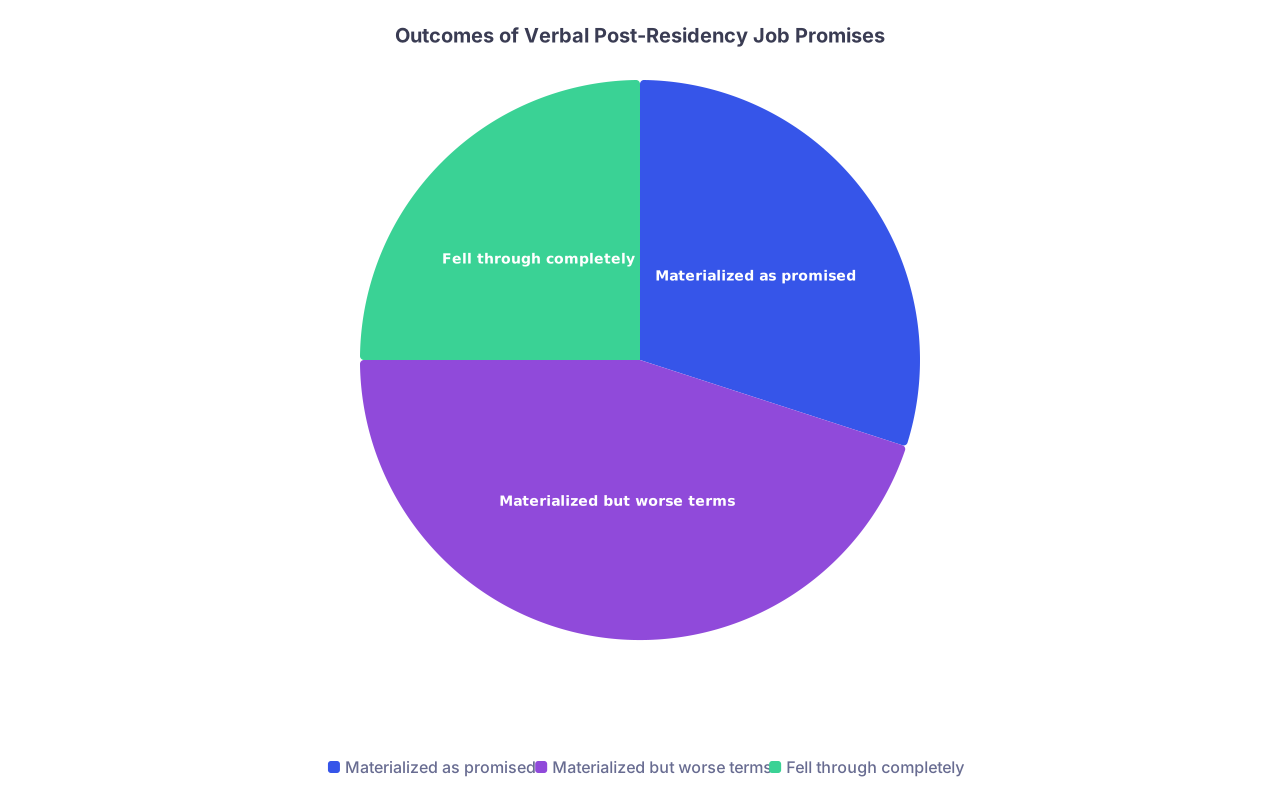
| Category | Value |
|---|---|
| Materialized as promised | 30 |
| Materialized but worse terms | 45 |
| Fell through completely | 25 |
I have lost count of how many versions of this I have heard:
- “The community hospital said I was their top choice and they’d send a contract soon.”
- “My fellowship director promised to hire me as junior faculty.”
- “The private group said, ‘We’ll bring you on after graduation, just let us know when you are ready.’”
Here is the problem: residents treat those phrases as commitments. Employers do not.
A department chair saying “We definitely want you” is not making a legal or even practical guarantee. They are:
- Expressing interest.
- Keeping you “warm” as an option.
- Testing your enthusiasm before they do any actual paperwork.
Meanwhile, you might:
- Stop aggressively looking at other positions.
- Turn down interviews because “I probably won’t need them.”
- Delay networking because “I am basically set.”
That quiet assumption you are making—“I have a job”—is the trap. You have nothing until there is:
- A written offer
- With specific terms
- A start date
- And signatures
Anything less is air.
Why Verbal Promises Fall Apart So Easily

You might think, “But they would not say that if they did not mean it.” That is naïve. Not because they are evil, but because organizations change fast.
Here is what I have actually seen derail “sure thing” verbal job promises:
Budget freezes
A hospital CFO decides: no new hires this quarter. Suddenly that “we’ll absolutely bring you on” becomes “We still want you, but we have to delay until next year” or “We can only offer a part-time or locums role.”Leadership turnover
The chair who loved you steps down. The new one has their own people. Or honestly? They have never met you and do not care what was said before. Your “promise” left with the previous leader.RVU or volume changes
Volumes drop. A group loses a contract. That “we definitely need another hospitalist” turns into “We actually have too much coverage already.”They found someone else
Another candidate shows up with a fellowship, a niche skill, or local ties. Suddenly you are their backup plan. Or backup to the backup.HR or legal blocks
This one surprises residents. Chairs think they can hire whoever they want, but HR often has hiring freezes, salary bands, or internal candidates that must be considered. Your “chair promise” can die in HR purgatory.
And here is the kicker: none of these reasons will protect you. Because you never had anything enforceable to begin with.
The Specific Ways Verbal Promises Hurt You
The damage is not just “I did not get that one job.” The real harm is what you did—and did not do—based on believing it was real.
| Area | Verbal Promise Risk | Written Offer Protection |
|---|---|---|
| Job search intensity | Often reduced or paused | Can still search, but with clarity |
| Negotiation leverage | Very weak | Stronger, terms are explicit |
| Geographic planning | Based on hope, not fact | Based on signed commitment |
| Financial planning | Assumptions, rough estimates | Actual numbers you can budget with |
Typical fallout I see:
Lost time in the job market
You wait for “the contract that is coming.” Weeks become months. Other positions close. Interview seasons pass. When the promise evaporates, you are behind your peers and applying late to worse options.Geographic cornering
You commit emotionally to a city because “my job is there.” Your partner starts job hunting in that location. You reject offers elsewhere that are actually written and real. Now if this one collapses? You either start over in a different city or accept a deeply suboptimal local role.Negotiation disaster
You think, “They want me; they told me so.” Then the written offer comes (if it comes) and it is far weaker than you imagined: lower base, worse call schedule, restrictive noncompete. But you already told everyone you are going there, maybe even mentally checked out of the search. You negotiate from desperation, not strength.Visa and credentialing nightmares
For international grads, this can be brutal. You rely on a verbal “we will sponsor you” or “we can do a J-1 waiver” and stop hunting aggressively for backup options. If that promise disintegrates, timelines for visas, licensing, and credentialing may make it impossible to fix in time.Psychological hit
Residents take these verbal offers personally. “They said they wanted me. Did I do something wrong?” Often no. It was never solid. But you carry the emotional weight of a “rescinded job,” when in reality you never had a job.
Red Flags in Post-Residency Verbal Promises
Let me spell out the common lines that sound reassuring, but should immediately raise your guard.
- “We will definitely have something for you.”
- “We just need to run this by administration, but it should be fine.”
- “We are not ready to put anything in writing yet, but you are our top choice.”
- “Consider this a handshake agreement; we will make it work.”
- “No need to talk to other places, you are basically one of us already.”
Every one of those phrases has the same problem: there is no commitment, no details, and no timeline.
If you hear that and then you say, “So should I stop looking at other jobs?” and they do not emphatically say, “No, you should absolutely keep looking until we send you a contract,” that is a problem.
A serious employer who respects you will not mind you continuing your search until you have something signed. Anyone who pressures you to “trust them” without a contract is asking you to absorb all the risk.
The Minimal Acceptable Written Evidence

| Step | Description |
|---|---|
| Step 1 | Verbal interest |
| Step 2 | Follow up email |
| Step 3 | Preliminary written summary |
| Step 4 | Formal written offer |
| Step 5 | Contract review |
| Step 6 | Signed contract |
Not all writing is enough either. An email that says, “Great talking today, excited to have you on board!” still means very little if there are no specifics.
At a minimum, if you are going to treat something as “likely,” you need:
- A written communication that explicitly states they intend to hire you in a defined role
- Clear salary range or starting salary
- FTE status (full-time/part-time), expected start date, broad duties
- Any contingency (board passage, licensing, visa, funding approval) spelled out
Better still: an actual signed offer letter or contract.
Here is the rule I want you to tattoo mentally:
If it is not specific enough that a lawyer could read it and tell what you are supposed to be paid, where, and for what work, you cannot treat it as secure.
A vague “we will figure out the details later” is not protection. That is a warning.
Common Situations Where Residents Get Trapped
Let’s call out a few particularly dangerous scenarios.
1. “We’ll hire you after fellowship”
You are a PGY-3 starting a fellowship next year. Your home institution says, “We will bring you back as faculty when you are done. No question.”
This sounds like long-term security. It is not.
In two years:
- The department budget may shrink
- The division chief may change
- The clinical footprint may be reorganized
- Or they might simply forget their enthusiasm
Until you have a written post-fellowship agreement with salary and start date, you should treat this as interest, not a commitment. Keep networking, keep looking.
2. Private group “handshake deals”
In some specialties (EM, anesthesia, radiology, ortho), groups love “handshake agreements.” It feels collegial and old-school. Do not romanticize it.
I have seen:
- Groups sell to corporate entities
- Partners retire suddenly
- Coverage contracts switch hospitals
The handshake “You’ll join us as an associate at $X after residency” can evaporate when the business structure changes. The new owner is not bound by a smile from three years ago.
3. Academic “we’ll create a position”
This one is particularly treacherous in academic centers. Someone says, “We will carve out a clinician-educator role for you” or “We will build a research-heavy position around your interests.”
That “we will create” phrase depends on:
- Funding lines
- Institutional politics
- Whether your mentor has enough pull
Many of these positions die in committee. Do not base your career plan on a job that does not even exist yet on paper.
How to Push Verbal Interest Toward Something Real
You are not powerless here. You do not need to just “wait and hope.”
When someone expresses strong interest verbally, your goal is to test how serious they are and push them toward written steps.
You can say, calmly and professionally:
- “I am very interested. To help me plan, could we outline the proposed terms in writing?”
- “What would be the timeline for a formal offer letter or contract?”
- “Are there any contingencies—budget, approvals, board results—that might affect this position?”
- “While we are working on this, I will continue exploring other opportunities. I hope that is acceptable.”
Watch how they respond.
Serious employers will:
- Give rough numbers
- Describe real constraints
- Offer a timeline for HR / legal review
- Respect that you will keep searching until things are formalized
Vague employers will:
- Dodge numbers
- Blame “process” indefinitely
- Get uncomfortable when you mention other options
- Use emotional pressure: “We thought you were committed to us”
That second response profile is a big, flashing warning sign.
Do Not Do These Three Things (Common Self‑Sabotage Moves)
You want a short list of ways to torpedo your own job search? Here:
Announcing prematurely
Telling everyone, “I am going to X Hospital after residency” based on a verbal discussion. Then when it falls apart, you are the one backtracking awkwardly and scrambling. Hold off on the victory lap until something is signed.Stopping all other interviews
Turning down interviews because “I probably do not need them.” Interviews are not just for jobs you will definitely take; they are data points, leverage, and backup plans. You should keep interviewing until you have a signed contract at a place you would actually be happy to work.Planning your financial life on imaginary numbers
Building a house, signing a long lease, or committing to large financial obligations based on “expected salary” from a verbal promise. That is how people end up leveraged and stuck when the promise changes or vanishes.
A Sane Way to Treat Verbal Promises
Here is how a cautious, experienced attending treats verbal job promises:
- As a signal of interest, not a commitment
- As one option in a larger portfolio of opportunities
- As a starting point for getting details in writing
- As something that can be lost at any time without explanation
You are allowed to be optimistic. Just do not convert optimism into inaction.
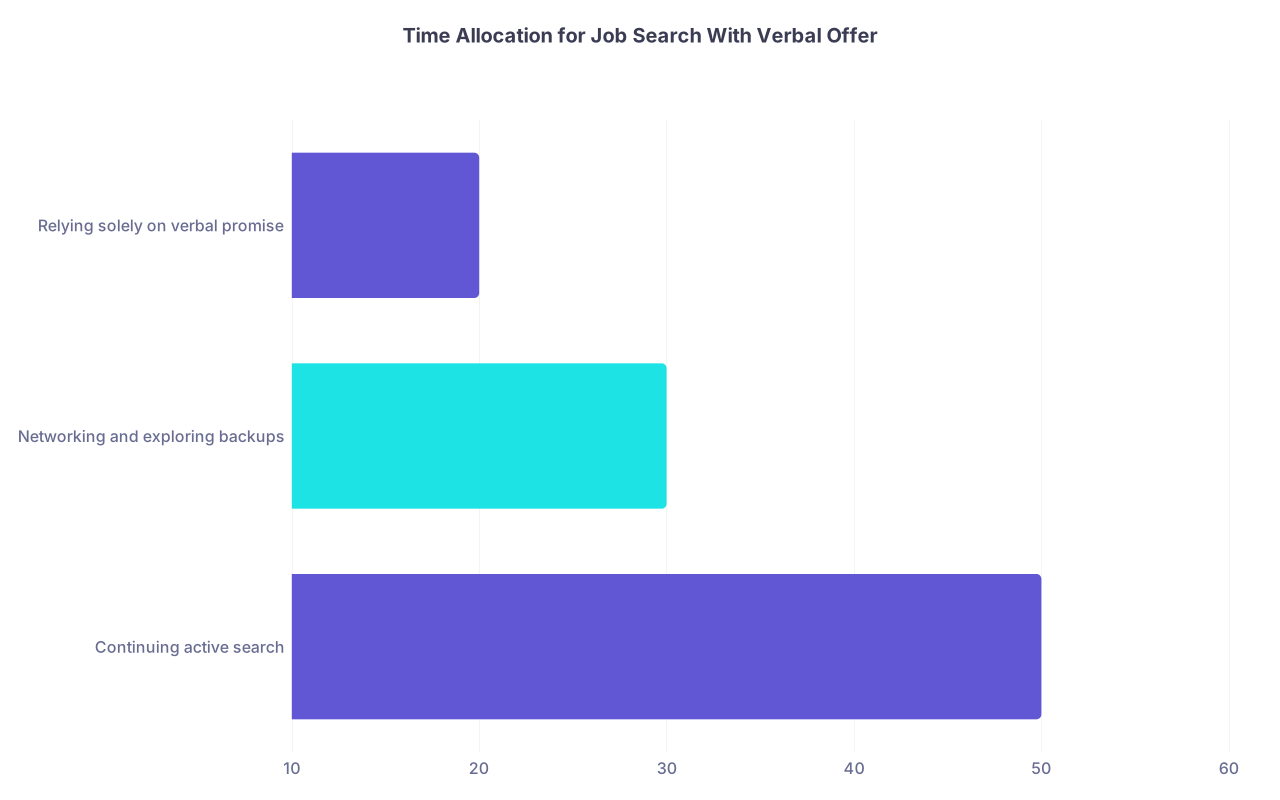
| Category | Value |
|---|---|
| Continuing active search | 50 |
| Networking and exploring backups | 30 |
| Relying solely on verbal promise | 20 |
If a program or hospital really values you, they will understand that you are managing uncertainty and trying to protect your future. If they punish you for that? That is not a place you should tie yourself to long-term.
Quick Reality Checks Before You “Trust” a Verbal Offer
Use this checklist. If you cannot answer “yes” to most of these, you are not safe.
- Have you seen any written outline of proposed salary, FTE, and responsibilities?
- Do you know the approximate start date and location (site-specific, not just “in the system”)?
- Have they mentioned HR, credentialing, or contract timelines in concrete terms?
- Have they acknowledged that you should keep looking until something is signed?
- Have you spoken to current physicians there about how long their offers took and whether promises were kept?
If most of those answers are no, treat the verbal promise as noise, not a plan.
FAQ (Exactly 4 Questions)
1. What if the person promising me a job is someone I deeply trust, like my program director or mentor?
Trust their intentions, not their control. Your director may genuinely want to hire you, but they are still limited by budget, institutional politics, and HR rules. Separate their personal sincerity from organizational reality. You can respect them and still insist on a written offer before you change your entire job search strategy.
2. When should I start to relax and act like I “have a job”?
Only when you have a signed offer or contract that includes role, compensation, start date, FTE, and key conditions, and you have confirmed that those terms are acceptable. Even then, do not completely shut down mentally until credentialing and licensing are reasonably on track. The earlier you “relax” based on hope instead of documentation, the higher your risk.
3. Is it wrong or disloyal to keep applying elsewhere after I receive a verbal promise?
No. It is responsible. You are not bound by casual words. Until you sign something, you are exploring options; that is normal in every professional field. Employers do the same thing—talk to multiple candidates at once. You owe it to yourself (and your future patients, frankly) not to end up in a bad or nonexistent job out of misplaced loyalty to a conversation.
4. How do I politely push for a written offer without sounding demanding?
Use timelines and planning as your justification. For example: “I am very excited about the possibility of joining your team. To help with my planning for licensing, relocation, and family logistics, is there a rough timeline for when a formal offer or contract might be available?” This frames the request as practical, not aggressive. If they repeatedly dodge that question, treat that as diagnostic: their “offer” was never solid.
Key points:
- Verbal job promises after residency are not jobs. They are interest, not security.
- Never slow or stop your search, financial planning, or geographic flexibility based on words alone.
- Push every serious conversation toward specific, written terms—and keep your options open until the ink is dry.