
Only 42% of new attending physicians negotiate anything beyond base salary in their first contract.
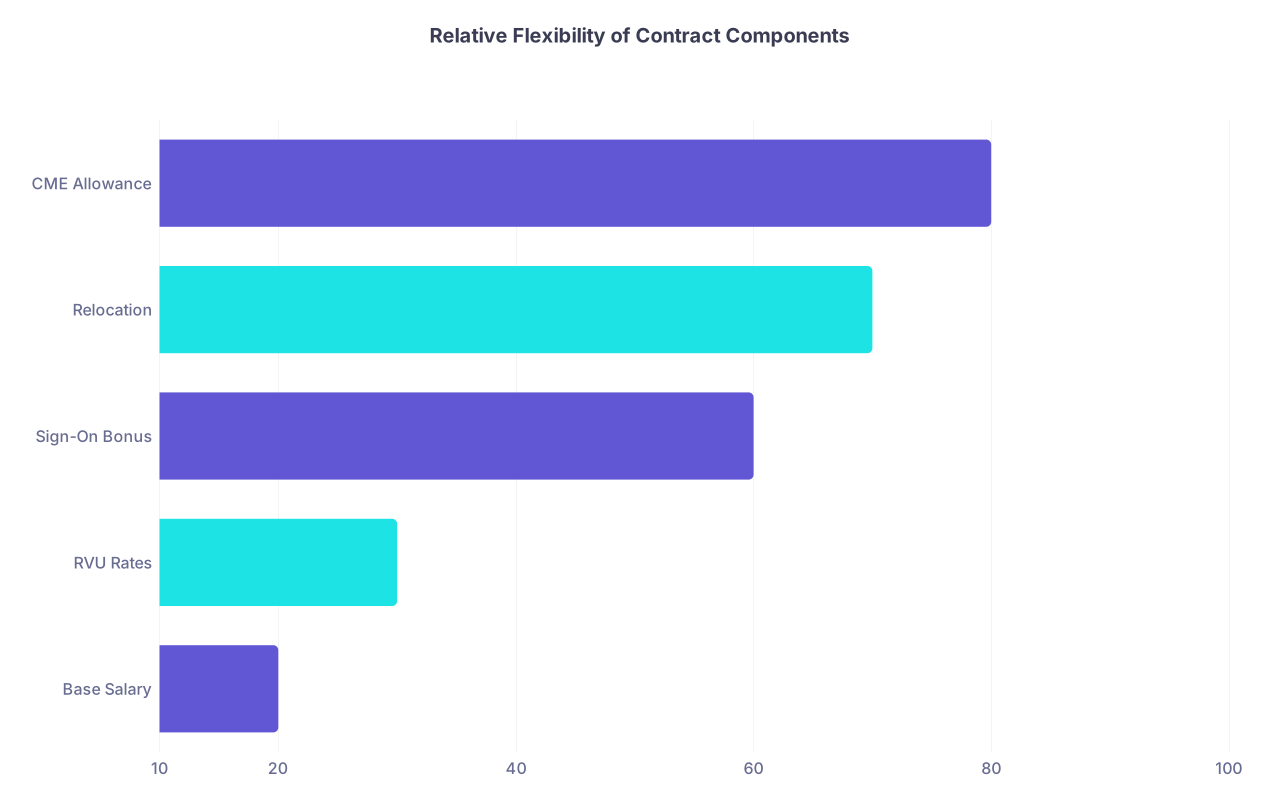
Which means most people are walking away from five-figure money that is frankly easier to move than your base comp: CME, sign-on, and relocation.
Let me break this down specifically, with actual numbers and benchmarks you can use in an email or across the table. Not vague “advocate for yourself” fluff. Real ranges, by specialty and setting, and what you can reasonably push for without blowing up the deal.
1. Ground Rules: How These Dollars Actually Work
Before we get into numbers, you need to understand how these three buckets behave:
- CME: Recurring annual benefit. “Soft” money. Usually most negotiable per-dollar.
- Sign-on bonus: One-time cash (or forgivable loan). Heavily tied to term length, repayment clauses, and non-competes.
- Relocation: One-time, often reimbursable. HR has standard bands but there is wiggle room, especially outside big metros.
| Category | Value |
|---|---|
| Base Salary | 20 |
| RVU Rates | 30 |
| Sign-On Bonus | 60 |
| Relocation | 70 |
| CME Allowance | 80 |
Here is the basic reality I have seen across dozens of contracts:
- Employers will fight you on base salary harder than on CME or relocation.
- The bigger the system (HCA, Tenet, large academic centers), the more they will claim “this is our standard package.” It often is not as fixed as they say.
- Rural and high-need specialties have far more flexibility on sign-on and relocation than cushy urban jobs.
Your strategy: Maximize the cheap-to-them, high-value-to-you benefits (CME, relocation, paid time for conferences) and then nudge sign-on in exchange for commitments they actually care about, like a longer initial term.
2. CME Money: Specific Benchmarks by Specialty and Setting
CME is the forgotten lever. People spend endless time wrestling over $10–20k of salary and ignore $15k over three years in CME that is much easier to move.
Let us talk real numbers.
Typical CME Allowance Ranges
These are realistic benchmarks for full-time physicians (0.8–1.0 FTE), per year:
| Setting / Specialty | Typical Range (USD) |
|---|---|
| Academic primary care | $2,000 – $3,000 |
| Community primary care / hospitalist | $3,000 – $4,000 |
| Surgical subspecialties | $4,000 – $6,000 |
| Radiology, anesthesia, EM | $3,000 – $5,000 |
| Private/single-specialty groups | $4,000 – $7,500 |
Lowball offers still show up at $1,500–$2,000. That is weak for almost any specialty unless you are strictly virtual/tele and not traveling.
The CME budget is usually tied to:
- Courses and conferences (registration fees)
- Travel (airfare, hotel, per diem)
- Educational materials (books, online subscriptions, board prep)
- Sometimes license fees, DEA, and board certification/recertification
You want those last items explicitly included.
What To Ask For, Concrete Numbers
If you see:
- Academic IM/hospitalist: Offered $2,000. Reasonable counter: $3,000–$3,500 plus explicit coverage of licensure and DEA out of a separate bucket if possible.
- Community cardiology: Offered $3,000. Reasonable counter: $5,000.
- Ortho / neurosurgery / high-RVU specialties: Offered $4,000. Reasonable counter: $6,000–$7,500.
And no, asking for $1–2k more in CME will not sink an otherwise good deal with any rational employer.
Bad Wording vs. Good Wording
Crucial detail: How they define it.
Bad:
- “Up to $3,000 per year for approved CME at employer’s discretion.”
Better:
- “Employer shall provide an annual CME allowance of $4,000, which may be used for courses, conferences, board exam/recertification fees, medical licenses, DEA registration, and educational materials. Approval shall not be unreasonably withheld.”
Push to include:
- Medical license renewals
- DEA
- Board certification / recertification
- Society dues (mandatory memberships)
- Online CME subscriptions (e.g., UpToDate, NEJM, specialty-specific)
If they will not separate license/DEA into their own line items, then at least specifically include them as eligible CME expenses.
3. Sign-On Bonuses: Realistic Ranges and Trade-Offs
Most new grads fixate on the sign-on bonus. That is fine, as long as you treat it like what it actually is: a retention tool with strings attached.
Core Benchmarks for Sign-On Bonuses
These are general starting ranges for new attendings, not lateral hires with big books of business.
| Specialty / Setting | Common Range (USD) |
|---|---|
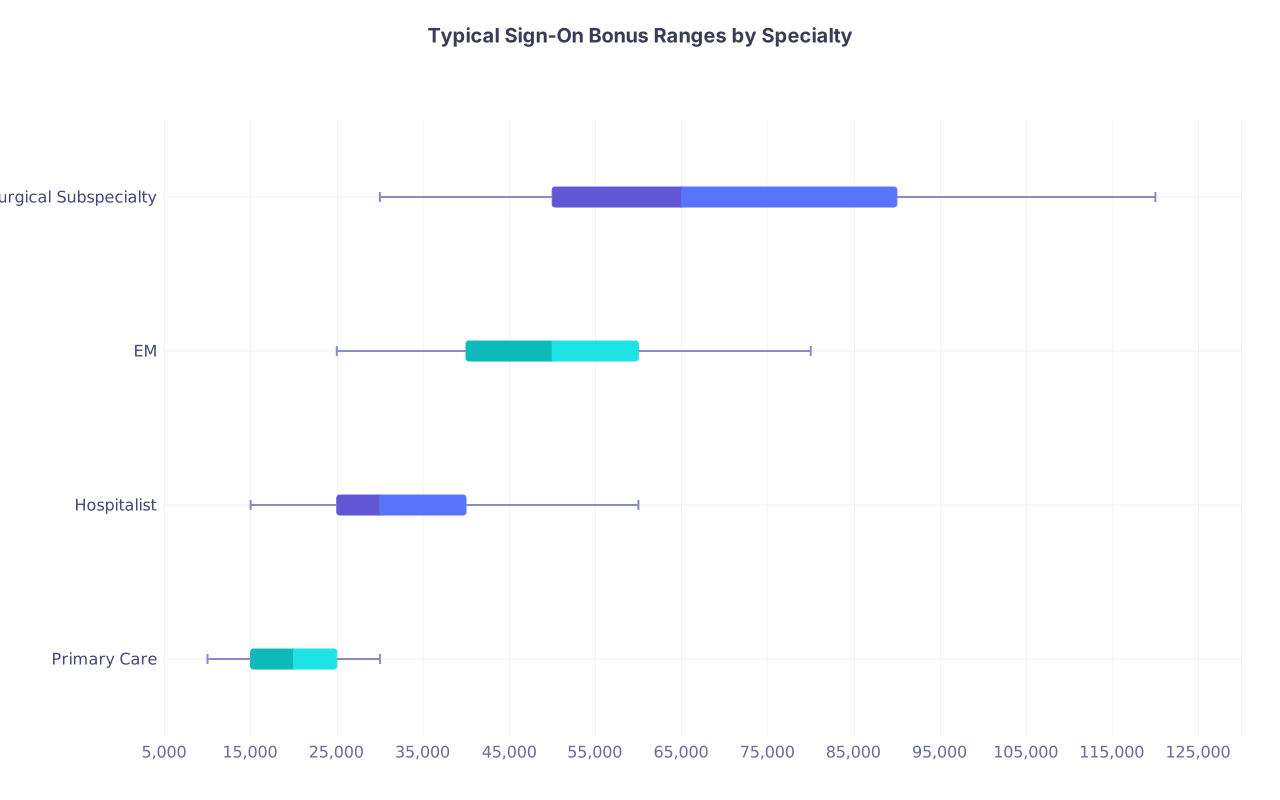
| Primary care, outpatient | $10,000 – $25,000 |
| Hospitalist (non-rural) | $15,000 – $30,000 |
| Hospitalist (rural / high-need) | $30,000 – $60,000 |
| EM (community) | $25,000 – $75,000 |
| General surgery | $25,000 – $50,000 |
| Ortho/Neuro/ENT subspecialties | $40,000 – $100,000+ |
Academic centers are often on the low end or zero. Community hospitals, large multispecialty groups, and rural placements tend to pay more.
String #1: Repayment Schedule
This is where people get burned.
Red flag language looks like:
- “Repayment of full bonus if employment terminates within 36 months, for any reason.”
This is insane. You leave at month 35 because they cut your support staff in half, and you owe $30k in a lump sum.
What you want instead:
- Forgiven over time in equal monthly (or yearly) increments.
- Repayment only of the unforgiven portion.
- No repayment if they terminate you without cause.
Concrete example:
- $30,000 sign-on
- Three-year forgiveness schedule
- You leave at 18 months
Fair clause: You owe 50% back ($15k), not the full $30k.
String #2: When You Actually Get Paid
There is a difference between:
- Paid on signing (rare), versus
- Paid on start date, versus
- Paid 30–90 days after start
Reasonable ask: “Payable within 30 days of start date.” If they insist on 90 days, not ideal but survivable. More than 90 is weak and signals penny-pinching.
String #3: Non-Compete and Term Length
Aggressive sign-on often pairs with:
- 3-year initial term instead of 1–2.
- Tight non-compete radius and duration.
If they push a huge sign-on (say $75k+), look hard at:
- Contract length (you probably want 2 years, not 3–5)
- Non-compete geography (10–15 miles vs. 30–50)
- Whether non-compete applies if they terminate you without cause
Do not trade a slightly bigger sign-on for a horrible non-compete that will box you out of an entire metro.

| Step | Description |
|---|---|
| Step 1 | Offered Sign-On Bonus |
| Step 2 | Check term length |
| Step 3 | Focus on forgiveness terms |
| Step 4 | Review non-compete |
| Step 5 | Consider accepting |
| Step 6 | Negotiate or walk |
| Step 7 | Size High or Modest |
| Step 8 | Reasonable clauses |
Concrete Ask Templates for Sign-On
Example language you can actually send:
- “Given my anticipated start date and relocation needs, I would like to request a sign-on bonus of $30,000, payable within 30 days of my start date, forgiven over three years in equal annual installments, with repayment limited to the unforgiven portion only if I voluntarily resign or am terminated for cause.”
You can scale the numbers up/down according to specialty and setting, but that structure is sound.
4. Relocation: Stop Leaving $5–10k On the Table
Relocation is where HR will swear “this is just our standard.” Then you push once, and the cap jumps by $5k.
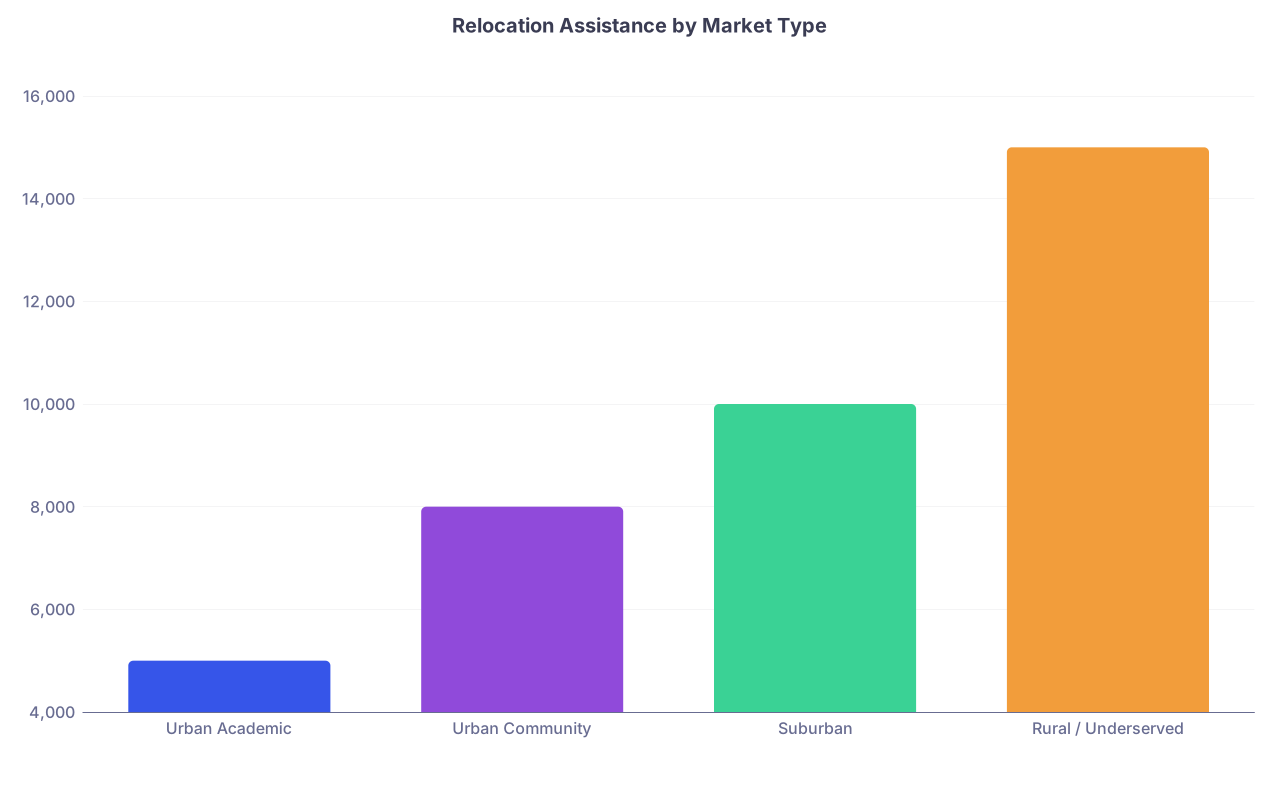
Typical ranges for new grads:
| Category | Value |
|---|---|
| Urban Academic | 5000 |
| Urban Community | 8000 |
| Suburban | 10000 |
| Rural / Underserved | 15000 |
Realistic benchmarks:
- Urban academic: $3,000 – $5,000
- Urban community / large system: $5,000 – $8,000
- Suburban private group: $7,000 – $10,000
- Rural / high-need: $10,000 – $15,000 (sometimes $20k+ for big moves)
Reimbursement vs. Lump Sum
Two flavors:
Reimbursable expenses up to a cap
- Requires receipts.
- Often includes: movers, travel, temporary housing, sometimes house-hunting trips.
Lump-sum relocation payment
- Taxable as income.
- Simpler. Can use for whatever you want.
If you are moving cross-country with a family, reimbursable up to a higher cap can be more valuable. If you are single with minimal belongings, a taxable lump sum you can partially pocket is often better.
Reasonable ask:
- “Given that I will be moving from Boston to Seattle with my family, I would like to request relocation assistance up to $12,000 in reimbursed expenses, including packing and moving, flights, and up to 30 days of temporary housing.”
Hidden Land Mines
- Repayment if you leave early, same as sign-on. Try to minimize or tie it to a shorter timeframe (12–24 months, not 36).
- Caps that exclude critical items like temporary housing. Get those listed explicitly.
5. How to Prioritize: CME vs. Sign-On vs. Relocation
You cannot max every category in every context. So be strategic.
Here is the hierarchy I usually recommend for new grads:
Fix structural problems first
- Non-compete radius/duration
- Call expectations
- Schedule, FTE status, and tail coverage
Then optimize recurring value
- Base salary or RVU rate
- CME budget and PTO
- Benefits (health, retirement matches)
Then clean up one-time money
- Sign-on bonus (with good forgiveness terms)
- Relocation cap (especially if moving far)
Why? Because:
- A $2k/year increase in CME plus better license coverage over 3–5 years is often more impactful than a one-time extra $5k on sign-on.
- A bad non-compete or brutal call schedule is not fixable with an extra $15k.

Short version: you negotiate structure first, recurring dollars second, and one-time sugar last.
6. Tactics: What to Actually Say and When
Most new grads either:
- Never push back, or
- Ask for dumb things in the wrong way (e.g., “double my sign-on” on a borderline offer)
A tighter approach:
Step 1: Get the Full Offer in Writing
Do not negotiate off vague verbal promises. You want:
- Base salary / comp structure
- Bonus plan details
- Call schedule
- CME amount and CME days
- Sign-on amount, timing, and forgiveness rules
- Relocation type and cap
- Benefits summary
Only then do you counter.
Step 2: Stack Your Asks Intelligently
If you are going to negotiate, bundle related items. Something like:
“I am excited about the opportunity and the role fits my clinical interests well. I have a few concerns about the initial offer that I would like to discuss:
CME and Professional Expenses
The current $2,000 CME budget will not realistically cover conferences, board fees, and license/dea renewals. I would like to see this at $3,500 annually, with explicit inclusion of license and DEA.Sign-On Bonus Structure
A $15,000 sign-on is appreciated. I would like to increase this to $25,000, with forgiveness over three years and repayment limited to the unforgiven portion if I resign or am terminated for cause.Relocation
Given the cross-country move, I anticipate relocation costs near $10,000. Increasing the relocation assistance cap from $5,000 to $10,000 would make the transition much more feasible.”
You gave them specifics. Reasonable, benchmarked numbers. Employers respect that more than “can you do better.”
Step 3: Know When to Trade
You want options in your head like:
- “If they will not move on sign-on, I will push harder on CME and relocation.”
- “If they insist on a 3-year term for the full sign-on, I want a higher annual CME budget as a sweetener.”
Example trade language:
“If increasing the sign-on to $30,000 is not feasible, I would be comfortable keeping it at $20,000 if we can increase the CME allowance to $4,000 annually and raise relocation assistance to $10,000.”
You are making it easy for them to say yes to something.

| Step | Description |
|---|---|
| Step 1 | Receive Written Offer |
| Step 2 | Identify Priorities |
| Step 3 | Fix non-compete, schedule |
| Step 4 | Move to financial items |
| Step 5 | Propose CME and relocation changes |
| Step 6 | Negotiate sign-on amount and terms |
| Step 7 | Sign and confirm |
| Step 8 | Walk or seek other offers |
| Step 9 | Structural issues? |
| Step 10 | Deal acceptable? |
7. Specialty-Specific Nuances
You are not bargaining in a vacuum. Market demand matters. A lot.
Primary Care (FM, IM Outpatient, Pediatrics)
You usually have:
- Decent negotiating room on CME (ask for $3,000–$4,000 minimum)
- Modest sign-ons ($10,000–$25,000)
- Relocation help varies by geography
Very rural primary care can actually look like hospitalist territory for sign-on and relocation. I have seen:
- FM in rural Midwest: $50,000 sign-on, $15,000 relocation, $4,000 CME.
- Peds in medium city: $15,000 sign-on, $7,500 relocation, $3,000 CME.
Hospitalist
Night coverage, weird schedules, and high burnout risk mean you have leverage.
Reasonable asks:
- CME: $3,000–$4,000 in community settings, $2,500–$3,000 in academic.
- Sign-on: $20,000–$40,000 in most non-rural jobs, more in tough locations.
- Relocation: $8,000–$12,000 for significant moves.
Watch the fine print on:
- How many CME days you get. Money without time is useless.
- If nocturnists get different packages.
EM, Radiology, Anesthesia
Groups vary widely. For these “highly marketable but sometimes saturated” fields, your leverage is more location-dependent.
- Busier, less desirable locations: You can often push sign-on into the $50k+ range.
- Desirable metros: Your win is often better CME, schedule concessions, or more predictable RVU floors rather than monster sign-ons.
Surgical Subspecialties and Ortho/Neuro
Here, recruitment is painful and expensive for them. You should absolutely push.
For example:
- Ortho in community setting:
- CME: $5,000+ should be standard.
- Sign-on: $50,000–$100,000 for true need.
- Relocation: $10,000–$20,000.
If they are dangling a huge sign-on, assume their expectation for productivity or call burden is equally large. Balance the package accordingly.
| Category | Min | Q1 | Median | Q3 | Max |
|---|---|---|---|---|---|
| Primary Care | 10000 | 15000 | 20000 | 25000 | 30000 |
| Hospitalist | 15000 | 25000 | 30000 | 40000 | 60000 |
| EM | 25000 | 40000 | 50000 | 60000 | 80000 |
| Surgical Subspecialty | 30000 | 50000 | 65000 | 90000 | 120000 |
8. Red Flags You Should Not Ignore
Even if the money looks good, watch for these contract problems tied to CME, sign-on, and relocation:
“Employer may modify or eliminate CME allowance at any time, at its sole discretion.”
Translation: This benefit is not real.“Physician shall repay the entire sign-on bonus if employment ends for any reason within 36 months.”
Hard pass. At least limit repayment to voluntary resignation or termination for cause, and only the unforgiven portion.“Relocation assistance to be repaid in full if employment ends within 36 months.”
Push for 12–24 months instead.No CME days specified.
Six days per year is a decent benchmark for full-time. Four is tolerable. Two is stingy.

If you see a pattern of punitive clauses, slow down. It usually reflects a culture that views physicians as replaceable labor, not long-term colleagues.
9. Short Example Packages: What “Good” Looks Like
To put this in perspective, here are three composite examples that would be considered solid for new grads:
Example 1: Community Hospitalist, Mid-Sized City
- Base: Market median for region
- CME: $3,500 + 5 CME days, includes license/DEA/boards
- Sign-on: $25,000, paid within 30 days of start, forgiven over 3 years, repay unforgiven portion only if you resign or are terminated for cause
- Relocation: Up to $10,000 reimbursed, including temporary housing, repay only if you leave within 12 months
This is respectable. You could push CME to $4,000 and relocation to $12,000, but not necessary to make this a good deal.
Example 2: Rural FM, High-Need Area
- Base: Slightly above MGMA median for FM
- CME: $4,000 + 5 days, license + DEA covered
- Sign-on: $50,000, 4-year forgiveness schedule, non-compete limited to 15 miles
- Relocation: $15,000 reimbursed, no repayment after 24 months
Given the location, that is strong. You should strongly consider it if the non-compete and call look sane.
Example 3: Orthopedic Surgery, Community Group Near Major City
- Base: Modest guarantee, aggressive RVU upside
- CME: $6,000 + 7 days, includes boards and license
- Sign-on: $75,000, 3-year forgiveness, limited repayment
- Relocation: $15,000 lump sum, taxable
- Non-compete: 10 miles from primary hospital only
That is the type of package where I would pay more attention to practice culture and call burden, because on paper the financial setup is very reasonable.
FAQ (Exactly 4 Questions)
1. How much can I realistically move these numbers without risking the offer?
In most non-academic settings, you can usually move at least one or two of the three buckets (CME, sign-on, relocation) by 20–50% from the initial offer if you are reasonable and the market is not oversaturated. For example, $2,000 CME to $3,000, $10,000 sign-on to $20,000, or $5,000 relocation to $8,000–$10,000. If they refuse to budge on everything, that tells you as much about culture as it does about finances.
2. Should I pay for a contract lawyer just to negotiate CME, sign-on, and relocation?
If those are the only issues and the rest of the contract is straightforward, you may not need a lawyer to tweak small numbers. Where an experienced healthcare attorney earns their fee is in spotting bad non-competes, termination language, tail coverage traps, and repayment obligations. I recommend at least one attorney review for your first attending contract. You can then handle second-round negotiations yourself with their guidance.
3. What if they say “this is a standard package for all new hires”?
I have heard this line from HR more times than I can count. Sometimes it is genuinely true, especially in large academic centers or tightly unionized systems. Often it is just a starting position. Your response can be: “I understand the desire for standardization. Given the cross-country move and my expected scope of practice, are there any exceptions that can be made on CME and relocation? Those two items are most critical for me.” If they still hold the line, you decide whether the rest of the package justifies accepting.
4. Which single number should I push hardest on if I can only pick one?
If your move is modest and you are not cash-strapped, I would prioritize recurring value: CME (and whether it covers license/DEA) plus CME days. Over a 3–5 year stretch, an extra $1,500–$2,000 per year in CME, especially with covered licenses and board fees, often beats an extra $5k–$10k one-time sign-on. If you are moving cross-country or carrying significant debt, then a well-structured sign-on with fair repayment terms becomes your top lever.
Key points, no fluff:
- CME, sign-on, and relocation are usually more flexible than base salary, and you should treat them as real money with real terms, not freebies.
- Concrete benchmarks exist: $3k–$5k CME, $10k–$50k sign-ons for most primary/hospitalist roles (more for surgical and rural), and $5k–$15k relocation. Use those to anchor your asks.
- Structure matters more than sticker price: forgiveness schedules, repayment clauses, CME inclusions, and non-competes will define how “good” this money really is when you try to leave or move later.