The way most new physicians sign noncompete clauses is reckless.
They skim the paragraph, assume “this is just standard,” and trust HR when they say “we never really enforce that.” Then three years later they are sitting in a Starbucks with their laptop, realizing they either have to move their kids to another state or walk away from the patient panel they built. All because of 3–4 sentences they did not understand.
Let me break this down specifically.
1. What a Physician Noncompete Actually Is (Not the Sales Pitch)
A physician noncompete (restrictive covenant) is a contract clause that limits where, when, and how you can practice after you leave an employer.
Forget the soft language your recruiter uses. Legally, it is designed to protect the employer’s business interests, not your career flexibility.
Typical components:
A geographic restriction
Example: “within a 20-mile radius of any clinic operated by Employer.”A time restriction
Example: “for a period of 24 months after termination for any reason.”A scope of practice restriction
Example: “practice of internal medicine or any similar primary care services.”
Those three levers—distance, duration, and scope—determine how painful this clause becomes for you.

Here is the key mistake I see repeatedly: new attendings evaluate offers on salary, signing bonus, and PTO… and treat the noncompete as a nuisance footnote. It is not a footnote. It is part of your real compensation calculus because it determines how expensive it will be to leave.
2. Enforceability: State Law Is Everything
Noncompete clauses do not live in a vacuum. Whether they are enforceable, partially enforceable, or dead-on-arrival is mostly a function of state law.
You cannot “out-negotiate” a statute. And you cannot rely on a friend’s experience in another state. That is how smart people end up boxed into terrible arrangements.
Broad state patterns (as of 2024–2025)
I will not list all 50 states, but the patterns matter.
| State | General Trend | Notes for Physicians |
|---|---|---|
| California | Noncompetes largely banned | Medical employment contracts exempt from typical noncompetes |
| Texas | Allowed with conditions | Must be reasonable; buyout option often required |
| Massachusetts | Allowed but scrutinized | Courts look closely at scope and harm |
| Colorado | Mostly banned with exceptions | Some allowances for physician agreements pre-2024 changes |
| North Dakota | Noncompetes banned | Strong statutory prohibition |
Do not rely on anecdote. I have seen OB/GYNs in Texas win partial modifications in court, and hospitalists in Massachusetts essentially handcuffed within half the state. Same concept, different courts, very different outcomes.
“Reasonableness” – the lawyer word that decides your fate
In many states, noncompetes are judged by whether they are “reasonable.” That usually means:
Protects a legitimate business interest
Patient relationships, referral patterns, confidential business info. Not just “we do not want competition.”Reasonable as to time
1 year is common and often upheld.
2 years is pushed but still enforced in many markets.2 years starts to look abusive in many jurisdictions, especially for non-partner employees.
Reasonable as to geography
Urban: 5–10 miles around a specific clinic location might fly.
Rural: 20–50 miles or more might be argued as reasonable due to wide catchment areas.
System-wide: “Any facility owned or operated by Employer” in a huge health system is exactly the sort of thing that gets litigated.Reasonable as to scope of practice
Blocking you from “any practice of medicine” is often overbroad. Blocking you from your specific specialty or niche may be upheld.
Courts in many states will not simply throw out a noncompete that is too broad. They will “blue-pencil” it—modify it down to what they think is reasonable—and then enforce that. Translation: do not count on the clause being so outrageous that it dies in court. The judge may just trim the edges and still rule against you.
3. Core Legal Nuances New Doctors Miss
You are not going to law school. But you do need to recognize the specific landmines that matter before you sign.
A. “For any reason” is not a throwaway phrase
Look for: “for a period of 12 months after termination for any reason.”
This means:
- If you resign voluntarily → noncompete applies.
- If they fire you without cause → noncompete still applies.
- If the hospital shutters your clinic overnight → noncompete still applies.
Savvy physicians push for:
- Noncompete applies only if the physician voluntarily resigns, or
- Noncompete applies only if physician is terminated for cause, with a narrow, clearly defined “cause” section.
If the employer insists the clause must survive termination “for any reason,” they are telling you clearly: your future flexibility is their last concern.
B. Multi-site employers and the “any facility” trap
This is where things get ugly, especially with health systems and national groups.
Watch for language like:
“within 20 miles of any facility owned or operated by Employer at the time of termination.”
Concrete example:
You work as a cardiologist at Hospital A in a mid-sized metro area. The system also owns 3 urgent care centers, a surgery center, and a small outreach clinic in every direction. That 20-mile radius around “any facility” basically covers the entire metro and most nearby suburbs. Your “local” restriction is now regional.
A safer version would be:
- Restriction tied only to the specific primary practice location(s) where you regularly see patients in the last 12 months of employment.
- Or, at most, a small defined set of sites explicitly named in an exhibit.
If the contract does not specify locations, assume they will construe it as broadly as possible later.
C. Moonlighting, telemedicine, and “practice of medicine”
Many contracts define the restricted activity as “practice of medicine” or “practice of [specialty] within the restricted area.”
Questions you absolutely must ask:
- Does moonlighting in an ED 60 miles away violate the clause if the hospital system has an urgent care 10 miles from there?
- Does telemedicine to patients located in the restricted radius count?
- If you shift to a purely administrative role (CMO, quality, utilization management), is that “practice” or not?
I have seen contracts where telehealth was explicitly included, and others where it was completely silent. Silence is not your friend.
At minimum, you want clear carveouts for:
- Purely administrative roles without direct patient care.
- Academic teaching without outpatient clinic responsibilities.
- Medical-legal work, consulting, or non-clinical industry roles.
You do not want a hospital arguing that your remote consulting gig for a startup somehow violates “practice limitations.”
4. How Noncompetes Shape Real-Life Career Decisions
Let’s get concrete. Because the impact is not theoretical; it is geographical and financial.
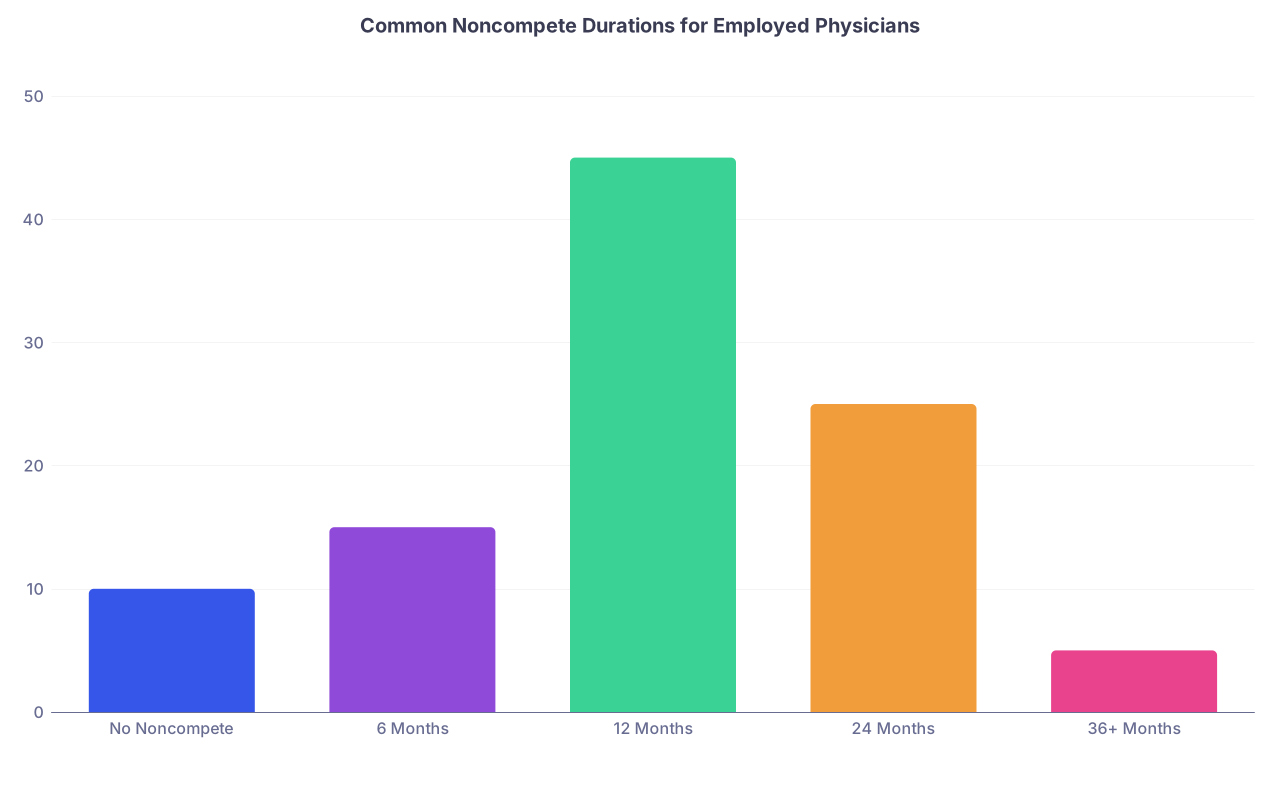
| Category | Value |
|---|---|
| No Noncompete | 10 |
| 6 Months | 15 |
| 12 Months | 45 |
| 24 Months | 25 |
| 36+ Months | 5 |
Imagine a standard first job offer:
- Internal medicine, hospital-employed
- Salary: $260,000 + RVU bonus
- Noncompete: 2 years, 25 miles, “any practice of internal medicine,” “any facility owned or operated by Employer”
You move your family to this city. Your spouse finds a job. Your kids enter school.
Three years later, a competing group offers:
- $315,000 base, better schedule, same city.
- But… they are 8 miles away from your current hospital. Still inside your 25-mile ring.
Now your effective choice set is:
- Stay in a job you have outgrown or resent.
- Leave the city entirely for 2 years.
- Hope the current employer waives the noncompete (with zero legal obligation to do so).
I have watched people pick option 2 and live in an Airbnb in another state for 12 months while their family stayed behind so the kids could finish school. That is not hypothetical. That is what a signed, enforceable noncompete looks like when life changes.
5. Negotiating Noncompetes: What Actually Moves
You cannot always delete the noncompete. Sometimes you can. Often you cannot. But you almost always can make it less toxic.
A. Know what is “market” in your specialty and region
Noncompete expectations differ:
- Hospitalist in a saturated metro – Noncompete is almost guaranteed. The leverage is modest because there are many of you and a finite number of hospitals.
- Dermatologist or orthopedist in semi-rural area – High revenue, less competition; they will push hard for a strong noncompete, but you might have more bargaining power on radius or duration.
- Psychiatrist or outpatient neurologist – Demand is high, and employers are often more flexible, especially where recruitment is difficult.
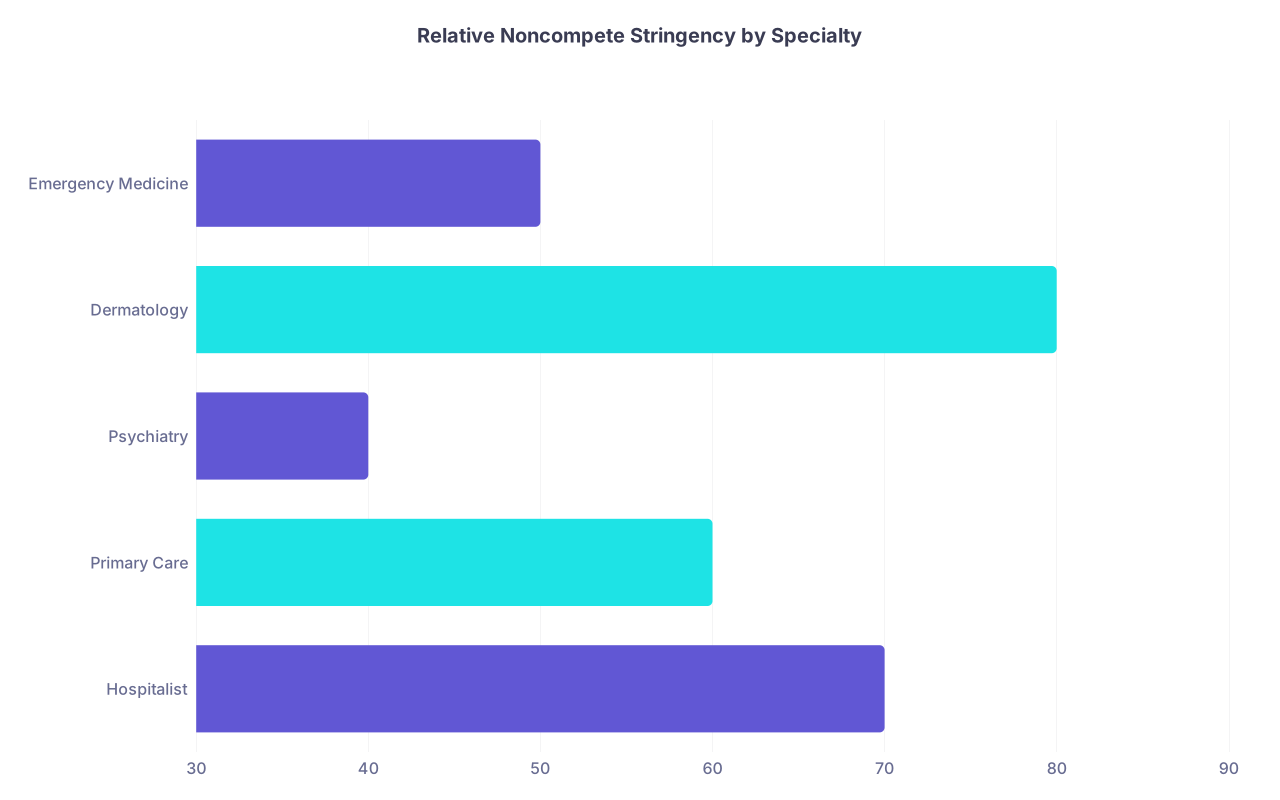
| Category | Value |
|---|---|
| Hospitalist | 70 |
| Primary Care | 60 |
| Psychiatry | 40 |
| Dermatology | 80 |
| Emergency Medicine | 50 |
(Think of that chart as relative pressure, not a legal metric. I am telling you what I see in actual contracts.)
B. Specific levers you can pull
You are not going to rewrite 10 pages. Focus on the 3–4 details that change your life:
Duration
Push 24 months down to 12.
Push 18 months down to 9–12.
Anything over 24 months for an employee physician is excessive in most competitive markets.Geographic scope
Tie it to your primary practice site with a named address.
Shrink 25 miles to 10–15 in urban areas.
In multi-site systems, limit it to the site(s) where you spend >50–60% of clinical time.Triggering events
Noncompete only applies if:- You resign voluntarily, or
- You are terminated for cause (with a tight, specific definition).
If they terminate you without cause, the noncompete should evaporate. You will not always get this, but you should ask for it clearly.
Buyout provision
In some states (notably Texas), physician noncompetes are more enforceable when there is a reasonable buyout option—essentially, you can pay to walk away.
Negotiate:- A fixed dollar amount (e.g., $50,000).
- Or a formula with a cap (e.g., 6 months’ base salary, not 2 years of total comp).
I have seen horror stories where “buyout” was defined as repayment of all compensation for the prior 12 months plus recruitment expenses. That is ornamental. Not a real option.
Narrowed scope of practice
If you are dual-trained or sub-specialized, you want precision. Example:
“Noncompete applies only to outpatient adult endocrinology practice” vs “any practice of internal medicine or related field.”That difference can mean the ability to work as a hospitalist or urgent care doc in the same city legally.
C. Leverage timing
You have the most leverage:
- Before you sign anything, obviously.
- When they are desperate (failed searches, under-served service line, urgent coverage needs).
- When you are the candidate they want, not one of twenty.
You have almost no leverage:
- After you have signed the offer letter and turned down other positions.
- Six months into the job when you “finally read” the contract.
If the employer refuses to negotiate at all—on anything—take that as a data point about their culture and how they view physicians. It is predictive.
6. Special Situations: Tail Coverage, Partnerships, and PSAs
A noncompete is rarely the only clause boxing you in. You need to see how it interacts with other parts of the contract.
A. Malpractice tail + Noncompete = Trap
If you are in a claims-made malpractice policy, someone has to buy tail coverage when you leave.
Some employers structure the deal as:
- If you resign within X years → you pay tail, noncompete still applies.
- If they terminate you for cause → you pay tail, noncompete applies.
- If they terminate without cause → maybe they pay tail, but noncompete stays.
You now have:
- The cost of moving your practice (noncompete).
- A five-figure tail premium (sometimes six figures in OB, surgery, pain).
THIS is how people end up staying “one more year” in jobs they hate.
Your goal in negotiation:
- Employer pays tail if they terminate you without cause.
- Noncompete is waived if they terminate without cause or close your practice site.
B. Partnership tracks and buy-in
In private groups, noncompetes are often attached to partnership expectations.
Common pattern:
- As an employee, heavy noncompete.
- After partnership, noncompete remains but is sometimes even more aggressive due to equity and goodwill considerations.
You must read:
- What happens if you do not make partner when expected?
- What if they “extend” your track?
- What if you become partner, then want to leave—does the noncompete become worse?
Sometimes, for true equity partners, a reasonable noncompete makes sense. You are protecting group goodwill that you now partially own. But “partner” in name only, with zero voting rights and a huge noncompete, is a red flag.
C. PSAs and hospital support deals
In some markets, you might sign:
- A Professional Services Agreement (PSA) between your group and a hospital.
- An income guarantee or recruitment agreement tied to a specific facility.
Each of these can contain their own restrictive covenants, separate from your group contract. I have seen physicians clear the group noncompete but get tripped by the hospital PSA they never bothered to read.
If there is a PSA, letter of intent, or support agreement with a hospital or system that has your name on it, you must read every page or have someone competent do it.
7. Practical Strategy: How to Actually Protect Yourself
You will not become a contracts expert during fellowship. But you can avoid the classic rookie mistakes.

| Step | Description |
|---|---|
| Step 1 | Receive Contract |
| Step 2 | Read Noncompete Section |
| Step 3 | Confirm Clause is Removed |
| Step 4 | Hire Healthcare Attorney |
| Step 5 | Identify Key Issues |
| Step 6 | Negotiate Radius Duration Triggers |
| Step 7 | Get Revisions in Writing |
| Step 8 | Reassess Offer or Walk Away |
| Step 9 | State Allows Noncompetes |
| Step 10 | Employer Willing to Revise |
Concrete steps:
Get a healthcare attorney to review your first real contract
Not your cousin who does real estate closings.
Someone who handles physician contracts weekly, knows your state’s current case law and legislative changes, and can tell you “this is normal / this is garbage” in your specialty and region.Read the whole noncompete clause out loud to yourself
If you cannot paraphrase what happens when:- You resign,
- You are fired with cause,
- You are fired without cause,
- The hospital closes your service line,
then you do not understand it.
Ask HR/recruiter point blank about past enforcement
Not “Do you enforce these?” (they will dodge).
Ask: “How many physicians in the last 5 years have left your organization and had noncompete enforcement actions or threatened litigation?”
They may not answer, but you will learn something from the reaction.Do scenario planning
Imagine:- Your spouse needs you to stay in the city for aging parents.
- You burn out of call-heavy work and want to pivot within your specialty.
- Leadership changes and the culture sours.
Can you move across town? Take a job with a competing group? Shift from clinic to hospital work? If the honest answer is “no” for 2 years, that is a massive hidden cost.
Be prepared to walk away
This is where most new doctors fold.
They have “mentally matched” with the job, fallen in love with the city, toured schools, and they suddenly discover a horrible noncompete. The employer refuses to budge. They sign anyway.That is how long-term career traps form.
There will be other jobs. There will not be another first contract that shapes your geography and leverage for the next 3–5 years.
8. Quick Comparison: Reasonable vs. Predatory Noncompete
Use this as a mental heuristic, not legal gospel.
| Feature | More Reasonable Example | More Problematic Example |
|---|---|---|
| Duration | 6–12 months | 24–36+ months |
| Geography | 5–10 miles from primary site | 25+ miles from any current or future facility |
| Trigger | Applies only if you resign or are fired for cause | Applies if terminated for any reason |
| Scope | Your specific specialty | Any practice of medicine or related services |
| Buyout | Fixed, affordable number or capped formula | Undefined or pegged to enormous revenue amounts |
If your offer looks more like the right-hand column in every row, you are signing up for pain.
FAQ (Exactly 4 Questions)
1. Are physician noncompete clauses going away because of recent FTC and legislative activity?
No, not in any uniform, reliable way. The FTC made noise about banning most noncompetes, but there has been heavy legal pushback, and health employment often sits in special statutory corners. Some states have moved toward restricting noncompetes generally; others carve out exceptions for physicians, or for certain contract structures. You cannot assume “these will be illegal soon.” You must evaluate the contract as if it will be fully enforceable in your state for the duration you sign.
2. If my employer says they never enforce the noncompete, can I just sign it and ignore it later?
That is naïve. Verbal assurances are legally meaningless if the clause is clear. Leadership changes. Market conditions change. A new CEO or legal department can decide to enforce aggressively next year. If they truly “never enforce it,” they should be willing to narrow or soften it in writing. If they refuse and tell you “trust us,” they are asking you to take all the risk so they can keep all their options.
3. Is it safer to join academic medicine if I want to avoid brutal noncompetes?
Often yes, but not always. Many academic centers either have no noncompete or a modest one tied to faculty roles. But I have seen large academic-affiliated systems with very aggressive restrictive covenants, especially for clinicians whose work is mostly clinical revenue rather than research or teaching. Do not assume “university” equals “no noncompete.” Read the clause and compare it against local community systems before you decide.
4. When should I involve an attorney in my first attending contract?
Before you sign the offer letter or at least before you sign the full employment agreement. The offer letter can lock in noncompete basics that become “harder” to change later because HR will claim “this is what we already agreed to.” A good healthcare contract attorney will focus on the 10% of the document that actually matters—compensation structure, termination language, malpractice coverage, and restrictive covenants—and give you concrete edits or negotiation talking points. The fee for that review is trivial compared with the cost of a bad noncompete and tail coverage trap.
Key Takeaways
- Noncompete clauses are not boilerplate; they are binding geographic and temporal limits on your future practice, and state law determines how real the threat is.
- The three variables that matter most are radius, duration, and triggers for enforcement—if you do not understand those in your contract, you are signing blind.
- You may not be able to delete the noncompete, but you can often narrow it; getting expert review and being willing to walk away from a bad clause is how you protect your career after residency.