
The biggest mistake new attendings make is treating call coverage like an afterthought instead of a core part of their compensation and lifestyle.
Call is not a line item. It is a second job layered on top of your day job. If you do not understand how your call structure works—stipends, in‑house expectations, home call restrictions—you will underestimate the load, underprice your time, and end up quietly resentful while your partners just nod and say, “Yeah, that’s how it’s always been.”
Let me walk through how this actually works in the real world, not in the sanitized HR brochure version.
The Three Fundamental Call Models
At attending level, virtually every call system you will see is some mix of:
- In‑house call
- Home call
- Daytime “hospitalist‑style” coverage that is misbranded as “call”
Plus, over the top of that, you get:
- Call stipends (fixed per shift)
- wRVU/productivity credit for work generated on call
- Or both (in the better‑run systems)
First, the base structures.
1. In‑House Call
In‑house call is what you did as a resident, but now with higher liability and (hopefully) higher pay. You are physically present in the hospital or facility for the entire call period: nights, weekends, sometimes 24‑hour shifts.
Common with:
- Hospitalists
- Intensivists
- OB/Gyn with L&D coverage
- Emergency medicine (though EM tends to be shift work, not “call”)
- Anesthesia in some hospitals
- Surgical subspecialists at large trauma centers (e.g., in‑house ortho, neurosurgery, ENT at level 1 trauma)
Key operational features:
- Defined start/stop times (e.g., 7p–7a; 24‑hour weekend shifts)
- Often high, predictable workload
- Typically shift‑based pay structure rather than “base salary plus rare call”
- Sometimes tied to nocturnist or “night differential” bonuses
Red flags for in‑house call:
- “24‑hour in‑house call” with no post‑call protection
- Flat stipend that does not scale with volume (e.g., your trauma center adds a new service line and volume doubles, but your call pay stays the same)
- You are “required to stay in‑house” but paid as though you could sleep through most of it
2. Home Call
Home call is where a lot of physicians get burned because they hear “home” and think “easy.” That is naive.
Home call means you are physically allowed to be at home or near the hospital, but practically:
- You are still on the hook for emergent and urgent calls
- You may have frequent phone management
- You might have strict response‑time requirements (e.g., 20–30 minutes door‑to‑door) that effectively tether you to a small radius
Common with:
- Most private‑practice surgeons (general, ortho, ENT, urology, neurosurgery in smaller centers)
- Cardiology (especially interventional cath call)
- Radiology (teleradiology after hours, call back for certain studies)
- GI (bleeds, acute abdomen consults)
- Many subspecialties where volume is variable but acute needs are real
Home call ranges from:
- “True light” call: a few phone calls a night, occasional rare trip in
- To functionally equivalent to in‑house: back‑to‑back trips in, constant pages, might as well have slept in the hospital
The IRS and labor attorneys do not set your sleep requirements. Your partner expectations and the hospital’s unwritten culture do.
3. Daytime “Call” That Is Actually Coverage
Some groups will use the word “call” for:
- Being the on‑service doc for the hospital census during the day
- Covering consults for the ED and inpatient units
- Being the “first call” for triage calls from outside clinics or referring hospitals
This is not call in the classic overnight sense, but it often gets blended into call expectations when you negotiate.
I have seen contracts where:
- “Call” includes one weekend per month of rounding + all ED consults + all phone call triage, from 7a–7p, with no additional stipend and no post‑call break.
- Groups advertise “q8 home call” but those same weekends include full inpatient rounding loads both days.
So when you hear “call,” you must drill down into:
- In‑house vs home
- Night vs day vs weekend
- Pure backup vs full clinical duties
How Call Stipends Actually Work
Call stipends are where the real financial differentiation happens. The advertised base salary is only half the story.
There are four main models you will see.
Model A: Pure Stipend Per Shift
You get a flat rate for each call period, regardless of volume. That call might be in‑house or home, depending on specialty.
Examples:
- $500 per weekday home call
- $1,500–2,500 per 24‑hour weekend call for many surgical subspecialties in community hospitals
- $3,000–4,500 per 24‑hour trauma or high‑acuity specialty call in some markets
- $200–300 per night for low‑volume home phone call (e.g., some outpatient specialties)
The good:
- Predictable income
- You get paid whether you are slammed or quiet
- Straightforward to calculate and compare across jobs
The bad:
- Volume creep. Hospital volumes go up; your stipend stays flat.
- Often not indexed to inflation. After 5–10 years, that same dollar figure is relatively cheaper labor for the hospital.
- If you are extremely light volume, the hospital may try to “reassess” stipends downward.
Model B: Stipend Plus wRVU or Bonus
Here you get:
- A base stipend per shift
- wRVU credit for consults/procedures done on call
- Or a collections‑based bonus for professional fees generated during your call nights
This is more common in:
- Surgical private practices aligned with hospitals
- Cardiology groups with intervention call
- Anesthesia groups with significant add‑on cases
This structure can be very lucrative if:
- Volume is high
- Payer mix is reasonable
- You have control over scheduling to batch or cleanly assign cases
It can also become brutal if:
- The stipend is low and used to justify brutal volume
- Call disproportionately generates poorly reimbursed work (e.g., uninsured, Medicaid‑heavy, trauma without a robust trauma contract)
Model C: “Call Is Included in Salary”
Translation: “You are underpaid for your call.”
Some hospital‑employed positions will advertise a high base salary and then slide in something like:
- “Standard call requirements included as part of duties”
- “Compensation includes expected call responsibilities”
- “No additional call stipend”
If call is rare, low acuity, and truly light, fine. But I would be extremely suspicious without clear numbers:
- How many calls per month, split weekdays/weekends?
- How often do they actually come in at night?
- What is your response requirement?
- Are you the only person on call (single coverage) or part of a larger rotation?
You should mentally carve out part of that “high salary” as call pay and compare to competitors who separate it explicitly.
Model D: Independent Call Coverage Agreements
Sometimes there is a separate contract between you (or your group) and the hospital for coverage of a specific service line:
- ED call coverage agreement for orthopedics, ENT, neurosurgery, etc
- Trauma call contracts for level 1/2 centers
- Cardiac call coverage separate from general cardiology
These often look like:
- Annual call coverage stipend to the group (e.g., $300,000–$800,000 per year)
- Internal group rules determining how that money is split (per shift, seniority, buy‑in, etc.)
- Typically structured around “unassigned” patients (those without an existing physician)
This is where group politics matter more than the initial hospital negotiation. I have watched junior attendings slowly realize that:
- Senior partners take a disproportionate share of the call stipend
- But the group advertises “equal call” based on nights/weekends, not dollars
- Or there is a multi‑year delay before you participate fully in call stipend distribution
If there is a separate coverage agreement, you must see how that pot of money is divided internally.
In‑House vs Home Call: Real‑World Tradeoffs
Let me spell out the practical differences in how these two feel in your life.
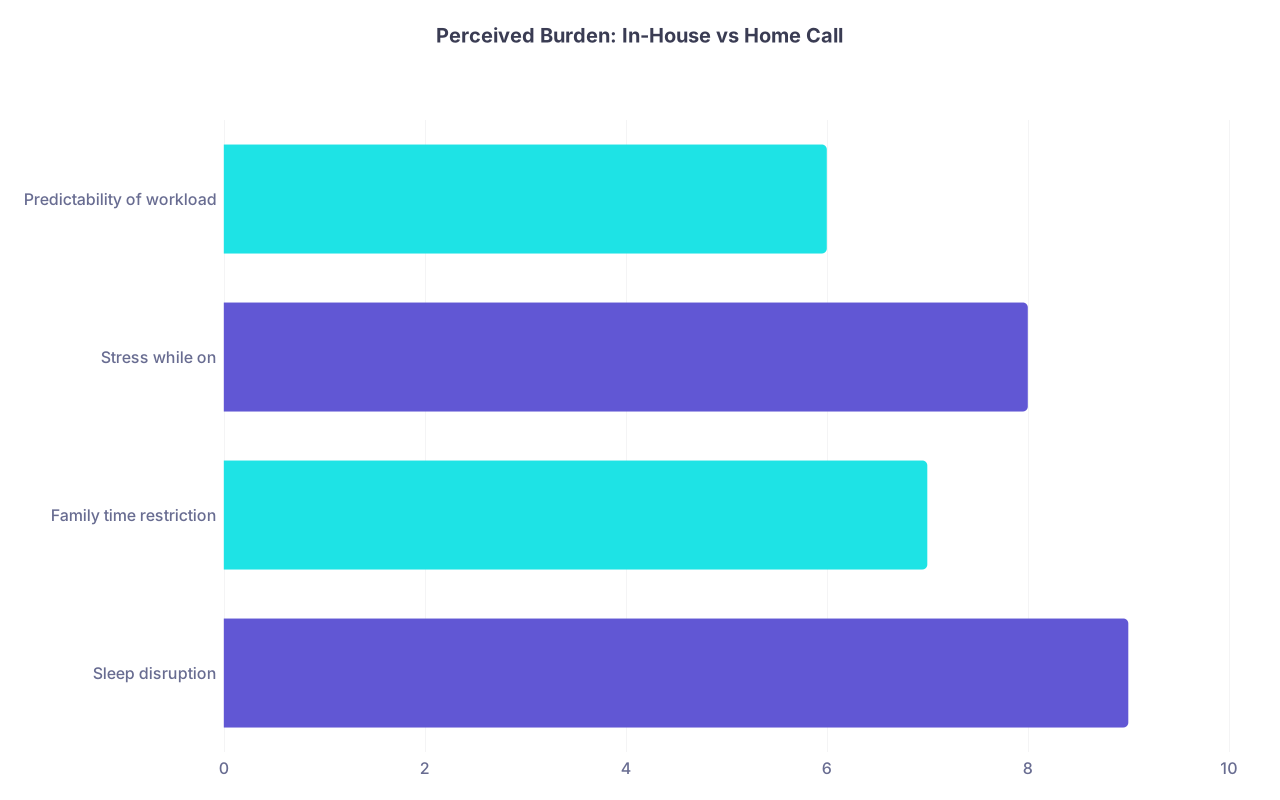
| Category | Value |
|---|---|
| Sleep disruption | 9 |
| Family time restriction | 7 |
| Stress while on | 8 |
| Predictability of workload | 6 |
(The above is a conceptual scale 1–10 for typical in‑house call; many home call setups rival or exceed it.)
In‑House Call Pros and Cons
Pros:
- Clear boundaries. You are at work; family understands you are gone.
- Usually compensated as true clinical work (shift pay or blended into productivity).
- Less constant low‑level anxiety at home (“Will the pager go off right when we sit down for dinner?”).
- If structured well, you get post‑call recovery time and predictable days off.
Cons:
- Physically exhausting. Overnight in the hospital never stops affecting you, even as an attending.
- Lifestyle disruptive, especially with kids or a partner who works standard hours.
- If your group is understaffed, post‑call “protected” time mysteriously erodes.
Home Call Pros and Cons
Pros:
- You are technically home. You can see your kids, eat dinner at your own table.
- If true light call, it can be mildly annoying but not life‑altering.
- Some physicians prefer home call with a lower stipend to constant in‑house presence.
Cons:
- Sleep fragmentation is brutal. Constant phone calls that “only take a minute” add up.
- The “in 30 minutes” response radius kills spontaneous social plans, driving distance, and sometimes even having a drink.
- Work is invisible to leadership. They see your daytime hours. They do not see call interruptions at 1 a.m., 3 a.m., 5 a.m.
- Home call without stipend is one of the most undercompensated burdens in medicine.
The worst is what I call “fake home call”: you are technically allowed to be at home, but practically:
- You are on the phone or in the EMR for hours
- You get called in so often you might as well have a cot at the hospital
- Yet you get paid as though you are sleeping peacefully most nights
Typical Call Structures by Specialty
There is huge local variability, but you should at least know the common patterns.
| Specialty | Primary Call Type | Typical Stipend Pattern |
|---|---|---|
| Hospitalist | In-house nights | Shift-based, no separate call |
| General Surgery | Home call | Per shift + wRVU/collections |
| Orthopedics | Home call | Per shift, often high demand |
| OB/Gyn | In-house or home | Mixed; some include in salary |
| Cardiology | Home call | Cath call often stipended |
| Anesthesia | In-house/home mix | Stipend or internal pool |
If an offer you receive looks radically different from what your peers are seeing in the same region and specialty, that is not “innovative.” It is a red flag.
How Call Interacts With Your Base Compensation
Call coverage is only rational if you understand how it layers on top of your main pay structure.
Scenario 1: Pure Salary + Call Stipend
Common in hospital‑employed roles. Example:
- $350,000 base salary
- Q5 weekday home call, Q5 weekends (1 in 5)
- $500/weekday call, $1,500/weekend day call
Run the math:
- Weekday call: roughly 10–12 nights/month → $5,000–6,000
- Weekend call: 1 full weekend/month → $3,000
- Roughly $8,000–9,000/month in stipends = $96,000–108,000/year
Effective total compensation: $450,000–460,000.
Now compare to:
- Another job offering $400,000 “including call” with the same schedule.
Those jobs are not equal. The second one is quietly paying you $50,000–60,000 less for the same burden.
Scenario 2: Pure Productivity (wRVU) + Call
Typical in some specialties like radiology, anesthesia, surgical subspecialties.
Here:
- You get no or minimal stipend
- You generate wRVUs or billable services overnight/weekends
- The “pay” for call is the additional collections/wRVUs
You must ask:
- How much revenue has each partner typically generated from call work?
- Is there any differential pay for overnight cases, emergent add‑ons, or holidays?
- Is there internal pooling (e.g., everyone shares call revenue equally) or eat‑what‑you‑kill?
I have seen:
- Groups where call is brutally busy, but volume is high‑reimbursement commercial insurance. Call can be financially attractive.
- Others where call is packed with uninsured trauma and Medicaid. You work like a dog and get almost nothing financially.
If a group tells you, “Call is busy but you will make it up in wRVUs,” ask to see anonymized production by year of partner for the last 3–5 years. If they refuse, take that as an answer.
Home Call, In‑House Call, and Work‑Hour Law (The Misconception)
You are no longer under ACGME duty hour limits.
As an attending:
- There is no external body limiting how many nights in a row you can work
- No one is tracking your average weekly hours
- Tort law does not care that you were up all night the day before you made a bad call
This is why you must self‑police and architect your call life.
I have seen “innovative” call structures such as:
- 24‑hour in‑house call followed by full clinic the next day
- Seven nights of home call in a row, each with several hours of work, but “since it is home call it does not count as full workdays”
- Q2 call “temporarily” during staffing shortages that last years
Do not rationalize this as temporary unless it is in writing with clear sunset clauses and meaningful penalties if it continues.
Negotiating Call: What Actually Matters
You will not always be able to change the raw call schedule (q4 vs q6). Often the structure is baked into the group’s dynamics. But you absolutely can and should negotiate around the edges that change your lifestyle and income.
Here is where you should focus.
1. Clarify Volume and Expectations
Ask very blunt questions:
- “How many times per night, on average, do you get called on a weekday? On a weekend?”
- “In the last 6 months, how many call nights resulted in your being physically in the hospital after midnight?”
- “On average, how many new consults or admissions do you see per call shift?”
- “If you are scrubbed in at 2 a.m., who covers your 8 a.m. clinic?”
Good groups will have concrete numbers. Bad groups will say vague things like “It varies” or “It is not too bad.” Translation: brutal.
2. Push for Call Differentials and Limits
Reasonable, adult structures look like:
- Higher pay for holidays and major weekends
- Caps on number of consecutive nights
- Extra or bonus pay if you exceed a certain number of calls during a coverage period
- Explicit clauses about post‑call clinic expectations if overnight workload crosses a defined threshold (e.g., you are allowed to cancel or reschedule a.m. clinic if you are in the OR after 2 a.m.)
You can also negotiate:
- Reduced call early on if you are straight out of training (q6 instead of q4 for year one)
- Buy‑down options (you take a slightly lower salary in exchange for lighter call schedule)
- Clear path out of higher‑intensity call as you age in the practice
3. Understand Internal Group Politics
Who actually:
- Sets the call schedule?
- Decides who gets the “good” weekends (light census, nice holidays) vs the bad?
- Controls how call pay is allocated across partners?
You want:
- Transparent call schedule rules
- Written guidelines for distribution of holidays and weekends
- Clear explanation of how call stipends are divided (per shift, seniority‑based, equal partner, etc.)
If all they say is, “We just work it out among ourselves,” that often means: “The senior partner makes the schedule in a way that benefits themselves.”
Call Structures Over a Career: Think Long Game
The call you tolerate at 32 is different from what you will accept at 52.
Nearly every mid‑career attending I know who is burned out says some version of:
“I underestimated how much this call would grind me down over the years.”
You need a mental model for where call fits across your career arc.
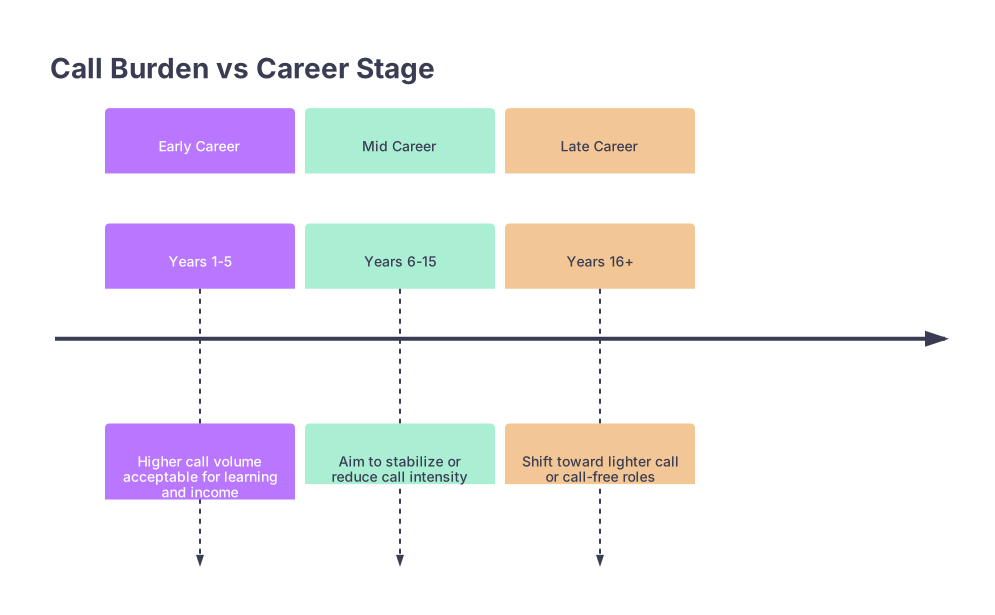
| Period | Event |
|---|---|
| Early Career - Years 1-5 | Higher call volume acceptable for learning and income |
| Mid Career - Years 6-15 | Aim to stabilize or reduce call intensity |
| Late Career - Years 16+ | Shift toward lighter call or call-free roles |
Smart moves:
- Negotiate explicit review of call structure every 2–3 years, especially if volume increases.
- Ask if there is a seniority path to lighter call or call‑free roles inside the organization.
- Consider whether there are non‑call‑based niches in your specialty (clinic‑heavy roles, administrative leadership, quality directorships) that you can migrate toward later.
If your only career path is “work the same brutal call until retirement,” you will resent it, and the group will eventually have a retention problem. That eventually may be you.
Concrete Example: Comparing Two Job Offers
Let me show you how this plays out with actual numbers.
Job A: Community General Surgery – Heavy Home Call
- Base salary: $425,000
- Call: q3 home call weekdays, 1 in 3 weekends
- Call stipend: $700/weekday, $2,500/weekend day
- Average call volume: 3–5 ED consults/night; 1–2 emergent cases/weekend; frequent returns to hospital
Rough math:
- Weekdays: ~10 calls/month × $700 = $7,000
- Weekends: ~3 weekends/month × 2 days × $2,500 = $15,000
- Total stipends: ~$22,000/month = $264,000/year
Total comp ~ $689,000, but with extremely heavy call burden, frequent nocturnal work, and significant lifestyle cost.
Job B: Academic General Surgery – Mostly In‑House Night Team
- Base salary: $380,000
- Call: q6 home call, residents in house; attendings mostly backup
- Call stipend: $300/weekday backup, $1,000/weekend day backup
- Average volume: 1–2 calls/night; rare need to come in personally
Rough math:
- Weekdays: ~5 calls/month × $300 = $1,500
- Weekends: ~1 weekend/month × 2 days × $1,000 = $2,000
- Total stipends: $3,500/month = $42,000/year
Total comp ~ $422,000, but call is far lighter, much more sustainable, with residents absorbing most of nocturnal workload.
Is Job A “better” because the total dollars are higher? Not necessarily. Depends on your priorities and your tolerance for years of q3 call.
The point: you must price your sleep, your marriage, and your sanity into the number.
Practical Checklist: What To Ask Before You Sign
Here is the short list you should have in front of you when contracts come in.
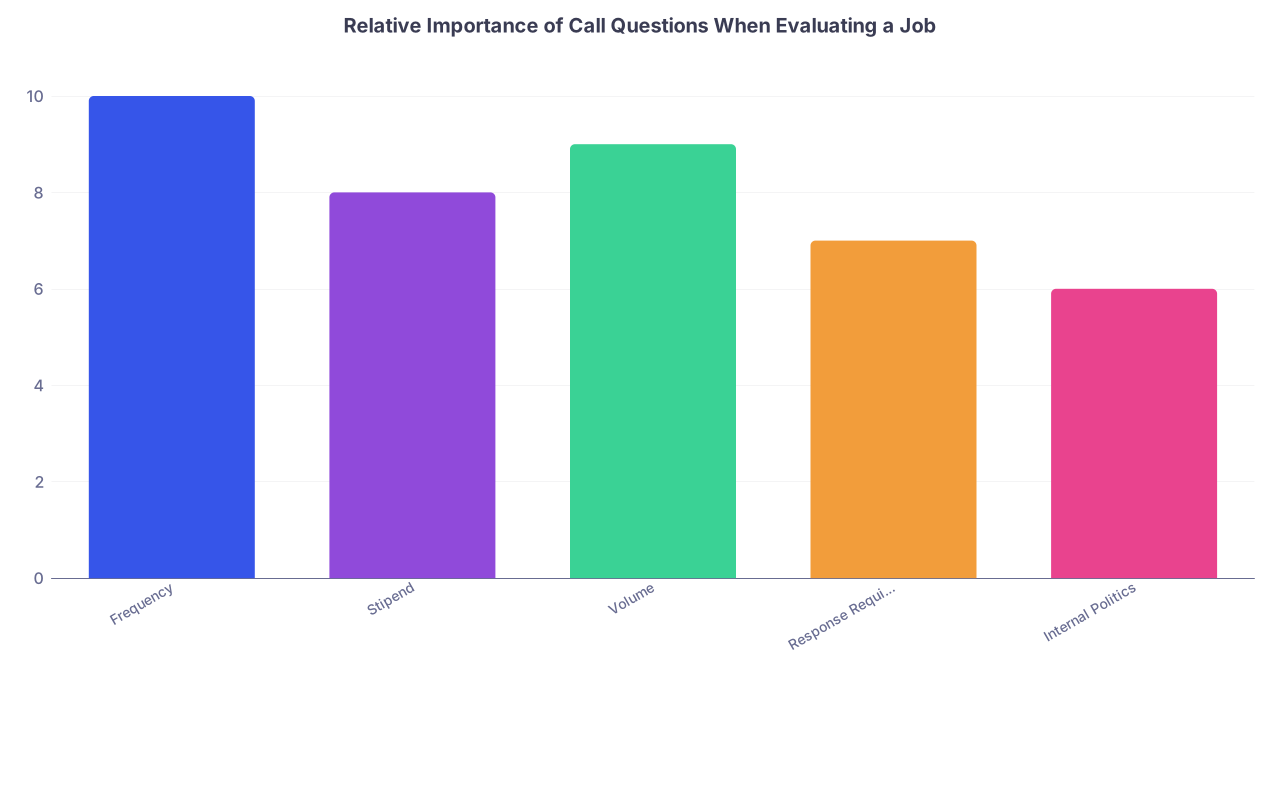
| Category | Value |
|---|---|
| Frequency | 10 |
| Stipend | 8 |
| Volume | 9 |
| Response Requirements | 7 |
| Internal Politics | 6 |
Ask:
Frequency and type
- How often do I take call (weekdays/weekends)?
- In‑house vs home for each type of call?
- Is there separate call for different services (e.g., general vs specialty vs backup)?
Pay structure
- Exact dollar amount per call night/weekend/holiday.
- How are stipends adjusted over time?
- Is call pay separate from wRVUs or built into salary?
Actual workload
- Typical number of pages, consults, admissions, and middle‑of‑the‑night trips in.
- Who covers when two emergencies hit at once (especially in single‑coverage services)?
- Any recent changes in ED volume, trauma designation, or service line expansion?
Post‑call and protection
- What happens to next‑day clinic/procedures after heavy nights?
- Written policy or “we just see how you feel”?
Internal distribution
- How are bad weekends and holidays rotated?
- Is there an internal call stipend pool? How is it divided?
- Are there seniority or partnership rules that change call expectations?
If they cannot answer with clear, specific numbers and policies, that job is not ready for a new attending who values their time.
Key Takeaways
Call is not a side detail; it is a core component of both your income and your quality of life. Treat it like that when you evaluate offers.
In‑house, home, and “daytime coverage” call each feel very different in real life, and the label matters far less than the actual volume, response requirements, and compensation tied to each.
If you are not explicitly paid for call, you are implicitly underpaid. Price your nights and weekends with the same rigor you give your RVUs and base salary, and your future self will thank you.